• Submit Poetry
  • Support SCP
  • About Us
  • Members
  • Join
Wednesday, November 25, 2026
Society of Classical Poets
  • Poems
    • Beauty
    • Culture
    • Satire
    • Humor
    • Children’s
    • Art
    • Ekphrastic
    • Epic
    • Epigrams and Proverbs
    • Human Rights in China
    • Music
    • Performing Arts
    • Riddles
    • Science
    • Song Lyrics
    • The Environment
    • The Raven
    • Found Poems
    • High School Poets
    • Terrorism
    • Covid-19
  • Poetry Forms
    • Sonnet
    • Haiku
    • Limerick
    • Villanelle
    • Rondeau
    • Pantoum
    • Sestina
    • Triolet
    • Acrostic
    • Alexandroid
    • Alliterative
    • Blank Verse
    • Chant Royal
    • Clerihew
    • Rhupunt
    • Rondeau Redoublé
    • Rondel
    • Rubaiyat
    • Sapphic Verse
    • Shape Poems
    • Terza Rima
  • Great Poets
    • Geoffrey Chaucer
    • Emily Dickinson
    • Homer
    • Henry Wadsworth Longfellow
    • Dante Alighieri
    • John Keats
    • John Milton
    • Edgar Allan Poe
    • William Shakespeare
    • William Wordsworth
    • William Blake
    • Robert Frost
  • Love Poems
  • Contests
  • SCP Academy
    • Educational
    • Teaching Classical Poetry—A Guide for Educators
    • Poetry Forms
    • The SCP Journal
    • Books
No Result
View All Result
Society of Classical Poets
No Result
View All Result
Home Poetry Beauty

‘Circles,’ a Sestina by Jack DesBois

November 20, 2021
in Beauty, Poetry, Sestina
A A
8
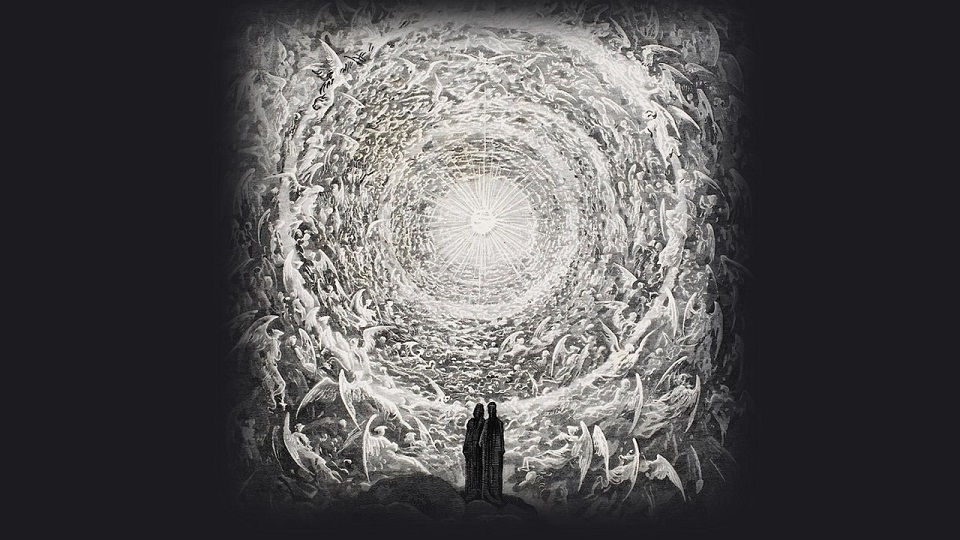
Illustration for Dante’s Paradiso, Canto 31 by Gustave Doré

Illustration for Dante’s Paradiso, Canto 31 by Gustave Doré

.

Circles

It seems to me that living comes in circles,
That nothing, even this, is ever new,
That all that we create is a stale rhyme,
A now that cannot cover marks of then.
It seems to me that every extant thought
Comes back again, as sure as fall to spring.

And yet, as winter warms and turns to spring,
And spring to summer, autumn, tracing circles—
Despite, in February, that I thought
That winter had at last killed all life new—
I find that, somehow, now, as sure as then,
I take delight in all the dusty rhyme.

Perhaps it’s that I recognize in rhyme
The sound in fall of sweet birdsong of spring,
Which, though not now, will be as it was then.
A comfort lives embedded in these circles
Which take the joys of old and joys of new
And bear a double joy all in one thought.

But still, I wonder whether this my thought
Is really mine alone, or is my rhyme,
Like rhyming “truth” with “truth,” not one bit new
But common as the yearly bloom of spring?
Can any effort free us from these circles,
Or will our nows be ever ghosts of then?

No need to labor over living, then,
If in our strivings we naively thought
That these worn tracks we trod were novel circles.
No need to suffer, searching for the rhyme
That, though we pray and yearn for it to spring
Fresh from our minds, will never spring forth new.

And yet I still come back—as if it’s new,
As fresh and green and living now as then,
As welcome and as welcoming as spring—
To one recurring, still persisting thought:
What matter that I plagiarize this rhyme
If simply to delight in spinning circles?

And then, with perfect constancy, my thought
Returns, like spring birds, back to that old rhyme,
Forever living, ever new, in circles.

.

.

Jack DesBois is a singer, actor, and storyteller. He gives annual Epiphany season performances of “The Western Star,” which he wrote in 2016. He self-published a chapbook of short poems in 2018. As a singer, Jack has had the good fortune to solo in several of the great works of Baroque Oratorio, including Handel’s Messiah (Bass) and Esther (Haman) and J.S. Bach’s St. John Passion (Jesus). Jack lives in Topsfield, Massachusetts. 

ShareTweetPin
The Society of Classical Poets does not endorse any views expressed in individual poems or commentary.
Read Our Comments Policy Here

RandomPoems

‘The Apprentice of the Dead’ and Other Poetry by Reid McGrath
Beauty

‘The Apprentice of the Dead’ and Other Poetry by Reid McGrath

November 12, 2015

The Apprentice of the Dead He painted the lines of the country road. He painted the leaves: saffron and gold....

‘Gun Control’: A Poem by Kevin Ahern
Poetry

‘Gun Control’: A Poem by Kevin Ahern

October 10, 2026

  Gun Control ---after Longfellow’s “The Arrow and the Song” I shot a bullet Into the air. It fell to...

Next Post
A Poem for Kyle Rittenhouse: ‘Don’t Tread on Me’ by Joseph S. Salemi

A Poem for Kyle Rittenhouse: 'Don't Tread on Me' by Joseph S. Salemi

‘A Knot of Ought Nots’ and Other Poetry by Leland James

'A Knot of Ought Nots' and Other Poetry by Leland James

A Poem on Transgenderism and Truth: ‘Reality—Plan B’ by James A. Tweedie

A Poem on Transgenderism and Truth: 'Reality—Plan B' by James A. Tweedie

Comments 8

  1. jd says:
    5 years ago

    Impressive Sestina in that it seems as natural
    as conversation or thought, not an easy thing
    to accomplish in a form that does not encourage
    natural flow (IMO).

    It’s been a very long time since I’ve been immersed
    in grammar, but I do wonder, in the third strophe,
    if “take” and “bear” shouldn’t be singular because
    “comfort” is singular.

    Enjoyed reading your poem, Jack.

    Reply
    • Jack DesBois says:
      5 years ago

      Thank you, JD! In the third stanza my intention was for the circles (rather than the comfort) to do the taking and bearing. I do need a comma after that “circles,” though.

      The sestina strikes me as an inescapably cyclical form. Choosing the circle theme allowed me to let the form serve the sentiment, rather than fighting against it, which I think helped keep the flow more natural.

      Reply
  2. Julian D. Woodruff says:
    5 years ago

    Very impressive indeed, Mr. DesBoise. Because of the plurals you noted, jd, I took the “Which” in III.5 to refer to “circles” rather than “comfort.” Although the latter may seem a more natural antecedent, I think the use of the former in II makes it a plausible candidate. Maybe “Great comforts” could be substituted for “A comfort,” but that alternative is less natural.
    Another niggle, for me, is the repetition of “Which,” at III.3/5: could either of these be made “That”?

    Reply
    • Jack DesBois says:
      5 years ago

      Thank you, Julian. I see what you mean about the two whiches (it might have worked if I had followed Shakespeare’s lead and made it three). I think it might work well to change the “Which” in line 5 to “That” — which could also help clarify its pointing immediately back to “circles” in line 4 (with no comma between the two words).

      Reply
      • C.B. Anderson says:
        5 years ago

        Learn the difference between restrictive and non-restrictive clauses, and the which/that dilemma disappears.

        Reply
      • Jack DesBois says:
        5 years ago

        That’s the heart of the issue, C.B. I think my clause “Which take the joys of old and joys of new” was a bit sloppy; I didn’t have a clear idea of whether it should be restrictive or non-restrictive (it could be grammatically correct either way), and as a result, I ended up with an ungrammatical hybrid with the “no-comma-which” construction. I’ll have to think some more about how best to fix it.

        Thank you, C.B. and others — these sorts of comments about English usage are one thing I enjoy about SCP. They help keep all of us poets honest.

        …I’m now leaning toward non-restrictive, so in goes the comma after “circles.”

        Reply
  3. David B. Gosselin says:
    5 years ago

    Jack,

    This is great. I think this is one of better poems I’ve seen here recently.

    You took a seemingly simple theme of cycles, the cycle of life, cycles of rhyme, and created a genuinely new metaphorical idea about the nature of rhyme and life, and the relationship between the new and the old. The irony is all your talk of circles and repetition became a metaphor for something new. The new and the old collided and yielded something original, as it always does in the hands of an original artist or thinker.

    Great job!

    Reply
    • Jack DesBois says:
      5 years ago

      Thank you, David. I must have hit the mark on this one. One could distill the work of an artist into two steps: (1) selecting disparate influences in the extant world, and (2) fashioning them into something that didn’t exist before. When the influences and the product are both true and both meaningful to the beholder, the artwork works. I wasn’t sure if I had managed (2) with this poem, but I’m glad you thought I did.

      One of my influences here, I think, was a historian who wrote that to say history repeats itself is a dangerous oversimplification of the subtle patterns of history. Another influence was the church liturgical cycle and its synchronicity with the seasons. A third was Pooh and Piglet following tracks in the snow…

      One last thought – another perspective on art is that it is the pursuit of truth. The truth is the truth, so the heart of any true work of art is never going be original. Insofar as it is a true work of art, its heart will be pointing to the eternal truth that was and is and ever shall be.

      Reply

Leave a Reply Cancel reply

Your email address will not be published. Required fields are marked *


  1. Paul Freeman on ‘Canzone in Winter’ by Dante Alighieri, Translated by Margaret CoatsNovember 25, 2026

    Expertly done, Margaret. I particularly enjoyed the astronomical references and noted both Dante and Chaucer heralding in spring with the…

  2. Levi Warren on ‘The Manner of Fall’: A Poem by Levi WarrenNovember 25, 2026

    I'm tickled pink that you caught that! It'd be just like a child to see a scattering of leaves as…

  3. Levi Warren on ‘The Manner of Fall’: A Poem by Levi WarrenNovember 25, 2026

    I definitely had images in my head of a child witnessing the change of seasons and misattributing each occurrence in…

  4. Levi Warren on ‘The Manner of Fall’: A Poem by Levi WarrenNovember 25, 2026

    I'm glad the fairy tale imagery came through. My intent was to write this through a child's eyes. That's why…

  5. Cynthia L Erlandson on ‘The Manner of Fall’: A Poem by Levi WarrenNovember 25, 2026

    This really is very clever (as Margaret said). And I agree with Paul that it is like a fairy tale.…

Subscribe to Daily Poems

Enter your email address to subscribe to this blog and receive notifications of new posts by email.

Join 1,673 other subscribers
No Result
View All Result

Recent Poems

  • ‘The Manner of Fall’: A Poem by Levi Warren
  • ‘The Prophet’: A Poem by Jeffrey Essmann
  • ‘Sennacherib’s Bad Day (Translated from Lord Byron)’: A Poem by Chris Hart
  • ‘From Geoffrey Chaucer’s Advice Column’: A Poem by Paul A. Freeman
  • ‘Interment’: A Poem by James A. Tweedie
  • ‘You Call It Death’: A Poem by Dr. Bhairab Barman
  • ‘Canzone in Winter’ by Dante Alighieri, Translated by Margaret Coats
  • ‘He Rides the Wind’: A Poem by Rodica Musgrave
  • ‘Seasons’: A Poem by T.M. Moore
  • ‘Victimhood of Biblical Proportions’: A Poem by Susan Jarvis Bryant
  • ‘Down the Narrow Ghetto Streets’ and Other Poetry by Janice Thompson
  • ‘All We Have to Decide’ and Other Tolkien-Inspired Poetry by Brian Yapko
  • ‘Our Toddler’: A Poem by Robert Thomas
  • ‘Poets to Saint Gregory, with Respect’: A Poem by Joseph S. Salemi
  • ‘The Wall of Separation’ and Other Poetry by Roy E. Peterson
  • SCP Poetry Symposium and Public Reading—June 2027
  • ‘A Villanelle from a Hill in Hell’ by C.B. Anderson
  • ‘Truce’: A Sonnet by Vernon Speed
  • ‘As You Leave’: A Poem by Michael Charles Maibach
  • ‘Poetry, Again?’: A Poem by Rachel Christensen 
  • ‘My Salute to Golden Era Thespians’: A Poem by Mark Stellinga
  • ‘After Dante’: Sonnets by James Edward Green
  • ‘Autumn Haunts’: A Poem by Cynthia Erlandson
  • ‘Praying for Patience’: A Poem by Briana Reavis
  • ‘Fractal’: A Poem on Suicidal Depression, by Golan Shahar
  • ‘Laughing’: A Poem by Jeffrey Essmann
  • ‘Childproof Caps’ and Other Poems by Russel Winick
  • ‘Daylight Savings Crime’ and Other Poetry by Jan Mennite
  • ‘Ambient Political Precarity’ and Other Poetry by Alec Ream
  • ‘To Actias Luna (The Luna Moth)’: A Poem by Jeff Kemper

Categories

  • Acrostic
  • Alexandroid
  • Alliterative
  • Art
  • Best Poems
  • Blank Verse
  • Chant Royal
  • Classical Poets Live
  • Clerihew
  • Covid-19
  • Deconstructing Communism
  • Educational
  • Epic
  • Epigrams and Proverbs
  • Essays
    • Interviews with Poets
    • Poetry Reviews
  • Featured
  • From the Society
  • Great Poets
    • Dante Alighieri
    • Edgar Allan Poe
    • Emily Dickinson
    • Geoffrey Chaucer
    • Henry Wadsworth Longfellow
    • Homer
    • John Keats
    • John Milton
    • Robert Frost
    • William Blake
    • William Shakespeare
    • William Wordsworth
  • Human Rights in China
  • Limerick
  • Love Poems
  • Music
  • Pantoum
  • Performing Arts
  • Poetry
    • Beauty
    • Children's Poems
    • Culture
    • Ekphrastic
    • Found Poems
    • High School Poets
    • Humor
    • Riddles
  • Poetry Challenge
  • Poetry Contests
  • Poetry Forms
    • Curtal Sonnet
    • Haiku
  • Poetry Readings
  • Rhupunt
  • Rondeau
  • Rondeau Redoublé
  • Rondel
  • Rubaiyat
  • Sapphic Verse
  • Satire
  • Science
  • Sestina
  • Shape Poems
  • Short Stories
  • Song Lyrics
  • Sonnet
  • Symposium
  • Terrorism
  • Terza Rima
  • The Environment
  • Translation
  • Triolet
  • Video
  • Villanelle

Quick Links

  • About Us
  • Submit Poetry
  • Become a Member
  • Members List
  • Support the Society
  • Advertisement Placement
  • Comments Policy
  • Terms of Use

Welcome Back!

Login to your account below

Forgotten Password?

Retrieve your password

Please enter your username or email address to reset your password.

Log In
No Result
View All Result
  • Poems
    • Beauty
    • Culture
    • Satire
    • Humor
    • Children’s
    • Art
    • Ekphrastic
    • Epic
    • Epigrams and Proverbs
    • Human Rights in China
    • Music
    • Performing Arts
    • Riddles
    • Science
    • Song Lyrics
    • The Environment
    • The Raven
    • Found Poems
    • High School Poets
    • Terrorism
    • Covid-19
  • Poetry Forms
    • Sonnet
    • Haiku
    • Limerick
    • Villanelle
    • Rondeau
    • Pantoum
    • Sestina
    • Triolet
    • Acrostic
    • Alexandroid
    • Alliterative
    • Blank Verse
    • Chant Royal
    • Clerihew
    • Rhupunt
    • Rondeau Redoublé
    • Rondel
    • Rubaiyat
    • Sapphic Verse
    • Shape Poems
    • Terza Rima
  • Great Poets
    • Geoffrey Chaucer
    • Emily Dickinson
    • Homer
    • Henry Wadsworth Longfellow
    • Dante Alighieri
    • John Keats
    • John Milton
    • Edgar Allan Poe
    • William Shakespeare
    • William Wordsworth
    • William Blake
    • Robert Frost
  • Love Poems
  • Contests
  • SCP Academy
    • Educational
    • Teaching Classical Poetry—A Guide for Educators
    • Poetry Forms
    • The SCP Journal
    • Books

© 2025 SCP. WebDesign by CODEC Prime.