


.
Columbus
by Joaquin Miller (1837-1913)
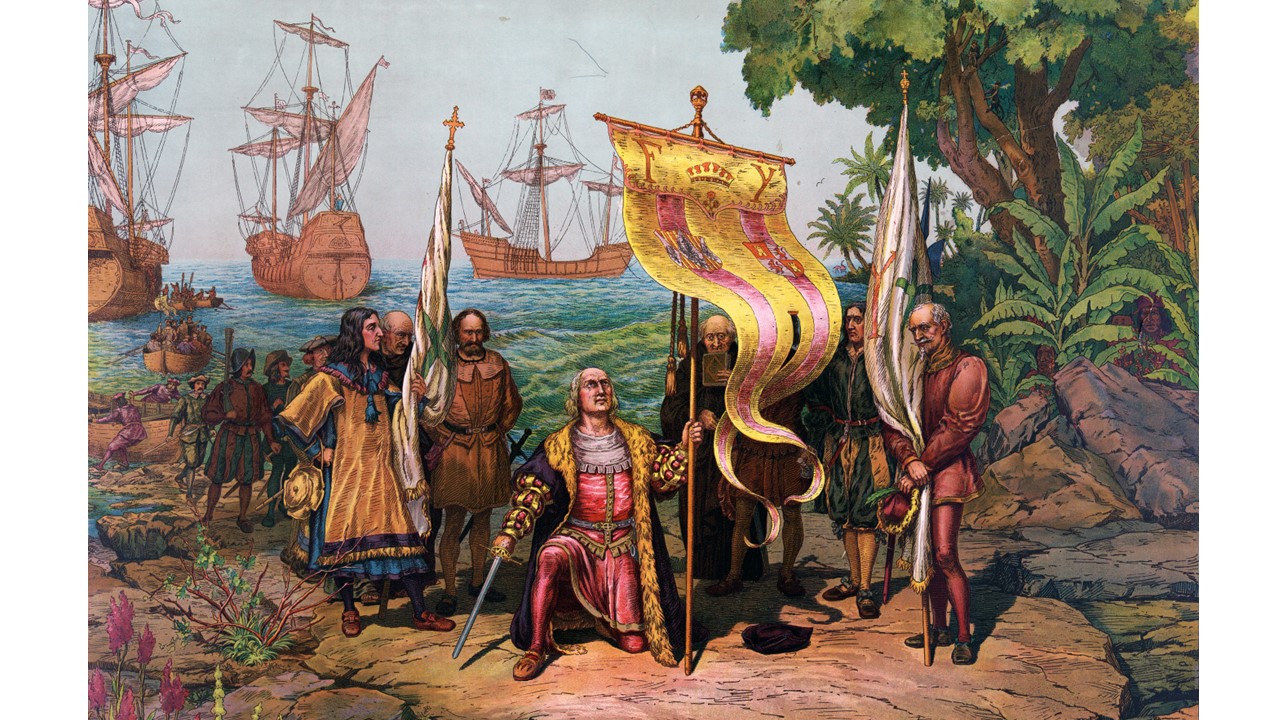
Behind him lay the gray Azores ,
Behind the Gates of Hercules;
Before him not the ghost of shores,
Before him only shoreless seas.
The good mate said: “Now must we pray,
For lo! the very stars are gone.
Brave Admiral, speak, what shall I say?”
“Why, say, ‘Sail on! sail on! and on!’”
“My men grow mutinous day by day;
My men grow ghastly wan and weak.”
The stout mate thought of home; a spray
Of salt wave washed his swarthy cheek.
“What shall I say, brave Admiral, say,
If we sight naught but seas at dawn?”
“Why, you shall say at break of day,
‘Sail on! sail on! sail on! and on!’”
They sailed and sailed, as winds might blow,
Until at last the blanched mate said:
“Why, now not even God would know
Should I and all my men fall dead.
These very winds forget their way,
For God from these dread seas is gone.
Now speak, brave Admiral, speak and say”—
He said: “Sail on! sail on! and on!”
They sailed. They sailed. Then spoke the mate:
“This mad sea shows his teeth tonight.
He curls his lip, he lies in wait,
With lifted teeth, as if to bite!
Brave Admiral, say but one good word:
What shall we do when hope is gone?”
The words leapt like a leaping sword:
“Sail on! sail on! sail on! and on!”
Then, pale and worn, he kept his deck,
And peered through darkness. Ah, that night
Of all dark nights! And then a speck—
A light! A light! A light! A light!
It grew, a starlit flag unfurled!
It grew to be Time’s burst of dawn.
He gained a world; he gave that world
Its grandest lesson: “On! sail on!”
.
.
In 1492
by Anonymous
In fourteen hundred ninety-two
Columbus sailed the ocean blue.
He had three ships and left from Spain;
He sailed through sunshine, wind and rain.
He sailed by night; he sailed by day;
He used the stars to find his way.
A compass also helped him know
How to find the way to go.
Ninety sailors were on board;
Some men worked while others snored.
Then the workers went to sleep;
And others watched the ocean deep.
Day after day they looked for land;
They dreamed of trees and rocks and sand.
October 12 their dream came true,
You never saw a happier crew!
“Indians! Indians!” Columbus cried;
His heart was filled with joyful pride.
But “India” the land was not;
It was the Bahamas, and it was hot.
The Arakawa natives were very nice;
They gave the sailors food and spice.
Columbus sailed on to find some gold
To bring back home, as he’d been told.
He made the trip again and again,
Trading gold to bring to Spain.
The first American? No, not quite.
But Columbus was brave, and he was bright.
.
.
Poems on the tearing down of Christopher Columbus Statues in the 21st century can be found here.
.
.
The True History of Christopher Columbus
Real Adventures Based on Primary Source Documents
There is a huge amount of negativity toward Christopher Columbus circulating in the world today. However, if you actually take a look at the historical context of Columbus’s time and the real historical primary source documents that are available then the picture painted is one of a grand adventure led by a man who is both a daring explorer and a courteous conqueror.
Based on Edward Everett Hale’s use of primary source documents and carefully updated and adapted for young 21st century readers, this book is perfect for middle school and high school students. A clarifying introduction and epilogue have also been added.
Below is a complete PDF of the book, which includes the above poems as well. You can obtain a physical copy on Amazon here. If you found the above poems or the PDF useful, please consider making a donation to the Society of Classical Poets, a non-profit organization based in New York. Donate here.








“Columbus” by Joaquin Miller a truly classic poem, if that adjective means anything. The first four lines are so powerfully good that any poet worth his salt would kill to have written them. Even today they still make my flesh tingle when I read them.
But that second piece is pure uninspired amateurism. Why post these poems together? It’s taking equal rights too far.
Yeah, as Joseph points out, that second poem is a bit William McGonagall.
I’d go a bit further with ‘Columbus’ though, and say the first 4 lines are pretty phenomenal. Just remember the sea charts of that era showed nothing west of Europe and Africa except an empty expanse populated with pictorial representations of sea monsters and guaranteed to make a sailor poo his breeches.
Back in 1992, on the 500th anniversary of Columbus reaching what became the Americas, as part of a ‘United Postal Service’ (UPS) competition (entry details sent out by the Regional Ministry of Education), three of my students wrote letters from the point of view of sailors on Columbus’s flagship. It was great fun researching all this in land-locked sub-Saharan Africa using books from our modest 6×5 meter library.
Alas, since there were three prizes and no other school had taken up the challenge, the Regional Ministry of Education didn’t forward our three entries from the same school since it would make them look worse than if they forwarded nothing.
Mind you, I and my students learned a lot about Columbus and his first voyage.
Dear Dr. Salemi and Mr. Freeman,
Yes, it is terrible to have to put these poems next to each other. I would rank Miller’s verse in the top tier of American poems and the second could have been written by AI today (the handling of meter was decent, so I would put it a notch above McGonagall). As you may notice, this post is in the categories of Children’s and Education. These are, as far as I know, the two most famous Columbus poems in English, hence the grouping for people interested in children’s and educational poems.
In my own experience teaching, the first two lines are a powerful mnemonic for a defining event in world and American history: the founding of the New World by Columbus in 1492. Of the students I talk to, virtually none of them have heard it before nor can they recall the date of Columbus’s great discovery, which seems sad to me. Also, when I was teaching American-themed poetry to kids around early high school and middle school age, I hoped that Miller would move them the way it did me, but the reality is that the simple 1492 verse was what really stuck with and seemed to inspire most them. If I taught any higher age students (11th grade and up) I would recommend leaving the 1492 poem out entirely.
Perhaps any poets with similar feelings could come up with a different memorable line for remembering the significance of 1492 and post it below.
Thank you!
I remember both these poems about Christopher Columbus and recognize the greatness of the first poem. The second poem, though, is one I remember from childhood and thought it wonderful. I still do, even though it does not stimulate the intellect like the first one. There is a lot to be said for poems that are simple and direct that do not disturb the intellect! I remember another addition to the first verse that I used to say, although I do not know from whence it came: ” In 1494, he sailed it some more.” I admire all levels of poetry from the simple to the erudite and arcane as long as they rhyme. Classical poetry is great by tradition and definition from the nursery rhymes for the children to the obtuse writings of academics with words meant to impress the reader with obscure thoughts, recherché vocabulary, and superior intellect. I recognize the greatness of “Columbus,” by Joaquin Miller, that should appeal to every poetic taste.
The Miller poem is exceedingly good, and those opening lines do give one goose bumps. But there is yet a better poem that is now virtually unknown, and the author too more or less gone into oblivion: try The Ship of Fools –
The Ship of Fools
We are those fools who could not rest
In the dull earth we left behind
But burned with passion for the West
And drank strange frenzy from its wind.
The world where wise men live at ease
Fades from our regretful eyes,
And blind across uncharted seas
We stagger on our enterprise.
The beautiful fierce billows leap
Like white-fanged wolves about our prow,
Where Mary, with her Christ asleep,
Is carved to hear the wanderer’s vow.
The thirsty decks have drunk our blood,
Our hands are tettered from the oars;
Wan ghosts upon a spectral flood
We drive towards a phantom shore.
And we have sailed in haunted seas,
Dreadful with voices; where the mast
Gleamed blue with deathlights, and the breeze
Bore madness; and have gazed aghast
To see beyond our splintered spars
That rattled in the wild typhoon,
A heaven strange with tawny stars
And monstrous with an alien moon.
Lean, naked, bruised, like famished slaves
We shiver at the sweeps; each one
A jest for all the scornful waves,
And food for laughter to the sun;
But never voice nor deathlike fare
Nor moon shall lure us with their spell;
Our eyes are calm as God, and stare
Defiance in the face of Hell.
The worn ship reels, but still unfurled
Our tattered ensign flouts the skies;
And doomed to prudence by a world
Of little men grown mean and wise,
The old earth laughs for joy to find
One purple folly left to her,
Where glimmers down the riotous wind
Tho flag of the adventurer!
O watchman leaning from the mast,
What of the night? The shadows flee;
The stars grow pale, the storm is past,
A blood-red sunrise stains the sea.
At length, at length, dauntless wills,
O dreamers’ hearts that naught could tame,
Superb amid majestic hills
The domes of Eldorado flame!
-St. John Lucas.
I agree with you, James, that is a great poem with vivid imagery. I remember reading this poem a long time ago. I particularly love the colorful phrase, “A blood-red sunrise stains the sea.” I believe the term, “ship of fools,” may have been generated from this poem as an epithet.
No, it comes from Sebastian Brand’s German poem “Das Narrenschiff” of 1494. Just another obscure thought from an obtuse academic.
Yes, Roy, it is full of incredible imagery. My own favourite lines are:
Like white-fanged wolves about our prow,
Where Mary, with her Christ asleep,
Is carved to hear the wanderer’s vow
Just love that contrast and the fact that Christ is ‘asleep’ whilst Mary ‘is carved to hear’.
For those who are interested in learning more, here’s a biography of Columbus written in 1870, called The Life of Christopher Columbus: From Authentic Spanish and Italian Documents; Compiled From the French of Roselly De Lorgues.
https://archive.org/details/lifeofchristophe00rose/mode/2up
Here is a good video someone just shared with me, perfect for quickly clearing the Zinn narrative that still poisons the air: https://www.youtube.com/watch?v=7N7q5rMzjU0
-Evan Mantyk