


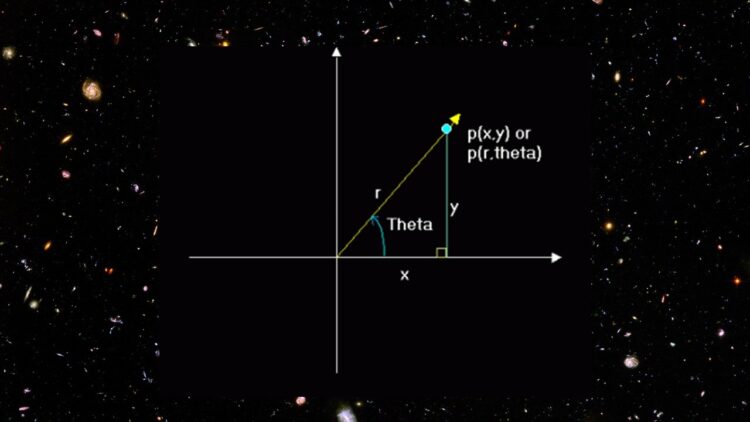
Polar Coordinates
Take an angle labeled theta and a radius called r:
They teach not only trigonometry. (I know, it seems bizarre.)
Theta is the gap between the eye’s line towards the wishing-star,
And hard reality’s unswerving path, so fittingly called r.
Theta always measures constant, but go down the length of r
And soon the span subtending theta grows immeasurably far.
Set r to t and now you see how where we aimed and where we are
Grow ever distant though they once met at the origin of r.
Thus the smallest theta starts divergence that will course afar,
Soon infinitely out of reach as time relentlessly tracks r.
Adam Sedia (b. 1984) lives in his native Northwest Indiana and practices law as a civil and appellate litigator. He has published four books of poetry and his poems, essays, and fiction have appeared in various literary journals. He is also a composer, and his musical works may be heard on his YouTube channel.
















How elegantly have you expressed the math explanation in your couplets, Adam. In the second couplet, you deftly unite wonder and science (“wishing-star” and “hard reality’s unswerving path”). This unity and the single end-rhyme and one internal rhyme create a peaceful poem.
Thank you! Elegance is a virtue both in poetry and in math, and I thank you for seeing it in my poem.
What a great poetic concept these couplets “r” that show how theta travel far. I am thinking now how pi can be a math poem if you try.
Adam, here you’ve combined poetry and math, two of my favorite subjects, to create such a unique poem!
Alas, I’m more a theoretical scientist, so had a few problems following, but did my valiant best, Adam.
As for ‘pi’, I do have a ‘pi’ limerick, which Roy might enjoy, written for ‘World Pi Day’ some years back:
‘Pi’ Day Limerick
A woman named Pi was once dared
to be cloned – and then it was declared,
though ethically troubled,
a scientist had doubled
each clone so that two Pi are squared.
as per Euclidrew Base
Polar coordinates are most appropriate when one
ties both direction and some length to a phenomenon,
like systems with their bodies moving round a central point,
a Fibonacci spiral or Eulerian clothoid.
Great job, Adam!
As an ex-Math Teacher, I truly appreciated this poem. I’ve tried a few similar things myself, which were usually met with blank stares and silence. It surprises me again and again that some folks don’t love Math.
Thank you for your compliment — from a former math teacher, no less! I picked up the strange hobby of reviewing my college math — multivariable calculus, linear algebra, differential equations — so I’ve had math on my mind lately, and the idea occurred to me to express accidents of life in mathematical terms. I thought it would make a good poem, and I’m glad to see someone versed in math appreciate it.
I’ve always been pretty good at math, but, like Paul Freeman, I had a few problems following the discourse. In the last two stanzas I began to sense an emergent subtext that could have been developed more fully. Or maybe I am confusing my r and my t. It wouldn’t be the first time.
I apologize if I sank too deep into jargon. The essence of the poem is the second stanza. The variable “t” in science usually represents time, so “r = t” is moving forward in time from the divergence point.
The r, theta coordinates tend to be precise and supposedly useful in natural, biophysical systems where we don’t usually need them for practical purposes. They are enormously helpful in finding meaning among loads of information collected in space, outside our normal frames of reference. But then, we have to rely on interpretive judgments of experts who lead us far from the t we are capable of understanding. Still, Adam, it’s nice to see a poem assert our capabilities in the simpler reaches spreading out toward spherical harmonics!