


Black Shuck
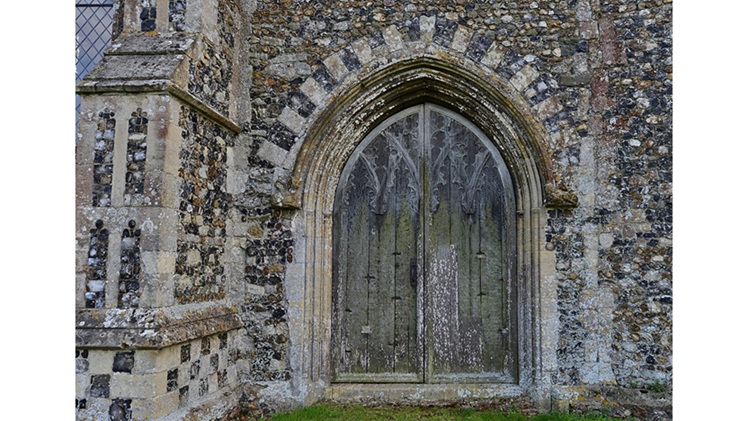
There are curious marks on the north door of Holy Trinity, in
Blythburgh, England. Tradition has it that they were left by the
scorching paws of Black Shuck, a fearsome dog which tried to
force its way into the church one violently tempestuous night
in 1577. Some say the door is charred and radiates a
perceptible warmth.
He muzzles moonward, howls a hollow howl
that drifts abroad on wreaths of frosty breath;
ember-eyed and shaggy-hackled, growls
at his own shadow, bares forbidding teeth.
Silenced, from a naked bough the owl
watches as an inky shape beneath
pads away, then lopes into a run
along remotely prehistoric ways
as if to keep appointment with someone;
through graveyards, crossroads, dells and sunken lanes,
leaping frozen ditches, seen by none
unless the bone-white crook of Charles’s Wain.
Uneasy in your bed, one night you’ll hear
over Anglia’s iron-furrowed ground
a heavy hasty pant draw hotly near:
eagerly but angrily the hound
approaches, bringing sorrow, shame and fear.
Falls a sudden silence; then the sound
of snuffing, whining, scratching at your door.
Deliverance or death, all ends must begin:
a roof-tree offers neither peace nor pause.
Out there waits your past, your sum, your sin,
your self. There’s judgement in those frantic claws.
Get up, go down, let retribution in.
Poet’s Note: The above poem contains a nod towards Francis Thompson’s The Hound of Heaven. It responds to a myth which like many myths contains a symbolic truth. Charles’s Wain is the constellation known alternatively as the Big Dipper, or the Plough.
Martin Briggs lives in Suffolk, England. He only began writing in earnest after retiring from a career in public administration, since when he has been published in various publications on both sides of the Atlantic.


















Thank you, Martin, for this powerful, expressive and thought-provoking poem. Your use of rhyme and half rhyme is very effective. Best wishes, Bruce
Thanks, Bruce, for reading and commenting.
The intermittent alliteration emphasizes this dark foreboding poem that ends with a comparison of a phantom canine to one’s past sins howling for retribution. Well-conceived and well-constructed.
Thank you Roy. I’m glad you approve.
Your ingenious marshaling of rare and rugged words crafts a dreamlike aura that is as powerful as the underlying tale.
Thank you David – I appreciate your comments.
Martin, simply everything about this admirably composed poem has grabbed my attention and thrilled me! The opening line gains instant intrigue – “He muzzles moonward” is superb! Your alliterative lilt is hypnotic – your mellifluous words conjure eerie images that send a shiver.
I don’t usually post links to my own poems, but (bearing in mind the subject matter) I think you might get a kick out of this one: https://www.classicalpoets.org/the-beast-of-bodmin-moor-by-susan-jarvis-bryant/
Martin, thank you very much indeed!
From the High Priestess of Alliteration this is praise indeed. Thank you Susan.
Thank you too for pointing me towards your Beast of Bodmin Moor. Which, by the way, we happened to spot while down that way earlier this year. No, really.
This is a truly interesting and intriguing poem, and for me those two qualities are the prime criteria for judgment.
First off, we have a very strange and unusual tale or legend. How many people have ever heard of “Black Shuck” of Blythburgh? Moreover, the story is not sentimental or sappy — like Conan Doyle’s “Hound of the Baskervilles,” this account will give your skin goosebumps. The clear reference to Thompson’s “The Hound of Heaven” is here with the presentation of its antithesis. This is not God, but A Hound of Hell — or if it is God, it is the cold, avenging God of Calvinism showing up with “judgment” and “retribution” for the reprobate.
Second, the language of the poem is rich and elegant, making use of striking compound words like “ember-eyed, shaggy-hackled, iron-furrowed.” The phrases “muzzles moonward” and “the bone-white crook of Charles’s Wain” are quite impressive.
Third, the poem breaks very neatly in half. The first two stanzas present the animal itself, and its night-time running. This could have been just the start of a recapitulation of the old legend, but the next two stanzas bring the poem right into the present day. Some terrified person in Anglia hears the beast coming, approaching the door, and scratching to get in. That is really upsetting and shocking, since we are no longer in 1577 but in the present, and a legend from past centuries has come alive for us in an unexpected and threatening manner.
It’s nice to read a poem that isn’t predictable.
It’s a pleasure to introduce Black Shuck, whose depredations took place three miles from where I write this. To the suggestible and credulous – me, for instance – his memory lives on. Thank you for your appreciation: interesting, intriguing and unpredictable will do nicely. Must go – there’s something at the door.
The origins of The Hound of the Baskervilles was most likely an East Anglian tale Arthur Conan Doyle heard in a hotel one evening in that part of the world.
Black Shuck?!
Thanks for a thrilling piece of horror poetry, Martin.
Thanks Paul. Yes, Conan Doyle did stay on the north Norfolk coast, in surroundings as un-Dartmoor-like as you can imagine.
Chilling, actually. I can’t remember when the Goths last invaded Britain.
Martin, you are veritable cinematographer of the hound. Your picture of crazed canine motions is convincing–and then you slip so easily into symbolic mode. Well-unified telling of your local myth, advancing toward the truth therein, and scratching into the emotions for good measure!
Thank you Margaret.