


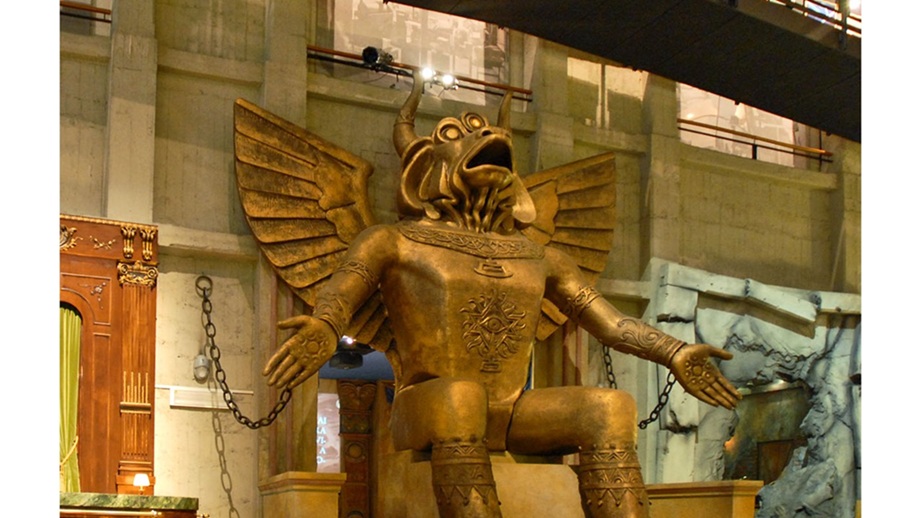
Arga’il’s Epistle to the Priests of Moloch
Hail, Brethren of the Sacrificial Rite,
Ye priests of Moloch, pride of Rabbath-Amon!
Accept this humble missive which is sent
From your most abject servant, Arga’il,
Who details visions borne of second sight.
I write of priest-craft (partly gleaned from Mammon)
On how to swell the stock of blood that’s spent
To thus ensure that Moloch drinks his fill.
A hungry god demands a hefty price
To meet his need for human sacrifice.
Consuming poppies steeped with wine and rye,
I slid into a trance which soon revealed
This world as it mote be in future ages—
An era filled with wonders of great dread!
Enormous ziggurats scrape at the sky;
Steel behemoths haul men through cloud and field;
The genders are dissolved; the mad are sages;
And all rejoice that dignity is dead.
I marvel at the wealth they have amassed;
And yet these strangers vilify their past.
Their world seems coldly different from our own:
Their gods are disrespected by their priests;
Those few who seek tradition are berated
And thoughts the mob dislikes they simply smother.
A thousand heresies are sown and grown
Which celebrate men acting as brute beasts.
But one thing which they do leaves me elated!
They foment hate twixt offspring, sire and mother!
Conceive a place where families are fractured
By outside conflicts slyly manufactured!
How useful this might be for us to try!
How commonly we find it hard to part
A youngling from a parent who’s impious
And tries to stop our Moloch-sacrifice.
Too oft we hear a mother’s selfish cry
Because we cut away a youngling’s heart
And burn the flesh. These blasphemers defy us;
They flee; they hide, and we priests pay the price.
When parents fight us, Moloch is defiled;
It’s complicated, harvesting a child.
But now, Priests, we can learn from this strange culture
The benefits of filial divorce!
How mutual contempt rends spawn from parent
So much so Nature’s ties lose all their powers!
Physicians can then take the role of vulture
And mutilate the younglings in due course.
Resistance flees since we’re seen as inerrant.
All cheer the flame; the younglings become ours.
Yea, from this future age we well can reap
The cold conceit that children’s lives are cheap!
Blood sacrifice supplies are always rife
With complications. Parent-breeders seem
Reluctant to give up their first borne sons
And daughters to be killed at Moloch’s altar.
But in the future, they will love the knife,
Believing this hard world is but a dream
Which dictates loveless terms, which bleeds and stuns;
Where fools who value life are doomed to falter.
I laugh that some see Moloch as a curse
When I have seen a future far, far worse.
Poet’s Note: Rabbath-Amon circa 830 B.C. was the main city of the Kingdom of Ammon. Ammon was located north of the Kingdom of Moab and east of the Jordan River during the period when the lands west of the Jordan were divided between the Kingdoms of Judah and Israel. Moloch was the chief deity of the Ammonites.
There are scholarly and theological disputes as to the exact logistics of how children were sacrificed to Moloch. As a fictive artifact, this poem does not purport to present a scholarly analysis of such methodology. It does, however, largely nod to the majority view that live children were burned to death.
Brian Yapko is a retired lawyer whose poetry has appeared in over fifty journals. He is the winner of the 2023 SCP International Poetry Competition. Brian is also the author of several short stories, the science fiction novel El Nuevo Mundo and the gothic archaeological novel Bleeding Stone. He lives in Wimauma, Florida.









Brilliant piece of work – just love the satire, simultaneously funny yet horrendous. What an indictment of our current civilisation! I am reminded of Swift’s Modest Proposal. The final couplet is a great clinch: I laugh that some see Moloch as a curse / When I have seen a future far, far worse. Indeed. Great writing.
Fixing the heading and email blurb, the character is Arga’il and not Arga’ll. It is an authentic (if obscure) name from history and the scansion demands this.
Brian, your brilliant powers of poetics are at their zenith. Like James, I recognize the abhorrent future fatalism found in your finely tuned fictive account mutilating children. I can only imagine what sources you are reading these days and nights in order to write from such arcane knowledge and historical perspective.
Brian, this indictment upon our perverse modern age is rendered with such perfect poetry– every line I read falls into its place so perfectly, the the exact right words, it is so satisfying and yet so disturbing. Well done!
So many painful ‘Truths’ I struggle to avoid contemplating, Brian, being about as depressed as one can get, this disturbing exposé on how things stand today, ideologically, and/but actually stem from practices as old as Methuselah is a perfect concept for ‘any’ day, but particularly for a Sunday. As a high school dropout (with a 4-point GPA), and the zealous rhyme-n-meter advocate you know I’ve been for more than 60 years, I find your vast repertoire of historical knowledge EXTREMELY impressive, and this very difficult and rarely seen ABCD-ABCD ‘scansion’ is, in my view, quite a feat in itself! A good, hot breakfast should calm me down 🙂 Another’WOW’, my friend.
I just love this creative anachronism of a poem. It’s as poignant as it is entertaining, great job! The picture of the gruesome looking statue also enhances the story for me.
James Sale is quite correct — this poem is much like Swift’s “A Modest Proposal,” but without the tongue-in-cheek humor that makes that essay bearable. In this masterly piece of work the parallels between the child-murdering Ammonites and our current anti-family, anti-natalist culture of abortion, child mutilation and death are made agonizingly apparent. As long as English survives as a language, this poem will be read as horrifying indictment of our degradation and debasement.
The ABCDABCD EE structure serves an important purpose. It has a remembrance of rhyme without the intrusiveness of a simpler and more direct rhyme scheme that would interfere with the ugly immediacy of the subject. We don’t want the tick-tock tinkle of rhymes in a poem that deals with such a serious and damning vision of what we have become, given through the mouth of a representative or friend of the priesthood of Moloch. It is as if we had a poem in the voice of a high-ranking SS officer recounting his dream of a distant future run on Nazi principles. An easily recognized rhyme scheme would be silly and undignified.
Brian, I agree with LTC Peterson. You are at the zenith of your poetic powers. The problem is this: if the poet is a person of deep feeling and perception and intuition (as you most certainly are), then your poetic insights can become a psychological torture to you. I pray that this will not happen in your case, as it has happened with so many other poets.
This is one hell of a poem, and not in a figurative sense. It gives us a glimpse of hell itself.
So well put, Brian. All your poetry is so intelligent, well researched and beautifully stated. I think your faith will sustain you through any possible psychological torture and still fuel your most creative sensibilities.