


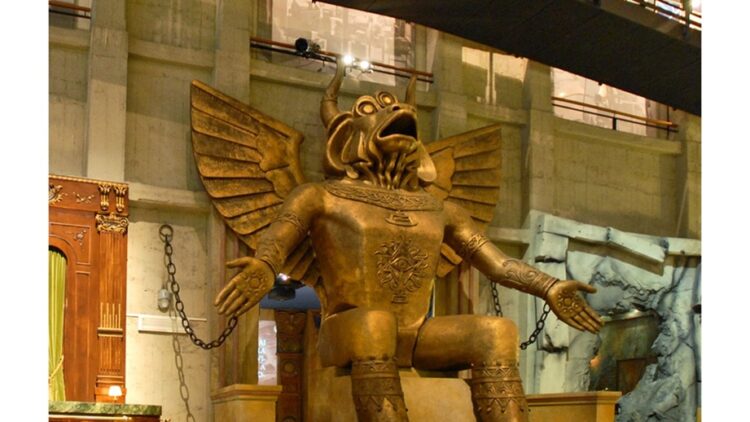
Arga’il’s Epistle to the Priests of Moloch
Hail, Brethren of the Sacrificial Rite,
Ye priests of Moloch, pride of Rabbath-Amon!
Accept this humble missive which is sent
From your most abject servant, Arga’il,
Who details visions borne of second sight.
I write of priest-craft (partly gleaned from Mammon)
On how to swell the stock of blood that’s spent
To thus ensure that Moloch drinks his fill.
A hungry god demands a hefty price
To meet his need for human sacrifice.
Consuming poppies steeped with wine and rye,
I slid into a trance which soon revealed
This world as it mote be in future ages—
An era filled with wonders of great dread!
Enormous ziggurats scrape at the sky;
Steel behemoths haul men through cloud and field;
The genders are dissolved; the mad are sages;
And all rejoice that dignity is dead.
I marvel at the wealth they have amassed;
And yet these strangers vilify their past.
Their world seems coldly different from our own:
Their gods are disrespected by their priests;
Those few who seek tradition are berated
And thoughts the mob dislikes they simply smother.
A thousand heresies are sown and grown
Which celebrate men acting as brute beasts.
But one thing which they do leaves me elated!
They foment hate twixt offspring, sire and mother!
Conceive a place where families are fractured
By outside conflicts slyly manufactured!
How useful this might be for us to try!
How commonly we find it hard to part
A youngling from a parent who’s impious
And tries to stop our Moloch-sacrifice.
Too oft we hear a mother’s selfish cry
Because we cut away a youngling’s heart
And burn the flesh. These blasphemers defy us;
They flee; they hide, and we priests pay the price.
When parents fight us, Moloch is defiled;
It’s complicated, harvesting a child.
But now, Priests, we can learn from this strange culture
The benefits of filial divorce!
How mutual contempt rends spawn from parent
So much so Nature’s ties lose all their powers!
Physicians can then take the role of vulture
And mutilate the younglings in due course.
Resistance flees since we’re seen as inerrant.
All cheer the flame; the younglings become ours.
Yea, from this future age we well can reap
The cold conceit that children’s lives are cheap!
Blood sacrifice supplies are always rife
With complications. Parent-breeders seem
Reluctant to give up their first borne sons
And daughters to be killed at Moloch’s altar.
But in the future, they will love the knife,
Believing this hard world is but a dream
Which dictates loveless terms, which bleeds and stuns;
Where fools who value life are doomed to falter.
I laugh that some see Moloch as a curse
When I have seen a future far, far worse.
Poet’s Note: Rabbath-Amon circa 830 B.C. was the main city of the Kingdom of Ammon. Ammon was located north of the Kingdom of Moab and east of the Jordan River during the period when the lands west of the Jordan were divided between the Kingdoms of Judah and Israel. Moloch was the chief deity of the Ammonites.
There are scholarly and theological disputes as to the exact logistics of how children were sacrificed to Moloch. As a fictive artifact, this poem does not purport to present a scholarly analysis of such methodology. It does, however, largely nod to the majority view that live children were burned to death.
Brian Yapko is a retired lawyer whose poetry has appeared in over fifty journals. He is the winner of the 2023 SCP International Poetry Competition. Brian is also the author of several short stories, the science fiction novel El Nuevo Mundo and the gothic archaeological novel Bleeding Stone. He lives in Wimauma, Florida.
















Brilliant piece of work – just love the satire, simultaneously funny yet horrendous. What an indictment of our current civilisation! I am reminded of Swift’s Modest Proposal. The final couplet is a great clinch: I laugh that some see Moloch as a curse / When I have seen a future far, far worse. Indeed. Great writing.
Thank you so much, James. “Funny yet horrendous” is precisely what I was aiming for. These are no longer days for subtle intimations. I had not thought of Swift but I’m delighted by the comparison.
Fixing the heading and email blurb, the character is Arga’il and not Arga’ll. It is an authentic (if obscure) name from history and the scansion demands this.
Brian, your brilliant powers of poetics are at their zenith. Like James, I recognize the abhorrent future fatalism found in your finely tuned fictive account mutilating children. I can only imagine what sources you are reading these days and nights in order to write from such arcane knowledge and historical perspective.
Thank you so much, Roy! That’s a very wonderful thing to say and I’m grateful always for your generosity and support. Don’t worry, I’m not spending my time reading about Moloch. I did some research — but just enough to keep it reasonably historical as I focused on the sociological points I was making. I’m relieved to be done with this subject.
Brian, this indictment upon our perverse modern age is rendered with such perfect poetry– every line I read falls into its place so perfectly, the the exact right words, it is so satisfying and yet so disturbing. Well done!
Thank you so much, Theresa. I appreciate you finding it both satisfying and disturbing. I wanted to write a poem which offered modern society what Melville called “the shock of recognition.”
So many painful ‘Truths’ I struggle to avoid contemplating, Brian, being about as depressed as one can get, this disturbing exposé on how things stand today, ideologically, and/but actually stem from practices as old as Methuselah is a perfect concept for ‘any’ day, but particularly for a Sunday. As a high school dropout (with a 4-point GPA), and the zealous rhyme-n-meter advocate you know I’ve been for more than 60 years, I find your vast repertoire of historical knowledge EXTREMELY impressive, and this very difficult and rarely seen ABCD-ABCD ‘scansion’ is, in my view, quite a feat in itself! A good, hot breakfast should calm me down 🙂 Another’WOW’, my friend.
Thank you so much, Mark. I’m sorry for the depressing subject matter. But that seems to be more and more de rigueur with each passing day and each new indignity that is thrust upon us. I appreciate your kind words about my historical knowledge but I really don’t think mine is all that noteworthy. I’m just a pretty good researcher. On a happier note, I hope that good hot breakfast did indeed give you some pleasure. When dealing with sad issues, gruel just doesn’t cut it.
I just love this creative anachronism of a poem. It’s as poignant as it is entertaining, great job! The picture of the gruesome looking statue also enhances the story for me.
Thank you very much, Yael. Bringing history alive is one of my favorite things to do as a poet. I love getting in historical characters’ heads and discovering that they are not all that different from ourselves. Of course, a good part of that could simply be my own projection. Be that as it may, the “putting on a costume” thematically as it were is great fun for me. Albeit less so in a dark piece like this one.
James Sale is quite correct — this poem is much like Swift’s “A Modest Proposal,” but without the tongue-in-cheek humor that makes that essay bearable. In this masterly piece of work the parallels between the child-murdering Ammonites and our current anti-family, anti-natalist culture of abortion, child mutilation and death are made agonizingly apparent. As long as English survives as a language, this poem will be read as horrifying indictment of our degradation and debasement.
The ABCDABCD EE structure serves an important purpose. It has a remembrance of rhyme without the intrusiveness of a simpler and more direct rhyme scheme that would interfere with the ugly immediacy of the subject. We don’t want the tick-tock tinkle of rhymes in a poem that deals with such a serious and damning vision of what we have become, given through the mouth of a representative or friend of the priesthood of Moloch. It is as if we had a poem in the voice of a high-ranking SS officer recounting his dream of a distant future run on Nazi principles. An easily recognized rhyme scheme would be silly and undignified.
Brian, I agree with LTC Peterson. You are at the zenith of your poetic powers. The problem is this: if the poet is a person of deep feeling and perception and intuition (as you most certainly are), then your poetic insights can become a psychological torture to you. I pray that this will not happen in your case, as it has happened with so many other poets.
This is one hell of a poem, and not in a figurative sense. It gives us a glimpse of hell itself.
Joe, I’m very grateful indeed for your generous comment. And you have, of course, read everything in this poem that I hoped would be read. It is indeed about the destruction of the family, child mutilations pushed by transgender ideologues, conscienceless abortion, and all the other ways modern society encourages us to destroy ourselves through the devolution of family life. About as depressing a subject, I suppose, as one might consider. It is indeed about hell — the hell we as a society have volunteered to create and deepen with every rejection of dignity possible.
Thank you, Joe, for your sensitivity to the poet behind the poem. I am overjoyed that you consider me to be at my zenith and that you can sense the deep feeling I put into my work. But if a person feels tortured these days it is probably because he or she is paying attention. For myself, I am at present deeply affected by the recent horrendous events in Australia and what that mass murder of Jews simply celebrating Hanukkah bodes for the future not just of Australia, but for the U.S. and the West. In this climate, I find it difficult to concentrate on poetry as I weigh whether a focus on prose editorial pieces might not allow me to more directly channel my rage and fear. I was a lawyer long before I was a poet. That being said, I’m sure this change of focus will only be temporary. I’m taking things one day at a time.
So well put, Brian. All your poetry is so intelligent, well researched and beautifully stated. I think your faith will sustain you through any possible psychological torture and still fuel your most creative sensibilities.
Thank you so much, jd. I felt that some things needed to be said and channeling this ancient awful Moloch-worshiper seemed like a good way to do so. As I mentioned to Joe above, torture seems to be part and parcel of paying attention to the news these days. But I do have great faith in God and I know that none of us — not one of us — has the power to thwart His will. I hope and pray that His Justice will come. And that right soon.
Great idea here, Brian: our current world viewed by a priest from a distant past. I think the analogy extends beyond the direct one of child sacrifice to abortion and gender reassignment. These ancient people sacrificed their children to gods that we could never believe in. Nowadays, careers and reputations have been sacrificed to the new gods of wokeness, diversity and the rest of the modern pantheon.
Thank you, David. Yes, you completely understand the terrible parallels — especially the idea that Moloch has merely been replaced by these destructive “new gods of wokeness, diversity” et al. For some reason I’m reminded of a gathering of five or six Hollywood celebrities recently on tv (the only name which I recall is Cynthia Nixon) in which EVERY SINGLE ONE OF THEM boasted about having a transgender child. Statistically impossible of course. But the bragging and the sick ideological lockstep made it clear that they were indeed not only derelict as parents but enthusiastically sacrificing their children’s lives and any possibility of happiness to their twisted god of Woke Narcissism.
It’s a wonderful thing when you find a Biblical or other historical reference and make a connection to modern times. The Muse works in mysterious ways!
Thank you so much, Cheryl. I love writing about Biblical themes. Literally everything we need to know about the modern world and the nature of Man has been set down in Scripture — if we are willing to dive deeply enough to search. The Muse does indeed work in mysterious — and wondrous — ways!
I can hardly add to what’s been said here. This is quite brilliant!
Thank you so much, Cynthia! I realize it’s not a likeable subject, but I’m very glad you liked this piece.
Some grim stuff here. I am instructed, but not happy about it:
Don’t lead me to those vaunted coral gables
If, there, dismembered parts shall grace our tables.
Grim indeed, Kip. And the couplet you offer does not bring much additional joy — though it is entertaining in a Sweeney Todd kind of way. Interestingly, the reference to coral gables brings to mind the murder of mobster Fatty Walsh in Coral Gables back in the Roaring 20s. It’s rather famous (infamous) here in Florida the way the St. Valentine’s Day Massacre is famous in Chicago.
Brian, you’ve created a haunting, impeccably controlled poem — brilliantly crafted, albeit on a deeply unsettling subject. Your vivid imagery and voice refuse to let me look away. Bravo for speculating on such an abhorrently possible future; this only underscores how powerful your writing is.
Thank you very much indeed, Laura. Sadly, I think that abhorrent future is here.
I swear that I am not self-advertising saying that this is a wonderful and complementary companion to my “Ba’al” , except more sophisticated and wider-ranging. Brian, this is a superbly stylized reverse prophecy on current idols that are worse than Ba’al and Moloch—if only because those ancient nations hardly knew any better, in contrast to their contemporary idol-worshipping counterparts. Mazal tov on a great piece! And happy new year!
Michael, I must have filed your Ba’al poem somewhere in the back of my mind as I wrote Arga’il — that’s how good your work was! I am happy to have our two poems considered companion pieces as we both contemplate the evil deification of all that is destructive, hateful and morbid in lieu of moral decency and the affirmation of life.
Brian, you have the knack of holding a mirror up to the wickedness of today’s society through excellently crafted poetry that paints a vivid and shocking linguistic picture. This masterpiece tears at the heart and screams at the conscience of those who know right from wrong. Brian, I thank you for your talent and for your bravery. You make a difference and offer hope to the voices in the wilderness. Never stop doing what you do so well!
Thank you so much, Susan. and bless you for your generous support of my poetry — even when it appears dark and pessimistic as here. I am grateful that you recognize my attempt to hold a mirror up to our strangely destructive society. I am especially grateful for your brave and bold example of speaking out concerning injustice and depravity. I must echo your advice back to you: Never stop doing what YOU do so well.
The poem has intriguing features, Brian, not yet much discussed because your social and emotional thrust takes the center of attention, as you plan.
Still, this piece could bear valuable comparison with (1) other poems on these subjects (child injury and parent-child standoff) right here at this site, some by yourself, and (2) broader use of Moloch as symbol in modern literature. Moloch is all over the modern world, more often in fiction and film, but in poetry, Ginsberg’s free verse “Howl” pays some attention to him as a figure of all-devouring oppression. In a shorter work, you’re able to maintain focus on the topic of child sacrifice, as Flaubert does in the popular historical novel Salammbo. Comparisons like these reveal unique individuality of genre and approach in what you’re doing. Sorry I have no time to compare at present!
(3) While your principal point is the value Arga’il absorbs from his dream vision [namely, his fellow pagan priests could use a modern idea to help overcome difficulties in their work], his perspective is broader and therefore more extensively interesting. He very much likes one thing from his vision {hostility between child and parent], but is appalled by another [lack of respect for religion, in particular for priests like himself]. This sets up a conflict Arga’il doesn’t understand, but we could–for consideration of social and religious values in our world, and of what Arga’il misses, despite the details you allow this observant figure to notice, even in a dream! David Whippman and Michael Vanyukov briefly consider religion, as you do in response.
(4) Almost everybody misses the complicated run of time scheme in this poem of historical fiction. The poem is not just an ancient way to show how wicked we are today. Laura Schwartz rightly reads and praises your “speculating on such an abhorrently possible future.” Arga’il dreams beyond us.
Those are my list potential topics provoking more thought, but I’m called away. Good work!
Thank you so much, Margaret, for your detailed comment on the piece and the depth you bring to your analysis. If you can believe it, I had a difficult time choosing between Moloch, Ba’al and Astarte as the pagan god central to the poem’s conceit. But given the consistency of child sacrifice to Moloch and my well-known criticism of transgender overreach vis a vis prepubescent children, Moloch became the logical choice. A good thing, too, as Michael Vanyukov had written a great poem about Ba’al and it’s just as well that I not revisit what had already been covered so well.
The fact that this is a dream-vision (my model was the vision quests of Native Americans) may have made the time frame here seem more complex than intended. It actually is rather simple: the “present” is a date approximately 800 B.C. The vision of the “future” leads Arga’il into a time period approximately 2800 years thence. That abhorrent future is NOW.
Brian, your choice of Moloch’s priest and his perspective is brilliant. Nothing has really changed. The priests are complicit with the governments—churches are on their payroll! All the killing has been streamlined, modernized, protocolized, and sanctioned by the gods of our various priests. No wonder Arga’il is so impressed… he fits perfectly into the modern mindset.
Thank you so much, Mike. That’s the sad part. Nothing has really changed. Except the consequences are much more far-reaching because our populations are so large and communication across the miles is so easy. Someone in Beijing can easily conspire with someone in London in real time, and social media ensures that some fat gamer in Amsterdam, financed with money from Qatar, can pretend to be freezing to death from a blizzard in Gaza. The REACH of corruption has become fully global. To disseminate propaganda and literally globalize a terrorist intifada has never been technologically simpler.