


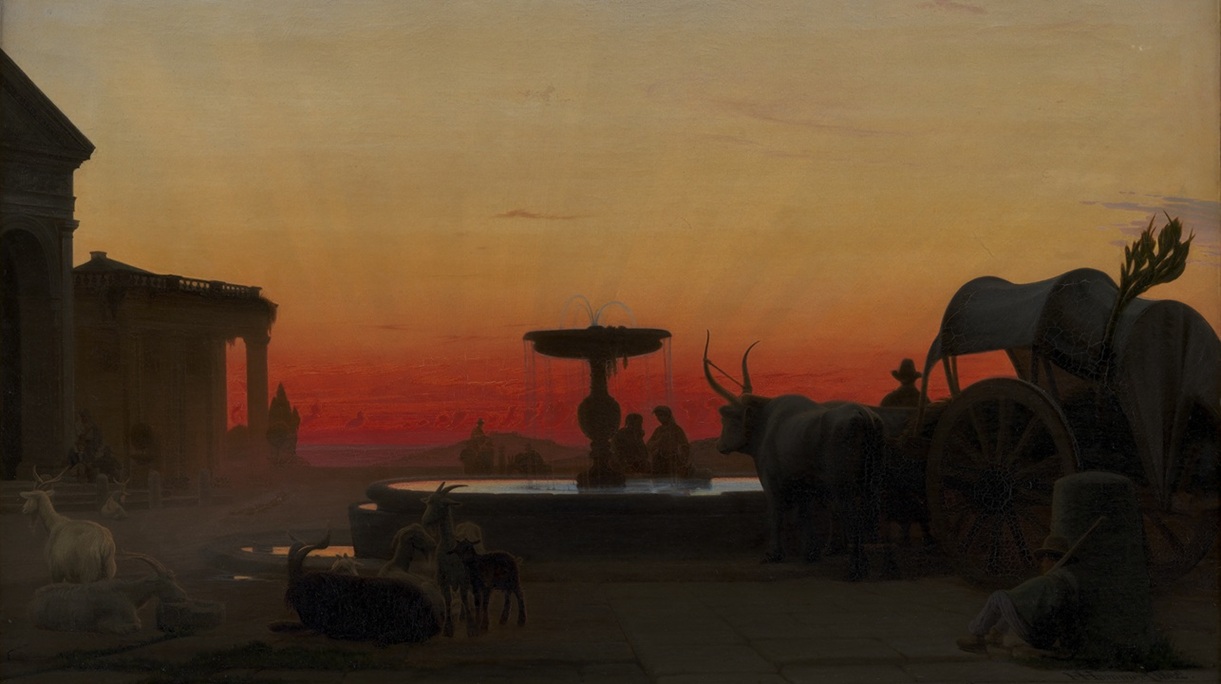
Canzone at Evening
by Francesco Petrarch (1304-1374)
translated from Italian by Margaret Coats
At the hour when heaven rapidly recedes
To greet the West, and our day flies away
To those who are perhaps expecting it,
Alone and far from where she used to stay,
A pilgrim, old and overtired, proceeds
To quicken her pace, intending not to quit
_The road until night’s veils permit
_Some moments to enjoy repose
_Wherein she can ignore the woes
And labors of the journey that she makes
In peace and comfort of the rest she takes.
Alas, for me, each day’s calamitous
_Sorrows increase my inward aches
As sunlight reddens and departs from us.
The sky’s car turns its flaming wheels and fades
Into approaching night. An afterglow
Produces transient hilltop silhouettes.
One mountain farmer plies again his hoe,
And with blithe words in alpine serenades,
All heaviness of heart he soon forgets.
_Upon his table then he sets
_Nourishing, pungent, earthy stuff
_With all the taste of acorns rough,
That people praise but hardly will devour.
Let him who will rejoice from hour to hour!
No cheer, no periods of calm I earn;
_My fare is bitter, sparse, and sour
If heaven whirls, or if the planets turn.
When a shepherd sees the grander planet’s rays
Enwrap the nest where it will spend the night,
While darkness blankets countries of the East,
He gently takes more active oversight
Of the sheep, using his staff to steer the strays
Into the flock, till settling work has ceased.
_Then when from branches he has pieced
_A hut’s green roof, or found a cave
_Far from where crowds of people rave,
There without cares he stretches out to sleep.
But, cruel Love, you force me then to keep
Awake, pursuing a wild creature’s feints,
_Whose dim trail only lets me creep
Toward her, whom you seize not in your restraints.
Riverboat crews, as the sun lowers his face,
Doze while they drift through shady valleys enclosed,
Lying on boards beneath a sailcloth sheet,
And when to sink from Spain he is disposed,
Diving amid the waves beyond the place
Where Africa’s and Europe’s limits meet,
_Gentlemen then, and ladies sweet,
_Our world and all its animals,
_Rest after bedtime rituals.
For me, the nights do naught but interfere
With troubles that each day grow more severe,
Augmenting my desires and misery;
_My grief soon enters its tenth year,
Still questioning what hour will set me free.
Why so? To vent my anguish, I demand
At sunset why I notice oxen loosed
From yokes, no more compelled to pull the plow.
The pains that cause my sighs should be reduced;
By twilight why are my ordeals not banned?
Why day and night do tears my eyes endow?
_O wretched man! What did I vow
_When first I fixed these eyes on her,
_Becoming thus the worshipper
Of an idol I wrought from my imaginings.
It cannot be cast down by sufferings
Until Death as his prey my corpse receive,
_Whose power separates all things.
Of her, I know not what I should believe.
_Canzone, daydream and nightmare’s glare
_You share with me from dawn to dusk;
_Now take my part as recluse brusque.
Wish not to be acknowledged everywhere,
And for fame’s praises have so little care
That you wonder as you flit from hill to hill,
_Only why raging blazes spare
This living brimstone through which passions thrill.
Italian Original
Canzoniere del Petrarca 50
Ne la stagion che ’l ciel rapido inchina
verso occidente, et che ’l dì nostro vola
a gente che di là forse l’aspetta,
veggendosi in lontan paese sola
la stanca vecchiarella pellegrina
raddoppia i passi et più et più s’affretta,
et poi così soletta
al fin di sua giornata
talora è consolata
d’alcun breve riposo, ov’ ella oblia
la noia e ’l mal de la passata via.
Ma, lasso, ogni dolor che ’l dì m’adduce
cresce qualor s’invia
per partirsi da noi l’eterna luce.
Come ’l sol volga le ’nfiammate rote
per dar luogo a la notte, onde discende
dagli altissimi monti maggior l’ombra,
l’avaro zappador l’arme riprende
et con parole et con alpestri note
ogni gravezza del suo petto sgombra,
et poi la mensa ingombra
di povere vivande
simili a quelle ghiande
le qua’ fuggendo tutto ’l monde onora.
Ma chi vuol si rallegri ad ora ad ora,
ch’ i’ pur non ebbi ancor, non dirò lieta,
ma riposata un’ ora,
né per volger di ciel né di pianeta.
Quando vede ’l pastor calare i raggi
del gran pianeta al nido ov’ egli alberga
e ’mbrunir le contrade d’oriente,
drizzasi in piedi et co l’usata verga,
lassando l’erba et le fontane e i faggi,
move la schiera sua soavemente,
poi lontan de la gente
o casetta o spelunca
di verdi frondi ingiunca,
ivi senza pensier s’adagia et dorme.
Ahi crudo Amor, ma tu allor più m’informe
a seguir d’una fer ache mi strugge
la voce e i passi et l’orme,
et lei non stringi che s’appiatta et fugge.
E i navigano in qualche chiusa valle
gettan le membra, poi che ’l sol s’asconde,
sul duro legno et sotto a l’aspre gonna.
Ma io, perché s’attuffi in mezzo l’onde
et lasci Ispagna dietro a le sue spalle
et Granata et Marrocco et le Colonne,
et gli uomini e le donne
e ’l mondo et gli animali
acquetino i lor mali,
fine non pongo al mio ostinato affanno,
et duolmi ch’ ogni giorno arroge al danno,
ch’ i son già pur crescendo in questa voglia
ben presso al decim’ anno,
né poss’ indovinar chi me ne scioglia.
Et perché un poco nel parlar mi sfogo,
veggio la sera i buoi tornare sciolti
da le campagne et da’ solcati colli.
I miei sospiri a me perché non tolti
quando che sia? Perché no ’l grave giogo?
Perché dì et notte gli occhi miei son molli?
Misero me, che volli
quando primer sì fiso
gli tenni nel bel viso
per iscolpirlo, imaginando, in parte
onde mai né per forza né per arte
mosso sarà fin ch’ i’ sia dato in preda
a chi tutto diparte!
Né so ben anco che di lei mi creda.
Canzon, se l’esser meco
dal matino a la sera
t’à fatto di mia schiera,
tu non vorrai mostrarti in ciascun loco;
et d’altrui loda curerai sì poco
ch’ assai ti fia pensar di poggio in poggio
come m’à concio ’l foco
di questa viva petra ov’ io m’appoggio.
Margaret Coats lives in California. She holds a Ph.D. in English and American Literature and Language from Harvard University. She has retired from a career of teaching literature, languages, and writing that included considerable work in homeschooling for her own family and others.











What a beautiful translation of a somber but beautiful Italian poem. You must be a linguistic marvel with your demonstrated knowledge of so many languages. In the second verse, I puzzled about the word “car” instead of “cart,” but when I looked it up, it had already entered the English language as short for “cart” around 1300 AD and thus fits the timeframe perfectly. I am amazed by your extensive literary resources and can only wonder about the magnificence of your library. Your choices of poems to translate also provides insight into your superb intellect. Merry Christmas Margaret!
Margaret C.
Congratulations on this brilliant and beautiful translation!