


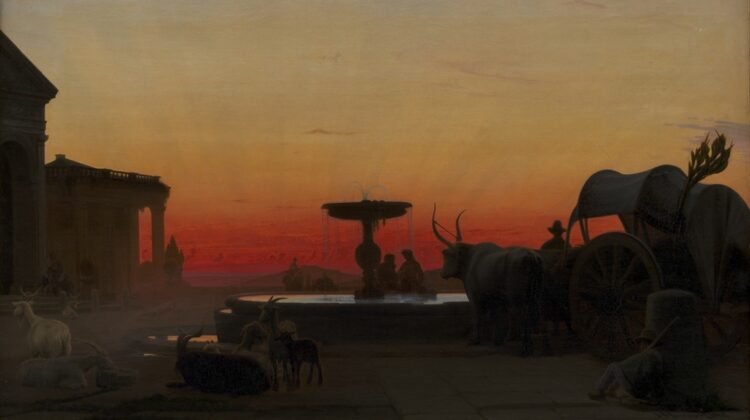
Canzone at Evening
by Francesco Petrarch (1304-1374)
translated from Italian by Margaret Coats
At the hour when heaven rapidly recedes
To greet the West, and our day flies away
To those who are perhaps expecting it,
Alone and far from where she used to stay,
A pilgrim, old and overtired, proceeds
To quicken her pace, intending not to quit
_The road until night’s veils permit
_Some moments to enjoy repose
_Wherein she can ignore the woes
And labors of the journey that she makes
In peace and comfort of the rest she takes.
Alas, for me, each day’s calamitous
_Sorrows increase my inward aches
As sunlight reddens and departs from us.
The sky’s car turns its flaming wheels and fades
Into approaching night. An afterglow
Produces transient hilltop silhouettes.
One mountain farmer plies again his hoe,
And with blithe words in alpine serenades,
All heaviness of heart he soon forgets.
_Upon his table then he sets
_Nourishing, pungent, earthy stuff
_With all the taste of acorns rough,
That people praise but hardly will devour.
Let him who will rejoice from hour to hour!
No cheer, no periods of calm I earn;
_My fare is bitter, sparse, and sour
If heaven whirls, or if the planets turn.
When a shepherd sees the grander planet’s rays
Enwrap the nest where it will spend the night,
While darkness blankets countries of the East,
He gently takes more active oversight
Of the sheep, using his staff to steer the strays
Into the flock, till settling work has ceased.
_Then when from branches he has pieced
_A hut’s green roof, or found a cave
_Far from where crowds of people rave,
There without cares he stretches out to sleep.
But, cruel Love, you force me then to keep
Awake, pursuing a wild creature’s feints.
_The dim trail only lets me creep
Toward her, whom you seize not in your restraints.
Riverboat crews, as the sun inclines his face,
Doze while they drift through shady valleys enclosed,
Lying on boards beneath a sailcloth sheet.
Later to sink from Spain he is disposed,
Diving amid the waves beyond the place
Where Africa’s and Europe’s limits meet,
_Gentlemen then, and ladies sweet,
_Our world and all its animals,
_Rest after bedtime rituals.
For me, the nights do naught but interfere
With troubles that each day grow more severe,
Augmenting my desires and misery;
_My grief soon enters its tenth year,
Still questioning what hour will set me free.
Why so? To vent my anguish, I demand
At sunset why I notice oxen loosed
From yokes, no more compelled to pull the plow.
The pains that cause my sighs should be reduced;
By twilight why are my ordeals not banned?
Why day and night do tears my eyes endow?
_O wretched man! What did I vow
_When first I fixed these eyes on her,
_Becoming thus the worshipper
Of an idol I wrought from my imaginings.
It cannot be cast down by sufferings
Until Death as his prey my corpse receive,
_Whose power separates all things.
Of her, I know not what I should believe.
_Canzone, daydream and nightmare’s glare
_You share with me from dawn to dusk;
_Now take my part as recluse brusque.
Wish not to be acknowledged everywhere,
And for fame’s praises have so little care
That you wonder as you flit from hill to hill,
_Only why raging blazes spare
This living brimstone through which passions thrill.
Italian Original
Canzoniere del Petrarca 50
Ne la stagion che ’l ciel rapido inchina
verso occidente, et che ’l dì nostro vola
a gente che di là forse l’aspetta,
veggendosi in lontan paese sola
la stanca vecchiarella pellegrina
raddoppia i passi et più et più s’affretta,
et poi così soletta
al fin di sua giornata
talora è consolata
d’alcun breve riposo, ov’ ella oblia
la noia e ’l mal de la passata via.
Ma, lasso, ogni dolor che ’l dì m’adduce
cresce qualor s’invia
per partirsi da noi l’eterna luce.
Come ’l sol volga le ’nfiammate rote
per dar luogo a la notte, onde discende
dagli altissimi monti maggior l’ombra,
l’avaro zappador l’arme riprende
et con parole et con alpestri note
ogni gravezza del suo petto sgombra,
et poi la mensa ingombra
di povere vivande
simili a quelle ghiande
le qua’ fuggendo tutto ’l monde onora.
Ma chi vuol si rallegri ad ora ad ora,
ch’ i’ pur non ebbi ancor, non dirò lieta,
ma riposata un’ ora,
né per volger di ciel né di pianeta.
Quando vede ’l pastor calare i raggi
del gran pianeta al nido ov’ egli alberga
e ’mbrunir le contrade d’oriente,
drizzasi in piedi et co l’usata verga,
lassando l’erba et le fontane e i faggi,
move la schiera sua soavemente,
poi lontan de la gente
o casetta o spelunca
di verdi frondi ingiunca,
ivi senza pensier s’adagia et dorme.
Ahi crudo Amor, ma tu allor più m’informe
a seguir d’una fer ache mi strugge
la voce e i passi et l’orme,
et lei non stringi che s’appiatta et fugge.
E i navigano in qualche chiusa valle
gettan le membra, poi che ’l sol s’asconde,
sul duro legno et sotto a l’aspre gonna.
Ma io, perché s’attuffi in mezzo l’onde
et lasci Ispagna dietro a le sue spalle
et Granata et Marrocco et le Colonne,
et gli uomini e le donne
e ’l mondo et gli animali
acquetino i lor mali,
fine non pongo al mio ostinato affanno,
et duolmi ch’ ogni giorno arroge al danno,
ch’ i son già pur crescendo in questa voglia
ben presso al decim’ anno,
né poss’ indovinar chi me ne scioglia.
Et perché un poco nel parlar mi sfogo,
veggio la sera i buoi tornare sciolti
da le campagne et da’ solcati colli.
I miei sospiri a me perché non tolti
quando che sia? Perché no ’l grave giogo?
Perché dì et notte gli occhi miei son molli?
Misero me, che volli
quando primer sì fiso
gli tenni nel bel viso
per iscolpirlo, imaginando, in parte
onde mai né per forza né per arte
mosso sarà fin ch’ i’ sia dato in preda
a chi tutto diparte!
Né so ben anco che di lei mi creda.
Canzon, se l’esser meco
dal matino a la sera
t’à fatto di mia schiera,
tu non vorrai mostrarti in ciascun loco;
et d’altrui loda curerai sì poco
ch’ assai ti fia pensar di poggio in poggio
come m’à concio ’l foco
di questa viva petra ov’ io m’appoggio.
Margaret Coats lives in California. She holds a Ph.D. in English and American Literature and Language from Harvard University. She has retired from a career of teaching literature, languages, and writing that included considerable work in homeschooling for her own family and others.



















What a beautiful translation of a somber but beautiful Italian poem. You must be a linguistic marvel with your demonstrated knowledge of so many languages. In the second verse, I puzzled about the word “car” instead of “cart,” but when I looked it up, it had already entered the English language as short for “cart” around 1300 AD and thus fits the timeframe perfectly. I am amazed by your extensive literary resources and can only wonder about the magnificence of your library. Your choices of poems to translate also provides insight into your superb intellect. Merry Christmas Margaret!
Thank you, Roy! This Italian canzone is a magnificent lyric by one of the world’s greatest and most influential poets. I’ve presented the Society two others by him, but none for the past three years. Petrarch wrote many sonnets, but the canzone form intrigues me most. The poet must not only develop his material, but invent a new form (within certain limits). The number of stanzas, number of lines per stanza, number of shorter lines as opposed to full-length lines per stanza, with an original rhyme scheme (and no rhyme sound re-used after its first appearance) create a unique form for each canzone. This particular one is also distinguished by the beautiful pictures of the evening and sunset as a time of day (and by the poet’s reflections on his obsessive love developed from these).
It was my challenge this time to produce an English canzone that could make sense without explanatory notes. Therefore, if you want to know more about Petrarch and his love, check out the two canzoni I’ve published here previously. So glad you enjoyed this one!
A merry Christmas to you, Roy! One more thing about “the sky’s car” is that the word “car,” especially in poetic usage, refers to a two-wheeled vehicle. That’s the picture we usually see when the sun god drives in grand fashion from east to west. The Italian only says he “turns his flaming wheels,” but that’s enough to suggest the brilliant golden chariot.
Margaret C.
Congratulations on this brilliant and beautiful translation!
Margaret B., I’m so glad you find it brilliant. Although the hour is sunset, the fading light with its ruddy color blaze through this poem from beginning to end–as a figure for the uncontrollable love of the poet. He’s still only 33 years old, suffering from ten years of passion. This canzone is the first, and I think the finest, of eight anniversary poems written during the lady’s lifetime. Thank you for reading!
This is truly beautiful, Margaret! And it looks as if you’ve kept the the original rhyme scheme, which I’m sure wasn’t easy.
Thank you, Cynthia! I always do my best to keep the original form of a translated poem, both rhyme scheme and stanza shape in this case. For the beauty of the evening scenes, and the significance drawn from them, I have to thank the master poet whose marvelous work remains a constant inspiration.
I know how difficult it is to translate a poem while maintaining both fidelity to meaning and a rhyme scheme. In a poem of this length. the task can be herculean.
The concluding short stanza is especially fine, and worthy of Petrarch’s Italian. Picking up the original rime rich of “poggio” and “appoggio” with hill and thrill is a brilliant touch.
Thank you, Joseph. That last line was the most difficult to translate, as it speaks literally of where the poet positions himself–something rather abstract and not suggestive of a brilliant image or action to end with. The complexity of the thought as developed, and the carryover into the following sonnet, is what makes it so striking in Italian. I thought you might object to rendering “viva petra” as “brimstone,” which is a gift of the English language. Brimstone is burning sulfur, but since Petrarch’s stone is living and therefore soft like sulfur, and certainly burning, it makes sense to render the words as such. They help then to conclude the poem by collating all the images of the setting sun into association with the poet lover’s uncontrolled passion.
That identical “rime riche” is deliberate here, I think, for the purpose of emphasizing stasis. My opinion could be overreading, but I began to think so because Dante too very occasionally uses identical rhyme as an artistic means of concluding with neither progress nor resolution.
I can’t imagine the effort, creativity and ingenuity that goes into a project like this. Job very well done! I enjoyed all of it, but the switch from pentameter to octameter (if I got that right) in each stanza was something I’ve never seen before. It was very catchy.
I’m off now to see if this night will do more than merely interfere with the troubles that await tomorrow (that couplet was also very catchy, and I apologize for ruining it).
Warren, it’s great you find catchy lines in Petrarch. His procedure of regularly switching line lengths within the stanza is part of making a canzone. See what I said to Roy above–and what Mary Jane says in analysis below! I call the shorter ones “cut lines.” The cut lines here are tetrameter (four stresses) as opposed to pentameter (five stresses) for the full-length line. When you guessed octameter, you were thinking of the number of syllables instead of stresses.
I thought of your “Victimhood Diet” poem when preparing this translation for submission. The poet lover, like many victims who can’t tolerate their situation, experiences tough suffering during the day and more so at night, but notice Petrarch doesn’t go for victimhood. He explains quite clearly that his suffering began as his own fault for wrongly idolizing his beloved–and leaves the reader to wonder how this has lasted for ten years if he understands that. The psychology of love for a worthy object confirms what this poet says, without blaming the beloved for the sufferings. Writing feelingly about that non-victim true-love experience was enough to gain the Italian poet innumerable followers.
Thank you for taking the time and effort to read and comment!
Margaret
Bravissima! I am fascinated by the rich complexity of the original poem, and by the excellence of your rendition into English.
The original form is: 5 stanzas of 14 lines, rhymed abcbaccddeefef with an envoi of 8 lines rhymed abbaacac. The original Italian appears to have the following syllabic counts: In long stanzas, all lines 12 syllables, except line 7, 8, 9 and 13 are 8 syllables; in envoi, lines 4, 6, and 8 are 12 syllables; lines 1, 2, 3 and 7 are 8 syllables.
You have “translated” the meter as follows: 12-syllable lines to English iambic pentameter; 8-syllable lines to English iambic tetrameter. This is a satisfying choice. You also have found perfect masculine end-rhymes which capture perfectly Petrarch’s rhyme scheme.
The narrator notices people in the world around him as they enjoy the wonders of sunset. Alas, for him, sunset only intensifies his grief over his unrequited love for the “her” (who is unnamed). The narrator gives us vivid “snapshots” of the world around him: the old pilgrim; the mountain farmer; the shepherd; riverboat crews. All are contented. However, he unfortunately is wracked by the “sorrows” of “cruel Love.”
Thank you so much Margaret, for sharing your marvelous work with us.
Merry Christmas!
Sincerely
Mary Jane
Thank you so much, Mary Jane, for special attention to the canzone form. You’ve discovered, in this example, its major features. The original form here, with five full stanzas, is a shorter canzone for this poet; his other canzoni have at least five, but as many as ten full stanzas. The stanza length of 14 lines is moderate, as there can be 10 to 20 lines per stanza. The canzone’s concluding stanza is called a “commiato” rather than an envoi. The commiato has the same shape and rhyme scheme as the final lines of full stanzas. The envoi to a French ballade usually has half the number of lines in a full stanza, but in Petrarch’s canzoni, it can be any smaller number, and he has several canzoni with commiati of only 3 lines. And while the envoi usually addresses the recipient of the poem, the Italian poet uses the commiato to address the canzone itself. This enables him to reflect on his achievement or on the poem’s reception.
Petrarch’s meter is conventionally called hendecasyllabic (11-syllable lines), but your count of 12 syllables is approximately correct because many syllables elide and therefore don’t count. Petrarch uses mostly feminine line endings, but that is natural in Italian, while I chose all masculine endings because this sounds more natural in English. In another poem, I have translated hendecasyllabics into 11-syllable lines, and didn’t like the effect. You are right about the proportion between full lines and cut lines in this Italian poem: it is more like 12/8 syllables than the 10/8 that I use in my English pentameter and tetrameter lines. I could have gone for trimeter to keep the proportion, but found that tetrameter worked better for meaning and syntax. In any case, the contrast between longer and shorter lines of regular lengths is preserved.
I hadn’t thought of “snapshots” to describe the little pictures in each stanza; good choice of word!
Thanks again for your studious attention to the poem’s structure. I know you consider these matters very carefully in both reading and writing. I’m very glad you liked canzone and translation.
Merry Christmas!
Wonderfully informative comment, Mary Jane, as is Margaret’s reply.
This is magnificent, Margaret. I’ve read it several times now and have especially loved reading it aloud. In the lover’s misery, people normally not seen as enviable (the weary female pilgrim, other poor people of various occupations, the hard-worked oxen themselves) seem to inhabit an inaccessibly cozy world. That world of evening, which is its own country, and of Italy, and of the past, which are also other countries, overlapping in these lines, is so poignantly evoked, each scene briefly touched as if by a wandering breeze. It seems impossible that a poem of such intricate structure and expressive of such bondage can share as it does in the freedom of the wind, and miraculous that you could carry that spirit over into your translation.
Wind can carry fire from hill to hill; it can be a dangerous thing. I especially like the link and shift between the two last poetic paragraphs. He “knows not what” he should believe (there’s resignation in that) and then he counsels the very canzone he’s writing to detachment from fame, as the condition of freedom. It gives me chills. This poem was probably famous for centuries, famous enough to be translated anew now, but still, how relatively few encounter it, in its flitting path. We are privileged.
When Petrarch speaks of the “restraints” of love, I remember when Dante, seeing Beatrice again at last, is caught again the “old net,” the “old flame.” But at the end of this poem, the flame passes over the lover who wants to be consumed. The frustration is palpable in both images and throughout.
I’ve long been intrigued by Petrarch but frustrated by most of the translations I’ve looked at. This one though flings the doors wide onto his world and inner world. It seems that A. M. Juster’s new translation of the Canzoniere has finally been published. I’ve been looking forward, with high hopes, to reading it.
A. M. Juster’s versions of Petrarch’s Canzoniere are scheduled to be published in April. So I’ll keep waiting patiently.
Thank you so very much, Monika, for your appreciation of Petrarch’s work as I was able to present it here. In college, when I became interested in his poetry, I encountered a number of frustrating and incomplete translations–and therefore made learning Italian a top priority. I’m intrigued that you speak of the “overlapping countries” in this canzone. It could be considered a short journey touching on varied locations and modes of poetry, with the cosmos as background. A fitting expansiveness for this first of the poems marking an anniversary of the poet’s falling in love. There are several canzoni yet more famous; any educated Italian can recall them by their opening words. I’m glad you liked my translation, and I too look forward to the long-awaited complete English Canzoniere by A. M. Juster.
This is a very good translation, extraordinarily faithful to the original yet maintaining not only the rhyme but a good sense of the meter. I would say nothing is lost in this translation (well, at least beyond what cannot help but be lost in translation). You do the Laureate justice.
Adam, to say that I do him justice is extreme praise, for which I thank you, knowing how well you can understand and appreciate the work. The Laureate, as I was bold enough to declare on the first page of my dissertation, can serve as model for almost any kind of poet. How easily he integrates love poetry with religious, moral, political, social, and devotional modes, never neglecting human emotion and never forgetting why love is the human person’s supreme activity.
I can add little to what others have said, Margaret, except to note that those first 3 lines sound so modern in their intricate tackling of sunrise’s journey westward, in the northern hemisphere, at a time when I imagine it was believed the world was flat.
Paul, you are quite right to notice Petrarch’s cosmology is NOT that of a flat earth. Like some of the ancient Greeks, he understood the curvature of the earth. Like them, he probably holds that it is a sphere. He was a learned man, and one who in his “Ascesa al Monte Ventoso” (“Ascent of Mont Ventoux”) is celebrated as the earliest modern observer of nature for its own sake. But notice as well that the sun (in the first line of stanza 3 here) is the “grander planet,” in motion like the other bodies we recognize as planets, while the earth seems to be the fixed center of a moving universe. The idea of geocentricity appears in the first lines of each of the first three stanzas of this canzone, and in lines 4-5 of stanza 4. The final line of stanza 2 is ambivalent about whether the “planets” (including the sun but not the earth) move, or whether it is also the heavens that move in relation to the earth. All I do as translator of the canzone is to present Petrarch’s viewpoint as he gives it. It is fascinating.
Thanks for your careful reading and taking the time and effort to comment!
Dear Margaret, what was that dissertation topic of yours whose opening you mentioned in passing? Is it in the public domain? The demands of my own dissertation have delayed my reading of your most recent publications here.
I can empathise with your past frustration about incomplete editions of the Canzoniere. I was very fortunate a number of years ago to stumble upon a rare collector’s edition, published by la stamperia Valdonega, in which the best English translation of each particular poem is set against the original Italian. I only lament that it is far too big to take with me on my travels. Your translation of the above canzone would not be out of place in it.
It was similarly difficult for me to find a complete edition of all 1,500 of Tasso’s lyrics in Italian, let alone in English; indeed, there is no English equivalent at all, not even close. I suspect that the inevitable monotony (in themes, conceits, and figures) of such lenghy works as Petrarch’s Canzoniere fatigued many potential translators of a complete edition.
Your translation is very fluid, which perhaps explains your decision, in at least two instances, to insert an extra, unstressed syllable into a line of iambic pentameter, e.g. “When ‘a’ shepherd sees the grander planet’s rays.” There is a precedent for this in a number of lyric poems from the Romantic period. I think the question of when to add an extra syllable is best answered by the ear, i.e. by reading poetry aloud, as used to be the convention. One sometimes comes across rather stiff, academic translations from the 18th and 19th centuries that too readily sacrifice grammatical for metrical correctness; in such works, the reader perceives at once that the translator is a scholar rather than a poet. Such a scholar would have not consulted his or her ear, as you have ably done here.
I say iambic pentamenter because I don’t think you were trying to replicate the hendecasyllable. As you suggest above, English is not sufficiently rich in femine rhymes to sustain it over a long poem. It is more natural, I think, simply to insert an anapaest in place of an iamb wherever the grammar demands it and the ear approves it, rather than to replicate the hendecasyllable as such.
Finally, what marks your translation as more modern is its careful reordering of inverted Italian syntax into more natural English. I think you were right to do so. In my experience, today’s native Italian finds the original syntax of Petrarch and Tasso strange. The same is true of native English speakers who read the Elizabethans. Having said that, while it is now long out of fashion to invert word order to the extent that the Elizabethans did, I think it still remains an important tool in the poet’s arsenal when used judiciously and sparingly; and you, if I recall correctly, have made such use of it elsewhere, in your own poetry. Aristotle considered that the language of poetry was by nature more elevated and flexible than everyday speech.
It is easy to forget that Petrarch, his predecessors and his contemporaries worshipped the greats of Greek and Latin poetry, and that the latter’s grammatical flexibility likely encouraged speakers of romance languages to superimpose the same flexibility (with mixed results) on Italian, French, Portuguese, etc.
Best wishes on your dissertation work in the new year, Daniel! And thank you for your interest in this translation and the extensive comment.
The title of my 1989 Harvard dissertation is “Religious Transformation of the Canzoniere in England.” Like most dissertations it was published by University Microfilms International or UMI. Your academic institution can obtain it in whatever digital form UMI now uses. The first chapter is on Petrarch and the scope of his influence. It condenses a vast amount of research, much of it in Italian. Too little of what I learned (from careful reading of all Petrarch’s lyrics, from early commentary on them, and from Pietro Bembo’s poetry following Petrarch) actually made it onto my pages. I had classified every single poem as a “canzoniere unit” of some sort, but I could only write about a select few of these. You know the pressure from advisors to make your original contributions to knowledge rather than recounting all you know!
I very much appreciate your considering the above translation the best of this particular canzone (i.e., worthy to be in the Valdonega collection, which I do not know). I did no verse translations in the dissertation. You’re right to think of this one as produced to suit modern readers; new translations are worthwhile when they make the original speak as directly and smoothly as possible to tastes of the time. This includes the taste I see in our Society for formal verse translation corresponding closely to the formality of the original. Not just the meaning (which theoretically could be conveyed in prose) but what Petrarch says in a Petrarchan canzone.
I did translate another canzone in 11-syllable English lines, but my attempt does not really give the effect of the Italian hendecasyllable. And it necessarily causes irregularity in English meter (in fact it sounds like mixed meter because of different numbers of accents in lines that should be the same length), whereas the Italian can be read as perfect on its own terms. I’ll put one stanza below in a full-width box to show what I mean. But this will need to done later; I apologize for additional delay.
Really fantastic. I can’t speak to the original but I love the translation here.
Thank you, Ella. I’m fantastically pleased with your appreciation!
In reply to Daniel Howard, here’s the first stanza of my translation of Petrarch’s Canzoniere 268, the English in eleven-syllable lines (with seven syllables for the cut lines):
What should I do? What counsel do you impart,
Love, when it is time to die,
And I delay much more than I could desire?
My lady is dead, and took with her my heart.
Soon to follow her on high,
I must break with the guilt of many years’ fire,
For no more can I aspire
To see her here, and this waiting both annoys
And ravages me, whose joys
Since her departure have all turned to weeping;
My life’s every sweetness was in her keeping.
Very interesting, Margaret. Your placement of two unstressed syllables side-by-side in most (perhaps all) of the long lines is a good way of bringing the count to eleven syllables. Two consecutive unstressed syllables roll off the tongue more easily than two stressed syllables. That complements the song-like effect that, I presume, should be produced by the ‘canzone’.
The hendecasyllable (in English) raises an interesting problem of metrical flow. I suppose one way of having a very consistent metrical flow would be to add a final, unstressed syllable to iambic pentameter. That would reproduce the Italian-sounding effect of the unstressed ending, albeit at the cost of restricting the number of potential rhymes, especially over a longer poem.
Yet another option could be to split the hendacasyllable more or less in half:
da-DUM da-DUM-da, da-DUM da-DUM da-DUM.
But I wouldn’t set any rule for it. I often come across metrical quirks in Shelley but in the best cases they work; this is especially the case if the flow of the poem, when read aloud, sounds natural to the ear. We shouldn’t forget that the some of the worst sounding poems (i.e. the most stiff) can be metrically perfect, and that it is their very perfection/monotony that bores the ear.
It would appear that the Greeks were much more comfortable at mixing meters than we English speakers, but then that is not suprising in the context of quantitative meter, where one can presumably calculate the correct foot to substitute in the abstract. I think the ear can make the equivalent calculation in English from time to time, and that the desired subtitution can be aided by placing together vowels and consonants that elide more easily. That’s all well and good in the abstract; but as we know, the challenge is that, sometimes, what we want to say cannot be expressed in the most sonorously ideal manner, since English does not have the same resources as the Romance languages. Conversely, we might be able to produce the perfect musical effect, but must either compromise or regard the substance as secondary in order to do so. I tend to think of Shelley as sometimes falling into the latter category – the sound so enchants the ear that the sense melts away, but how much (profound) sense was there in the first place? I know he alludes to Platonism and contemporary political thought but that’s not what I read him for. Shakespeare was often the opposite, e.g. simplying the rhyme scheme of the sonnet to facilitate the expression of something deeply moving and meaningful. Perhaps it is an almost unattainable ideal for a poet to be both Shelley and Shakespeare at once.