


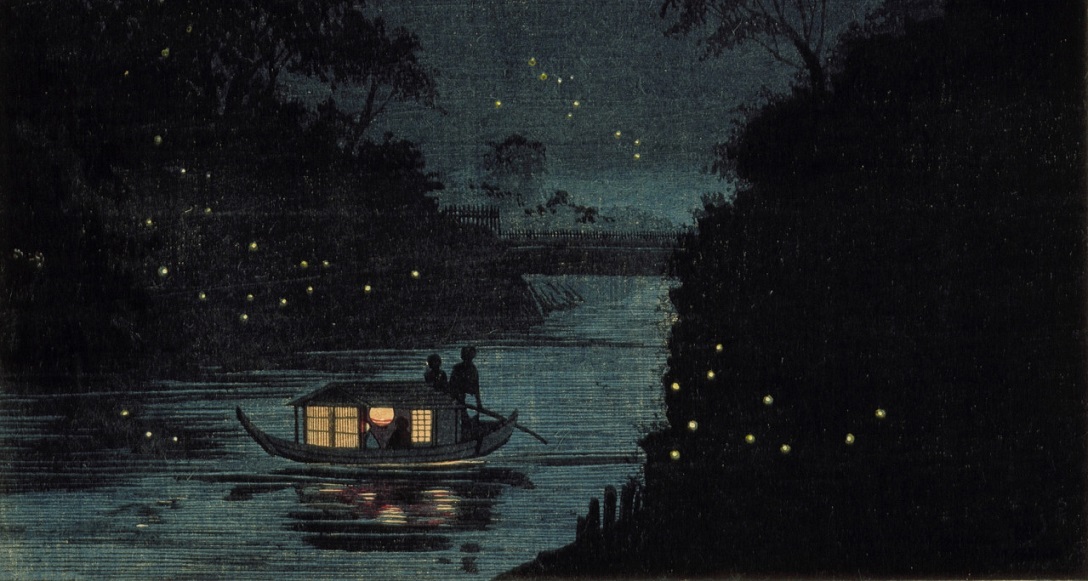
Firefly
Behold it glimmer through the trees—
A lantern drifting soft and low—
It weaves along the evening breeze,
A thread of light with gentle glow.
It floats, a flick of fairy flame
On wings too fine for eyes to trace—
A moment’s spark—yet not the same
As stars that guard the night’s embrace.
Its lamp recalls a distant shore,
A beacon lost to time’s retreat.
It flickers close, then shines no more,
And leaves the hush of mossy feet.
So like the stars that shimmer high,
It twinkles through the shaded eaves—
A quiet voice, a soft goodbye,
That hums behind the whispering leaves.
Yet as I watch its fleeting glow,
A thought stirs gently in my chest—
That we, like it, are born to go,
Brief glimmers ‘neath the sky’s unrest.
We rise, we drift on unseen thread,
Through shadowed woods and silent years—
A little light by darkness led,
A smile between our hopes and fears.
No thunder crowns our humble flame,
No star looks down with jealous eye—
And yet we burn, though none may name
The place we passed, nor reason why.
Not like the fire that flares and dies,
Bright-burning scars upon the air—
The firefly neither claims the skies,
Nor scorches all it wanders near.
Not like the sun in grand array,
Whose gaze commands both field and sea—
The firefly moves through twilight gray,
Content with soft obscurity.
Its light is not for pride or fame,
It asks no praise, it seeks no throne;
And yet it shines, and just the same,
It lights a path—unknown, alone.
And oh! if one should chance to see
Our spark before it slips from view,
May it, like this small firefly, be
A light—though none quite know from who.
The Elegy of the Silent Oak
I rose in silence from the moistened ground,
A tender blade by gentle dewdrops blessed,
With one pale leaf in modest verdure crowned,
That shrank beneath the breeze’s lightest jest.
Yet still I sought the boundless skies above,
To tower high o’er field and lowly thorn;
My arms outspread with ever-constant love,
To yield both shade and solace newly born.
When I was but a sapling, weak and slight,
She came with water, silent in her grace,
Then turned to yew and elm in twilight’s light—
Their branches clasped in mute embrace.
An oak I grew, yet frail in form and limb,
With squirrels darting through my youthful green;
My roots were shallow, and my crown was dim,
My acorns lost in grass, unknown and unseen.
With brothers twain, she played beneath my eye;
They carved their names upon my tender frame.
Their laughter rose beneath the summer sky,
Then passed like dusk—and now only scars remain.
In years mature, I reached a noble height;
She brought a man, worn down in face and tread.
Yet in his eyes there shone a gentle light,
And in her smile, a softer grace was spread.
The years went on, as summer turns to fall,
While ivy crept, and birds made homes in me.
My limbs grew wide, my shade grew deep and tall,
But she withdrew, as far as one could be.
I shook my crown to catch her distant tread,
And flung a hundred leaves to call her near.
They danced and died, by autumn’s fancy led—
But still she came not—neither smile nor tear.
Yet still I stand, in vigil long and deep,
Through frost’s white breath and summer’s golden haze.
The stars above their solemn courses keep,
Unheeding of my long and watchful days.
The breeze, once playful, hums a colder song.
The children’s laughter echoes here no more;
Where once their feet in joyful haste belonged,
Lie moss and shadow on the forest floor.
The birds that nested in my arms of yore
Have flown to younger groves or gone to rest.
And silence clings where once sweet voices soared,
Like dreams that fade within the yearning breast.
Her face—now dimmed in memory’s waning light—
Returns in glimpses through the mist of years,
A ghost that visits on the edge of night,
To stir my bark with half-forgotten tears.
I have not moved, though all the world has changed,
Nor sought to roam, nor wished for younger skies.
But still I feel, with roots through time estranged,
The ache of love that never wholly dies.
O passersby, who seek my shade awhile,
Rest gentle here, and let your burdens cease.
Know I once held a love, a voice, a smile—
Now I hold only silence, roots, and peace.
Ulysses Arlen resides in India, where he works a desk job by day and writes at night.












Ullysses, these are vibrant poems of imagery with innate lessons for life that beautifully resonate and beg for our reflection. Being like a firefly casting its light indiscriminately or like an oak that treasures the moments of being tended by a child and enjoying the play with her brothers are beautiful contemplative thoughts.
“The Silent Oak” tells a mysterious tale of love for an object entirely of another kind when compared to the lover tree. Everything about this love is subdued because of the practical impossibility of the tree conveying it to the beloved girl, or of the girl responding in return. There is a possibility that love begins when the girl brings water that may have allowed the tree’s life and growth to continue–but not much is made of this. The tree observes the girl with someone who seems to be a love of her own kind, the man “worn down in face and tread.” The tree lover expresses no passion, neither sympathy nor jealousy. The girl become woman seems to pass into memory–for the oak lover is not capable of comprehending human death or departure. Rather, as unmoved tree speaker, in the final two stanzas, he assures uncomprehending human beings who can move and pass by, of his “ache of love that never wholly dies.”
Eerie and emotional, Ulysses. You manage to depict this love as the unnatural mystery it must be, with feelings not to be described in terms of human love.