


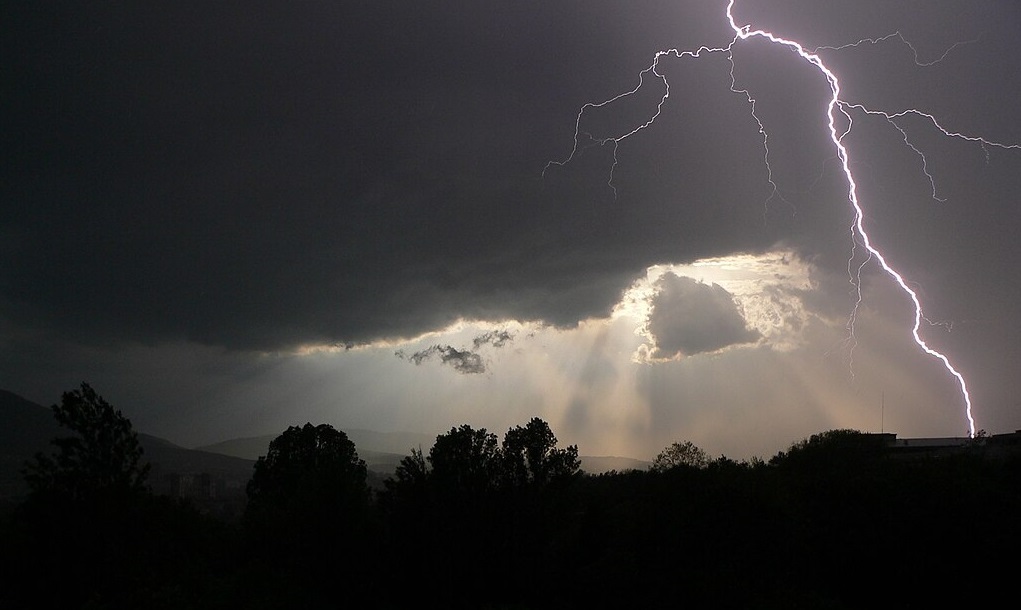
Ghost Lightning
So ominous, this strange, unsettling sight:
Sharp lightning pulses pierce the moonless sky
In silence as if Jove hurled demon-stars
At Earth. The embers streak across the night
Beyond the clouds—but mute. No blast or cry.
Could this yet be the soundless rage of Mars—
A subtle threat of deaf, perplexing wars?
I’m overwrought. Perhaps it’s just a nova—
A star exploding somewhere out in space;
Perhaps an aging satellite exploding;
An asteroid; some meteoric ova.
Or does this show how archangels embrace?
I picture them just south of Heaven floating…
But no. This pulsing sky bespeaks foreboding.
Foreboding of a wrath which transcends Earth;
A dark mood which infests these tropic nights
And then subverts how reason might explain
This mystery—its import and its worth.
It’s something like a throbbing Northern Lights
And yet more sinister, a bit less sane,
And quite divorced from wind or pounding rain.
It augurs blood—that’s perilously clear.
The sky won’t rumble, nor the clouds increase.
The wind will whisper not, nor will it roar.
Instead, there’s silence striking dread and fear.
These ghost lights are not harbingers of peace
But rather of great terror soon in store:
They speak now of the imminence of war.
In silent horror recollections start
Of London’s Blitz, the Siege of Syracuse,
Of Panipat, Antietam, Bunker Hill
And other scenes which bleed and bruise the heart
And push a fractured people now to choose:
To either fall as victim or to kill.
We all must die. But how? Upon which hill?
O, phantom lightning in a fearsome sky!
Your wizardry has cast a fiendish spell
Infusing all I see with ghastly wonder—
Phenomena viewed with a gasp and sigh
But dreadful and disturbing as red Hell.
I do not fear to hear the sound of thunder.
I pray we hear at last the sound of thunder.
Poet’s Note: In Florida, “silent lightning” or “heat lightning” is the term used to describe lightning flashes from distant thunderstorms that are too far away for the thunder to be heard. This phenomenon is not a separate type of lightning, but rather a visual effect caused by the light from distant strikes reflecting off high-altitude clouds. The thunder, being a sound wave, dissipates with distance, while the light can travel much further. Florida’s high humidity and warm temperatures contribute to frequent thunderstorms, making “heat lightning” a common sight, especially during the summer months.
Gators Gone Wild
The springs which dot the woods north of I-4
Trail southward past the Seminole casino
To join the rivers, marshes, creeks and lakes.
Then at the Gulf they somehow flow together
And lard the air with sticky, humid weather.
Ah, Tampa, Florida! That spicy place
Of guavas, Cuban bread and swaying palms;
Of fishing tackle stores and suntanned girls
In halter tops (with couture shades and shoes)
Who flirt with hombres flexing their tattoos.
This pleasure dome of clubs, golf and Spring Break
Is anything but dull. Here there’s more edge,
More spice than most New Englanders expect—
A land of beaches, yachts and butterflies,
Of pirate kitsch, cigars and key lime pies.
The tourists, drained by traffic, sun and sweat,
Find comfort floating down the lazy rivers
Or seek out film locations from Cocoon.
They then gaze east to monitor a squall
Or rocket launch from Cape Canaveral.
They say that Tampa is muy caliente—
A hundred shades of green and pastel blue,
Garbed in Bermuda shorts and hats of straw,
Ensconced with pink flamingos, rum-laced cokes,
And Spanish moss-draped antebellum oaks.
Proud cultures here collide. And nature, too.
The insects sting, the turkey vultures feed
While watched by jealous feral hogs and panthers.
But alligators have the surest nerve,
Intriguing Tampa with their primal verve.
The gator’s not the slow, ungraceful beast
You see in films set in the Everglades.
He’s fast! Velociraptor of the swamp!
He sports a leather grin. Give it no heed.
He’s trying to lure you in so he can feed.
A gator is a strange, transfixing beast
Who blends superbly with the marshy fields.
He does not roar but bellows or else snarls.
The gator sniffs and roams from his abode
To nearby ponds, the Mall, your local road.
His muscles flexed, he’ll sow his wild oats
To shake up the monotony of meals
Of frogs and fish, raccoons and river snakes.
He’ll clamber over hurricane-smashed fences
Oblivious to fear or consequences.
He’ll brandish teeth in strong Jurassic jaws,
Ignore the flow of traffic and step forth
With confidence—reptilian yet regal.
He’s heavy as an anvil, greenish-gray
And focused hard on his pursuit of prey.
He offers a charisma that’s thick-skinned,
Carnivorous and rugged in exchange
For your forgetting to secure the gate.
He’s arrogant. He knows he won’t be killed.
Like us, he simply wants to be fulfilled.
Beware! He’ll try to eat you if you’re lax!
Just let him be. He fends well for himself
And he is fierce. Admire him from afar.
Don’t rub his belly; don’t say “coochy coo,”
Or that’s the last thing you will ever do.
Brian Yapko is a retired lawyer whose poetry has appeared in over fifty journals. He is the winner of the 2023 SCP International Poetry Competition. Brian is also the author of several short stories, the science fiction novel El Nuevo Mundo and the gothic archaeological novel Bleeding Stone. He lives in Wimauma, Florida.















Brian, I do not recommend that you join the Florida Chamber of Commerce or send them your magnificent poem. I was not aware of the “silent lightning or heat lightning” that must be a tropical phenomenon. Thank you for including the note of explanation. These superbly wrought descriptive poems of creative imagery perpetuate your already vast legacy of scintillating verbal fare. I also had to really laugh at the last two lines of the second poem.
Thank you so much, Roy! I have to laugh at your Chamber of Commerce observation. You’re probably right, but I hope my love for the Florida landscape, seascape and cityscape has come through despite my being overwrought in the first poem and a bit cheeky in the second. The “coochy-coo” lines are my favorite in the second poem just because of the absurdity of getting friendly with a gator. (I’m reminded of the song “Never Smile at a Crocodile” from Disney’s “Peter Pan” from the 1950s — back in the days when Disney was actually Disney.) As for the lightning… it’s a very disturbing thing to see all of these silent flashes of light against the clouds. You don’t see lightning bolts because this is reflected light, so what you see truly looks like the distant explosions of artillery fire and missiles.
Beautifully written, Brian! I especially love the line: “He’ll brandish teeth in strong Jurassic jaws”. You’re an observer and chronicler par excellence.
Thank you, Fr. Dan! It’s great to hear from you and I’m so glad you enjoyed these poems! The “Jurassic jaws” came to me as a very lucky alliteration. Thank you for reading and commenting.
2 more pleasantly-peculiar ‘concepts’ that have likely never before been addressed in ‘Verse’, Brian – one of your many penning fortes – and this relatively challenging rhyme scheme is no easy feat. We see brief displays of ‘heat lightning’ here in Iowa from Spring to late Summer – and, like you, Connie and I find it nothing short of hypnotic. Wonderful pieces – both, and Merry Christmas & Happy Hanukkah.
Thank you so much, Mark! I love it that you think of my poetry ideas as “pleasantly-peculiar.” I rather suppose my poems do flirt with a certain oddness, but I’m just trying to find my voice and trying to be original rather than to rewrite things others have already written (and far better than I ever could.)
As for heat lightning, I’m intrigued by the fact that there is heat lightning up in Iowa! I suppose it shouldn’t be that rare, particularly for the states up in Tornado Alley (I believe Iowa qualifies…?) “Hypnotic”is exactly the word. Speaking of which, I had a really neat experience on the 4th of July this year when there were a lot of coastal storms. The rain stopped and the fireworks commenced. (There is a ridiculous amount of firework action in Florida, where they sell commercial grade fireworks at the local grocery store parking lot.) And as the fireworks exploded through the sky (in several directions) the heat lightning also pulsed throughout the sky far beyond the exploding fireworks. It looked like God Himself was joining in the celebration of our country’s independence. Well, I may have to write a poem about that.
Merry Christmas and Happy Hanukkah to you as well.
I love both of these poems, they are a pleasure to read. You have achieved the perfect mix of detailed descriptions versus brevity for my taste. In the first one I like the pondering comparisons between the natural phenomena with the ever present raging cosmic conflict between principalities and powers. It’s dynamic and engaging and it satisfies the senses all the way through until the end. In the second one I enjoy the lively descriptions of the persons, places and things of the locale. It segues into the expected description of the gators which seem to undergird and embody the culture and place like a chosen and respected mascot. Great work!
Thank you very much indeed, Yael! I’m glad you enjoyed the details of the Gator poem — gathering a list of Tampa’s quirks gave me a great deal of pleasure. As for the Ghost Lightning poem, I am glad you perceived that raging “cosmic conflict” which is “ever present.” Because it is undoubtedly here and now. There are battles to come which will surely be added to this list.
Superb writing of a very high order and so many things one could comment on, but perhaps my favourite lines are: “To either fall as victim or to kill.
We all must die. But how? Upon which hill?” The very simplicity of the rhyming, the syntax and the interrogatives create an effect that is almost sublime – and touches deep down on that which we all desperately seek to know. Wonderful stuff – love it.
Thank you so much, James! As you note, we are all desperate to know what comes next. Spiritually and politically. The UK and the USA are once again in the same boat. This time civilization itself is at stake.
“Ghost Lightning: is a wonderful example of taking a natural phenomenon and using it as entree into a larger, meditative comment. And what is particularly effective here is that the poet doesn’t make what would be the usual mistake of first describing the ghost lightning, and then following it up with a a moral exposition of what higher matters it brings to mind. That kind of didactic structure would have ruined everything. Instead, Brian mentions “wars” and gods of power and warfare right in the first stanza. Ghost lightning and the coming threat of war are intermingled and fused right from the start.
And the rest of the poem jumps directly in with talk of novas, stars, asteroids, meteors. foreboding, wrath, dark moods — and then blood, dread, terror, and the mention of sanguinary past battles. And in his last stanza, Brian hits us with a surprise: the poem has been saying “some terrible kind of war is coming,” but the final line lets us know that he WANTS it to come! And the use of “rime riche” (thunder and thunder) in the closing couplet emphasizes this shocking revelation. In the contemporary context of America’s polarization, the poem says “War is coming — BRING IT ON!”
“Gators Gone Wild” is pure Florida. I suppose most of us will remember that old “Girls Gone Wild” show from the 1990s, which was a kind of cutesy-poo teen bacchanalia set in Fort Lauderdale on spring break.
My first reaction was to think this: The poem should be broken into two separate pieces. The first six stanzas would make a lovely descriptive and cultural piece on the city of Tampa — its style, its history, its weather, its ethnic mix. The other six stanza could be a different (and just as effective) poem about alligators. As it stands now, I think the poem has a definite “fold in the middle” that is a bit awkward, but if it were made into two poems both of them would be perfect.
As Yael has said above, both of these new poems of yours are a pleasure to read.,
In “Gators Gone Wild” I see the first line of Stanza Six as an effective bridge between the contrasts.
Thank you so much, Mary, for reading, commenting and for making a very helpful critical comment. You have read the bridge that I wrote exactly as a I intended and I am grateful for your perspective here. As I said to Joe, I wanted to go from wide-angle of Tampa to close-up on the gator. Your comment makes me think the transition was at least a partial success.
Thank you very much indeed, Joe, both for your appreciation of the first poem and your critical eye on the second. With respect to Ghost Lightning, you have absolutely nailed my mindset here. War is not a desirable thing. It never has been, whether it’s Marathon or Desert Storm. But as we become adults, we learn to distinguish between our wants and our needs. War is not desirable but sometimes it is ESSENTIAL. What fool would say World War II didn’t have to be fought? Or the Revolutionary War? Or the Civil War? Well, now we are facing a new civil war and this time good and evil exist in every single state and in every country of the West and with each passing day the possibility of coexistence becomes more and more unattainable. So my feeling is, stop refusing to tear the bandage off — it will only make things worse in the long run. In other words, as you boldly but accurately phrased it, BRING IT ON!
I strongly appreciate and respect your thoughts regarding “Gators Gone Wild.” It does rather divide down the middle. I did intend for it to be in two parts — but not as two separate poes! What I intended was a cinematic technique of doing a wide angle lens on a subject — in this case, Tampa, Florida — and then slowly closing in on the “star” of the piece, the Florida alligator for his “close-up.” There are several movies which do exactly this type of wide-angle to close shot. Films that come to mind are the original West Side Story, Working Girl, Apocalypse Now and The Sound of Music. Admittedly, I’m not sure the same effect works well in poetry, but I thought I would give it a try. As it applies to Gators Gone Wild, my thinking is that the wide-angle to close-up (general to specific) is still a good idea but that I overfreighted the two sections such that the kaleidoscope of details in the first half outweighed the subsequent focus on the alligator. If I were to do this poem over again, I would still aim for that effect — the wide angle reduced to the close-up — but I would probably make the ratios more like 1/3 Tampa and 2/3 alligator. That way the focus would not seem as diffuse. That’s my thinking, anyway. I doubt that I’ll come back to this particular piece but it’s certainly something to chew on for the next time I go for this effect. Thank you for your sharp eyes on this, Joe!
I like the descriptive beginning of “Gators”. It gives the reader a feel for local ambiance and culture. Between swaying palms, suntanned girls, flamingos, and antebellum oaks, the atmosphere is one of serenity. This sets the stage for contrast and potential conflict with dangerous insects and wildlife lurking about. (My aunt, who lives in Palm Beach Gardens, recently wrote to say they were dealing with “lizards”). Then we come to the gator: “Velociraptor of the swamp”, “charisma that’s thick-skinned, Carnivorous and rugged”, and “Jurassic jaws”– definitely a terrifying scenario. The last two lines are pure gold.
Thank you so much, Cheryl! That’s definitely what I was aiming for — the general before I got to the specific — so I’m glad to hear that it worked well for you. And you’re right about the terrifying scenario. The really weird thing, though, is that when we see alligators in Florida we rarely get scared. We pull out the cameras, take pictures, post them on social media, call friends to come see. Given the damage gators are capable of — including homicide — we Floridians should really give them greater deference. They’re not cute. And yet the coochy coo line that you like (me too!) is not without foundation.
These poems really cause synesthesia, as they you can almost smell the ozone from the lightnings and the Floridian warmth and marshes. They are a true sensual record of your experience that takes no imagination for the reader to get immersed in it. All the minute details are as rich as reminding me of Zola, who of course had nothing to do with alligators or poetry but was as evocative in his descriptions.
Thank you so much, Michael! I love getting comments from you because I always end up learning something new. Now I understand the concept of synesthesia, which I’d heard of vaguely but never really gave much thought to since I’ve never experienced it. And although I know of Emile Zola, I really don’t know anything about him. Now I must do some online research to learn more about him. But even in my ignorance I am deeply flattered that my treatment of Floridian details is rich enough to remind you of a great author! Thank you for that!
Both of these poems were thrilling to read! You really captured the energy of a place that transforms a mere man into a Florida Man! Fantastic!
Thank you so much, fellow Floridian poet!!! I’m very glad that these poems resonated with you, Patricia. As for “Florida Man”, you now have me laughing. For the majority of readers who are probably unaware, “Florida Man” (a Sunshine State in-joke) is an apocryphal superhero (completely tongue-in-cheek) who is known to wrestle alligators, surf with sharks, patrol the Everglades in a zooped up golf cart wearing a Darth Vader mask or jog nude down the middle of I-75 wearing only a Disney hat. Florida Man is everywhere and nowhere. The source for this amiable fiction is, as I understand it, news story after news story which declares “Florida man wrestles feral hog,” “Florida man arrested for driving inside Walmart” — that sort of thing. Florida Man finally became a trope to describe goofy dudes who do dumb or entertaining or unusual things. Well, if I myself can’t be Florida Man, I’m honored to be in his entourage!
The entourage has a history of mystery.
Don Ponce De Leon, first Florida Man,
Doffed his regal Spanish armor
At the Fountain of Youth, for a Coppertone tan,
To dawn surf as Ron Jon, the Cocoa Beach charmer.
That’s very funny, Margaret!
You’ve approached the subject of ghost lightning with what anyone who observes it must be subconsciously thinking and feeling: this is more than just a natural phenomenon; it has to mean something — something supernatural and likely even apocalyptic, evoking “the soundless rage of Mars”, or archangels embracing. Its “fiendish spell” augurs the immanence of war.
Thank you so much for reading and commenting, Cynthia. It truly is an amazing phenomenon which was completely outside my realm of experience. I’ve lived in 7 states and Florida is the first place I’ve ever witnessed this. It truly feels supernatural. And deeply ominous.
Thanks for sharing these poems that help us understand the landscape of Florida (Never heard of that lighting phenomenon.) The last two lines in the second poem made me chuckle.
Thank you very much indeed, Paul. I’d never heard of it either nor did anyone prepare me for it when I first saw it. (One can see it most evening during the summer here during hurricane season.) I’m so pleased you found the conclusion of the second poem funny. I had great fun writing it.
Dear Brian, what a dazzling gift to a heat lightning aficionada! The experience described is very far from any of mine, which gives “Ghost Lightning” greater interest. Your pictures of the phenomenon are mere touches scattered throughout an account of terror in celestial proportions. There’s more astronomy here than weather. However, this is a Florida poem, not only because muted heat lightning is common in the state. I’m glad Mark Stellinga says he’s observed it elsewhere, because conditions should make that possible. Nonetheless, I’ve lived in a number of hot, damp, breezy locations without seeing it. But Florida has always been well supplied with both heat lightning and an unusual number of “overwrought” seniors who think the world is going to hell before their eyes. And many of them are hard of hearing, though capable of being frightened by ordinary thunder and hurricane wind forces.
It takes perceptive and expectant hearing, of course, to make silence after a lightning bolt as apocalyptic as it becomes in this poem. You combine the lack of sound with imagination and memory for an extreme emotional effect. Memory of history is evident in the listed battles. Spirit lifts imagination beyond history through myth into thoughts of an angelic embrace–but even that potential sign of peace cannot conquer the foreboding continually expressed. The prayer to hear in your final line reminds me of the desperation that happens when sense experience cannot be had. I’m sorry to say I know of one fatal heart attack brought on by what appeared to be latter signs of hearing loss. That psychological dread doesn’t usually go with seeing heat lightning, but you, Brian, imagine how it could. Hearing the worst would be better.
I admire the stanza choice and your use of the potential in abcabcc. It supplies a strong couplet conclusion often well used in English (in ababbcc rhyme royal) to space portions of longer narratives. In this lyric, you’ve varied views and breath to create a dramatic movement from beginning to end of the poem. I’d say the six seven-line stanzas come off approximately as 5 + 2, 5 + 2, 4 + 3, 4 + 3, 6 + 1, and 1 + 4 + 2. The couplet gets used, gets lost, and comes back resoundingly.
In my very small collection of Florida poetry books, I think I remember heat lightning being mentioned, but not as the topic of a poem. Your “Ghost Lightning” launches imagination and emotion far into space, but I remain enchanted by the splendid Floridian grounding.
Thank you so much, Margaret, for your thoughts on this poem as well as your native Floridian experience! I suspected this might be a phenomenon you would have encountered at some point when you lived here and you are so right: Florida is well-supplied with lightning (both the regular kind and heat) as well as a surfeit of overwrought seniors.
Your sad story concerning psychological trauma associated with hearing loss is interesting in the context of this poem. It is a very disturbing thing to have one’s senses diminish. I myself have some hearing loss and that probably informs the anxiety-aspect of the piece. I imagine one of the “overwrought” aspects of the poem here is the sense of omission — the idea that something SHOULD be there but isn’t. That absence can create its own foreboding. It is rather similar to being in the eye of a hurricane knowing that there should be massive wind and storm noise all about but all you hear is… silence. There’s something primal at work in the mind at such times, even as when we see the sun disappear during the course of a total eclipse. One knows intellectually exactly what is happening and yet one feels butterflies in the stomach.
Thank you for your generous comments and for giving me something interesting to chew on.
A lovely pair of poems that warmed me up amid snowy December. “Ghost Lightning” is a real tour-de-force, taking us from a vivid description of the eerie phenomenon to another realm entirely, casting it as a presage of doom. The final couplet begs to hear the thunder, desperate for a sense of reality that will not come. There is something more at play there than mere meteorological effect; the preternatural (and indeed supernatural) come into play (for a subject that all but demands it).
“Gators Gone Wild” is a lovely atmospheric piece that paints a picture of the Bay Area for me (pastel colors and Bermuda shorts — so true!). The poem, though, fixes on its title, and we get an ode to the Florida Gator, the “velociraptor of the swamp,” as you accurately call it. You have given me a Florida vacation without ever having to leave my computer.
Adam, I’m so pleased that you liked these poems! You are entirely right about the preternatural/supernatural aspects of Ghost Lightning and the anxious awareness of the speaker that so much more is happening than he can grasp. He fears the worst — and yet the worst may not really be the worst. A “desperate sense of reality” puts it as well as I could hope.
On Gators Gone Wild, I’m delighted that I got to give you a virtual Florida vacation! When you take a real one down this way, let me know! I’ll buy you some key lime pie.
One cannot merely read your poetry, Brian; you create multi-sensory experiences. I don’t just see the words; I hear the music. During my second reading of “Ghost Lightening”, I YouTubed Holst’s: “The Planets, ‘Mars’ Bringer of War”. His music was the perfect background for your word-painting, which also led me to ponder Oksana Koneva’s moody lightening oil painting. Thank you for the brilliant ‘hat-trick’!
Upon reading “Gators Gone Wild”, visions of Singer Sargent’s “Muddy Alligators” “danced through my head” as I recalled experiencing my first sighting with you and Jerry last year. Ol’ Bruce and his son often visit my backyard pond; If I’d read your poem in 2023, I might not have moved here! “Gators Gone Wild” also brought to mind (and ear) Disney’s Louis, the trumpet-playing alligator in “The Princess and the Frog”, as well as Capt. Hook, who never “coochy-cooed” twice, I’ll bet! “Gators” should be required reading for any newbies to Florida. Again, Brian, a trifecta!
Thank you so much, Laura! I’m thrilled that Ghost Lightning brought you into a mental space of desiring to listen to Holst. I’ll have to look up Oksana Koneva with whom I am unfamiliar. A multi-sensory experience sounds like the ideal way to appreciate poetry!
As for Gators Gone Wild being required reading for future Floridians… I appreciate the thought. There are a lot of YouTube videos out there that show alligators crashing into people’s homes, eating people’s pets and causing all kinds of mayhem. Florida is reputed to have over 1,300,000 alligators and they seem to live in every body of fresh water. And since most communites have retention ponds, most communities also seem to have their resident Alvin the Alligator or, as you mention in your community, “Ol’ Bruce.”
I have seen ghost lightning, and I have seen ghost rain (virga), but has anyone ever heard ghost thunder?
As much as alligators would like to eat us and/or our pets, they should bear in whatever mind they have that they, too, can be eaten or turned into shoes and handbags. I wonder whether Brian has seen that reptile on the menu anywhere down his way, and especially whether he has ever ordered it.
Thank you for reading and commenting, Kip. Have I seen alligator on the menu? You bet, in almost every restaurant that’s not a chain restaurant. Alligator bites. Alligator poor boys. Alligator tacos. Alligator stir-fry. I’ve only ever dared to eat it once. Tastes like gamey chicken. And its definitely not kosher.
All in all, this is how the game is played.