


.
This poetry challenge comes from poet Roy E. Peterson: Provide a poem about your inspiring Muse. If you name a Muse, put it in a poet’s note at the bottom of your poem. If it is someone living, you need not reveal their name. For those who do not claim a Muse inspires them, you may write on mythical, historical, spiritual, or religious Muses who have inspired others. Post yours in the comments section below.
Here is my example:
.
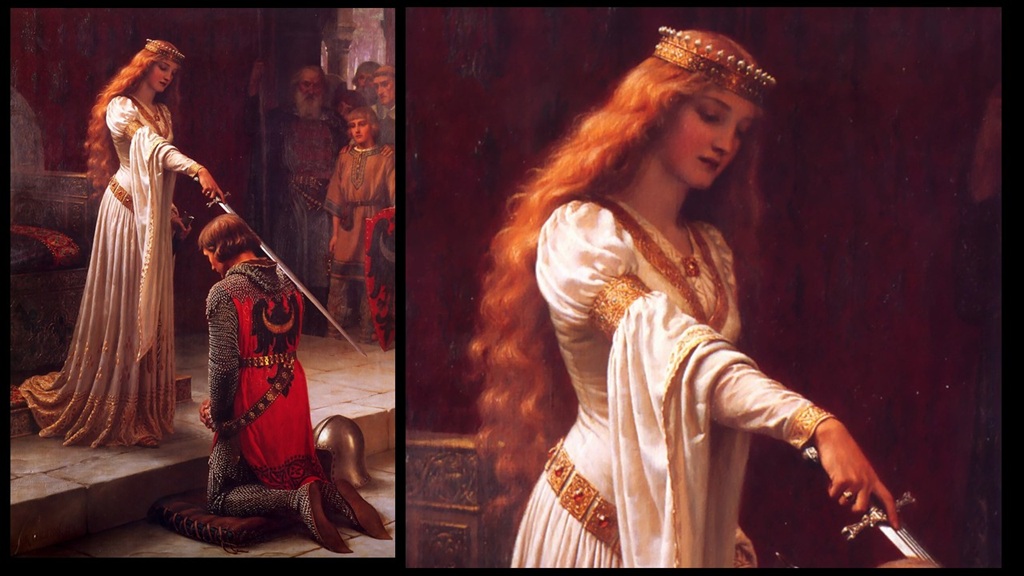
My Lady of Light
by Roy E. Peterson
I kneel down before my Lady of Light.
Her accolades shower my shoulders with praise.
No more in the dark woods shall wander this Knight.
The touch of her sword my honor repays.
A true heart by heaven has never been blessed
By just such an angel to love and adore.
The rose that I gave, to her bosom she pressed;
Fealty forever to her I have sworn.
My mission is, as a Knight-errant, to love,
Protect, and defend my Lady of Light,
To fight in the duels she would be proud of.
With sword strokes of justice, great evil I’ll smite.
Till Elysian Plains are brought into my view,
I’ll always be Champion, Knight-errant of you.
.
Poet’s Note: My Muse is married to another person and lives in Dallas, Texas. We were close at our university. We have shared our secret love. I have an entire poetry book, “My Lady of Light Awaits Her Knight,” dedicated to her from which this poem was taken.
.
Post yours in the comments section below.
.










Dear Calliope
Calliope, my dear old friend,
I write you in despair
The numerous works that I have penned
Are hardly standard fare
No, I have grandeur, I have style
My works are epic, pure
And yet denial after denial
Have rendered me obscure
I hardly seek bestseller fame
Or Hollywood awards
But they reject, with notes of “lame”
They use not pens, but swords
These hurt my feelings but I keep
Inscribing what I feel
I persevere and do not weep
I know my stuff is real
Calliope, you know my plight
So help me with my craft
I’m striving only to delight
So I include my draft
And in a SASE envelope
No postage, free of charge
So mark it up and give me hope
I wish to be writ large
Arthur, your words resound with sincerity and a perfect plea that we all have experienced of rejection. This is a great poem that demonstrates your deft poetic skills that certainly are immense. Bringing Calliope into the present by sending a metaphorical letter is enchanting and winsome.
thx Roy!
No… I Will Not Loan You My Muse!
You’re gazing through your windows though not seeing what is there – and often cursing barren sheets of paper, terrified –
Worried how depleted you’re reserve of ‘subjects’ is – afraid your muse has either lost her touch or – even died!
It’s seemingly more difficult to conjure up a purpose adequately meaningful to justify the ‘cause’,
And… struggling far too frequently to find the proper words… you wonder if the reason why is more than just a pause!
Mine has never left my side for more than 60 years, helping me to prune the truths I’m trying to convey,
And each collaboration has produced a piece of verse that says precisely what it was we meant for it to say!
That, for me, is proof enough that penning without muses does leave poets stranded far more often than does not –
But loaning you the one I have – even for a second – isn’t gonna happen — she’s the only one I’ve got!
Mark, I am overwhelmed by such a great poem in tribute to your Muse who has inspired you for so long and your insistence that you will never even consider loaning your Muse. There is both levity and sincerity in your poem that you have conveyed to us. I love how you phrased the collaboration and the conclusion.
Mark, What is your school of writing? A spirited manifesto!
What an entertaining fantastic poem about what must be the most unusual Muse in history! This is a great beginning to the challenge and an amazing tribute with your usual unassailable alliteration and imaginative imagery.
Coincidentally, I just penned this ‘Musie’ one yesterday, Roy – pardon my excess punctuation, I rely on it to help me better read my works at recitals. 🙂
Cool challenge –
This Is Our Final Poem!
My Muse has all but ruined my life! That ornery little shithead far too often woke me with some random word or phrase
At anywhere from 2 a.m. to 4 or 5 – abruptly – and, like a fool I’d stagger to my office – in a daze –
Grab a piece of paper and record her damn suggestion – knowing I’d forget it if I’d opt to disobey –
Then stumble back to lie awake, aware her ‘interruption’ would guarantee a – had-a-bad-night’s-sleep-ish sorta day.
Fortunately those after-midnight now-n-then ‘disturbances’ have fostered, for the most part, what are good to super poems
Which — off-n-on for 60 years have helped me fill the pages of a couple dozen – for the most part – briskly selling tomes!
Nevertheless, at 95, I badly need my sleep, so… despite a Muse — a genuine Muse — is said to never age —
This piece here’s the last one we’re submitting as – a ‘Team’, and represents, for her an’ I, our last book’s final page!
Mark, what a fantastic continuation of your exotic poem that resonates with me though not with the negative thoughts which are turned on their head by your appreciation for the Muse having invaded your sleep. In my book, “Lady of Light,” are many poems inspired by my Muse after midnight. In fact, I provided a list in an appendix of 13 dreams I had of my Muse. Since I knew my Muse personally, I also have an appendix containing all the things she liked from food to golden oldies.
The Desktop Muse
The dealer droned on despite my frown,
then I noticed her, hunched and gravel, kept
on a cluttered shop floor long unswept,
Greek beauty callously marked down.
Suffering divinity looked on me then.
Her iced eyes thawed to sparkling when
I cleansed her brow with religious care
and placed her to reign on my desktop. There
her sunlit face shines coldly bright,
a Mona Lisa in sculpted white,
but under a cloud-crossed moon by night
she dances in waves of milky light,
lunar passions her morning features hide.
Yet the smile dawning over my midnight phrase!
As if love for a mind still trapped inside
devolves like grace on one who prays.
(Poet’s Note: Muse’s name withheld by request.)
Carey, what a beautiful breathtaking find and tribute for the physical presence of your Muse on your desktop. How you found your “suffering divinity” and then restored her beauty is a great story and fascinated me in part because I have a desktop goddess in bronze as part of a desk set with inkwells.
While I’m contemplating:
A muse is just like writers’ block,
Existence of such is a crock.
No cat, dog or beau
Can make the words flow –
Your main inspiration’s the clock.
I had to laugh at your initial contemplation; however, from my first poem as an example, I have been inspired and encouraged by one I regard as having the qualities of a Muse. I noted your second contribution and will respond to it, as well.
And less cynically:
My muse is the Sun and the Moon,
A beautiful song or a tune.
And oh, what a feast,
Each plant and each beast,
And mountain and sea Earth hath hewn.
Paul, the sun and moon can indeed inspire us to write poetry not only about them, but also about other fantasies such as nature, love, romance, and the list goes on. I appreciate your points of view and contributions.
Here’s a song about the best-beloved doing her work – a series of watercolours of living individuals of all Canadian herpetofauna (the verse about myself supposedly working as hard as she does was inserted by her): REGINA SEPTEMVITTATA (10 Sept. 1986. Bishops Mills & Cartier, Ontario; This is the story of the painting of Regina septemvittata, the Queen Snake, for Francis Cook’s ‘Amphibians & Reptiles of Canada,’ just after we returned from the transCanada Fragile Inheritance trip, on which our daughter Jennifer was conceived & born; based on Stan Rogers The Field Behind the Plow. The Mimp was our daughter Elsa, killed by a car in 1985, and the Simple Native was our brother Paul, also road-killed in 1977.
Watch the snake behind the brush stand up on the page
You can almost see it crawl, but you’ve got to do it all.
Pencil scales and paint the eye, but your tea is cold
And the CBC is playing rock and roll.
And it figures that the child wants to get up now,
She can sleep for hours while you are busy on the phone,
But perhaps she’ll settle down, every keel’s a gain,
And there’s victory in every row of scales.
And so Frederick walks the floor,
His frogs and bones and writing left alone,
Gave it up to put her down,
Read to you all afternoon.
But it’s not the book he’d read if he could choose,
It’s nothing he can use,
As he works as hard as you.
Poke your model in the side, No, he can’t stay there,
He has got to turn around, show that little patch of brown,
You can just paint what you see, but you wish he’d feed
And you wonder how those rows fold as he turns.
Half an hour, at the news, you’ll be stiff and cold
Get the baby up to nurse, put some supper on the stove,
And watch the snake behind the brush stand up on the page,
Bind another species’ spirit to your own.
If the Mimp were still alive
She might be reading C.S. Lewis now,
Get you up to exercise, microwave some Ovaltine.
And the Simple Native might
Be drawing Grasses in the Amazon.
You’ve lost so much you love, or they’re California-bound.
For the good times come and go, but at least you’re home
So this won’t be left half done as you head on down the road,
So watch the snake behind the brush stand up on the page,
Bind another species’ spirit to your own.
Watch the snake behind the brush stand up on the page,
Bind another species’ spirit to your own.
Fred, so sad to read of your personal losses, but a precious tribute to the artistic talents of Regina and to her as your unspoken, but intimated Muse. Thank you for sharing.
There’s only one job for your Muse —
She rouses you out of a snooze,
Makes you get off your ass,
Pump your brain full of gas,
And write stuff that’s bound to amuse.
Dr. Salemi, what a funny take on the job of a Muse. Sometimes mental images of my Muse inspired me to write on a broad range of topics including humor. You are so right about when Muses seem to appear or at least are remembered. I usually have mental images and dreams of my Muse from my university days with exact colors of dresses, blouses, and skirts she wore. I plan to add much more on Muses later.
Dr. Salemi and James Sale: Since both of you are scholars of poetry and of Dante, here is a poem I wrote about Dante’s Muse.
DANTE’S MUSE WAS BEATRICE.
By Roy E. Peterson
Poets pursue a passion
they find hard to conceal.
Their idealistic lover
whom they idolize with zeal.
One who sets their heart on fire;
one whom they yearn for;
One whom they profess
will be their lover evermore.
Take the case of Dante,
who fell in love with Beatrice.
Though they only met twice,
he dreamed of lover’s bliss.
The first time they met,
he was nine and she was eight.
As young adults, they met again,
through a quirk of fate.
Both of them were walking
on a Florence Street.
When she turned and greeted him,
she swept him off his feet.
They never got together
for love’s conjugation
The emerald-eyed beauty though,
became his inspiration.
Tragically Beatrice died
at the age of twenty-four.
He never saw the object
of his affection anymore.
Dante wrote about her
in his poetry you will find.
After all, she became
“the glorious lady of my mind.”
“She is my beatitude,
the destroyer of all vice
And the queen of virtue,
salvation,” though met twice.
Now you know how Muses
play upon imagination.
They become the fountainhead
We call inspiration.
When you’ve paid all your poetry dues,
It’s important to follow your muse.
Be careful of diction
Remember, it’s fiction
Or you just might end up in the News!
I love your inventive and humorous poem, Mike. This is a perfect contribution.
Dear Susan, your first one was so much fun, but I love so much your great Sonnet with the ghost of Dylan, the balladeer, one who’s lyrics and music are magic. I can imagine you writing while listening to his music and I take your “hail of hiccups from the shore” as a self-deprecating inference that further endears your poem and makes its own magic.
Let Me Tell You about Her
She opens up my eyes to see beyond
The suffering that’s present here on earth.
She lets me hear Creation’s song of mirth,
And feel the mercies fresh that come at dawn.
I’ve walked the road of hopelessness alone;
I’ve failed in ways I never thought I could.
But then my muse appeared; I understood.
Her light upon my path in beauty shone.
She’s taught me much of goodness, truth, and love,
By her gentle hands I’m often fed
Amazing feasts of honey, wine and bread.
She reminds me, “Keep your sights above.”
And though I’ve yet to meet her face to face,
She is my sister, Father’s daughter, Grace.
Gigi, what an intriguing sonnet that begs the question of how she does all this for you while never having met Grace face to face. I presume, though, you have been able to be in contact with her by modern communication methods to include social media. From your beautiful thoughts of her, she seems to be a copy of you.
There I go again, being too vague.
My earth born sister is an amazing person, but my muse, Grace, is the grace of God – a creation of His, as am I, thus my sister, in a sense.
Bless you for the clarification. I can understand your adoption of the “Grace” of God as a Muse-like entity. In any event, from your wonderful poetry, you have all the attributes of Grace/grace.
For the Society Of Classical Poets
Although my muse is one,
She is made of many parts
That are scattered far and wide
And yet she is always by my side.
I am enticed with delectable fare
That inspire me to type and to thrive
And take excellence too in my stride.
Alas, this wonderful muse always strives
But I let her down again and again
But bless her , she never gives up,
For her mission is carved in her heart,
Poetry and beauty in life are a must.
Maria, that seems like you have found a wonderful Muse, since “she never gives up,” or did your Muse find you? Your poem gives rise to so many possibilities, especially with the “delectable fare,” which makes me think of some food product(s). Thank you for your contribution and your heartfelt expression, “Poetry and beauty in life are a must.”
I was thinking of the SCP when I wrote it.
The challenges always inspire me as well as reading the wonderful poems published{delectable fare}. It is a great site for learning about classical poetry and much more.
What better muse {one, but made of many parts} does one need?! Thank you for the challenge and your evident love and support of SCP.
I think the muse deserted me on the last line:
She rattles your brain, dusts it off,
She makes you perk up with hee cough.
You’re soon feeling swell,
And drink from her well
Like pigs with their snouts in a trough.
Your Muse must have deserted you by the last line on this one. Your Muse would never approve of the “pigs” simile. I will have to add a poem or two about the desertion of a Muse.
WHEN MY MUSE WON’T APPEAR
By Roy E. Peterson
Indigo skies. Cobalt curtains come down.
Hail and tornadoes are scarring the ground;
Electric lightning sends daggers of dearth;
Thunder to silence the meek of the earth.
Batten the hatches; close up the cellars.
Mimic ancestors; ancient cave dwellers.
Wind shaking trees in a frenzied display.
Rain falling like bullets, won’t go away.
That’s how I feel when my Muse won’t appear;
Trembling insatiably. Doom must be near.
Faith, hope, and love are drowned in the flash flood.
Something is slowing the flow of my blood.
Heaven is lost. I have no where to turn
Until the face of my Muse I discern.
Then glorious rhapsodies I will sing.
When the storm passes, I have everything.
I’ve sometimes noticed a similar phenomenon with reading poetry. I’ll read through a poem on the site, not be impressed, but later realise I as reading in entirely the wrong mood. Later, on a second reading, I discover an absolute gem .
GREEK MUSES MUST HAVE DISAPPEARED.
By Roy E. Peterson (July 20, 2024)
The nine Muses have been called, “The Daughters of Wit and Charm,”
Born of Zeus and Mnemosyne to cause none any harm.
After all of the Greek poets that I consider great,
The Muses must have turned their heads and left them to their fate.
Each Muse represented their distinct literary bent–
For history, dance and music and poetry were sent.
When they were called upon, then to the writers they appeared.
But after anno domino, they must have disappeared.
Of all the early Greek poets before year 1 AD,
Homer was the greatest with his Muse goddesses in play.
There were dozens more who would often call upon their Muse.
In the modern era they Greek Muses fell into disuse.
In the Middle Ages, pretty women, poets would choose
For their inspiration and they would call them their own Muse.
Beatrice was Dante’s Muse who would mingle in his mind
Since the childhood age of nine who had left Dante behind.
In the modern era, Muses will still inspire men.
They think of them as goddesses just as they did back then.
When I am feeling lonely as I try to think and write,
I turn to my special Muse I call, “My Lady of Light.”
Poet Note
The last of the great Greek poets is listed as Quintas Smyrmaeous
in the fourth century. He wrote an epic poem, “Posthomerica.”
MY MUSE HAS RETURNED TO ME
By Roy E. Peterson
My Muse returned again to me after three long years;
After trials and tribulations, my doubts, and my fears.
Ailments happened to her that affected how I write.
My Muse has returned to me. She’s my Lady of Light.
I finished up a book of poems that was haunting me.
My Muse helped me write again composing poetry.
In one week I wrote sixty poems. Oh, what ecstasy.
I pray she will stay with me. She is my destiny.
MUSES ARE SO HARD TO COME BY
By Roy E. Peterson
Poets, and singers, and artists need Muses
To write, and to sing, and to paint.
A perfect ideal who whispers to them
Like a penitent talks to a saint.
I feel like a sculptor when writing a poem,
An image I have in my head.
The rest of the poem is still an unknown
I don’t know what lies ahead.
I think of my Muse who waits silently
For me to summon her image.
Then my fingers fly as I write and I write.
What I write I will read at the finish.
Muses are so hard to come by these days,
Who inspire what poets will do,
A model who lives in our innermost soul.
Thank heaven that I found you.
“MUSES ARE SO HARD TO COME BY” is certainly one of my favorites in this excellent thread! The first stanza along just blows me away!
Bless you, Paul, for your wonderful comment!
I thought I might give a brief look at the Greek Muses and those of some famous poets.
Greek Muse Origins:
The Society of Classical Poets Survey revealed 44.1% of respondents said they relied on a Muse at least some of the time, whether that Muse was a living or dead one, spiritual or religious, a fantasy, and/or mythological figure.
The three original Greek Muses were: 1.) Melete: the Muse of study and practice. 2.) Mneme: the Muse of remembrance and memory. 3.) Aoide: the Muse of song.
The ancient Greek poet, Hesiod, expanded the three original Muses to nine: Calliope, Clio, Erato, Euterpe, Melpomene, Polyhymnia, Terpsichore, Thalia, and Urania.
Famous Poets and Their Muses:
1. Edgar Allan Poe’s wife, Virginia Clemm, was also his Muse.
2. William Shakespeare and his Dark Lady.
3. John Keats fiancée, Fanny Brawne, although the relationship was tumultuous and he also included nature.
4. W.B. Yeats had a complex relationship with his Muse, Maud Gonne. Maud was an Irish revolutionary, feminist, and actress.
5. Dante Alighieri’s Muse was Beatrice di Folco Portinari (Met her as a young boy and saw her once in their twenties.).
6. Percy Bysshe Shelley and Mary Wollstonecraft (He left his first wife for her).
7. Lord Byron’s poem, “She Walks in Beauty” was inspired by Mrs. Anne Beatrix Wilmot, his Muse and wife of his first cousin. He also wrote “Farewell to the Muse.”
8. Robert Burns took Coila (Coilus) as a stated Muse from Coilus or Coel Hen, who was a King of the Picts. In his poem, ‘The Vision” the reference to Coilus is: “Coila my name; and this district as mine I claim.”
9. Oscar Wilde’s Muse was Sarah Bernhardt, the most acclaimed actress of her day, and an exceptionally accomplished sculptor who exhibited in Paris, London, New York, Philadelphia, and Chicago.
10. Some writers who mentioned Greek Muses collectively or individually: Homer, Virgil, Petrarch, Edmund Spenser, John Milton, William Wordsworth, W.H. Auden, Sylvia Plath.
Pretty durn good.
Edward Hayes
As yet unpublished. No real muse. Not amusing.
I have written two Muse poems to date, both for the same Muse. Here is the first:
My Muse Can Beat Up Your Muse
My muse can beat up yours – don’t even try her.
She’s armed with wit and sense and holy fire.
Unparalleled in her alacrity,
She will not sanction mediocrity.
Her frightening aesthetic probity
Eschews the common for the rarity.
At home with pen or brush, with harp or lyre,
Her beauty doth continually inspire.
Your muse, I’m sad to say, is often slow.
She’s tardy to arrive, but quick to go.
Your muse plants only barren things and plain
Within the convolutions of your brain.
While my muse grants me victory again,
You cannot yet complete your first quatrain.
Your paper fallow, not a word will grow.
Your pen will never reap if she won’t sow.
But let us pass from talking of her ways,
And turn again my worthy muse to praise.
In speed and grace she never fails to please,
Likewise in balancing asymmetries.
To discipline and form she holds the keys.
Yet wild she is, untamed as any breeze.
I will not fail to heed her piercing gaze,
Nor fail to thank God for her all my days.
© 2010, Paul Erlandson
(This was written for one of my art models.)
Paul, you had my attention with the title, and the poem was magnificent. What a great tribute to a Muse! I identified in particular with the closing line, “Nor fail to thank God for her all my days.” That is how I feel about my Muse.
Your relationship to your Muse sounds super interesting!
That first poem was “How it started …” The second one is “How it’s going …”
My Muse Has Left Me Desolate
“… and it was ordained by angels in the hand of a mediator.” – Galatians 3:19
My Muse has left me desolate this year.
October, not a single word from her.
My brush will hold no paint, my pen won’t stir,
And I sit trapped in uninspired fear.
Some friend will murmur to me (as a curse):
“No guide but Christ, and no Muse but the Church!”
But God through intermediaries works,
And all who say such things write rotten verse.
When God passed down His holy Law it came
Ordained by angels and through Moses’ hands.
Return, my Muse! Release me from these bands,
And mediate God’s poems to me the same.
Come home, my holy angel, heed my call.
Return to me, thou “Moses” of my verse.
All other Muses make my writing worse.
I need your kindly succor, lest I fall.
Perhaps some other poet has you now,
And some more agile painter hears your voice.
Abandon them! Come, make my heart rejoice:
Renew with me our old, truehearted vow.
And then shall heart, hand, pen feel no restraint.
Once more I’ll gladly follow; you shall lead.
The finger-graven tablets you shall read,
And I shall sing and write and dance and paint.
© 2013. Paul Erlandson
(Written for the same Muse as the first of my two poems.)
The intensity and love for your Muse is enchanting and entrancing. Both poems are great tributes that speak to the heart. Paul, such wonderful poetry and sincere blessings for those of us who are privileged to read them.
Thanks so much, Roy, for the kind words!