• Submit Poetry
  • Support SCP
  • About Us
  • Members
  • Join
Saturday, August 8, 2026
Society of Classical Poets
  • Poems
    • Beauty
    • Culture
    • Satire
    • Humor
    • Children’s
    • Art
    • Ekphrastic
    • Epic
    • Epigrams and Proverbs
    • Human Rights in China
    • Music
    • Performing Arts
    • Riddles
    • Science
    • Song Lyrics
    • The Environment
    • The Raven
    • Found Poems
    • High School Poets
    • Terrorism
    • Covid-19
  • Poetry Forms
    • Sonnet
    • Haiku
    • Limerick
    • Villanelle
    • Rondeau
    • Pantoum
    • Sestina
    • Triolet
    • Acrostic
    • Alexandroid
    • Alliterative
    • Blank Verse
    • Chant Royal
    • Clerihew
    • Rhupunt
    • Rondeau Redoublé
    • Rondel
    • Rubaiyat
    • Sapphic Verse
    • Shape Poems
    • Terza Rima
  • Great Poets
    • Geoffrey Chaucer
    • Emily Dickinson
    • Homer
    • Henry Wadsworth Longfellow
    • Dante Alighieri
    • John Keats
    • John Milton
    • Edgar Allan Poe
    • William Shakespeare
    • William Wordsworth
    • William Blake
    • Robert Frost
  • Love Poems
  • Contests
  • SCP Academy
    • Educational
    • Teaching Classical Poetry—A Guide for Educators
    • Poetry Forms
    • The SCP Journal
    • Books
No Result
View All Result
Society of Classical Poets
  • Poems
    • Beauty
    • Culture
    • Satire
    • Humor
    • Children’s
    • Art
    • Ekphrastic
    • Epic
    • Epigrams and Proverbs
    • Human Rights in China
    • Music
    • Performing Arts
    • Riddles
    • Science
    • Song Lyrics
    • The Environment
    • The Raven
    • Found Poems
    • High School Poets
    • Terrorism
    • Covid-19
  • Poetry Forms
    • Sonnet
    • Haiku
    • Limerick
    • Villanelle
    • Rondeau
    • Pantoum
    • Sestina
    • Triolet
    • Acrostic
    • Alexandroid
    • Alliterative
    • Blank Verse
    • Chant Royal
    • Clerihew
    • Rhupunt
    • Rondeau Redoublé
    • Rondel
    • Rubaiyat
    • Sapphic Verse
    • Shape Poems
    • Terza Rima
  • Great Poets
    • Geoffrey Chaucer
    • Emily Dickinson
    • Homer
    • Henry Wadsworth Longfellow
    • Dante Alighieri
    • John Keats
    • John Milton
    • Edgar Allan Poe
    • William Shakespeare
    • William Wordsworth
    • William Blake
    • Robert Frost
  • Love Poems
  • Contests
  • SCP Academy
    • Educational
    • Teaching Classical Poetry—A Guide for Educators
    • Poetry Forms
    • The SCP Journal
    • Books
No Result
View All Result
Society of Classical Poets
No Result
View All Result
Home Poetry Culture

‘The Maze’: A Poem by Pamela Ruggiero

July 25, 2024
in Culture, Poetry
A A
13
poems 'The Maze': A Poem by Pamela Ruggiero

.

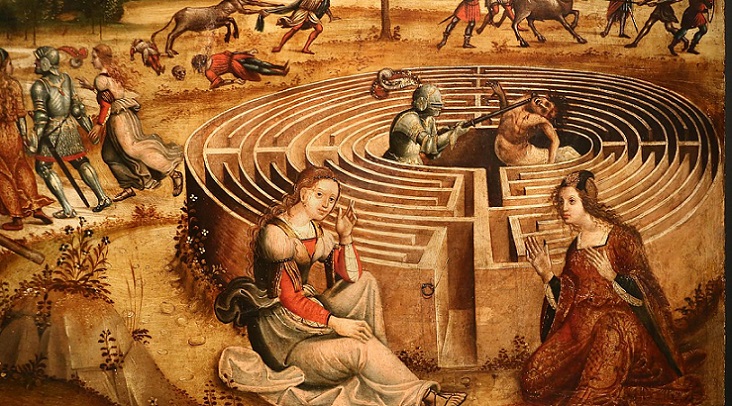
The Maze

Her little game of make believe
has turned into a nightmare maze.
Her tears have spilled upon her sleeve
while empty eyes have lost their gaze.

Her maze is very hard to beat;
The mice go round and round and round.
Not one of them admits defeat
though exit doors have not been found.

Deciding something must be done
she wanders to the entrance gate.
Although her instincts say to run,
she knows she can’t afford to wait.

She steps inside and seeks a clue.
Her sniffles make it hard to hear.
Her feet seem stuck as if to glue.
Inside her throat she’s tasting fear.

She finds a lamp to guide her way,
then runs and stumbles through the cells.
Her mind begins to hope and pray
until she hears the sound of bells.

She’s through the maze and at the end
but she has wandered too far out.
The exit’s closed and will not bend.
She won’t return; there’s not a doubt.

Her nightmare maze has claimed her life.
If only she had told things true
Instead she’s told a maze of lies
And so her maze just grew and grew.

.

.

Pamela Ruggiero was born in Urbana, Illinois in 1952. She currently resides in Antioch, California.
She was a software engineer and did consultation work in IT. She also played tournament chess at a high level and did oil paintings. She’s now retired.


ShareTweetPin
The Society of Classical Poets does not endorse any views expressed in individual poems or commentary.
Read Our Comments Policy Here

RandomPoems

‘Beneath an Iron Hand’: A Poem for Iranians, by Dusty Grein
Poetry

‘Beneath an Iron Hand’: A Poem for Iranians, by Dusty Grein

March 16, 2026

Beneath an Iron Hand Though they spent years beneath an iron hand, the quiet people still knew how to sing...

‘CCP Members in World Organizations’ by Damian Robin
Culture

‘CCP Members in World Organizations’ by Damian Robin

July 20, 2021

. in reference to an Epoch Times' exposé We’re in the loop, we’re up the sleeve, we’re near the Party’s...

Next Post
‘Summertime’: A Poem and Photo by James A. Tweedie

'Summertime': A Poem and Photo by James A. Tweedie

‘Men Sail Out’: A Poem by Michael Charles Maibach

'Men Sail Out': A Poem by Michael Charles Maibach

‘The “La Vache Qui Rit” Candidate’: A Poem by Joseph S. Salemi

'The “La Vache Qui Rit” Candidate': A Poem by Joseph S. Salemi

Comments 13

  1. Roy Eugene Peterson says:
    2 years ago

    Pamela, that is a first-rate poem on the maze of lies. Keeping the type of maze until the end greatly enhanced the entire poem and kept me guessing. You have such creative and imaginative thoughts innate in this superb poem.

    Reply
    • Pamela Ruggiero says:
      2 years ago

      Thank you so much, Roy. Your words mean a lot to me and I appreciate you

      Reply
  2. Margaret Coats says:
    2 years ago

    Your poem, Pamela, gives the reader a feeling of being lost. In accord with its topic, you don’t reveal the full truth about the maze until the end–where there is no possibility of the protagonist’s return and correction. Things go step by step. The maze created by her has defeated the mice who keep running but can’t escape. It’s a bit of a surprise that she herself would want to enter (to release the mice?), and a greater one that she gets out. But how? At the end, when the maze has claimed her life, those bells last heard seem to have been her funeral bells. It’s a good thing you chose a third-person narrator for this eerie and suspenseful story!

    Reply
    • Pamela Ruggiero says:
      2 years ago

      Thank you so much for your wonderful comments I appreciate you

      Reply
    • Pamela Ruggiero says:
      2 years ago

      Thank you so much, Margaret for these wonderful comments and ideas. I appreciate you.

      Reply
  3. C.B. Anderson says:
    2 years ago

    The writer has pointed her antennae in the right direction, for which every reader should be grateful.

    Reply
    • Pamela Ruggiero says:
      2 years ago

      Thank you so much. I appreciate you

      Reply
  4. Shamik Banerjee says:
    2 years ago

    After my first read, I read the poem again with the end in mind and noticed how each instance foreshadowed the conclusion. For example, the perpetual cycle of the mice (lies lead to lies), the lump of fear, the state of being stuck, the closed exit door, and her demise (I am not sure if that’s her actual death or spiritual death). It’s a thought-provoking piece. Well done, Pamela.

    Reply
    • Pamela Ruggiero says:
      2 years ago

      Thank you so much. Your words meant a lot to me. I appreciate you.

      Reply
  5. Lannie David Brockstein says:
    2 years ago

    Pamela, I suppose that Sigmund Freud, were he living in today’s day and age, would have a veritable field day interpreting the moral of your excellent “The Maze” poem as a female version of “The Adventures of Pinocchio” fairy tale.

    One of the reasons that some truthtellers do not lie is because, as your poem basically mentions, it soon becomes impossible for any liar to keep their story straight, whereby it is easy for others to discern their lack of truthfulness.

    But what happens when an A.I. robot that has a much higher brainpower capacity than any human has decided to lie, and can get away with it because it has the brainpower to keep its story straight, even though its story is based on a false narrative?

    Would it surprise anybody in their right mind if military grade A.I. technology is decades ahead of the commercial grade versions such as ChatGPT, and that the demented narratives of the Left supremacists are actually being written by a military grade A.I. robot?

    Is that why the USA’s Demented Party politicians, along with their equivalents in Canada and many other countries, are always being updated in real time with perfectly scripted answers that are demented but nonetheless consistent with their progressively wacko Left supremacist narratives, whenever they reply to the softball questions of the mainstream media? Is that why they always have nothing to say when asked hardball questions by the independent media?

    Thank you Pamela, for having helped to shine a light on the practice of lying.

    From Lannie.

    Reply
    • Pamela Ruggiero says:
      2 years ago

      Thank you for your comment. I, also am afraid of AI. I think it’s going to ruin the world. A lot of tech companies agree with us and tried to lobby Congress to regulate AI.

      Reply
  6. Daniel Kemper says:
    2 years ago

    This poem reminded me of Blake in the way that his poems were often simple-appearing but far more complex than met the eye. Your poem reminded me of an aphorism I picked up from a movie, “Always leave the cage door open.” (Meaning, among other things, that there’s an instinct to return, as you’ve portrayed in your maze.)

    I did think for a moment of the 580/680/80/880 maze in the Bay Area, but you’ve wisely positioned yourself almost at the end of the BART line to stay out of that mess! 🙂

    The last line I like because it must be digested a little. At first blush, it sounds like the protagonist is back inside the maze again, which would be how it would feel when finally out and maybe ruminating a bit. But it captures a key facet of mazes not often observed: they usually aren’t static.

    Once out, there is a period of a very weird feeling of, “OK, now what?” right?

    I like that the maze can stand for a number of situations: relational, psychological, social, career…

    Reply
    • Pamela Ruggiero says:
      2 years ago

      Thank you, Daniel for these wonderful comments. I too live in the Bay Area so I know just what you’re talking about when I used to drive anyway But I think that LA might have an even worse maze

      I did mean that her maze had grown and grown before she died. And I suppose it could be a spiritual death rather than a physical death.

      The last line is just saying that because lies just kept growing, so it was unmanageable. And you could even say that she had to go in the maze because she needed to retrieve all the lies in order to figure out how to remember what they were so she could keep them straight.

      I appreciate you

      Reply

Leave a Reply Cancel reply

Your email address will not be published. Required fields are marked *


  1. Joseph S. Salemi on ‘Warfare by Remote Control’: A Poem by Paul A. FreemanAugust 8, 2026

    It's a matter of practicality, Paul. If your enemy has a new and effective weapon, you have to have it…

  2. Paul Freeman on ‘Good and Evil’: A Poem by Roy E. PetersonAugust 8, 2026

    Teachers and professors often take up these positions, I believe, so that they can pontificate from a position of power.…

  3. Paul Freeman on ‘The Story of a Plague’ and Other Poetry by Michael RobinsonAugust 8, 2026

    Unfortunately, pandemics happen, whether through a sudden mutation (Spanish flu, the Spanish king being the first prominent sufferer), man encountering…

  4. Paul Freeman on ‘Rain’ and Other Poems by Russel WinickAugust 8, 2026

    One reason I leave the Sahara every year for a month (though we do have downpours) is for some British…

  5. Paul Freeman on ‘Deliverance’ and Other Poetry by Peter VenableAugust 8, 2026

    Wow! Two contrasting pieces. We've probably all got into trouble in the water, one time or another, so Deliverance resonates.…

Subscribe to Daily Poems

Enter your email address to subscribe to this blog and receive notifications of new posts by email.

Join 1,606 other subscribers

Recent Poems

  • ‘Deliverance’ and Other Poetry by Peter Venable
  • ‘Rain’ and Other Poems by Russel Winick
  • ‘The Story of a Plague’ and Other Poetry by Michael Robinson
  • ‘Javert Derailed’: A Poem by Zanna Barton
  • ‘People Forget’: A Poem by James Sale
  • ‘Good and Evil’: A Poem by Roy E. Peterson
  • ‘The Royal Arse Hortillery’: A Poem on the Spoonerism, by Jeff Eardley
  • ‘Who Hears a Robot’s Prayer?’ and Other Poetry by Brian Yapko
  • The Society of Classical Poets 2026 Haiku Competition
  • Four Love Sonnets by Adam Sedia
  • ‘Rasputina Confers with Her Cohorts’: A Poem by Joseph S. Salemi
  • ‘Warfare by Remote Control’: A Poem by Paul A. Freeman
  • ‘The Passing’: A Poem by Margaret Brinton
  • ‘Of Webs and Whispers’: A Poem by Susan Jarvis Bryant
  • Poetry Book Review: Petrarch’s Canzoniere, Translated by A.M. Juster
  • ‘What Folly Dares’ and Other Love Poems by James A. Tweedie
  • ‘Allegrezza’ and Other Poetry by Rob Griffith
  • ‘The Lessons of Lot’: A Poem by Adam Wasem
  • ‘Prophecy and Divine Intervention in Virgil’s Aeneid’: An Essay by Kaitlyn Brown
  • ‘The Last Voyage of Barnaby Bear’: A Poem by Tashvi Reddy
  • ‘Impressions’ and Other Poems by Russel Winick
  • ‘The Reveal of the Rocks’: A Poem by Kyle Fiske
  • ‘Art Work’: A Poem by T.M. Moore
  • ‘A Strange Sun’: A Poem by Patricia Rogers Crozier
  • ‘Shave Off Those Whiskers’: A Poem by Roy E. Peterson
  • ‘The Man from China’: A Poem by Evan Mantyk
  • ‘The Ballad of the Ghost Mountain Boys’: A Poem by Rachel Lott
  • ‘The Threat of Virtue’: A Poem by Zumwalt
  • ‘A Poet at the Tower’ and Other Poetry by Michael C. Paul
  • ‘Florence Foster Jenkins’ and Other Poetry by Brian Yapko

Categories

  • Acrostic
  • Alexandroid
  • Alliterative
  • Art
  • Best Poems
  • Blank Verse
  • Chant Royal
  • Classical Poets Live
  • Clerihew
  • Covid-19
  • Deconstructing Communism
  • Educational
  • Epic
  • Epigrams and Proverbs
  • Essays
    • Interviews with Poets
    • Poetry Reviews
  • Featured
  • From the Society
  • Great Poets
    • Dante Alighieri
    • Edgar Allan Poe
    • Emily Dickinson
    • Geoffrey Chaucer
    • Henry Wadsworth Longfellow
    • Homer
    • John Keats
    • John Milton
    • Robert Frost
    • William Blake
    • William Shakespeare
    • William Wordsworth
  • Human Rights in China
  • Limerick
  • Love Poems
  • Music
  • Pantoum
  • Performing Arts
  • Poetry
    • Beauty
    • Children's Poems
    • Culture
    • Ekphrastic
    • Found Poems
    • High School Poets
    • Humor
    • Riddles
  • Poetry Challenge
  • Poetry Contests
  • Poetry Forms
    • Curtal Sonnet
    • Haiku
  • Poetry Readings
  • Rhupunt
  • Rondeau
  • Rondeau Redoublé
  • Rondel
  • Rubaiyat
  • Sapphic Verse
  • Satire
  • Science
  • Sestina
  • Shape Poems
  • Short Stories
  • Song Lyrics
  • Sonnet
  • Symposium
  • Terrorism
  • Terza Rima
  • The Environment
  • Translation
  • Triolet
  • Video
  • Villanelle

Quick Links

  • About Us
  • Submit Poetry
  • Become a Member
  • Members List
  • Support the Society
  • Advertisement Placement
  • Comments Policy
  • Terms of Use

Welcome Back!

Login to your account below

Forgotten Password?

Retrieve your password

Please enter your username or email address to reset your password.

Log In
No Result
View All Result
  • Poems
    • Beauty
    • Culture
    • Satire
    • Humor
    • Children’s
    • Art
    • Ekphrastic
    • Epic
    • Epigrams and Proverbs
    • Human Rights in China
    • Music
    • Performing Arts
    • Riddles
    • Science
    • Song Lyrics
    • The Environment
    • The Raven
    • Found Poems
    • High School Poets
    • Terrorism
    • Covid-19
  • Poetry Forms
    • Sonnet
    • Haiku
    • Limerick
    • Villanelle
    • Rondeau
    • Pantoum
    • Sestina
    • Triolet
    • Acrostic
    • Alexandroid
    • Alliterative
    • Blank Verse
    • Chant Royal
    • Clerihew
    • Rhupunt
    • Rondeau Redoublé
    • Rondel
    • Rubaiyat
    • Sapphic Verse
    • Shape Poems
    • Terza Rima
  • Great Poets
    • Geoffrey Chaucer
    • Emily Dickinson
    • Homer
    • Henry Wadsworth Longfellow
    • Dante Alighieri
    • John Keats
    • John Milton
    • Edgar Allan Poe
    • William Shakespeare
    • William Wordsworth
    • William Blake
    • Robert Frost
  • Love Poems
  • Contests
  • SCP Academy
    • Educational
    • Teaching Classical Poetry—A Guide for Educators
    • Poetry Forms
    • The SCP Journal
    • Books

© 2025 SCP. WebDesign by CODEC Prime.