


.
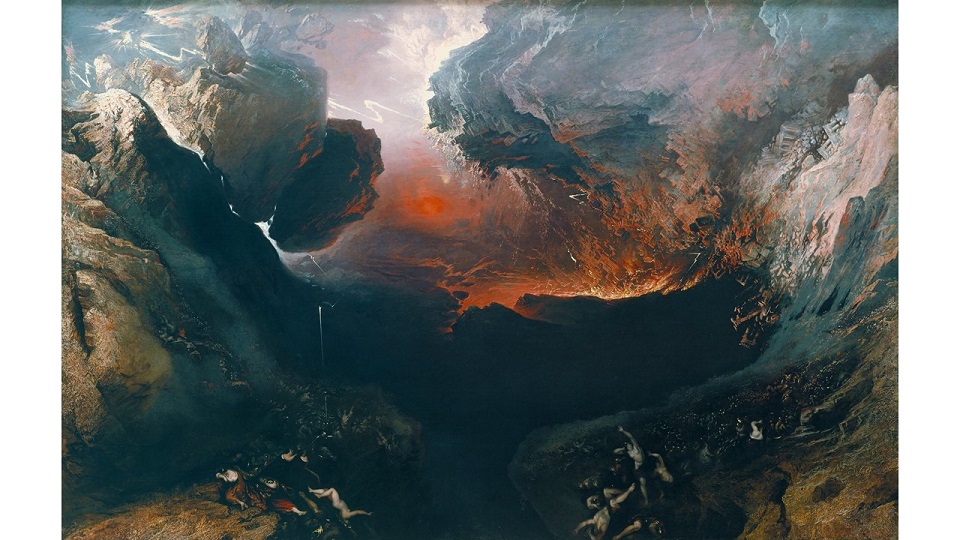
Apocalypse
The fractured sky splits, flaming at the edge—
The earth heaves upwards in explosive wrath.
No eye can bear the clay-caked risen dead
Sleepwalking through the streets in blackened shrouds.
The seas turn into boiling, viscous blood
And everywhere, unending trumpet-blasts,
Swarms of gnawing locusts whose foul wings
Buzz and whine like sand-filled, shaken rattles.
Disgust and violation choke all throats;
The stench of chaos, havoc, and disorder
Pollutes the nostrils of a baffled world.
This is Apocalypse, or Revelation—
A tearing-down, a showing-forth, a leap
From what we are to what we must become.
.
.
De Inimicis Nostris Libera Nos Deus Noster
“…and bathèd every veyne in swich licor.” —Chaucer, The Canterbury Tales Prologue
Remember that the curling tree
Whose veins were bathed in springtime showers
Still grows and curls in the book of hours
Fruit-laden, shading, arching over
Scriptorium saints in initial D—
Dic, O Domine, dic mihi!
Remember that the curling tree
Shading the road to Canterbury
Was cut for arrows and for spear-shafts.
.
De Inimicis Nostris Libera Nos Deus Noster: From our enemies deliver us, our God
Dic, O Domine, dic mihi: Tell, Oh Lord, tell me
.
.
Oberammergau
The inhabitant of Oberammergau does not regard his role in the
play as a mere episode; for him it is a vocation, an obligation, his
destiny. He is formed by it, just as he shapes it. When age compels
him to abandon it, he very often loses all zest for life.
—Das Oberammergauer Passionsspiel
In the tavern of the mountain town
The players sat in silent self-collection.
An unknown vagabond actor—just a clown—
Told of a ribald play with lewd direction:
“It’s set in a bawdy house awash in sluts.
Lechers go out and come in from the streets.
Gross peasants roar with laughter from their guts—
There’s drinking, stealing, dancing, rumpled sheets…”
The Christus player raised his stein of beer,
Took a great gulp, and spoke for all to hear:
“Give me a plume to grace my modest hat,
And I am that lecher, bald and fat.
Give the young virgin who plays Mary’s part
A scarlet ribbon, and she’ll play the tart.”
.
Note:
Each of these poems touches upon a religious issue. The first imagines the horrors that will accompany the end of the world; the second points out the persistence of warfare and enmity even in times when religious devotion is strongest; and the third asserts that all humans, even those connected with manifestations of profound faith, can take on totally opposite roles if required.
The title of the second poem (taken from the Office of the Holy Cross in the Roman Breviary) alludes to the fact that we must pray for liberation from our enemies, who are real and powerful and hostile. In spite of the usual pietistic chin-music about “peace” and “brotherhood” and “understanding” coming from too many contemporary pulpits, the Church has always understood that Christians must be armed and ready to kill when necessary. The Battle of Lepanto may have been won by rosaries, but let’s admit that culverin cannon, halberds, and swords also helped.
I have brought these three poems together here to suggest that the extraordinary times in which we now live (which may be pre-Apocalyptic) demand a deeper perception of what is expected of us than the mild-mannered resignation, irenicism, and wistful dreaming that are content with silence and acquiescence.
.
.
Joseph S. Salemi has published five books of poetry, and his poems, translations and scholarly articles have appeared in over one hundred publications world-wide. He is the editor of the literary magazine Trinacria and writes for Expansive Poetry On-line. He teaches in the Department of Humanities at New York University and in the Department of Classical Languages at Hunter College.















This, Joseph, is the kind of stuff I really like to read — instructive and evocative at the same time. I’ve been waiting for these.
I’m glad they please you, Kip. You are a tough judge.
Dear Joe —
I am no judge, nor would I attempt to be. But I do thoroughly appreciate your
response to and appreciation of Chaucer.
As usual, you give us more to think of than just poetry and a wider perspective to delve into than the parochial.
Thanks for the reads.
Dear Dr. Salemi,
Thank you for the three striking poems. I found the first especially poignant given the recent devastation in Tonga, where the island was plunged into an apocalyptic state because of a surprise volcano that debilitated the island, including its means of communication. A warning of the end? Who knows? I do recall a Nostradamus quatrain predicting something disturbing at the time of the “Hecatomb,” a sacrificial slaughter that occurred at the end of Olympics games. Just sayin’… https://classicalpoets.org/2019/09/13/a-translation-of-quiet-night-pondering-by-li-bai-dedicated-to-hong-kong-protesters/#/
Dear Evan —
What you say about possible apocalyptic events in connection with the mass murders committed by the Chinese Communists has great resonance in our current situation. The dissident exile Guo Wengei has reported that the CCP is sending two billion dollars a year in subsidies to the Vatican, which is now controlled by the current Antipope Jorge Bergoglio and his appointees. This money is for several reasons: 1) to pay off Bergoglio for the right to vet all episcopal appointments in the Catholic Church in China, 2) to keep the Vatican silent about ongoing Communist atrocities in China, 3) to allow the Chinese government to suppress and control Catholicism in China, and 4) to maintain a strong influence on all Vatican pronouncements and diplomatic activity. Judas was a piker — all he got was thirty pieces of silver.
This betrayal is not just evil in its own right, but also profoundly suggestive of an apocalyptic or pre-apocalyptic situation. And yet we still have R&R Catholics who think that this corrupt Argentine thug is “the Holy Father.”
Each of these poems is masterful and provocative. Although they are relatively brief, each carries a heavy load. I greatly admire the imagery of your “Apocalypse” poem. It is written in 14 lines — the same length as a sonnet — but a world away thematically and in your use of blank verse. I think your choice of blank verse brilliantly supports a subject which deals with the chaos of destruction but which yet speaks firmly of divine order. And, yes. All the signs are there that this is the world we inhabit. For now. One would have to be blind to not see it.
I’ve been to Bavaria several times but have never been to Oberammergau. I’ve long been intrigued by the passion play the residents present every 10 years and I very much enjoy how you use that event as a springboard for a discussion of the full bloodedness of life, including religious life. I am reminded of your Chaucer limericks — the revelation that the sacred and the bawdy can (perhaps must) coexist even in the same person. Even religious people must be allowed to breathe.
There is much to read into your De Inimicus poem and your discussion of the Christian being willing to fight has great meaning for me. I was greatly influenced by a Lutheran pastor who served as a U.S. Navy military chaplain for many years, most recently deployed in Afghanistan. He taught me Ephesians 6:10 — taking up the armor of God “so that one can take one’s stands against the devil’s schemes.” There was nothing metaphorical about this passage. He recited it daily as he literally put on bomb-proof gear in case of a terror attack. I learned from him the important of not being passive and of being willing to fight for both faith and country. Thank you for this reminder which is both timely and — in many ways — urgent.
Thank you for your kind words, Brian. There is a traditional Chinese curse: “May you live in interesting times.” We seem to be in such a period now.
About the Passion Play at Oberammergau — members of my family have been present to see the performance in 1950, 1960, 1970, and 1980 (I and my aunt and grandmother were the ones who saw the 1970 play). I love Bavaria, but Oberammergau can really be cold at night!
The Alps can get very cold indeed. But what a great experience for you! The Passion Play is definitely on my bucket list.
Each of these three poems present necessarily forceful messages, and make for illuminating reading. The truth in “Oberammergau” that even the faithful are capable, and often willing, to change roles is so true.
Joe, I understand the point of your note, but the poems seem to say that you do not at all expect any “deeper perception.” The curling tree made arrows and spear shafts for the useless Hundred Years War, when both sides might have done better to go on the crusade that at least one of their kings had vowed to carry out. The Oberammergau poem simply says the show must go on, and your comment that actors will do whatever is “required,” confirms that you attribute no personal or communal purpose to the production. My husband and I had reservations for the 2020 Passion Play, and as late as May received a letter of determination from the producers that they intended to go ahead with the drama, as its original purpose was to overcome pestilence by expressing gratitude and confidence in God. They were, of course, roundly forbidden to perform by state and national governments. This seems to show that when individuals and groups have the “deeper perception” you desire, and even when they express this deeper perception publicly, they accomplish nothing. I suppose that’s why you favor cannon, halberds, and swords.
I’m not quite sure what you’re driving at, Margaret. Of course it would have been better if the Hundred Years War had never happened. But in fact it did, because of human pride and greed. And the fact that both armies were composed of Roman Catholics mattered not a whit to anyone involved in the pointless struggle. When push comes to shove, nations fight.
All the Oberammergau poem suggests is that serious artists use their skills for many possible acts of creation, not all of them consonant with their personal beliefs and values. A good actor can play a virtue-encrusted hero or a rank villain, and his moral condition as an individual has no bearing on his skill or dramatic achievement.
I’m sorry that the Oberammergau performance of 2020 was cancelled, but what do you expect from the left-liberal scum who govern Germany today? In the midst of this Covid mass hysteria, it would have been truly remarkable if the play had been allowed to go on.
I think we must be talking about two different “deeper perceptions.” No one questions the good faith and devotion of the Oberammergau people, or their desire to honor God. They were prevented because they live in a modern secular state where the subjugation and emasculation of the populace is taken for granted by everyone.
If, on the other hand, we lived in a society where weaponry, martial arts, and pride in honorable combat were still a normal part of life, things might be different. And if you think those culverin cannon, halberds, and swords were not essential at Lepanto, I wonder about your perceptions.
The rosaries were prayed to win the battle at Lepanto, which means that without ships, soldiers, and weapons, there would have been no point to the prayers, even though every bead is a bullet. As we found out in later news of Oberammergau 2020, there were deeper perceptions on the part of about half the town. They were prepared to present the play, even with no audience and no hoopla, as a timely prayer of petition against pestilence. They perceived that God has a hand in human events, and as an additional point, they perceived a need for resistance to tyrannical measures of dealing with the ongoing situation. They failed, but I am impressed that as many as fifty percent of them had the perceptions you seem to encourage. Some of the actors may now be dealing with the spiritual and psychological distress described in your epigraph to the poem. Frustrated resistance can lead to acquiescence, or to deeper determination, or to deeper pessimism. Pessimism seems realistic, but unlikely to win battles.
Anyway, your poems are worthwhile incentives to consider in regard to our attitudes and actions.