


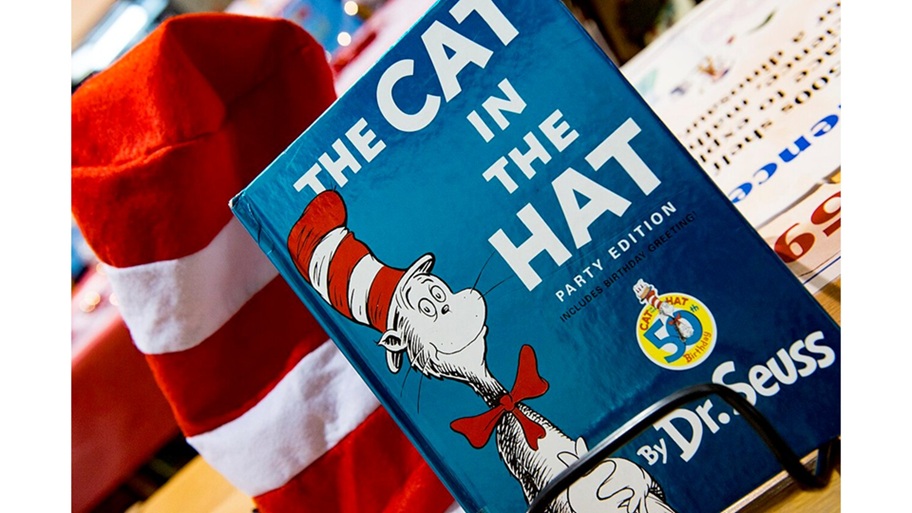
Up-up-up with a Fish
A scowl crossed the face
of the Cat in the Hat,
on hearing the Fish
in the Bowl was a rat.
The goldfish had threatened
to snitch on his scheme,
to thwart fun, fun, fun,
or so it did seem.
He suggested a game
called: “Up-up-up with a fish,”
involving an oven,
knives, forks and a dish.
So while Sally and I
chased Thing One and Thing Two,
the Cat took the Fish
to the kitchen to “stew,”
and then for a “grilling.”
Next onto a plate
he placed Mother’s pet
who’d been readied to sate
our appetites, served up
with crinkly chips,
gutted and boned
amongst flavoursome dips.
But we knew not then
of our goldfish’s fate
as we welcomed Mom home—
she had been working late.
What seemed chicken nuggets,
we bore down to sup,
and as the Cat forecast
ate the Fish “up-up-up.”
Paul A. Freeman is the author of Rumours of Ophir, a crime novel which was taught in Zimbabwean high schools and has been translated into German. In addition to having two novels, a children’s book and an 18,000-word narrative poem (Robin Hood and Friar Tuck: Zombie Killers!) commercially published, Paul is the author of hundreds of published short stories, poems and articles.














Thank you, Paul, for this exceptionally fun way to start the day! Dr. Seuss is on my (very long) list of favorite poets, and this slightly more grown-up sequel shows that you know how to have lots of good fun that is funny!
Thanks, Cynthia. I’m glad you enjoyed it.
Paul, your delightful poem really tickled my funny bone! You nailed the style of Dr. Seuss, right down to his signature use of anapestic meter. Thank you for brightening my day!
Thanks, Thomas. The poem needed a number of partial rewrites to get it to work. Evan was very patient.
I loved the Cat in the Hat and enjoyed your poem. I remember reading a few years ago that the editor for Dr Seuss, gave him a word list of around 350 words for use in his poems for young children. I also remember that his best seller, “Green Eggs and Ham” had only 50 words as a bet that he could write such a story. He did make up some words of his own, including the first use of “nerd.”
I heard that those 350 words were the vocabulary kids had to learn by a certain age, so Dr Seuss took up the gauntlet. And aren’t we glad he did.
It was called “The Basal Vocabulary List.” There was nothing wrong with the idea as a minimum that had to be achieved by a certain age, but many elementary school teachers re-imagined it as a maximum, beyond which the child was not permitted to go. So if a story contained a word that was not in the BVL, the story was not allowed to be read in school as part of the learning process. A typically insane result of bureaucratic administrators trying to micromanage everything.
I recall sitting in groups at primary school, reading a book in turn, and the teacher noting down our reading ages. Of course, if your reading age was assessed as less than your actual age (as mine often was), you reaped the ire of your disappointed parents.
This brought back happy memories. I’m glad you didn’t cancel Dr. Seuss as some people did not so long ago. I’d like to see what you can do with Green Eggs & Ham!
Jimmy Carr, the UK comedian, famously said, “I’ve already told the joke I’ll be cancelled for.” I reckon most writers have written stuff they now regret, or that doesn’t match with what’s ‘okay’ these days. Dr Suess was a product of his time, just as we all are. We shouldn’t hold that against him.
Green Eggs and Ham! I’d have to have a look.
When I was in second grade (more than half a century ago), already the Dr. Seuss books were the choice of young readers. And do you remember when swallowing goldfish was actually a thing among with-it cosmopolitans? I’ve eaten worse things.
My sister got one of those annuals based on a girls’ weekly comic, one year, and the Cat in the Hat was in it. It was the first time I’d come across Dr Seuss (his books weren’t readily available in the UK), at the age of about fourteen, and that was the book I read to her at night for a long time.
The tale is ingenious, Paul, in that the Cat (natural enemy of fish) manages (in an evil adult manner) to bring about the slaughter of the goldfish without either the benefit of the meal or culpability for the deed. That is how you realistically take the narrative beyond Dr. Seuss, while imitating his style. Not that there aren’t foul things in Seuss books, but this story appears to make the Cat a rat, unless of course his opinion that the fish was a rat is correct. Hard to say who’s the villain, as in many adult experiences.
In The Cat in the Hat, the Fish is against the Cat’s antics, for which he’s punished by becoming part of the Cat’s juggling act. I just went a step forward and silenced the fish – permanently!
Thanks for reading and commenting, Margaret.
What a treat! You have imitated Seuss’s style and brought back great memories of a classic with a twist, or perhaps a “taste.”
Thanks, Gigi. Here in Mauritania, where most books you find in shops are in French, The Cat in the Hat is one of the few books I brought with me, eating into my baggage allowance. That’s how much I value the book.