
Poet Adam Sedia reads his work at the Society of Classical Poets’ in-person Poetry Symposium held in Naperville, Illinois on September 5-6, 2025:
Video created by Andrew Benson Brown.


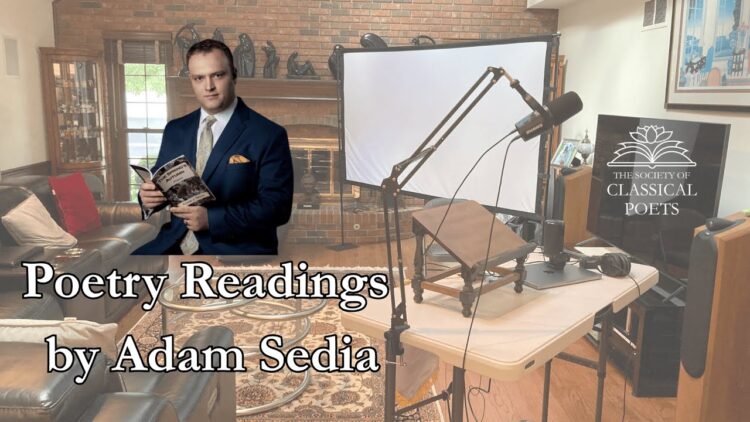
Poet Adam Sedia reads his work at the Society of Classical Poets’ in-person Poetry Symposium held in Naperville, Illinois on September 5-6, 2025:
Video created by Andrew Benson Brown.
Atomized The Great Stillness fell throughout the loud town. A quiet dust began to settle down. Where laughter once...
. . Late Bloomers My last red rose-of-sharon __Is slowly curling closed, Each giant shell-shaped petal __Beginning to turn in,...


Thank you, Margaret. I know of a number of people suffering long term consequences from Covid and I'm glad to…

The "memento" lyric is usually a sad one, even when it doesn't go so far as "memento mori." Here, James,…

Wow, Mary Jane! This looks like the type of numerical analysis that only a tax-specialist-turned-poet could do. I'd love to…

just before they fall the cherry blossoms begin to dance in the wind

ancient tortoise strolls land steward tills sand, sows seeds under ruthless sun abandoned strip mall nature reclaims cracked concrete ox-eye…











Thanks for sharing. It’s nice to enjoy poetry off the page.
Adam, those are entrancing poems written from the heart that beckon our contemplation and are laced with a belief in present and eternal life.
Thank you, Roy. All poetry must be written from the heart. And I’m especially glad you see an affirmation of life even in “Mushrooms.”
They are all quite powerful. “Remembrance” is a perfect villanelle, deeply tinged with regret and remorse over unspoken sins and mistakes. “Incense” is clearly religious-liturgical in its inspiration. But the poem on mushrooms is especially ambitious, in that it deals with all possible aspects of its subject — decay, food and flavor, the danger of poison, and most striking of all, the metaphor of the mushroom cloud of an atomic blast. The only other time I recall a poet using this metaphor was in a lengthy poem titled “Destroying Angel”, published in The New Yorker back in the 1960s. I don’t recall the author. I remember only one line (“From Asia’s heart, or New Mexico springing…”), and it clearly connected the poisonous mushroom called “destroying angel” with the possibility of a nuclear exchange. I was only an undergraduate at the time, and the poem was shown and read to our English class by Prof. Frank P. Jay.
Adam has very substantial poetic skills, and he is still comparatively young. I predict even greater things from him.
Hey guys, I found the poem…
https://www.newyorker.com/magazine/1962/09/08/destroying-angel-2?utm_source=chatgpt.com
Hilary Corke, September 1, 1962. Thank you, Mike. You brought me back to my undergraduate days, when my parents and all my grandparents were still alive. I’m amazed at how much of the poem was still familiar to me — phrases, metaphors, and whole lines came back to me as I read them just now. How much better do I understand it now, than I did back then!
Adam’s poem is wonderful in itself, but it also linked me to past poetic experience.
You bet, Doctor…
Thank you — not least for considering me still young, even if comparatively. I hope to live up to your expectations. And frankly I’m surprised the mushroom/mushroom cloud metaphor hasn’t been explored more. I suspect it had something to do with the age of atmospheric testing occurring precisely as classical poetry began to reach its nadir.
You are too good, Adam. Along with Jared Carter, you make Indiana look like the hub of contemporary American formal poetry, with Texas a close second. Hoosier daddy?
Thank you! To be mentioned alongside Carter, especially by you, is high praise indeed.
After a villanelle (a form I struggle with) like that, no wonder you took poetry more seriously. It’s brilliant.
Thank you! That villanelle will always have a special place in my affections, not only for what I expressed, but because of its effect on me.
Great to see/hear you read these poems Adam – really makes them personal and close. I wish I could have been there. Thank you.
I wish you could have been there, too, James, but I consider us all blessed to be able to share our readings online as if we were all there.
I feel fortunate, Adam, to have been in attendance. Still, the video record clarifies how well you selected and presented a significant variety of your work.
Thank you! I feel fortunate to have met you, too. For a reading, only some of my favorites would do.
Such beautiful poems, Adam. I especially love the villanelle. I’ve never written a sestina, but I can see how challenging they must be, and I admire yours.
Thank you! To be honest, I struggled with writing a sestina – mainly with finding a topic that could make such a long form interesting. Then I hit upon mushrooms, which always fascinated me as a child. My adult brain tried an experiment, partly inspired by the permutations of the sestina form itself. I am glad to know that you appreciate the result.
Adam, I am very glad I have now had the opportunity to hear you read your poetry. You read very well! I literally was getting lost in the very sounds of your voice and the words… they were beautiful in and of themselves– the rhymes, the alliteration, the stresses, the pauses… then I came back to earth to attempt to appreciate how excellent a poet you are. I look forward to more readings and poetry in the future.
Thank you! I’ve always been somewhat reserved about reading my poetry, but your words provide real encouragement.