


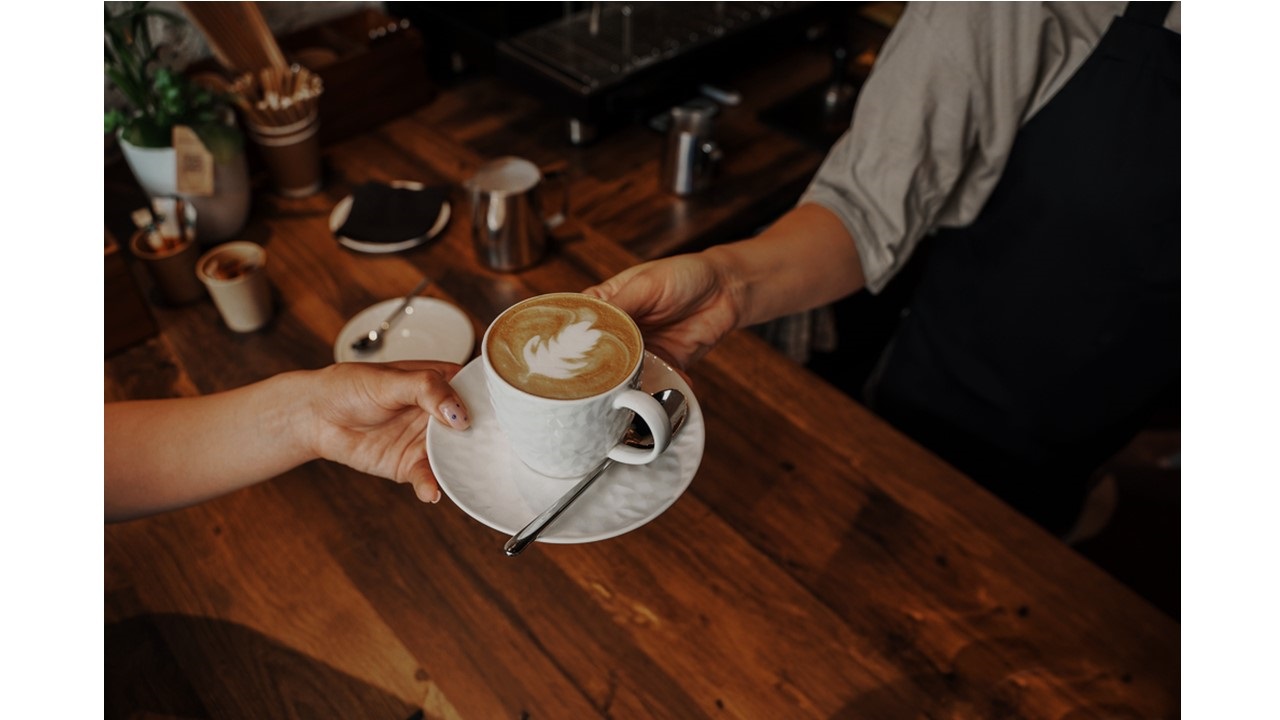
.
The Barista’s Hands
Surprisingly, she knew my name and used
the chance to give a fleeting glimpse and catch
me off my guard. I cocked my head, perused
her angled pose, and stretched enough to match
her risk. “You have one up on me, I think:
I never caught your name.” My hand slipped out;
the space became electric in a blink;
she gave her name and shaking hands without
a thought, “Amazing,” left my mouth before
I knew it. Soft but clear. Her startled look
had almost passed, “You work so hard, but your…
your hands… they are so soft.” That’s all it took.
The moment let me know that I could bless,
be blessed, and dream a little, I confess.
.
.
Running Toward the Thunder
With a turbulent bellow, the clouds re-collapse, but the strains
of the thunder have always been there. And eternity says,
as the Muses advance, Inspiration is always in chains
to the past, since existence is always in medias res.
On the stroke of your pen is the finger Melpomene lends,
but the gift isn’t ever her hand. She caresses your ear,
and she presses your lip and she traces a line that she bends
towards your belly, resurgent in even the words that you fear.
In the ink from her well is the shine and the shade of desire,
and the promise of morning and fullness of evening with her,
and it runs through your veins with the fleshiest, holiest fire,
and the longing to marry your muse, but she’ll always demur.
In the love and the loss is the lightning of poetry, gone
in the flash into which it was born—as her thunder rolls on.
.
Melpomene: (mel – PEM – ehn – ee ) the muse of tragedy.
.
.
For Dactyl Lovers
Difficult love is a beautiful love, is a love for the
loud, is a love that is overabundant, persistently
awkward, and shocking. And savage. And yet it’s a love for the
subtle, reluctantly mentioned in public, insistently
tempting in private. It starts with a whisper, then fingering
lines on a sheet with a touch that will turn you combustible,
promising nothing, delivering something still lingering…
This is a love unpossessable, never un-trustable.
Never again be afraid of this lover’s expressiveness.
Never defer from the challenge. The love’s in the struggling
worrying, agony: YES, you’ll encounter possessiveness,
happily though, as the climaxes settle to snuggling.
Dactyls are difficult lovers indeed but they’ll readily
take you to unachieved heights, though you quiver unsteadily.
.
.
Daniel Kemper is a systems engineer living in California.









I particularly enjoyed The Barista’s Hands, though would have loved to see a picture with a heart shape in the froth.
Thanks for the reads, Daniel.
Hi Paul!
Thanks for the read. I’m glad you enjoyed The Barista’s Hands. TBH, it’s “based” on a true story, but I chickened out before saying anything. The barista was MUCH younger than me. It’s one thing to be a dreamy poet, another to cross into “the creep zone,” I guess.
Anyway, I love Evan’s picture, though like your thought about the heart. Evan’s picture catches just enough of the hands to make us believe the fingers of those two are slyly, flirtingly touching under the saucer…
These are interesting poems. Do you know that it’s possible to read “Running Toward the Thunder” to the music of Billy Joel’s “She’s Always a Woman”? It’s refreshing to read love poems these days.
Oh boy, “interesting” – flopped that much? 🙁 Oh, well. Fascinating about Billy Joel; I really like him. Never realized before that “She’s Always a Woman” is anapestic. Cool!
It’s also 3/4 time, like dancing a waltz. It’s not a fail! It’s actually fascinating.
I noted the touch of the hand in all three poems in which even in a passing moment endearment, dreams, and destiny collide and stimulate us which our mind turns into a snapshot we remember with special feelings. I love poems that are romantic and stir the inner us! Your use of enjambment was amazingly captured with wonderful rhyme.
Roy! Howdy. You know, I composed them all around the same time, roughly (lots of other stuff going on at the time as well). I had much of the same “buzz” in my head for all of them when writing them, but did not realize that I had maintained the touch of a hand motif throughout. I mean, I think I was aware individually, but it didn’t occur to me in toto. Thank you for that keen observation.
I love the velocity, the “rush” that anapestic meter can capture. “Proprietary theory,” I learned 2-3 months ago sort of gets at that idea — the idea that certain meters are suited for certain subjects, or certain moods. Although I sense where they’re coming from, I can’t get all the way there with them. For example, there are only four basic meters and a lot more moods. But, maybe [meter + (something)] might begin to get there.
In this case [anapest + very_few_words_spanning_a_metrical_foot] seems to reliably produce a rushing feeling (whether from running or other activities or situations that might make one breathless).
Anyway, thank you for the note on Billy Joel. Dig him! Dig the note!
Daniel, these expressive poems take the reader into rhapsody. Doing so using iambs, anapests, and dactyls, all three, as you have done, evinces talent.
Hola, Mary~
Thank you for noting the palette of meters that I’m trying to learn to paint with. I work hard at it every day. I’ve been doing a lot of journal reading of late and have found several substantial figures saying things like there are no [x] in English poetry. e.g. trochaic poems, dactylic poems, etc. Some even say there is only iambic pentameter. On their more plausible claims of the paucity of poetry in other meters, it dovetails with other work I’ve been building, and seems to be true. There just aren’t nearly as many poems in meters other than IP. So I thought, why not? Why not sonnets in all meters?
It’s the next logical place to grow traditional poetry, I think.
Daniel, so much said and much to say! “The Barista’s Hands” is one of those “perfect moment” poems, always a new topic because there are always more moments. Renaissance poet Thomas Ford’s “There is a Lady Sweet and Kind” is a valuable comparison, and for the moment, I prefer yours.
“Running Toward the Thunder” makes tragedy so attractive: “promise of morning and fullness of evening” and “longing to marry” and “loss is the lightning” if I may make these particular snippets “as her thunder rolls on.” That last snip is the only anapestic one, but the entire anapestic sonnet is a great tribute to Melpomene.
Dactyls are difficult lovers, and there are more kinds than you portray, as you probably know from your exercises with them. Being one myself I savor the pun in the title, and may try more, but I am going to defer the challenge. Your sonnet is splendidly unsettling.
Hi Dr. C~
Hold onto that moment! 🙂
What a compliment to be compared favorably to such a famous poet as Thomas Ford!
Guess I’m an odd duck: Melpomene and Hades are my favorites in Greek Mythology. The former probably tells something of my previous romantic life, but the latter is likely less obvious since I’m a Christian.
For all my life, I’d imagined Hades as the devil, or the angel of death, just in a mythology. But he’s really far from that. He rules over Elysium as well and doesn’t live in Tartarus, but I found a quote somewhere which said Tartarus was as far below [the basic lower planes] as the sky is above the earth. Also, although he acquired Persephone by dubious means, and took some pressure to convince, he’s actually a modern husband, letting his wife go do her independent thing for half the year. To top that off, except for a few rather sketchy addenda, he’s the only Greek God who never cheated on his wife. I’ll have to write an Ode for him one of these days, I guess.
Anyway, way off course here.
I *LOVE* that you got the pun! Yay!! I love this, “splendidly unsettling” also. Thank you for that! The latest work (and too many irons in the fire these days) I’m doing is trying to study the impact of sentence length and spanned metrical feet in dactylic verse. Dactyls tend to run away like anapests but descending. The idea is to learn how to tame that a bit. Kindof like how trochees are incantatory if perfect in meter and no spanned feet (a clever spin on singsong) or they can be angry, dammit. 🙂 Looking at different patterns of breaking the sentences and feet…
I think everyone should work with dactyls. (Of course, I’d say that.) But here’s a reason why that I don’t think has been observed yet. When I worked in just dactyls for about a month and went back to iambs, the iambs were much easier/better, too! A twofer!
I’ve been reading a lot lately about what’s “natural” to English and the more that I work with dactyls, the more I think that’s just the wrong question.
This post has another “moment to hold on to,” not in its first poem, but in “The Woman Who Passed Me” by Baudelaire.
https://classicalpoets.org/2019/10/27/a-poem-by-michelangelo-the-woman-who-passed-me-by-charles-baudelaire-translations-by-michael-coy/
I find all three amazing. Thank you!
Thank you jd,
I appreciate you checking in. Glad you enjoyed them so much.
“Barista’s Hands” was very delightful. I confess, I am biased. I married my favorite barista. Incidentally, the barista in the picture, I think, is male.
Hi Patrick — Great for you! Would I were as lucky!
You say the hand is “male,” but what does that *mean* these days? lol. I didn’t interpret it that way for one of my earlier comments. But who knows?
Sorry, I meant to communicate that the barista in the picture that accompanies the poem appears male. I just thought it funny since, in the poem, the barista is female.
If i did not know how much Joseph Brodsky loved English poetry, I’d think, anachronistically, that he’d read your “Barista” but particularly “Running” before writing some of his characteristic stuff. Both poems are like great paintings.
Fascinating! But first, thank you for the great compliment. What fascinates me about your reference to Brodsky is that I seemed to have hit upon what Bloom called “Apophrades” without being familiar with Brodsky’s work.
https://en.wikipedia.org/wiki/The_Anxiety_of_Influence
What was your favorite poem of Brodsky’s? (Or which ones compete in your mind when asked that question?)
Apophrades or not (I had no idea that thing existed, if it did at all :)), I was sincere in saying that while for you that was natural, i only now really have felt how influenced Brodsky was by the English poetry. Little that I know, if at all, the theory (never read any), to me a big part of Brodsky’s charm comes from what is not quite natural for Russian: the meter, the rhythm, and the sentence construction. For instance, he starts on occasion a sentence with what’s in English “Because”—that’s not that unusual in English, but nobody talks like that in Russian. So, as far as I can see, it’s a calque from English—but it’s charming, like sometimes a foreign accent is. It’s hard to say which of Brodsky’s is a favorite of mine (I like many and i hate one), but some are “Я родился и вырос в балтийских болотах» and other things from Part of Speech. Письма римскому другу. Post aetatem nostram. Do you read Russian?
I used to be stumbly with French, know remember embarrassingly little Japanese from college, and even less Korean from being there a year. About a decade ago, my Amharic was at about kindergarten level. And I remember greetings in about twenty languages — having discovered how sweet it is on the ear to hear a native greeting in a non-native land.
But no Russian. 🙁
Though I’m an admirer of much that is Russian.
What a marvelous metrical journey through the labyrinths of love and lust. Whatever the meter, you’ve maintained a smooth flow that never detracts from the enticement of the images you paint with aplomb. I especially like the line: “… a touch that will turn you combustible”… a scorching image that explodes across the page and makes me long to write a series of scintillating sonnets. Great stuff, Daniel.
“Aplomb!” The word surprised me pleasantly. It’s a word I like and has recently found its way into a poem of mine.
Thank you for your praise. Coming from a wordsmith as yourself, they always have added impact.
I just want to run around excitedly and encourage everyone to test out sonnets in uncommon meters. One of the knocks against traditional/formal poetry has been, “Woe is me; it’s all been done before.” Well, actually it hasn’t. The iambic space is well-explored, though by no means exhausted, but there are three more realms left far less travelled.
It’s really challenging and really fun. The feel is so different, so good. But I have to also say, the feel of returning home to iambs is a great feel, too. I think it actually helps with iambic writing to work in a different meter for a while.
Anyway, thank you for the praise. I appreciate it so much.