• Submit Poetry
  • Support SCP
  • About Us
  • Members
  • Join
Monday, October 19, 2026
Society of Classical Poets
  • Poems
    • Beauty
    • Culture
    • Satire
    • Humor
    • Children’s
    • Art
    • Ekphrastic
    • Epic
    • Epigrams and Proverbs
    • Human Rights in China
    • Music
    • Performing Arts
    • Riddles
    • Science
    • Song Lyrics
    • The Environment
    • The Raven
    • Found Poems
    • High School Poets
    • Terrorism
    • Covid-19
  • Poetry Forms
    • Sonnet
    • Haiku
    • Limerick
    • Villanelle
    • Rondeau
    • Pantoum
    • Sestina
    • Triolet
    • Acrostic
    • Alexandroid
    • Alliterative
    • Blank Verse
    • Chant Royal
    • Clerihew
    • Rhupunt
    • Rondeau Redoublé
    • Rondel
    • Rubaiyat
    • Sapphic Verse
    • Shape Poems
    • Terza Rima
  • Great Poets
    • Geoffrey Chaucer
    • Emily Dickinson
    • Homer
    • Henry Wadsworth Longfellow
    • Dante Alighieri
    • John Keats
    • John Milton
    • Edgar Allan Poe
    • William Shakespeare
    • William Wordsworth
    • William Blake
    • Robert Frost
  • Love Poems
  • Contests
  • SCP Academy
    • Educational
    • Teaching Classical Poetry—A Guide for Educators
    • Poetry Forms
    • The SCP Journal
    • Books
No Result
View All Result
Society of Classical Poets
No Result
View All Result
Home Poetry

‘Fibromytrauma’: A Poem by Golan Shahar

May 7, 2026
in Poetry, Culture
A A
19
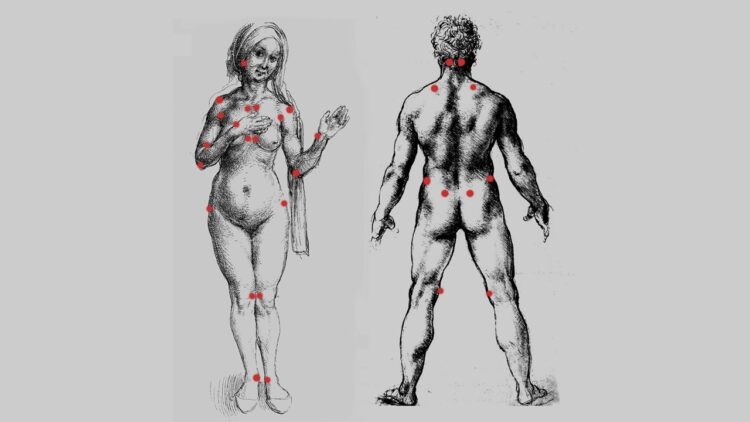
Fibromyalgie Tender Points outlined on a Da Vinci drawing (Richard Huber)

Fibromyalgie Tender Points outlined on a Da Vinci drawing (Richard Huber)


Fibromytrauma

My body’s still and will not settle.
It keeps the scores: Muscles. Nerves.
“Tough love,” he said. A girl of mettle
again receives what she deserves.

The room was dark. I couldn’t see.
Only the blows. They came and went.
I screamed. His belt imposed on me.
I had to stay impertinent.

And now it pulses through my joints.
The doctors call them “tender points.”


Golan Shahar, Ph.D., is a professor of clinical-health psychology and public health at Ben-Gurion University of the Negev and an adjunct professor of psychiatry at Yale School of Medicine. His research examines stress, psychopathology, and mind–body processes. His creative writing, in both English and Hebrew, has appeared in On the Hill and Psychoanalytic Inquiry.


Tags: Golan ShaharPoetry About Life
ShareTweetPin
The Society of Classical Poets does not endorse any views expressed in individual poems or commentary.
Read Our Comments Policy Here

RandomPoems

‘Maurras at the Parthenon (Acropolis, 1896)’ by Joseph S. Salemi
Beauty

‘Maurras at the Parthenon (Acropolis, 1896)’ by Joseph S. Salemi

February 4, 2021

. Charles Maurras (1868-1952) was a highly influential French poet, essayist, and political journalist. He edited the rightist paper Action...

The Top-Ten, Best, Most Popular Poems of Emily Dickinson People Should Read at Least Ten Times
Best Poems

The 10 Best Poems of Emily Dickinson

January 12, 2024

. The 10 Best Poems of Emily Dickinson by Monika Cooper Being presented with an Emily Dickinson poem is like...

Next Post
‘The Man in the Moon Was a Very Round Man’: A Poem by Lauren V. Leon

'The Man in the Moon Was a Very Round Man': A Poem by Lauren V. Leon

‘Spontaneous Conjugal Combustion’ and Other Poems by Susan Jarvis Bryant

'Spontaneous Conjugal Combustion' and Other Poems by Susan Jarvis Bryant

‘A Squall of Squibs’: Short Poems by Susan Jarvis Bryant

'Creation of Mom': A Mother's Day Poem by Roy E. Peterson

Comments 19

  1. Susan Jarvis Bryant says:
    6 months ago

    This poem is extremely powerful in its brevity. Every word and every punctuation mark counts. It speaks to me on many levels. I am especially drawn to “I had to stay impertinent”… but oh, the cost! The closing couplet lands harder than a blow from a belt in a dark room. Sometimes a poem says so much, and for me, this is one of those poems. Thank you very much indeed!

    Reply
  2. Golan Shahar says:
    6 months ago

    Thank you! And very much! Thanks for being all of this. The poem is of course derived from clinical work but the word “impertinent” came to me from the movie Good Will Hunting, ahere the protagonist — Matt Damon — tells his therapist — Robin Williams — about how he remained defiant in the face of his father’s beatings.
    A triumph of sorts but as you indicates — at awful cost.

    Reply
    • Susan Jarvis Bryant says:
      6 months ago

      Thank you for your generous reply. I’m always interested in words that inspire, and “impertinent” now holds even greater weight in the context of the poem. I understand the poem is derived from clinical work, which is why it appeals on many levels. I didn’t touch upon this aspect because I am still thinking (deeply) about the cause and effects of childhood abuse on one’s health as an adult. I love poetry because it has the ability to entertain, surprise, enlighten, alarm, and engage me… this brief and potent piece seems to be doing all these things at once.

      Reply
      • Golan Shahar says:
        6 months ago

        Wow, thanks a lot….it took nth drafts to arrive at this one.

        Reply
  3. Brian Yapko says:
    6 months ago

    An astonishing poem, Golan, which describes brutality with a detachment which I find horrifying. The clinical ending may be the most disturbing aspect of the whole piece. Something truly monstrous has been reduced to its component, physical parts and stripped of the psychological, human trauma. You capture — qute powerfully — the numbness between the screams. I have read many witness statements (this poem almost sounds like court testimony) and forensic records in my day, most of them divorced from the humanity they purported to record. It is that disconnect which makes one want to weep.

    Reply
    • Golan Shahar says:
      6 months ago

      I am not sure that my reply came through so I am repeating it.
      Thanks Brian! So perceptive. It never occurred to me that numbness is is salient here but if course it is. AKA dissociation. The enormity of trauma can only be absorbed bit by bit.

      Reply
  4. Margaret Coats says:
    6 months ago

    Your use of the “envelope” time structure, Golan, is remarkably effective. In the first two lines and the last two, you describe chronic pain disorder widespread in the body. The traumatic etiology appears in the poem’s middle lines. Indeed these end-stopped lines might refer to several patients you have observed. They flashback to past moments of pain both physical and psychological that return in the “now.” It’s interesting that you employ a single word taken from the movie you cite, another work of art that deals with the subject in a complex drama.

    Reply
    • Golan Shahar says:
      6 months ago

      Thanks so much. This is incisive and I am still taking it in. In the movie, the protagonist didn’t use the word impertinent but it felt right in the context of this poem.

      Reply
  5. Joseph S. Salemi says:
    6 months ago

    This is indeed concise and hard-hitting, in more ways than one. The brief ten lines seem to carry within them the physical discomfort of the speaker. Bodily abuse, medical treatment, lingering pain.

    Reply
    • Golan Shahar says:
      6 months ago

      Thanks a lot!

      Reply
  6. Jenna Tedesco says:
    6 months ago

    A gorgeous poem crafted with compassion for the long-term suffering associated with abuse. The body truly does keep the score.

    Reply
    • Golan Shahar says:
      6 months ago

      Inevitably. Thanks!

      Reply
  7. Mike Bryant says:
    6 months ago

    Since our brains interpret reality, perhaps it’s not a huge stretch to say that some of our current pains are revisitations of past traumas.

    I have often heard the words, “It’s all in your head.” I guess it’s true.

    Very thought-provoking and effective poetry.

    Reply
    • Golan Shahar says:
      5 months ago

      Absolutely. All in the head (brain). Psychoneuroimmunology.

      Reply
  8. Roy Eugene Peterson says:
    6 months ago

    “Fibromytrauma” is a creative and apt title for this “hard hitting” poem.

    Reply
  9. Golan Shahar says:
    5 months ago

    Thanks!

    Reply
  10. C.B. Anderson says:
    5 months ago

    What a strange poem, for truth, as they say, is stranger than fiction. I love poems that tie the mind in knots, just as I like the look of knotty pine. I hope this is not your last stop here.

    Reply
    • Golan Shahar says:
      5 months ago

      I am pretty sure it isn’t. Thanks!

      Reply
  11. Paul A. Freeman says:
    5 months ago

    The belt was one of those punishments still occasionally used when I was at school, along with the slipper and some more imaginative tortures.

    This is a very powerful piece, Golan.

    Reply

Leave a Reply Cancel reply

Your email address will not be published. Required fields are marked *


  1. Rohini Sunderam on ‘The River & The Sea’: A Poem by Rohini SunderamOctober 19, 2026

    Oh, wow and thank you! I used to love this form of personification of natural forces as a child. It…

  2. Gerard Maritato on ‘Biblical? Emblematic?’: A Poem by Stephen DiLauroOctober 19, 2026

    I will never look in the same way at that apple on my phone! Good cause for reflection.

  3. Joseph S. Salemi on ‘After-Action Report’: A Poem by Joseph S. SalemiOctober 19, 2026

    Thank you, Adam. When "Melissa" recounted the event to me, I had to put it into a poem, but a…

  4. Russel Winick on ‘Their Words, My Fault’ and Other Poems by Russel WinickOctober 19, 2026

    Thank you Adam. I agree with you about the first poem.

  5. Adam Sedia on ‘The River & The Sea’: A Poem by Rohini SunderamOctober 19, 2026

    I was struck by this wonderful narrative that turns a natural phenomenon into a touching love-story. Dramatic narratives like this…

Subscribe to Daily Poems

Enter your email address to subscribe to this blog and receive notifications of new posts by email.

Join 1,660 other subscribers
No Result
View All Result

Resources

       1. A Guide to Writing Poetry

      2. The Best Poems of 2020      

      3. Poetry and Writing Contests

      4. Journals Accepting Formal Verse

Recent Poems

  • ‘Biblical? Emblematic?’: A Poem by Stephen DiLauro
  • ‘The Valley’: A Poem by Briana Reavis
  • The Blobfish—‘Mr Blobby’: A Poem by Paul A. Freeman
  • ‘Nature’s Family’: A Poem by Margaret Coats
  • ‘The River & The Sea’: A Poem by Rohini Sunderam
  • Poems by Derzhavin, Akhmatova, and Tyutchev, Translated by Kevin Rainbow
  • ‘After-Action Report’: A Poem by Joseph S. Salemi
  • ‘The Walking Wounded’: A Poem by Jeffrey Essmann
  • ‘Their Words, My Fault’ and Other Poems by Russel Winick
  • ‘Lazarus I’: A Poem by Jason Hunt
  • Poetry Challenge: Dictionary Delights
  • ‘In Defense of Rhyme’: An Essay by Euphrates Moss
  • ‘Gun Control’: A Poem by Kevin Ahern
  • ‘Power of a Pen’: A Poem by Janice Stanley
  • The Best Haiku of 2026
  • ‘One Night in Bangkok’ and Other Poetry by Brian Yapko
  • ‘Invocation’: A Poem by D.R. Rainbolt
  • ‘Enjoy the Peace, Prepare for War’: A Poem by Roy E. Peterson
  • Faust Part Two, Act One: ‘A Pleasant Landscape’ by Goethe, Translated by Josh Olson
  • A Song Inspired by Robert Frost’s ‘The Road Not Taken’, by Gunny Markefka
  • ‘Reappraisals of Mortality’: A Poem by C.B. Anderson
  • ‘What Is the Measure of My Days?’: A Poem by Peter Venable
  • ‘Polar Coordinates’: A Poem by Adam Sedia
  • ‘It Never Lies!’: A Poem by Paul A. Freeman
  • ‘The Mahjong Flowers’: A Set of Sonnets by Margaret Coats
  • ‘The Martyrdom of Saint Cassian’: A Poem by Joseph S. Salemi
  • ‘Mind Versus Beauty’: A Poem by Johann Wolfgang von Goethe, Translated by Eric v.d. Luft
  • ‘Summer Sails’: A Poem by Paulette Calasibetta
  • ‘Aquarius’: A Poem by Patricia Rogers Crozier
  • ‘No Body Here on Earth’: A Poem by Gerard Maritato

Categories

  • Acrostic
  • Alexandroid
  • Alliterative
  • Art
  • Best Poems
  • Blank Verse
  • Chant Royal
  • Classical Poets Live
  • Clerihew
  • Covid-19
  • Deconstructing Communism
  • Educational
  • Epic
  • Epigrams and Proverbs
  • Essays
    • Interviews with Poets
    • Poetry Reviews
  • Featured
  • From the Society
  • Great Poets
    • Dante Alighieri
    • Edgar Allan Poe
    • Emily Dickinson
    • Geoffrey Chaucer
    • Henry Wadsworth Longfellow
    • Homer
    • John Keats
    • John Milton
    • Robert Frost
    • William Blake
    • William Shakespeare
    • William Wordsworth
  • Human Rights in China
  • Limerick
  • Love Poems
  • Music
  • Pantoum
  • Performing Arts
  • Poetry
    • Beauty
    • Children's Poems
    • Culture
    • Ekphrastic
    • Found Poems
    • High School Poets
    • Humor
    • Riddles
  • Poetry Challenge
  • Poetry Contests
  • Poetry Forms
    • Curtal Sonnet
    • Haiku
  • Poetry Readings
  • Rhupunt
  • Rondeau
  • Rondeau Redoublé
  • Rondel
  • Rubaiyat
  • Sapphic Verse
  • Satire
  • Science
  • Sestina
  • Shape Poems
  • Short Stories
  • Song Lyrics
  • Sonnet
  • Symposium
  • Terrorism
  • Terza Rima
  • The Environment
  • Translation
  • Triolet
  • Video
  • Villanelle

Quick Links

  • About Us
  • Submit Poetry
  • Become a Member
  • Members List
  • Support the Society
  • Advertisement Placement
  • Comments Policy
  • Terms of Use

Welcome Back!

Login to your account below

Forgotten Password?

Retrieve your password

Please enter your username or email address to reset your password.

Log In
No Result
View All Result
  • Poems
    • Beauty
    • Culture
    • Satire
    • Humor
    • Children’s
    • Art
    • Ekphrastic
    • Epic
    • Epigrams and Proverbs
    • Human Rights in China
    • Music
    • Performing Arts
    • Riddles
    • Science
    • Song Lyrics
    • The Environment
    • The Raven
    • Found Poems
    • High School Poets
    • Terrorism
    • Covid-19
  • Poetry Forms
    • Sonnet
    • Haiku
    • Limerick
    • Villanelle
    • Rondeau
    • Pantoum
    • Sestina
    • Triolet
    • Acrostic
    • Alexandroid
    • Alliterative
    • Blank Verse
    • Chant Royal
    • Clerihew
    • Rhupunt
    • Rondeau Redoublé
    • Rondel
    • Rubaiyat
    • Sapphic Verse
    • Shape Poems
    • Terza Rima
  • Great Poets
    • Geoffrey Chaucer
    • Emily Dickinson
    • Homer
    • Henry Wadsworth Longfellow
    • Dante Alighieri
    • John Keats
    • John Milton
    • Edgar Allan Poe
    • William Shakespeare
    • William Wordsworth
    • William Blake
    • Robert Frost
  • Love Poems
  • Contests
  • SCP Academy
    • Educational
    • Teaching Classical Poetry—A Guide for Educators
    • Poetry Forms
    • The SCP Journal
    • Books

© 2025 SCP. WebDesign by CODEC Prime.