


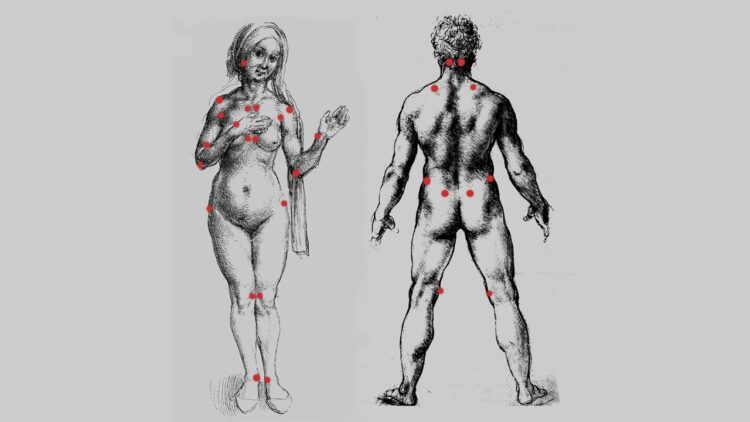
Fibromytrauma
My body’s still and will not settle.
It keeps the scores: Muscles. Nerves.
“Tough love,” he said. A girl of mettle
again receives what she deserves.
The room was dark. I couldn’t see.
Only the blows. They came and went.
I screamed. His belt imposed on me.
I had to stay impertinent.
And now it pulses through my joints.
The doctors call them “tender points.”
Golan Shahar, Ph.D., is a professor of clinical-health psychology and public health at Ben-Gurion University of the Negev and an adjunct professor of psychiatry at Yale School of Medicine. His research examines stress, psychopathology, and mind–body processes. His creative writing, in both English and Hebrew, has appeared in On the Hill and Psychoanalytic Inquiry.


















This poem is extremely powerful in its brevity. Every word and every punctuation mark counts. It speaks to me on many levels. I am especially drawn to “I had to stay impertinent”… but oh, the cost! The closing couplet lands harder than a blow from a belt in a dark room. Sometimes a poem says so much, and for me, this is one of those poems. Thank you very much indeed!
Thank you! And very much! Thanks for being all of this. The poem is of course derived from clinical work but the word “impertinent” came to me from the movie Good Will Hunting, ahere the protagonist — Matt Damon — tells his therapist — Robin Williams — about how he remained defiant in the face of his father’s beatings.
A triumph of sorts but as you indicates — at awful cost.
Thank you for your generous reply. I’m always interested in words that inspire, and “impertinent” now holds even greater weight in the context of the poem. I understand the poem is derived from clinical work, which is why it appeals on many levels. I didn’t touch upon this aspect because I am still thinking (deeply) about the cause and effects of childhood abuse on one’s health as an adult. I love poetry because it has the ability to entertain, surprise, enlighten, alarm, and engage me… this brief and potent piece seems to be doing all these things at once.
Wow, thanks a lot….it took nth drafts to arrive at this one.
An astonishing poem, Golan, which describes brutality with a detachment which I find horrifying. The clinical ending may be the most disturbing aspect of the whole piece. Something truly monstrous has been reduced to its component, physical parts and stripped of the psychological, human trauma. You capture — qute powerfully — the numbness between the screams. I have read many witness statements (this poem almost sounds like court testimony) and forensic records in my day, most of them divorced from the humanity they purported to record. It is that disconnect which makes one want to weep.
I am not sure that my reply came through so I am repeating it.
Thanks Brian! So perceptive. It never occurred to me that numbness is is salient here but if course it is. AKA dissociation. The enormity of trauma can only be absorbed bit by bit.
Your use of the “envelope” time structure, Golan, is remarkably effective. In the first two lines and the last two, you describe chronic pain disorder widespread in the body. The traumatic etiology appears in the poem’s middle lines. Indeed these end-stopped lines might refer to several patients you have observed. They flashback to past moments of pain both physical and psychological that return in the “now.” It’s interesting that you employ a single word taken from the movie you cite, another work of art that deals with the subject in a complex drama.
Thanks so much. This is incisive and I am still taking it in. In the movie, the protagonist didn’t use the word impertinent but it felt right in the context of this poem.
This is indeed concise and hard-hitting, in more ways than one. The brief ten lines seem to carry within them the physical discomfort of the speaker. Bodily abuse, medical treatment, lingering pain.
Thanks a lot!
A gorgeous poem crafted with compassion for the long-term suffering associated with abuse. The body truly does keep the score.
Inevitably. Thanks!
Since our brains interpret reality, perhaps it’s not a huge stretch to say that some of our current pains are revisitations of past traumas.
I have often heard the words, “It’s all in your head.” I guess it’s true.
Very thought-provoking and effective poetry.
Absolutely. All in the head (brain). Psychoneuroimmunology.
“Fibromytrauma” is a creative and apt title for this “hard hitting” poem.
Thanks!
What a strange poem, for truth, as they say, is stranger than fiction. I love poems that tie the mind in knots, just as I like the look of knotty pine. I hope this is not your last stop here.
I am pretty sure it isn’t. Thanks!
The belt was one of those punishments still occasionally used when I was at school, along with the slipper and some more imaginative tortures.
This is a very powerful piece, Golan.