


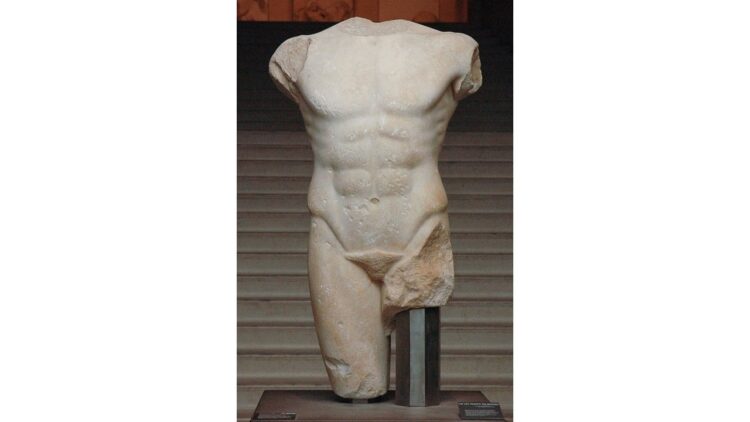
Archaic Torso of Apollo
by Rainer Maria Rilke (1875-1926)
translated from German by Mary Jane Myers
We’ll never know his head, its mythic fame,
the fiery ripening-apple eyes, although
his torso casts a candelabra’s glow,
the gaze now dialed down to a lower flame,
its gleam preserved. Or else the breast’s slight curve
would not so blind us; nor the faint S-twist
of loins display a smile that hints a tryst,
the center of his procreative verve;
this weathered marble couldn’t disenthrall
us, chiseled near the shoulders’ lucent fall;
it wouldn’t glint like panthers’ satin coats;
nor pulse, as quasars flare. Absorb its strife.
In every place it sees your feeble thoughts,
there’s no escape. You must reform your life.
Original German
Archaischer Torso Apollos
Wir kannten nicht sein unerhörtes Haupt,
darin die Augenäpfel reiften. Aber
sein Torso glüht noch wie ein Kandelaber,
in dem sein Schauen, nur zurückgeschraubt,
sich hält und glänzt. Sonst könnte nicht der Bug
der Brust dich blenden, und im leisen Drehen
der Lenden könnte nicht ein Lächeln gehen
zu jener Mitte, die die Zeugung trug.
Sonst stünde dieser Stein entstellt und kurz
unter der Schultern durchsichtigem Sturz
und flimmerte nicht so wie Raubtierfelle;
und bräche nicht aus allen seinen Rändern
aus wie ein Stern: denn da ist keine Stelle,
die dich nicht sieht. Du mußt dein Leben ändern
Mary Jane Myers resides in Springfield, Illinois. She is a retired JD/CPA tax specialist. Her debut short story collection Curious Affairs was published by Paul Dry Books in 2018.


















Wow! Very impressive, and imaginatively creative, translation feat!
Mary Jane, this is a wonderful translation of Rilke’s original German. I love how you maintained the rhyme-scheme and the highly pensive tone leading to the “nowhere to hide” and “change of life” conclusion. And you perform a great service by offering us translations from works in other languages. I don’t know Rilke well but am particularly taken by his “Panther.”
I have one quibble which may in fact be more than a quibble, because my query concerns a similar word-choice analysis as in your Horace translation and what I perceived as your anachronistic use of the term “Lilliputian.” In this Rilke poem you chose the word “quasar” as a translation for “Stern,” which simply means “star.” I don’t think this was the right choice here. If “Lilliput” suggests anachronism, the word “quasar” does so to an even greater extent. Quasar is an acronym coined by astrophysicists in the late 1950s to reflect a “Quasi Stellar Radio Source” — a completely new scientific discovery. “Quasar” is a word — particular as an acronym — with a very specific time-stamp which does not serve your poem. I imagine you thought it might make the poem modernized and universalized, but I don’t think it serves either goal. The subject model of your poem, the sculptor, and Rilke himself would have no idea what a “quasar” is.
I understand the desire to take translations and both update them and put your stamp on them, but I think you must still be very mindful of vocabulary which may take the reader out of the universe of the poem. To have Achilles address a “snafu” for example or to have Dante reference “quarks” might lend interesting meaning to old texts but I think the poet must balance the benefit of the word-choice with the burden it imposes. A word which is too anachronistic or which carries inadvertent associations undermines rather than enhances. I would remove “quasar” and restore the original “star.” The line could be rewritten as “or pulse as starlight flares…” No loss in meaning and a substantial gain in fidelity and a sense that we are in Rilke’s intended poetic universe.
I hope it doesn’t seem like I’m picking on you, Mary Jane. I really love your work and I want to more of it — and often! But I am presently writing an essay on the subject of word-choice and so I am particularly attentive to this issue.
Brian — yes, I think “or pulse as starlight flares” would be absolutely right. It gets rid of “quasar” and yet maintains the force of Rilke’s text. The problem of “anachronism of tone” is one that many modern translators seem to have ignored.
This translation of a Rilke poem is clearly the product of much work and thought, and its rhyme scheme, matching the German, is quite a substantial achievement. Ms. Myers always presents us with excellent work!
I’m jealous of his six-pack, MJ. That aside, what a wonderful poem.
Thanks for the read.
Very well done, Mary Jane! I come from a discussion of this very poem as one of Rilke’s “thing poems” (Dinggedichte). The poet’s program seems to abandon human subjectivity as much as he can, replacing it with intense scrutiny of the object, and thus guiding readers to an emotional impact based heavily on contemplation of objects, with less contribution from the poet’s personal psyche. Especially admire your replacing the “not break out” in the final tercet with the exhortation “Absorb the strife.” Leads very naturally to “change [your life]” as the final word in the original.
There is background word painting in the title that helps interpret the “thing.” A male human torso, created by an artist, already promises animation. Its origin in the “archaic” period adds age. You work sensitively to make the most of Rilke’s description, and sometimes move beyond him, for example specifying his predator as a panther (maybe thinking of his “Panther,” another thing poem). But where you do the most is in your own word choices adding heat and light, to correspond to Rilke’s identification of the figure as Apollo. The “glint” is there, but you add “flame” and translate a literal “transparent” to “lucent.” Your “quasar” I can thus accept as a contraction of “quasi-stellar” (“almost starlike”) for the statue when Rilke refers to a star, even though he may not have known of the high luminosity astrophysical phenomenon that is a quasar in common usage at present.
To further comment on modernisms in translation, I’ll point to many of them in both word choice and usage in A. M. Juster’s recently published Petrarch. This definitely adds a shocking contemporary timbre. Juster justifies it by pointing out that he presents a “now-and-future” Petrarch he hopes will be a long-lasting standard translation. It would be ridiculous to use only English words available from the time of Chaucer, Petrarch’s near contemporary.
Maybe your own collection of translations, Mary Jane, using the word choices available to you, can represent your unique artistry.
No one is limiting vocabulary to period, Margaret, else one would have to write late Medieval work in Middle English. No, the question is one of word-choice which damages a sense of period and poetic intent. Some words have layers of meaning or associations which inadvertently alter a text or remove the text from the poet’s intent so much as to be a distraction. The word “quasar” does that here. I’m sorry you don’t understand the issue.
Margaret, do you think you could stop sounding like the patronizing Mother Superior of a convent? It’s irritating to many of us. You seem to think that you are some kind of gatekeeper at the SCP.
Brian and I merely expressed an aesthetic opinion concerning the use of certain modern words in a translation. We did not demand that Ms. Myers follow our suggestion, nor did we claim any especial authority to control her diction choices. In fact, we praised her work. Our comments were perfectly in accord with the SCP’s function as a teaching site.
Your comment above, however, is purely performative, in the sense that it creates a cloud of lit-crit verbiage and pyrotechnics to conceal a mere opinion: “I like this translation , and Yapko and Salemi are totally wrong.” That’s not part of the teaching function. It’s merely disguised one-upsmanship.
Mary Jane, I don’t usually comment on translations because I don’t feel qualified to do so. I just read them in awe, enjoy them, and learn. I would like to thank you for bringing “Archaic Torso of Apollo” to a wider audience, and for doing it so beautifully.
As an everyday reader, I would like to say the word “quasar” pulled me up for these reasons:
1. I had to look the word up which pulled me away from my enjoyment.
2. When I observed the meaning, I too was not sure it added to the message. This is not because it’s modern, but because it doesn’t seem to fit the poem. A star is universal but a quasar is very different – scientifically it is luminous, but it carries a very specific intellectual history which doesn’t feel in keeping with the message of the poem. It appears to change the quality of the image. A star is light, a quasar suggests cosmic violence instead of light.
Whether I am right or wrong is of no consequence. The fact that I was pulled up and had to reach for an explanation may speak for others who felt distracted by the word.
This is why I am grateful to Brian and Joe for their explanations, which I don’t find at all “ridiculous”.
I can understand the escalation from “lower flame” to “lucent” to “glint” to “quasar” – but I don’t believe the word “quasar” fits Rilke’s image.
I would also like to take this opportunity to say, calling other’s interpretations “ridiculous” is out of order. Everyone is entitled to an opinion that is in the interest of the poet. I agree with Brian and Joe – does that make my opinion ridiculous?
Mary Jane, thank you for your gift to us here at the SCP.
This Modern Torso of this Universe
by R. Lee Ubicwedas
“nor pulse, as quasars flare”
—Mary Jane Myers
We’ll never know its mythic fame—extremely luminous—
that active, starlike object and galactic nucleus,
that compound region at the center of that galaxy,
emitting a significant amount of energy,
across the spectrum, showing that its candelabra’s glow,
includes x-rays and ultraviolet wavebands, and more,
th’ accretion at a supermassive black-hole’s central crux,
th’ electrical-magnetic radiation all in flux.
In each plane that this quasar finds your thoughts, absorb its strife;
for there is no escape from it. You must reform your life.
Dear Zumwalt, Brian, Joseph, Paul, Margaret, Susan and BDW:
Thank you everyone for reading and commenting on my work, and for wrestling with this important topic of translation. I wonder if in a poetic context, the word “translation” might be completely inapplicable. Perhaps I should have titled my poem a “rendition” or “rendering” rather than a “translation.”
A “translation” brings to mind most often a “trot” or a “metaphrase”—that is, the exact words used by the original poet. But to “translate” a foreign-language poem into poetic English means to compose a beautiful English poem that is as excellent as the original. This rendering might more accurately be designated an “imitation.”
Note: I would like to point everyone to an excellent essay that takes up this challenging topic: Wilson, Ryan (2018) “The Polyvocal Poet: Tradition, Translation, and the True Original,” Birmingham Poetry Review: Vol. 45, Article 13.
Available at: https://digitalcommons.library.uab.edu/bpr/vol45/iss2018/13
For this poem, I set out certain parameters. First, I followed the rhymed sonnet form of the original, and used iambic pentameter for the English. Second, I attempted to catch the intensity of Rilke’s emotional response as he contemplates this statue on display in the Louvre.
This ancient statue originally would have been brightly colored. The sculptors fabricated “real eyes” out of precious gems and inserted them into the carved sockets. The effect of these uncanny eyes mesmerized viewers, as they would feel “seen” and “penetrated” (possessed?) by the spirit of the statue (and in this case, by a powerful god Apollo).
The 30-year old poet Rilke feels this power emanate even from a fragment of this ancient statue. Though the head and much of the body are gone, and though the bare unpainted marble is weathered, the torso still pulsates with creative godly energy. Even the twist of the body is suggestive of a journey toward primordial creation. And what is this energy? It might be characterized as the original vision of this ancient sculptor, so attuned to the essence of all creation, so inspired by some artistic daemon. The statue seems to be “hunting” Rilke. All the eyes of the cosmos are staring at him. Beauty itself sees him, stalks him. He must rise to this challenge. He must abandon low standards, and create beautiful poems according to universal standards of beauty.
My method was as follows: I have never studied German, so I consulted both a “trot” and a reputable “metaphrase.” I glanced at some of the available translations, but I did not study them carefully, as I wanted to render my own poem without undue influence.
Note to BDW: I never saw the wonderful “imitation” of R. Lee Ubicwedas—his/her final two lines are uncannily close to my own!
So here is a partial list of the myriad decisions I madewith regard to word-choice, always bearing in mind the fact that I was adhering to a classical rhymed sonnet form.
1) I added “fiery” to the description of the eyes, because I wanted to emphasize the original effect of precious-gems inserted into the sockets. Also: I thought of how apples ripen, and “catch fire” (shades of Hopkins?)—from dull green to shiny yellows and reds.
2) Rilke wrote: “faint twist of the loins”—I decided to point toward the technical term for this sculptural technique: the ancient sculptors used an “S-curve” in their statues. (I render it as “S-twist.”)
3) Rilke writes: “center that bore procreation” —I settled on “procreative verve” and of course I was looking for a rhyme-word with “curve”. Of course, the “twist” is only a “smile.” That is, the deep well of creative energy in the genitals is hidden and only hinted at.
4) Rilke writes: “transparent plunge” of the shoulders. This image puzzles me. I believe Rilke is saying that the arms are missing. Since I was a bit flummoxed, I settled on “lucent” which is somewhat ambiguous, and points toward the luminosity of the torso. “Fall” is a rhyme-word (arguably plunge is better because fall has so many other definitions).
5) I chose deliberately the word “disenthrall” because I believe Rilke is saying that the energy of the statue releases the poet/speaker from the thralldom of banality and low standards.
6) Rilke writes: “flicker like the pelts of predators” Of course not all predators have flickering pelts. Panthers are a notable example of an apex predator with a glinting coat. Since Rilke during this time wrote another famous poem “The Panther” based on his observation of a caged panther in the Jardin des Plantes, I believe I’m capturing the image he must have been thinking of. Therefore, I identified the predators specifically as “panthers” with “satin coats”.
7) From the website littleastronomy.com: A quasar (a word first first “coined”) in 1964) is the nucleus of a galaxy that is very active and extremely luminous. A subtype of quasars called blazars are the most luminous objects in the universe that we know of.
Rilke writes: “The stone… breaks out from all its edges like a star.” In addition, the stone sees the speaker from all points. Rilke is imagining a an explosive celestial object or objects. I note that the brightest objects in an ordinary night sky are the planets, which do not pulse. At first I was thinking of “supernova” (a term from 1926). Then I settled on “quasar,” because although anachronistic, that is, Rilke would not have know it, still this word captures what I think what Rilke is trying to say. Rilke is being watched and influenced by some uncanny energy-source in the far cosmos. I agree that this choice might be controversial.
8) Rilke writes: “the stone… break(s) out from all its edges.” I wrote “absorb its strife.” Because of English grammar rules, the final line in English wants to “land” on the noun “life.” A good rhyme word is “strife.” The speaker is telling himself he must absorb the intense energy of this statue and rise to high standards of poetic composition.
Most sincerely
Mary Jane
Mary Jane, thank you very much for your generous, intriguing, and informative response to an interesting discussion, which leads me to this question: how much creative liberty can a translator take before readers should be told they’re reading something other than a straightforward translation? If your work is a “translation” Brian’s point remains an excellent one. Perhaps (as you suggest) it’s the labelling of the piece that needs a second look.
Thank you for your detailed and very lucid description of your writing process, Mary Jane. I agree with Susan and would simply like to elaborate on one point: A “translation” carries with it both a certain level of expectation and responsibility. Fidelity to the original poet’s intent and vocabulary not only matter but are paramount. On the other hand, a “rendition” or “rendering” or even “reimagining” is completely fair game — if that’s how it’s represented and if it’s not under copyright. And on those latter more flexible and subjective terms, your poetic rendering is terrific. But please do note that reader expectations matter.
Ms. Myers, this is an interesting account of your procedure in translating the poem. I myself would not hesitate to call it a translation, because the terms “rendition” or “loose interpretation” don’t seem fair to you. Your poem stays decently close to the original text’s meaning, and where it varies more than usual in some spots, that is clearly the privilege of every translator. Your ability to conjure up a solidly effective rhyme scheme in translating this difficult piece is remarkable. That’s one of the hardest things to pull off in translation.
I still think “quasar” is problematic, for reasons that have already been discussed above. But the poem is a substantial achievement, as I mentioned in an earlier comment.
R. Lee Ubicwedas is merely Bruce Dale Wise (anagram), what I call a charichord, simply a way to catalog my poems—no more. I particularly liked the work “quasar” in Ms. Meyer’s work; so I wrote from Rilke (that man of many names) and her sonnet to produce the above tennos.
I long ago stopped “translating” poetry, when I realized I was only drawing from other languages, in the same manner as Shakespeare did Plutarch, etc. That is explained relatively well in Ryan Wilson’s “Polyvocal Poet”.
Rilke’s idea is a common theme in World literature—to contemplate an older work of art, and comment upon it. I thoroughly enjoyed Ms. Myers rendition of Rilke’s sonnet, especially because it reminded me of a poem I wrote in the early years of the NewMillennium: “An Archaic Statue of Hercules”; nevertheless, among the dozen “translations” of Rilke’s poem I have read, I prefer Ms. Myers’ diction. But then, it may be Time (the late 1970s) when I was obsessed with German philosophy, music, and literature, that may cloud these later convictions.
Here is my “Archaic Statue”, which drew nothing from Rilke.
An Ancient Statue of Hercules
by Aedile Cwerbus
I came across a sculpted piece just recently.
It was a lifelike statue of old Hercules.
The ancient Greek hero was tall, but dented. He
was also old, as old as wily Ulysses.
The centuries had worn this Roman copy well;
but there was one small chip out of its noble nose,
and there were other marks one could easily tell.
It was quite an old piece; and yet despite all those
flaws, it was still remarkable. I was amazed
that it had even lasted this long. All those years
had not destroyed the cheeks or jaw of its firm face,
and one could still see the sinews in its shoulders.
It stood erect upon its formidable legs,
which, despite time’s enormous power, were intact,
though from a distance looked a little like shriveled pegs.
Up close one could see ugly marks upon the back.
So, overall, this sculpted work had, in fact, worn
rather well, though it was not as dynamic as
more modern ones, like those finely wrought works by Bjorn:
“The Hiker”, “The Quarterback”, “The End”, and “The Pass”.
Still there was something exquisite in its gray shape,
a thing that made it worthy of a certain awe.
After all, it had managed somehow to escape
thus far the clutches of time’s inexorable law.
Who knows but maybe even Statius had seen
its miniature in the time of Domitian,
or maybe Ovid saw it before he had been
exiled to the Black Sea by hard Octavian.
Whatever the case may be, it’s a miracle
of sorts that I have come to see it standing near,
imperious, impious, and empirical,
this hunk of hard material and hard matter.
Although the artist has done a very good job,
I would have made the abdomen less flabby, and
I would have made the shoulders broader. I would crop
the hair shorter, and I would make the statue stand
differently. There’s not a work of art one can’t
improve; nonetheless, I am still happy I got
to see this work, so staid, so strong, so elegant.
It reminds me that there are heights that I have not
yet reached. It’s a spur to my imagination.
It goads me on to striving for a finer form.
My satisfaction requires examination
to find greater order despite Earth’s fiercest storm.
Ironically, in retrospect, the ending seems downright Rilkean.