


Kaddish for My Father
Yitgadal v’yitkadash sh’mai rabah…
I’ve said the mourner’s kaddish now a thousand times
To mark the 30 years since I last held your hand
And hoped that you could hear me through the tubes and drone
Of the machines that kept your weak lungs pumping air.
This Aramaic prayer goes back two thousand years.
The words mean “Glorified and sanctified be God’s
Great name throughout the world…” There’s so much more, of course.
But, Abba, then my thinking wanders back to you.
I still remember all the things you did for me
From roaring discipline to sleepless nights when I
Was sick; your anger when I snuck off with the car.
The boundless pride you showed when I first started school
With hopes that I might live the dreams denied to you.
How much you loved your family. How hard you worked
To make sure that we had a home and food to eat!
I still can see your glower when I gave you lip
And forced me to learn manners when I acted rude.
And, Abba, I can still remember all you taught:
The way to ride a bike so that I wouldn’t fall,
The way to cope when “love forever” did not last;
And later on—much later—how to live with death.
A vast kaleidoscope of moments fill my mind:
The smiles and sobs, the gains and losses, fears and hopes.
You labored hard—so often working through the night
And yet you never let us see your weary stress.
How you loved Mom. How much you treasured each of us.
I’m prouder of you, Abba, than I’ve ever been.
I hope you know your memory will never fade
And that my love stays strong these decades since you died.
A sigh. I’m glad you left before the world grew hateful.
And for this final mercy I am truly grateful.
Brian Yapko is a retired lawyer whose poetry has appeared in over fifty journals. He is the winner of the 2023 SCP International Poetry Competition. Brian is also the author of several short stories, the science fiction novel El Nuevo Mundo and the gothic archaeological novel Bleeding Stone. He lives in Bradenton, Florida.

















This is a wonderful tribute to your father, and by extension to all fathers. A father as good and loving as yours was deserves all honor, but even those fathers who may have been wanting in some respects always have some quality that allows them to be remembered with respect and affection.
Your choice of a hexameter line seemed strange at first, but as I read the unrhymed lines I sensed that what you wanted for this poem was complete freedom of expression, and plenty of space in which to fit the details. Ending with a rhymed couplet was a touch that added proper closure after all had been said. And addressing your father by the traditional “Abba” added a note of devoted reverence, linked to the Kaddish prayer that begins the poem.
The words summon up a full array of the emotions that predominate in family life: love, pride, anger, suffering, hope, worry, disappointment, and fear. All of them (and more) are part of the kaleidoscope of feelings that exist between a parent and a child. What you have done is to present them with acceptance, even the ones that are necessarily painful — and perhaps even alienating — at times. What they all resolve into, in the final section, is filial remembrance and gratitude. We have the parents we are given to have, and they are an indelible part of our identity.
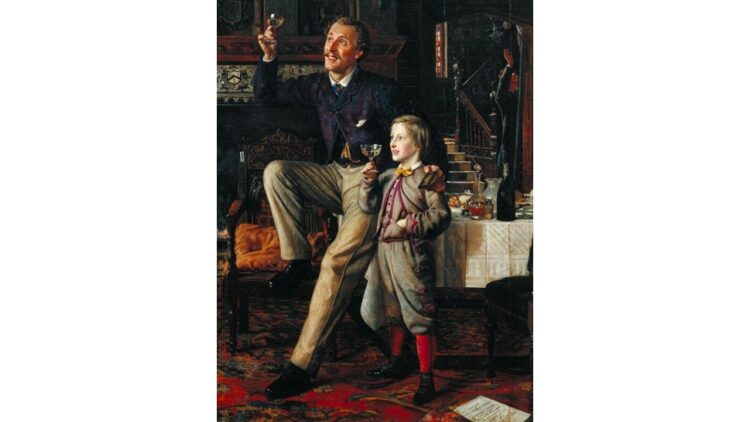
A note on the illustration that Evan has chosen for this poem — it was used by the modern paperback publishers for the cover of Samuel Butler’s excellent novel “The Way of All Flesh” (1902, I think). That is one of the most important novels in English literature dealing with father-son relations, and how they can be decisive in the psychological crippling of a child, or in his coming to manhood. For a similar text (also English) on the same subject, see Edmund Gosse’s “Father and Son,” an autobiographical account of a deeply fraught parent-child relationship.
Thank you so much, Joe. I debated whether or not to submit this poem to Evan for a very long time. It felt too personal, maybe even too ethnic. But I realized that I would regret it if I didn’t at least submit it. Now I’m very glad I did. Readers have found something universal in the my memories of my father so that the piece is not limited to Jewish experience.
I did not intend this as a Father’s Day poem. I actually wrote this poem a year or so ago when I was particularly distressed by the extensive antisemitism I was witnessing (and still witness) on a daily basis. My father was a Jewish man, a very gentle man, an educated man with strong values and a deep hunger for justice. He was a New Yawker from Brooklyn who never lost his NY accent and who I loved very much. But what really made me write this poem was the realization that it truly was a mercy that he died long before the horrific events since October 7, 2023 occurred. He never had to see his world crumble or witness the kind of antisemitism that now occurs when smug bigots like Mamdani have power and where the woke and the Islamists have managed to defame an entire people.
As for the poem itself, you understand exactly why I structured the poem as I did. Yes, I wanted the breathing space to meditate on life with my father. I also wanted to take my cue from the Aramaic words which start the Mourner’s Kaddish — the “rabah” is a natural stopping place in the prayer and that left me with a line of six feet. So I ran with it, so to speak. That also led to my use of the Hebrew word for father, “abba.” I usually just called my father “dad” but I remembered how the main character in Chaim Potok’s “The Chosen” referred to his father as “abba” and decided it worked best.
Thank you again, Joe, for these appreciative comments and for the insight regarding Evan’s choice of image.
And a heartfelt thanks to Evan for accepting this poem and encouraging it to be published despite my ambivalence.
Amen a thousand times. “I hope you know your memory will never fade.” Memory acts (not stands but moves) as bridge between past and future. Your kaddish, Brian, fades in actively, with memory present in multiple modes, as the ancient words fade out. The poem moves in and out like a sine wave. A sign as well as a sigh to be repeated. Poignant.
Thank you very much indeed, Margaret. I especially like your appreciation and understanding of memory — a bridge between past and future is beautifully and accurately phrased. I also appreciate your mention of the “sigh.” I actually use the word in the penultimate line almost as a stage direction so as to allow for a volta which might otherwise have seemed too abrupt.
I love the stately, considered and precise syntactical movements of these lines and how they reach that wonderful rhyming and decisive couplet: you’ve nailed it! Wonderful work.
Thank you very much, James. I love the adjective “stately” for this. As I mentioned to Joe above, the Aramaic prayer dictated the hexameter, and yet as I wrote in this form I found myself able to really open up and allow memories to be expressed without having to overly-pruned. Pentameter would probably have worked but I think any poem with less than 5 feet would have caused a real diminishment of tone as well as meaning.
Brian, I can’t add anything of value to what’s been said above; but I found this piece very, very moving. Thank you for your honesty and your poetic skill in sharing it.
Thank you so much, Martin. This generous comment means a lot to me.
How wonderful to have been well-nurtured, encouraged, and loved by your Abba (and Ima). So great is your love for your father that you unendingly represent him honorably every day. If knowing you is to know something of your parents, then my envy is multiplied exponentially. Your beautiful tribute melts my heart, Brian.
May their memories be a blessing always.
Thank you so much, Laura. To live up to my father’s level of integrity, leadership and generosity is a pretty high hurdle to clear. I don’t think I do, but it pleases me to try. Yes, his memory — and that of my mother — is indeed a blessing. Every single day.
Ishar Koach, Brain! This one was profoundly moving. I imagine that your dad is proud of you from above (and so is your creed).
And a cool maneuver leading the reader rhymeless through an almost entire poem, only to land on a strong couplet at the last minute…
Thank you very much, Golan! I certainly hope my father is pleased with this offering of memories and appreciation. And thank you for noting that rhyming couplet at the end of the piece. It seemed like a fitting way to cap the poem — especially since I change focus a little at the end.
Brian, what a great Father’s Day tribute to your dad. Personal information is something I feel we are in greater need of on SCP to bring us all closer together as you have done and shown us. The emotional content is something to which we all can relate.
Thank you very much, Roy! I fully agree — I think it would be a great thing for poets to share more of their personal histories and experiences in their poetry. Not only do we get to know each other better but it is often said that the best writers write about what they know. And I’m glad you felt that the emotional current was relatable. I wasn’t sure if it would be and so was hesitant about submitting this piece.
Thank you for such a touching and heartfelt poem about your father, Brian. May his memory be for a blessing.
Oseh shalom bimromav,
Hu ya’aseh shalom aleinu,
v’al kol Yisrael,
v’imru: Amen.
Thank you so much, Theresa! Believe me, his memory is truly a blessing. And thank you for quoting the last section of the Mourner’s Kaddish. I will translate: “May there be abundant peace from heaven, and life, for us
and for all Israel; and say, Amen.” I think many readers would see the word “shalom” and readily understand this to mean “peace.” It is worth remembering, too, that “Amen” is a Hebrew word which means “so be it.”
What a wonderful Father’s Day gift to all of us! Your personal memories intertwined with my own thoughts today about my beloved dad.
Thank you very much, David! This is a wonderful thing to hear!
Brian, your beautiful and moving tribute to your father on Father’s Day only reminds me of the daunting conflictions between my dad – who passed several years ago, and I, that still today coax me to forgive him for his parental ‘flaws’ despite our sudden and total alienation in my high school years. Ironically, ‘homeless’ at 15 made me a stronger and wiser man. Your piece is wonderful.
Thank you so much, Mark! I’m so sorry for all of the tribulation you went through with your dad. I must confess my own relationship had its rocky moments, but I never doubted my father’s love and loyalty. I can’t imagine what you must have gone through. But, as you say, you have become a stronger and wiser man as a result. This is, I think, the most positive way to deal with adversity: to allow it to fuel self-reliance and self-improvement. I appreciate your kind words and the personal experience.
This is a touching package of memories, Brian, made more affecting by the simple language, with no straining for effect. To remember what should be remembered is to fulfill an honorable duty, and you’ve done that very gracefully here.
This is such a beautiful comment, Bhikkhu! Thank you so much. I very much appreciate the idea of an “honorable duty.” I’m grateful for the opportunity to do something for my father. I wish I had done more for him when he was alive, but at least this is something.
Beautiful poem, Brian, as testified by all of the above. I had occasion to reread
another of your heartfelt poems this morning while re-reading e-mails with
an old friend who passed away last November. “The Prayer Blanket” is what I
had sent him. So I thank you twice today.
Thank you so much, jd. I’m so glad that you enjoyed this and that you also returned to “The Prayer Blanket.” That “The Prayer Blanket” has brought comfort means a great deal to me. My deepest condolences on the loss of your friend.
Brian, I know firsthand how difficult it is to craft with precision and effectiveness an emotional poem when the subject matter is dear to one’s heart – and you do this so perfectly and admirably. I feel every line personally, especially:
I’m prouder of you, Abba, than I’ve ever been.
I hope you know your memory will never fade
And that my love stays strong these decades since you died.
I have a firm belief that we do not know the depth of a loving father’s sacrifice until we are wise enough to know the ways of this wicked world and the lengths fathers go to to prepare us for the harsh realities. Sadly, I am estranged from my father, but that doesn’t stop me loving, appreciating, and gaining from all he taught me… lessons I’ve passed on to my son who is a wonderful father to my granddaughter. Your poem has captured the essence of fatherhood in a way that speaks to my soul, and for that I thank you!
Thank you so much, Susan. I would like to say that those lines were planned but in fact they came almost at the very end of writing — a summation, as it were, of the import of all those memories and lessons. But now I think they are my favorite lines as well. And you are so right — we cannot know the depth of a loving father’s sacrifice until we ourselves understand the harshness of the world that he navigated. I’m only four years younger than my father when he passed away so it is very humbling for me to realize that I am now older than he was for the vast majority of our shared life together.
I am so sorry about the estrangement. The fracturing of families has become a staple of life in this horrible age of division and lies. But thank God for your son — he sounds like a wonderful man ==one to be truly proud of. Thank you again, Susan. Your emotional reaction to this poem gives me great satisfaction.
Brian, rhymeless poems seldom hold my interest, but yours did. It’s packed with emotion, and as Golan states above, the final rhyming couplet provides an emphatic ending.
Thank you so much, Cheryl! I’m so glad this emotional piece resonated with you. And that rhyming couplet seemed to offer natural closure. I’m glad you agree.
This is where emotions call for utmost simplicity, as the meaning takes over. It’s all there, ad maximum: intimacy, spirituality, nostalgia, a millennia -old Jewish prayer and the mitzvot. Z”L. May his memory be a blessing.
I’m very grateful for your comment, Michael! Thank you! My father died when I was 36 years old, but we were able to pack a lot of memories into those 36 years. His memory is indeed a great blessing — but I wish I had said more to him when he was alive. I have learned a valuable lesson — don’t wait to let people know you love them. Tell them and tell them often.
I have seen the way Jews grieve close-up, as one of my best friends at Wesleyan was a Sephardic Jew who often invited me to his parents’ home on major feasts and holidays. Later, at his place in Maine I took part in many a shabbat meal. When his mother died he abstained from shellfish for an entire year, even though his family was anything but kosher. The poem was comforting and syntonic with many of the thoughts and recollections that have passed through my inner sanctum lately.
Thank you so much, Kip, not just for the generous comment but also for the wonderful memory of your friend at Wesleyan. Jews seem to have a special relationship with grief because it so pervades the liturgy and a dedicated period of mourning and remembrance is included in almost every worship service. Sabbath services always include a time of rememberance for the departed, we always light candles on the anniversary of a loved one’s death, we have special services for the unveiling of tombstones, we collectively remember the many tragedies that have befallen Jews resulting in death, ranging from the destruction of the Second Temple in 70 A.D. to the Holocaust and, now, the massacre of October 7, 2023. The constant focus on remembrance can be a bit overwhelming but it binds the Jewish people together. Collective memories are very deep which is why “never again” is repeated with such depth of feeling.
Thank you for sharing this deeply personal poem. I can imagine this work is very close to you. You certainly bare your thoughts about your love for your father in a way that is immediately relatable – the firmness and discipline alongside tenderness, all rooted in love.
You do the Kaddish justice after it has been abused so much – notably by Leonard Bernstein.
I’m very grateful for this beautiful comment, Adam. Yes, this was a personal poem but — as you well know yourself — baring one’s soul is a professional risk of becoming a poet! I’m deeply glad you registered the love even in the discipline and the darker parts of the father-son relationship. And hearing that this piece did justice to the Kaddish means a great deal to me. Thank you, Adam. Now I must take some time to listen to the Bernstein version!