


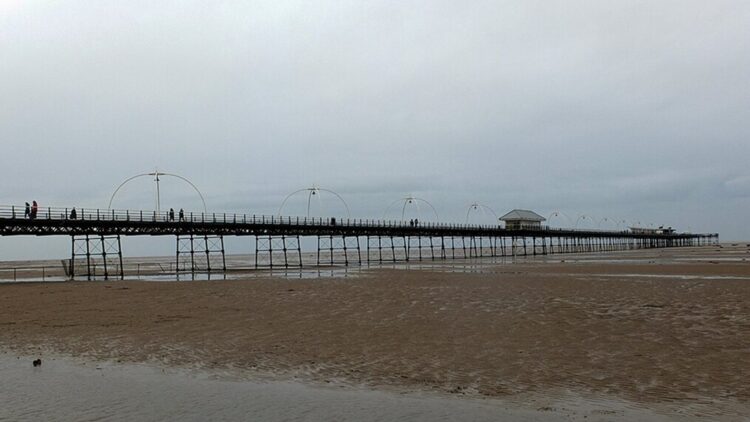
The Estuary
—at the “seaside” resort of Southport, England,
where the sea is always miles away
I must have been just nine or ten,
I really can’t remember when
We’d travelled from our smoky town,
Upon the beach, we settled down,
Beside the rolling estuary,
We seldom caught a glimpse of sea.
We ran to seek it every day,
It seemed a million miles away.
Now three score years have come and gone,
Again, I sit beneath the sun.
Remembering, that kid was me,
I gaze in vain, but still can’t see.
The tide rolls in, the ebb and flow,
Oh, where did all those decades go.
Toward the far horizon’s hills,
The far-off sea eludes me still.
Jeff Eardley lives in the heart of England near to the Peak District National Park and is a local musician playing guitar, mandolin and piano steeped in the music of America, including the likes of Ry Cooder, Paul Simon, and particularly Hank Williams.

















Jeff, this is one of those perfectly attuned poems comparing the seemingly far off tides with life.
Oh, thanks for your comment Roy. The estuary town of Southport was the subject of a horror story in 2024 where a knifeman stabbed to death 3 little girls and wounded many others at a dance school. This was the seaside town of my childhood.
These are nice quatrains on a childhood remembrance. One minor suggestion: place a question mark at the end of the second line in the final quatrain.
One rarely hears the word “estuary, and most of us need to look it up to find out precisely what it means, geographically. The only place where it seems to be used beyond that is in linguistics, where the phrase “Estuary English” (EE) is now applied to a London-based pronunciation that seems to be in competition with the traditional “Received Pronuciation” of the twentieth century British English.
Thanks Joseph. The “seaside” town of Southport was the location of an event of appalling horror in 2024. It is sad to replace my childhood memories with such a dreadful event. Thank you for taking the time to comment,
Joe is right. As it stands, the sentence is run-on.
I reminisce with you Jeff. I went with my family to Southport beach a number of times, hoping to paddle in the ocean that was too far away, (paddle meaning wading for anyone picturing a canoe). 🙂 Thank you for the memories and a most enjoyable read.
Norma, so did I. I recall heading for the sea in an amphibious vehicle called a DUKW. Happy .days indeed.
“We ran to seek it every day,” in the first half of the poem, gives the child’s point of view about the sea, a symbol that implies or contains more than one can see. Abruptly, in the latter half of the poem, one meaning (sea = life) is revealed by the adult perspective. The transitioning between, Jeff, makes the poem. It’s more than a memory; rather, sea and tides and estuary become a kind of mystery framed by the hills behind, and gradually suggesting still more to a reader. Yes, I like it!
Margaret, thank you for taking the time to comment. Your work and your analytic contributions are a huge part of the SCP family.
I like that, Jeff. Like an unobtainable mirage, a seaside wannabe.
I’m not sure if estuary is such an unfamiliar word in the UK. Maybe it’s used more since the UK’s an island with lots of estuarine rivers.