


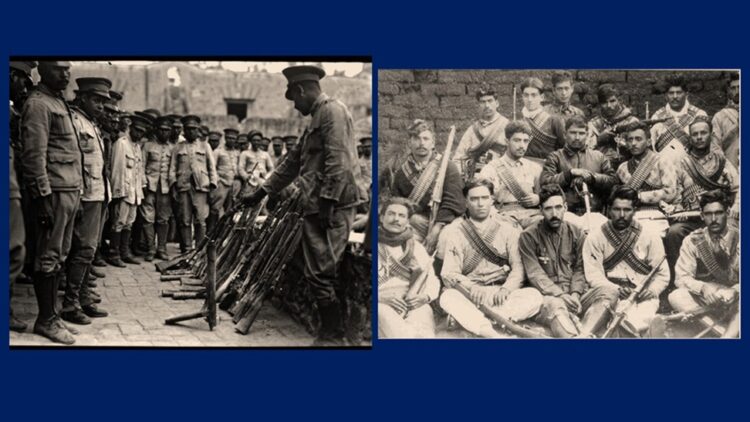
The Cristero Centennial
In Mexico a hundred years ago,
The government forced secularization.
Its liberal politicos roared “No!”
To worship and religious education,
To convents, vows, processions, celebration
Of marriages and funerals that show
Devotion in a Christian civilization.
The communistic head of state and crew
Were ruthless hypocrites with much to do:
Enforcing law meant culture had to go,
And every criticism would be banned;
Church buildings seized by nationalization
Were given back in 1992.
Still, piled-up stones are not the Church. Faith grew
First peacefully against crude bigotry:
Boycotts, petitions, talks, tax payment strikes
Only increased the godless zealotry.
On August third of 1926,
Four hundred fought, the first Cristero band:
“Without a priest’s permission or command,
We throw ourselves into this blessed struggle
For freedom! Without permission or command,
We will continue till we win or die.”
Eighteen died that day. Two hundred thousand
Were killed in three unyielding years of war;
More yet, in twelve years of state treachery.
The common lay folk led in being martyrs;
Their bodies hung on telephone pole crosses.
Remembrance activates no frail nostalgia,
But firm commitment. “Viva Cristo Rey!
Viva la Virgen de Guadalupe!”
Whispered and shouted for a hundred years,
These words join earth with the celestial spheres.
Cristo Rey: Christ the King
Margaret Coats lives in California. She holds a Ph.D. in English and American Literature and Language from Harvard University. She has retired from a career of teaching literature, languages, and writing that included considerable work in homeschooling for her own family and others.













This is a fantastic preview of what could happen here! What a great treatment of classical historical proportions. I remember studying the communist rise and demise in Mexico in my graduate history minor. If only our younger generation could learn from history. The time has come for action by Christian forces of righteousness before the enemy within become overwhelming for even a short time.
Thanks for your comment, Roy. From your history studies, you would realize that the United States started out on the wrong side in the Cristero conflict, probably because the Mexican party in power did not identify as “communist” (I call them “communistic”), and because in the 1920s the full horrors of communism were only beginning to become obvious, and because there were influential persons in the U. S. who favored leftist totalitarianism. Your recommendation of watchfulness and pre-emptive action today is a good one.
I had the same thought as Mr. Peterson as I was reading your excellent poem, Margaret. Thank you for casting light on a very sad part of history, the likes of which we ourselves seem to be courting.
Thank you for appreciating my poem, jd. The Cristero history, relatively close to us in time and just across our southern border, is too little known. It’s a good indication of what can happen when secularization overwhelms our institutions.
Hi Margaret,
Thanks for this bit of history!
Have you ever read Grahame Greene’s “The Power and the Glory”? I can never think of Mexico under communism without bringing that novel to mind.
Jeremiah
Thanks, Jeremiah, for bringing up that early work of art about the Cristero conflict. It was published in 1940 while the persecution was still quite active. 1929 to 1941 are the “twelve years of state treachery” mentioned in my poem. There were still many being murdered after the 1929 ceasefire agreement. Sufficient research hasn’t yet been done to determine the numbers, but it looks like more than the 200,000 during the years of declared war. What Greene describes in the novel is not the outright violence that was still happening, but the cultural strangulation aimed at stopping Catholic practice by tempting and/or forcing priests to abandon their proper role. Not to mention that many well-populated Mexican states would not license a single priest anywhere in their territories.
Hi, Margaret. Like Jeremiah, I’ve read about this chapter of Mexican history through the lens of Graham Greene, so it was nice for me to be reading of these events and not being totally ignorant of them.
Your poem is as inspiring in its way as the ‘whiskey priest’ in ‘The Power and the Glory’.
Thanks for the read.
Thank you so much, Paul, for finding the poem inspiring. Its method is much more “outline history” than Greene’s absorbing fiction. Interesting that the first important work of art on the Cristero War was written by an Englishman and published in Britain (with a different and less intriguing title when it was published the following year in the U. S.). The United States was notoriously silent, despite the presence of a quarter of a million Cristero refugees in our southwestern states. In Mexico itself, there may be some lines of poetry written in the 1950s by Octavio Paz, who was a young teen during the War, and in his 20’s through the aftermath. But if so he treats the matter in a highly symbolic way. As I imply above, there was no real regime change. The Church won back the right to own property in 1992 only because that was negotiated by the charismatic Pope John Paul II, in connection with a visit very much wanted by many Mexicans.
Hello Margaret C.
This is, indeed, an ominous poem. My mind returns to the relatively “innocent” mid-century decades when corruption, upheavals, political tensions, religious persecutions , etc. were not in the every day mind-set ( at least in the Midwest) as those issues are today. Society and civilization seem to be at great risk today with so many under-currents raging. Your poem reminds us .
Thanks for your comment, Margaret B. You’re right that those mid-20th century decades seemed innocent to us, and I think there are two plain reasons for that. The first is the United States Constitution with our guarantees of rights including freedom of religion. We might look around and see the lack of such in communist countries, but we could feel secure and constitutionally protected at home. Not so in Mexico, where there had been no stable constitution during its entire history of independence from Spain. The second plain reason is that bigots in our country, corresponding to the enemies of religion in Mexico, did not feel strong. But you and I have experienced a gradual increase in bigoted vigor, starting with the forbidding of the simplest public prayer, even a moment of silence to start the school day, when students might pray on their own if they wished. My poem reminds us of our civilizational danger, by pointing out that (as in Mexico) those threatening our rights adhere to their own secularist religion and wish to impose it, caring nothing for constitutional rights, and intending to impoverish culture of its spiritual elements.
Thank you for the excellent poetic history lesson, Margaret. May courage not fail us.
Cynthia, thanks for your response. We need those cardinal virtues.
God bless you for writing this! Indeed: A warning. But also a joyous proclamation: Jesus is King! Now and forever!
Thank you, Stephen. The poem and the events it recounts have two levels or perspectives, which gradually becomes apparent in the story of how the Cristero War began. The values and determination of individuals shine, but why? Because they understand the worth of the human spirit enough to make that joyous proclamation which was their war cry and password. Viva Cristo Rey!
A somber reminder of what happened not too long ago. I fear that same atmosphere has engulfed the world we live in today. Prayers and courage, Viva Cristo Rey!
Thank you for your comment, Angelica. The threatening atmosphere does seem more widespread than it was. Communism and its hatred for religion was on the rise in certain places when the Cristero conflict took place. Seems to have fallen dramatically, but returned in other forms. Viva Cristo Rey!
Great history lesson poem Margaret, thank you. Christ is King indeed and the gates of hell cannot prevail against Him.
And thank you for a heartening response, Yael!
It’s hard to believe that something like this has been suppressed from the history presented to us in academia. I had never heard of this until a handful of years ago and as I ask family and friends about it, neither had they.
I think history is repeating itself across the world in Nigeria. So few people are aware of what is now happening there.
Yes, Laura, history has been suppressed. And Nigeria today is comparable.
As for the suppression, I first heard of the Cristeros in a lecture by man who lived and went to school in Mexico until he was about 12 years old. He never heard of the Cristeros in Mexican school. He immigrated to Los Angeles and graduated from American high school. Never a word of the Cristeros even in a part of the United States close to the conflict. This man speculated about why. One reason, he thinks, is sensitivity about conflicting loyalties within families–especially since Mexican federal troops who participated in the battles and killings may not have wanted to. Many would have been Catholic, but as federal soldiers couldn’t refuse commands without being shot for insubordination.
Nigeria is worse because there is less reason for the disinformation. Those of us who are old enough heard about Biafra on TV news in the late 1960s as a “rebel” state defeated by the Nigerian national government. What we didn’t hear was that Biafra declared independence because of religious and tribal persecution against Christian Ibo tribespeople. This has heated up again with the killing of native Catholic priests among the Ibo.
Laura, as I forgot to say earlier, thanks for your taking time and effort to read the poem and make your comment!
Thank you Margaret for sharing this piece of history with us. I very much identify with the tone of your poem and its sentiments. In 2020 my poem “The Ballad of Babi Yar” was published here at SCP. It describes the massacre of Jews and other “undesirables” by the Nazis in a ravine at Babi Yar in Ukraine at the beginning of WWII. Your poem reminds me so much of it. Kindred spirits!!!
https://www.classicalpoets.org/the-ballad-of-babi-yar-by-theresa-rodriguez/
Your poetry is very unexpected, surprising, enlightening, educational, not to mention so beautifully executed!! There is so much beauty in the way you put your interesting topics to verse, even (and maybe especially) in a telling of the tragic Cristero war, which Evan published on its Centennial. I learn so much from you, by way of what you write about, and how you write it. I truly look forward to more of your unique poetry!!!
Thank you, Theresa. The first thing I did to answer this comment was to go back to your “Ballad of Babi Yar” and post a comment better than the one I might have made in 2020. That poem and this one do have similarities beyond the nature of the topic, though our styles are not similar. We both examine the motives of evildoers, and anyone can see what I said about your procedure, in my comment on your ballad, much more recent than others you received. In “The Cristero Centennial,” I make two points about the culture-crushing government. It’s hypocritical, trying to disguise its hatred of religion under cover of maintaining law–the infamous “Calles law” made by the persecutors for their purposes. More important, perhaps, the Mexican government was not irreligious, but adhered to its own fanaticism that I call “bigotry,” “zealotry,” and “treachery.” This is the way of all “communistic” powers, whatever rational excuse they present at first for restricting or forbidding the religious expression of the human spirit.
I had no idea about the Cristero War before reading this, which sent me down a bit of a rabbit hole afterward. It’s striking how recent it was, and how little I knew about it.
A few lines really stayed with me. “Still, piled-up stones are not the Church. Faith grew” felt especially powerful-the distinction between the physical church and the faith of the people says so much in very few words.
“Their bodies hung on telephone pole crosses” is such a stark image. It made the violence feel immediate, but also connected the suffering of the Cristeros directly to the imagery of crucifixion.
And I loved “Whispered and shouted for a hundred years.” There’s something beautiful in that contrast-the idea that faith can survive both quietly and defiantly, in private and in public.
This gave me both a poem to think about and a piece of history I’m glad to have learned more about.
Thanks so much for your comment, Nicole. Those words about “piled-up stones” were spoken at the time. While the government took the buildings, they didn’t stop there, because it was the Faith and culture they wanted to destroy. The “telephone pole crosses” were so real and so frequent that you can see a picture of three in a row at the Wikipedia article on the Cristero War. I could not have written a poem on this subject without those words “Viva Cristo Rey! Viva la Virgen de Guadalupe,” because these were the battle cry, secret password, and mark of identification during the time of the war and its afteryears. They became so impressed in faithful minds that they have continued in use long after. I heard them from others and joined in shouting them myself following covid church closures. As you say, whether used quietly or defiantly, they oppose persecuting power in any form.
I’m extremely glad to see you devote your talents to reminding us all so vividly of an event that elite opinion has tried its best to memory-hole. Reading the comments above, you’ve brought awareness to at least one reader. Viva Cristo Rey!
Thanks, Adam. Writing this came from heartfelt obligation. My tiny California parish is also celebrating its centennial this year, having been founded by Italians who entered the United States through Mexico. Here they were in 1926, with an outlook of American opportunity, building a new church modeled on one back in the Piedmont area, while fellow Catholics not too far across the border were battling to the death with churches closed. Time to remember them all with awareness and commitment. Viva Cristo Rey!
Epitaph
José Luis Sanchez del Rio had so pure a heart;
we will not see his like again on this old-weathered Earth;
yet still his cry can be heard now, years since he went away,
along with those who bravely shouted, ‘Viva Cristo Rey’.
Many thanks for this pure tribute to the boy who is the best known of the individually canonized martyrs from this time and place. Orent pro nobis.
correction:
José Luis Sánchez del Río
Thanks for getting all the accents right. You lead me to mention the nickname, too, “San Joselito”!
I was unaware of this piece of history until the movie, ” For Greater Glory” came out. A beautiful poem Margaret! Thank you for sharing. May God Bless all the “Cristeros” who fought so valiantly for our Lord Jesus Christ and freedom to worship God.
Thanks for your comment, John. “For Greater Glory” really opened our eyes in 2014. The more I hear of the Cristeros, the more impressed I am by them as faithful soldiers of Christ the King. Freedom for the good, in many ways, was an important aspect of their battle, as I quote directly from their description of that “blessed struggle.”
Margaret, Thank you for posting this wonderful poem. Thank you also for your additional observations and facts that followed after your readers’ comments. In the case of the Cristeros and the other attocities that we have witnessed in rcent history there exists among the persecutors a belief that what they are doing is good and justified by certain closely held “truths”. St. John, quoting Pontius Pilate wrote, “Truth, what is that?” I submit that dangerous seeds are planted when a society accepts, without question, a claim that “My truth is not your truth.” There is only one truth: Cristo Rey!
Your comment on the belief in a variety of “truths” is much to the point, Gary. Each person or party with a “truth” valid for self or group becomes a danger to others. More so, it seems, than with any traditional competition for resources that might be settled by an appeal to justice recognized by all. In reading more of the Cristiada, I was struck by a comparison of the conflict to that experienced by the Greek heroine Antigone, in the ancient play by Sophocles. It was called a conflict between demands of a ruler and the demands of divinity. Viva Cristo Rey!
We appreciate you, Dr Coats, for highlighting the centennial of the Cristero War with your eloquent writing.
It is good to bring these harsh realities to light.
For decades there was an absolute silence agreed upon by both the Mexican government and the Catholic hierarchy resulting in almost an erasing of history.
Many Cristeros were hunted down and executed by the government after the pact was signed.
Viva Cristo Rey!
Thank you, Loretta, for a very serious comment mentioning aspects I have hardly touched in the poem. After I’d written it, I was given a copy of the best current (but still incomplete) book on the subject,
THE CRISTERO COUNTERREVOLUTION AND THE BATTLE FOR THE SOUL OF MEXICO
by Father Javier P. Olivera Ravasi
English translation (2025) from the third Spanish edition, first published in Argentina in 2019
“Only now, in the twenty-first century and already a hundred years after the events, we are beginning to access the sources and archives that, little by little, have become available. We see how the Mexican people not only applied the doctrine of the right to rise up against oppression, but even brought about, without realizing it, the Church’s proclamation of a right already found in ancient Greece and in the New Testament (Acts 5:29) where the Apostles say they must obey God before men.”
Thank you Margaret, great way to honor our Cristeros.
Blessed,Anacleto González Flores: “No hermano, ya no es tiempo de confesarse, sino de pedir perdón y perdonar. Es un Padre, y no un Juez, el que te espera. Tu misma sangre te purificará.”Translated into English, it means: “No, brother, it is no longer time to confess, but rather to ask for forgiveness and to forgive. It is a Father, and not a Judge, who awaits you. Your own blood will purify you.” The Context of the QuoteAccording to historical and biographical accounts from Catholic archives like ACI Prensa, González Flores spoke these final words on April 1, 1927, moments before his execution by a firing squad. He addressed this specifically to his close friend and fellow captive, Luis Padilla Gómez, who had expressed a deep desire to receive the Sacrament of Confession from a priest before they were shot. Because no priest was available in their prison cell, Anacleto comforted Luis by reminding him that offering their lives as martyrs out of love for God would serve as their ultimate purification. Moments later, Anacleto also famously forgave the military commander orchestrating the execution, General Jesús Jaime Quiñones, stating that they would both soon face the tribunal of God, and offering to pray for him.
Moises, my thanks to you for what is another and yet more beautiful poem, these words you quote from the handsome life of Anacleto Gonzales Flores. “El Maestro Cleto” is the finest example of the Christian and moral character ordinarily found among the Cristeros. Thank you as well for being one of the first readers of my poem (when it was still only handwritten!), and for giving me the book, THE CRISTERO COUNTERREVOLUTION. I’ve heard that the author, Father Javier Olivera Ravasi, has been speaking at several places in the United States, finally letting us know more of those terrible and highly instructive war years. May he and others continue the research and bring fuller truth to light!
Dear Margaret,
Thank you for educating so many about the Christeros! This poem reminds me of how ancient man understood History, namely, as a story. If more modern history books could be written with a bit more attention to language as an art form, perhaps more of us would remember it. I’ve been meaning to look into the Christeros for a while because, as an American Mexican, it is my heritage.
It doesn’t surprise me that America started on the wrong side of the conflict. We have a complicated history with the Mexican people in general. The Mexican Repatriation during the Great Depression was not long after 1922. My family was among the American Citizens who were tricked out of their land, promised work, and then left in the desert without any resources. My grandmother was born under a tree in Mexico because the rest of the family could not re-enter the US despite being US Citizens who didn’t even speak Spanish at the time. My great-uncles were finally able to get back into the country when they enlisted during WWII (though most of them were underage). Suffice it to say, we have a speckled history, but what unifies the common people of both Mexico and the US is resilience!
Viva Christo Rey!
Thanks for commenting, Lauren. We do have a complicated history! The Cristero conflict has a big part in it, because in addition to the actual battles that took place, many Mexicans fled their country during the Cristero War years, and during the preceding years of revolution before the horrifying persecution of religion began in earnest. It’s interesting that the official American Repatriation of Mexicans began in 1929, the year of so-called Settlements that were supposed to enable Catholics (the vast majority of the population) to live peacefully in Mexico. As Loretta Garcia comments above, Cristeros were still being hunted down and executed after that. It wasn’t until World War II (exactly when your great-uncles were able to re-gain U. S. citizenship by military enlistment) that things calmed down. That was helped as well by the persecuting leaders of Mexico dying or fading from power during the 1930s.
As I said in reply to Mrs. Garcia above, the best book so far to look into the Cristeros is Father Javier Olivera Ravasi’s THE CRISTERO COUNTERREVOLUTION AND THE BATTLE FOR THE SOUL OF MEXICO (in English, 2025). It’s excellent history according to the sources, but full of individual stories (personal letters and accounts) that make history interesting and memorable.
This is an amazing poem. Thank you for gracing the public with this work. It is such an important piece of history. ¡Viva Cristo Rey!