


.
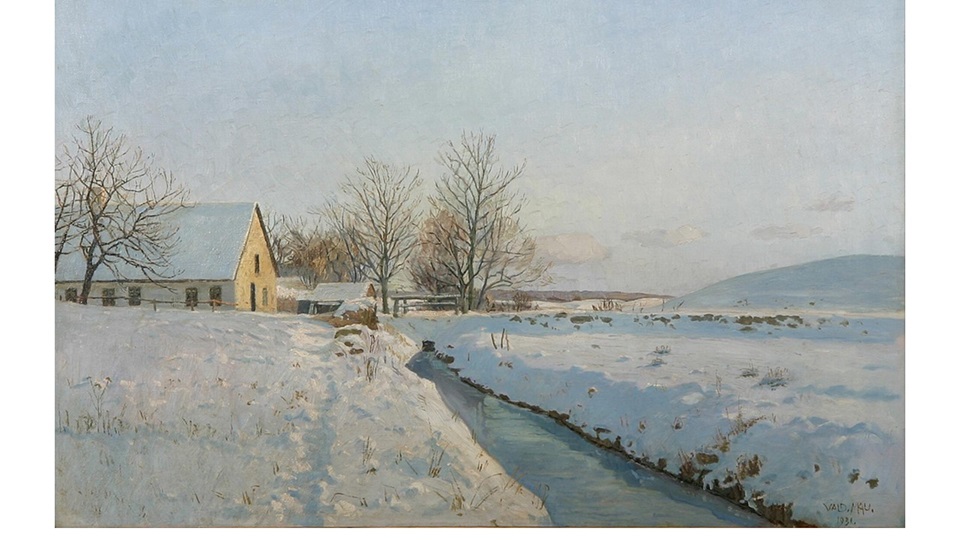
A House in Winter
Preternaturally silent, still.
The omnipresent biting chill,
And deepest, darkest night surround.
The snow’s soft crunch, the only sound;
Fierce, unrelenting wind gusts down
From boreal realms afar, unknown
Through naked woods, through night-abyss,
To chafe and rouge with icy kiss.
Yet winter chills and haunts no more
Behind that small and distant door.
Behind it, torrid air hangs calm,
Perfumed with woodsy, pungent balm;
The candles cast their warming glow;
And songs and laughter ebb and flow.
That inner world, so finite, hides
Engulfed by night on all its sides;
Its windows lure with muted glare
And none unbidden enter there.
.
.
First Snowfall
Autumn chills with its cheerless airs,
Rustling faded, fallen leaves
Lying sere on what green death spares,
Piled in high, haphazard sheaves.
Snow-flecks fall from the steel-gray sky
Gently, in a soft cascade
Silently they descend and die,
Melting on the promenade.
Some survive where the leaves lie, stay,
Gather, veiling them in white,
Stainless, showing the world’s decay
In a mystic, peaceful light.
Fair it is, but the fast-come snow
Spreads the pall that drapes the tomb
Where the fallen no longer grow,
Left to winter’s icy doom.
.
.
Snowfall
Conceived in Heaven, high above the shroud
That births them, unshorn veil of darkened cloud,
They gently but inexorably fall
To vanish on Earth, powerless to stall
Their end, but fall with grace, and so enthrall:
An endless swarm of numberless white flecks,
Each singular, elaborately complex;
As they run their brief course from cloud to mire,
They twirl, they dance, caught in the whirlwind’s gyre,
Free, joyous, reveling till they expire.
They vanish, fallen in the frozen sea
Of white drifts stretching to eternity,
Their singularity, their beauty fled,
Melded as one, dissolving with the dead
In Earth, the sustenance whence Spring is fed.
.
.
Adam Sedia (b. 1984) lives in his native Northwest Indiana and practices law as a civil and appellate litigator. He has published four books of poetry and his poems, essays, and fiction have appeared in various literary journals. He is also a composer, and his musical works may be heard on his YouTube channel.












“A House in Winter” reminds me of an old mountain cabin with the candlelight and smell of wood. I love the images of this poem.
“First Snowfall” gave me a feeling of melancholy, especially with the last verse point out the fallen with the “tomb” and “icy doom.”
“Snowfall” is solemn, but ends with the value of snow and the prospect and hope of new birth in the spring that benefits from the fallen snow.
Thank you for sharing your impressions. I’m glad my poems could make them.
What a wonderful picture you paint in ‘A House in Winter’. My fave line was: ‘To chafe and rouge with icy kiss’. Subtle, yet sensual.
‘First Fall’ lulls us into a false sense of expecting a typical autumn poem, which it is until that spectacular last stanza.
‘Snowfall’ also had some fantastic images and thoughts on snowfall, but this was usurped by that final haunting couplet that’s ultimately filled with optimism and hope for the advent of spring.
Thanks for the reads, Adam.
Thank you for the perceptive comment — especially for catching the hidden sensuality in the verse you quote. And I always enjoy hearing my work described as “haunting.” It’s one of the hardest effects to achieve, I think.
All three poems are beautiful evocations of winter, but let me comment on the first one.
The poem divides neatly after the fourth couplet. The beginning is about winter itself — its strength, force, and biting cold. The following four couplets present the contrast of a home, where the winter is kept away with warmth and light and human cheerfulness. This structure allows for several simple metaphorical meanings: death vs. life, raw nature vs. humanity, pain vs. comfort, darkness vs. light. There is even the typical “turn” word (Yet) at the start of the fifth couplet, signalling the division just like a sonnet’s volta.
But the poet adds a final ninth couplet, which serves as an additional judgment that goes beyond these ordinary oppositions:
Its windows lure with muted glare
And none unbidden enter there.
This is more than mere description. This final couplet puts the entire poem into the realm of conflict, contestation, and warfare. What is being asserted here is the exclusivity, independence, and walled-off status of one’s life, home, and private property. No one who is a stranger may enter the home “unbidden.” The “glare” of its firelight is not just for warmth, but for warning. In short, Adam has thrown in just a dash of meaning or message — not plainly stated, but suggested purely by this imagery. And that’s the way meaning and message should be employed in poetry — like a very small dash of cayenne pepper, and not as a blaring neon signboard.
The reticence of this final couplet makes it all the more powerful. We live in a world where there are massive assaults on our property, privacy, and independence. The morally sanctioned requirements of altruism are officially shoved down our throats. Floods of strangers and “others” swirl around us, like a winter snowstorm. This small poem says NO to all that violent intrusion.
Let me add something else about Adam’s diction. The words in the poem would send the Plain Language Police of the poetry workshops into a screaming fit. Just look at the lush vocabulary: preternaturally, omnipresent, boreal, night-abyss, torrid, pungent, engulfed. Adam’s rhetoric is in itself another part of the argument! He is giving the middle finger to a world where sameness and plainness and mindless conformism in discourse are the accepted standard, and where any other kind of language is considered elitist or arcane.
This is not just a Christmas-card poem. It is also an attack on our enemies, and the world they are trying to impose on us.
Thank you for your careful and well-thought analysis. I particularly appreciate your recognition of what I was trying to achieve in the final line of “A House in Winter.” You capture the idea masterfully.
Thank you also for your compliments about my vocabulary. English has a marvelous palette of words — much richer than in most languages. Avoiding some because they might seem difficult or arcane only hurts the poetry. It would be like painting without certain colors simply because they’re too bright or too dark, regardless of whether they’re appropriate for the composition. I pride myself in using all the resources English will afford me.
I thoroughly enjoyed your three outstanding poems. My favourite is “A House in winter” it reminds me greatly of one of my favourite poems “The Listeners” by Walter de la Mare. Although in your poem, behind the door lies welcoming warmth and a glowing sanctuary from winter chills.
Thank you! I am an admirer of de la Mare — I even wrote an essay on his poetry published on this site. The comparison is flattering.
Oh really! I shall definitely read that then.
I’ve admired each of your poems that I’ve seen, Adam, and these, too, are exquisite. In the two about snow, I love how they’ve both ended with a reference to the imagery of death in the profound phrases “the pall that breaks the doom” and “dissolving with the dead”. Yet your description of the snowflakes gracefully dancing makes me think I need to see some good in the snow, which I long ago had decided I’ve had enough of.
Thank you. As much as, like you, I grow tired of winter and enjoy escaping it when I can, I cannot deny its unique beauty, and I appreciate it at least for that aspect.
Adam, I imagine I hear your voice joining those of classic American poets (Longfellow, Whittier, Lowell) in a theme they favored. Perhaps I should add fellow Indiana poets–the ones I know being Riley and Appleman. I mention such a wide variety because I credit each (including yourself) with confident artistry displayed in personal poetic diction.
“A House in Winter” could be just a house, and well depicted, with a message as Joseph Salemi allows. But word choices here would also permit an allegorical reading of the house as a heart or soul. In that case the windows are conventionally eyes–the part of the body revealing emotion and aspirations. The final couplet has the windows “lure with muted glare.” They attract or invite in a conditional manner, though “none unbidden enter there.” The poem ends with an unanswered question about meaning of the “lure,” the “muted glare,” and those attracted by it to house or heart or soul. It suggests that some are bidden to enter, but the reader is left to contemplate how or why. The expansive ending grabs attention.
“The First Snowfall” is a good process poem, recognizably showing a slow-to-fast movement from decay to death. This is clearly nature plus symbolism. The one entitled “Snowfall” is, if I may use a double entendre about the imagery, deeper. The topic is the water cycle, but cannot be that alone with this exalted vocabulary. Even when the snow melts into water that will permeate the ground, the process is not described so earthily. The purpose is not to evaporate and rise again to keep the water cycle going, but to feed Spring.
All three poems are more than adequate treatments of winter, because your imagination, Adam, works at multiple levels. I very much enjoyed this trio.
Thank you for the comment — especially regarding my “voice.” I find it an odd thing — developed through practice, yet unable to be forced. It simply has to ripen on its own. I’m happy to see I’ve achieved a recognizable “voice” — at least to one other fellow poet.
I also enjoyed reading your comments on the poems themselves. The final line of “A House in Winter” summed up exactly where I wanted the poem to go, and I recognized immediately that that was where the poem should end. Without going to much into intent, I will say that “Snowfall” was inspired in part by the description of the journey of the soul at the end of Plato’s Phaedo.
All three of these poems are superbly beautiful, Adam. It is as if you have stopped time so as to describe winter in a most magical way. “First Snowfall” would be well-served if set to music. I can imagaine it as a beautifully-composed choir piece. I would say the same about “A House in Winter” but the starting word “preternaturally” — although perfect for the poem — would be very difficult to sing!
I am delighted that you hear the makings of a song in my poems. It was music that first drew me to poetry, so I always try to keep that deep connection in mind. (I think “preternaturally” will work in a song — I’ll have to try setting this to music. Haha.)
Beautiful and deeply touching images, Adam. The slight sting of cold contrasted with the security of a woody warmth: reasons to appreciate winter.
Some lovely things in these poems, Adam; I particularly like the lines: “but the fast-come snow
Spreads the pall that drapes the tomb
Where the fallen no longer grow – ” – the catalectic second line really accelerates the pace and creates a moving and powerful effect. Well done – very apt too in this winter time.