


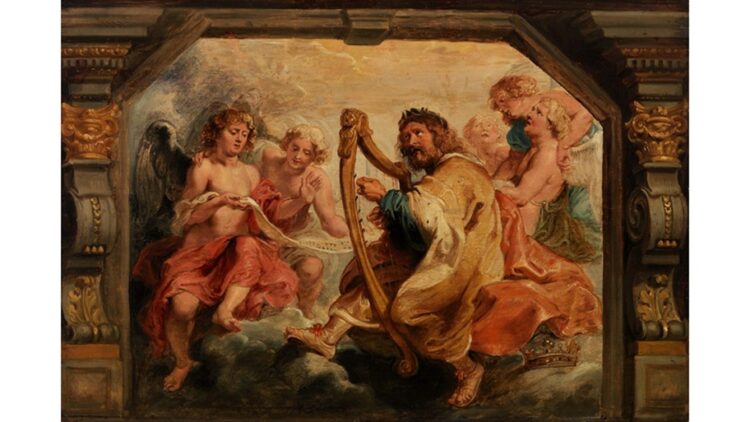
King of Poets
Salaciously Saul slouches on the throne
(Backbiting envy never sits upright)
Since David’s victories surpass his own.
The king’s hard heart and weakened faith excite
Malevolence for which he won’t atone.
Young David could have cured the spirit’s flaw
With moving melodies from seven strings
To usher in a reverential awe
Affectionate, and stop mad wanderings
Outside the mind’s accustomed manly law.
Not David, but Saul’s disobedience,
Had introduced the soul’s cacophony,
Reverberating strident preference
For self-directed Saulish tyranny,
Instead of psalmody’s magnificence.
In pastures, David’s boyish fingers learned
To kill a bear or lion with bare hands
And arms God gave. His shepherding soon turned
To pluck concurrent notes on catgut strands
Well-tuned, whence pleasing concord he discerned.
To add his baritone felt natural,
Pronouncing Eden’s Hebrew as inspired;
The music broached a higher interval:
To speak of Law and Deity required
Ascent to overtones angelical.
The messianic reign will sing eight modes
Of chant, it’s said; eight strings befit new lyres.
The ten-stringed psaltery plays heaven’s odes
While David orchestrates celestial choirs
For blissful listeners in ideal abodes.
O Israel’s sweet singer, lend me ruth
Like yours to magnify the Holy Name,
To praise, give thanks, adore, lament, and soothe,
Beatitudes and parables proclaim,
Dancing with youthful confidence in truth.
Poet’s Note
Many of the 150 psalms in the Bible are attributed to David, king of Israel after Saul. As a shepherd boy he played a portable harp or lyre (kinor) of seven strings. Jewish tradition predicts a harp of eight strings for the kingdom of the Messiah, a descendant of David. Christians (for whom the Messiah is Jesus Christ) point to the liturgical music of Gregorian chant in eight modes. Both traditions regard the ten-stringed psaltery (a musical instrument mentioned in the divinely inspired psalms) to be a figure of the Ten Commandments, whose perfect observance makes heavenly music.
“Eden’s Hebrew” alludes to the opinion of some Jewish and Christian thinkers that Biblical Hebrew, in which David composed his globally significant lyric poetry, is the original language of humankind. Historical linguistics describes it otherwise, but scholarly controversy continues.
Margaret Coats lives in California. She holds a Ph.D. in English and American Literature and Language from Harvard University. She has retired from a career of teaching literature, languages, and writing that included considerable work in homeschooling for her own family and others.


















Yet another expertly crafted poetic form I’ve never seen before. I also hope I’m not the only one who knew nothing about the concepts in the poem including Eden’s Hebrew and the Harp of eight strings. I generally hate to have my ignorance exposed, but your poems make that process something I look forward to.
Thank you, Warren! I often create the form for the poem, or rather choose a traditional one less often used, in contrast to our more common couplets and quatrains. I do have an inclination toward odd numbers, shown here with seven five-line stanzas. The intent in bringing forward little known information is a classical one: poets don’t so much instruct as remind readers of thing likely to have been forgotten. That way we keep ancient culture current!
I, too, learned some fascinating things by reading this poem and the poet’s note. Though the psalmist’s “instrument of ten strings” is familiar, I didn’t know it had been assumed to be a figure of the Ten Commandments. Nor had I heard the theory that Hebrew was the original human language.
Your characterization of Saul in the first verse is a concisely expressed, intense, and believable one. “Soul’s cacophony” and “Saulish tyranny” are not only great phrases, but they echo each other sonically.
Thanks for reading, Cynthia! I read in Augustine the interpretation of the ten-stringed psaltery as the Ten Commandments, but clearly his was not the first, as Jewish commentators record it. In fact, they compare the musical instrument not only to the Commandments, but to the Ten Utterances, or words by which God created the world. This goes much farther into musical imagery, associating music with the natural order of the universe, as the Ten Commandments define the moral order. And with maintenance of that order, when we recall Dryden saying of the end times, “Music shall untune the sky.”
As one unlearned in Biblical history and musical theory, I welcome the Poet’s Note, which increases my appreciation of the erudition behind your poem. You are certainly equipped to deal with lofty themes and do it with impressive skill. What I like especially is the dignity of your lines. They are eloquent and beautiful but not overdone, not extravagantly ornamented. They do not hasten but proceed with grace–musically, I might say. The structure of your stanzas is particularly interesting; it must have required some careful planning to get those triple rhymes, but you have done it without noticeable strain. Thus, when we reach the end of the poem, the poet steps out in the last stanza with both modesty and confidence, entirely in tune with what has gone before. This is a remarkable demonstration of poetic art.
Thank you for describing my lines with such appreciation, Bhikku Nyanasobhano. The qualities you mention are what I could hope a reader would find. Your praise of the final stanza is especially meaningful, because there I cite purposes of sacred poetry, and allude to the worshipful dance done by King David himself.
Margaret C.
Can’t you just hear David’s music echoing through the ages? You also have a capacity to inspire!
from Margaret B.
Thanks, Margaret B! His inspired words have echoed through the ages, in many languages, and I’ve memorized Psalm 1 in David’s own language to learn a little of the music.
Margaret, you undoubtedly are a musical historian, a singer in choirs praising God, and masterful poet that I could read all day. David was a man of many talents who ascended from a shepherd to king but more than that left us with a great legacy of Hebrew poetry befitting the tradition and times. I really loved the double and triple rhymes in each verse that flowed mellifluously as I read them. You have given us a rare gift for our education and edification.
Roy, I am so happy you like this gift! Certainly most of us know David’s works in translation as a legacy to treasure. They reveal this King of Israel’s love of God, and the virtues by which he merited the gift of inspiration, especially the virtue of heartfelt contrition for his own offenses–which is the virtue I ask for in the final stanza. It opens the way to song of many kinds!
I love your beautiful biblically themed poem Margaret. It flows very naturally like a mellow and melodious brook which picks its way through rocks and meadows on its way down the mountain. You touch on the contrasting Spirits which animate Saul and David and the relationship between heavenly music and obedience to God, which grants entry into the peace of His kingdom. If there is a balm in Gilead I would imagine it to flow just like your poem. Great job!
Yael, thank you so very much for the compliments describing my poem as a “mellow and melodious brook” flowing like the “balm in Gilead.” You are correct to find the contrast of spirits in Saul and David as central to the piece. Saul like David had been anointed, but as kings incline to do, he disobeyed God in important matters more than once. Who knows whether poetic music and messianic promises might have been his, had he freely directed his spirit in the way of true abundance for the self? David too made serious errors, but expressed his repentance in some of his most beautiful psalms.
Poor Saul, who had no call to change his name to Paul.
Thanks for giving him your sympathy, C. B., which is due, since David himself respected Saul so much that he did not kill him when he had a chance, even after Saul’s enmity to him became clear. I think Saul had a call of some kind–and then abandoned the vocation. In I Samuel 10, we can read about Saul prophesying with a company of prophets, to the wonder of many. It says, “he was changed into another man.” In failing to follow whatever inspiration he received (or might have received), the texts suggest action of an evil influence. Kingly power provided options to resist, including David’s music!
Very musical, well-crafted poem, Margaret. Thanks for a delightful return to the Old Testament!
Thanks very much for your reading and appreciation, Paul!
Thanks for sharing your biblical poem. And I learned from your contributor’s note. I am a lapsed catholic getting re-acquainted with the faith, so I appreciate poetry that incorporates it.
Welcome home, Paul!
Thank you, Margaret, for this masterly fusion of prayerfulness with music terminology and biblical narrative. For anyone who doesn’t know it, now might be a good time to get acquainted with “O Lord, whose mercies numberless”, from Handel’s oratorio Saul: it’s tuneful and deeply moving.
Thank you, Martin, for thinking of the oratorio that deals with the same characters and emotions as this poem. Though Handel’s music adds much, let me quote here the appealing words by libretto writer Charles Jennens of the aria you mention, sung by David.
O Lord, whose mercies numberless
O’er all Thy works prevail:
Though daily men transgress Thy law,
Thy patience cannot fail.
If yet his sin be not too great,
The busy fiend control;
Yet longer for repentance wait,
And heal his wounded soul.
Margaret,
This is a lovely song to sacred music and those producing it. (It seems I’ve been drafted into my parish choir, trying to sing for the 1st time in 15+ years, struggling to reach e’ at one end and c at the other, but looking forward to widening the compass on music of Josquin, Morales et al.)
Your lines, with their occasional enjambments, flow so smoothly, after the opening, that is, with its metrical comment on the unruly Saul. And the proximity of “Saulish” and “psalmnody” is a nice ironic punning touch.
The connection between the modes and the 8-stringed lyre is new to me, so thank you for your note, too. An, speaking of numbers, I’m guessing your choice of meter and stanza length for this poem had something to do with David’s five fingers.
Julian, thanks for reading and finding much to appreciate. I’m glad to know you’ll be making sacred music yourself; hope once you’re back in practice, the range of notes will no longer be a struggle. The 8-stringed lyre is explained as numerologically supernatural, and thus to be employed in the messianic kingdom, expanding upon the natural perfection to be achieved with 7 strings. For the form of the poem here, I’m using seven stanzas of natural perfection. If we think of the poem as a figure for David’s kinor, naturally he would play it with five fingers, making full use those talented hands, so I give him five lines, one for each finger in each stanza. I didn’t think of that in writing, but I’m glad you did!
Thank you so much for this, Margaret. As someone whose spiritual life is centered on the Liturgy of the Hours, I’ve found that, after meditating on and savoring the poetic–and, as others have remarked, the educative–beauties of this work, my experience of the Psalms has already been deepened, for which, again, I can’t thank you enough. God bless, and all best in the new year.
Thank you, Jeffrey. The Psalms represent a full library of poetic kinds–all to be savored over and over again, during every week in the most traditional monastic practice. In my poem, I’ve tried to suggest something of how David grew as a music maker, more and more open to inspiration. And for ourselves, may we become increasingly receptive to the beauties of his Psalms as we interpret and apply them. Best wishes for that in your new year!
P.S. The conceit that Saul is still nursing his grudge against David in Heaven somehow provides me a strange comfort, one I should probably remember when I go to Confession this weekend.
If Saul has arrived in Heaven, he must have absorbed the healing music of Davidic psalmody by now!
In the interim, while ‘the scholarly controversy continues’, you’ve created a wonderful piece of poetry that as usual educates as well as entertains, making parts of ‘The Book’, as it’s known in Arabic, more accessible and relevant to a modern audience.
Thanks for the read.
Thank you, Paul! The poem does deal with both the history and the poetry from “The Book,” trying to allow both to reflect beyond themselves. I’m very happy to know you find it accessible and relevant to modern readers.
Dear Margaret, this is such a wonderful poem, perfectly composed and so inspiring as it uplifts and elevates the reader and certainly made me feel as though I was there at the court of King Saul listening to the holy music of the future King David. I am not fortunate enough to share your talent or knowledge but I am pleased to say that I do share your love of Hebrew and often listen to Hebrew songs and prayers but have not managed to memorise more than a few lines.
You have inspired me to keep trying
Praise my soul the King of Heaven for this wonderful tribute that you have given us.
Happy New Year to you, and to everyone here on SCP
Thank you, Maria, and I hope you are enjoying a happy new year. Glad to know of your love for Hebrew. The Psalms (whether by King David or by others to whom they’re attributed) are an inexhaustible source of inspired beauty, imitated by many poets in many languages. Praise, my soul, the King of Heaven!
Your poem serves as a wonderful reminder of the centrality of poetry to one of the most significant books of Scripture, and that the poet was a king who had also known the hard labor of shepherding — a sobering reminder of what it is to be a poet and where God chooses to bestow His poetic gifts. I especially like how you begin with Saul, opening with conflict and giving the poem a dramatic flair. I love the envoi at the end, with its reminder that the Psalms were above all prophecy and praying to partake in David’s gifts.
Thanks for your thoughtful comment, Adam. I begin with Saul, and the potential effect of David’s music, to emphasize the power of music to affect emotion directly. This works at a different level than the poetic words of the psalms, which may describe emotion of many kinds, in accord with the many types and purposes of psalm. And you are right that prophecy is frequently present. This book of the Bible is the one most often used: every day and every hour in Jewish and Christian worship, often accompanied by musical melody. We hear much more of David than even Moses or Paul. The gift of inspiration is his abundantly.
Margaret something about your lines evokes the Trumbull Stickney poem, especially the way it was read in the film “The Good Shepherd.” I’m a warehouse / farm worker and lack the capacity for technical description. This poem is magnetic; once the first stanza’s touched? no going back.
I haven’t seen the film, Alec, but I hope you’re referring to the ebullience of the Stickney “Song” itself. King David’s poems flow with what I think of as inspired magnetism, and if you think I’ve been able to capture a little of that in praise of his gifts, I’m pleased. Thanks for your opinion!
Margaret, as usual, your poem brings color and life something that I somewhat know about, but in a mundane way.
Thank you, Laura! I like the idea of color and life being more than mundane, and King David about whom I’m speaking, surely had the gift of bringing spiritual qualities to music and words we can still hear.