• Submit Poetry
  • Support SCP
  • About Us
  • Members
  • Join
Thursday, January 8, 2026
Society of Classical Poets
  • Poems
    • Beauty
    • Culture
    • Satire
    • Humor
    • Children’s
    • Art
    • Ekphrastic
    • Epic
    • Epigrams and Proverbs
    • Human Rights in China
    • Music
    • Performing Arts
    • Riddles
    • Science
    • Song Lyrics
    • The Environment
    • The Raven
    • Found Poems
    • High School Poets
    • Terrorism
    • Covid-19
  • Poetry Forms
    • Sonnet
    • Haiku
    • Limerick
    • Villanelle
    • Rondeau
    • Pantoum
    • Sestina
    • Triolet
    • Acrostic
    • Alexandroid
    • Alliterative
    • Blank Verse
    • Chant Royal
    • Clerihew
    • Rhupunt
    • Rondeau Redoublé
    • Rondel
    • Rubaiyat
    • Sapphic Verse
    • Shape Poems
    • Terza Rima
  • Great Poets
    • Geoffrey Chaucer
    • Emily Dickinson
    • Homer
    • Henry Wadsworth Longfellow
    • Dante Alighieri
    • John Keats
    • John Milton
    • Edgar Allan Poe
    • William Shakespeare
    • William Wordsworth
    • William Blake
    • Robert Frost
  • Love Poems
  • Contests
  • SCP Academy
    • Educational
    • Teaching Classical Poetry—A Guide for Educators
    • Poetry Forms
    • The SCP Journal
    • Books
No Result
View All Result
Society of Classical Poets
  • Poems
    • Beauty
    • Culture
    • Satire
    • Humor
    • Children’s
    • Art
    • Ekphrastic
    • Epic
    • Epigrams and Proverbs
    • Human Rights in China
    • Music
    • Performing Arts
    • Riddles
    • Science
    • Song Lyrics
    • The Environment
    • The Raven
    • Found Poems
    • High School Poets
    • Terrorism
    • Covid-19
  • Poetry Forms
    • Sonnet
    • Haiku
    • Limerick
    • Villanelle
    • Rondeau
    • Pantoum
    • Sestina
    • Triolet
    • Acrostic
    • Alexandroid
    • Alliterative
    • Blank Verse
    • Chant Royal
    • Clerihew
    • Rhupunt
    • Rondeau Redoublé
    • Rondel
    • Rubaiyat
    • Sapphic Verse
    • Shape Poems
    • Terza Rima
  • Great Poets
    • Geoffrey Chaucer
    • Emily Dickinson
    • Homer
    • Henry Wadsworth Longfellow
    • Dante Alighieri
    • John Keats
    • John Milton
    • Edgar Allan Poe
    • William Shakespeare
    • William Wordsworth
    • William Blake
    • Robert Frost
  • Love Poems
  • Contests
  • SCP Academy
    • Educational
    • Teaching Classical Poetry—A Guide for Educators
    • Poetry Forms
    • The SCP Journal
    • Books
No Result
View All Result
Society of Classical Poets
No Result
View All Result
Home Poetry Beauty

A Poem on John Duns Scotus, by Mary Jane Myers

June 24, 2025
in Beauty, Culture, Poetry
A A
6
poems A Poem on John Duns Scotus, by Mary Jane Myers

.

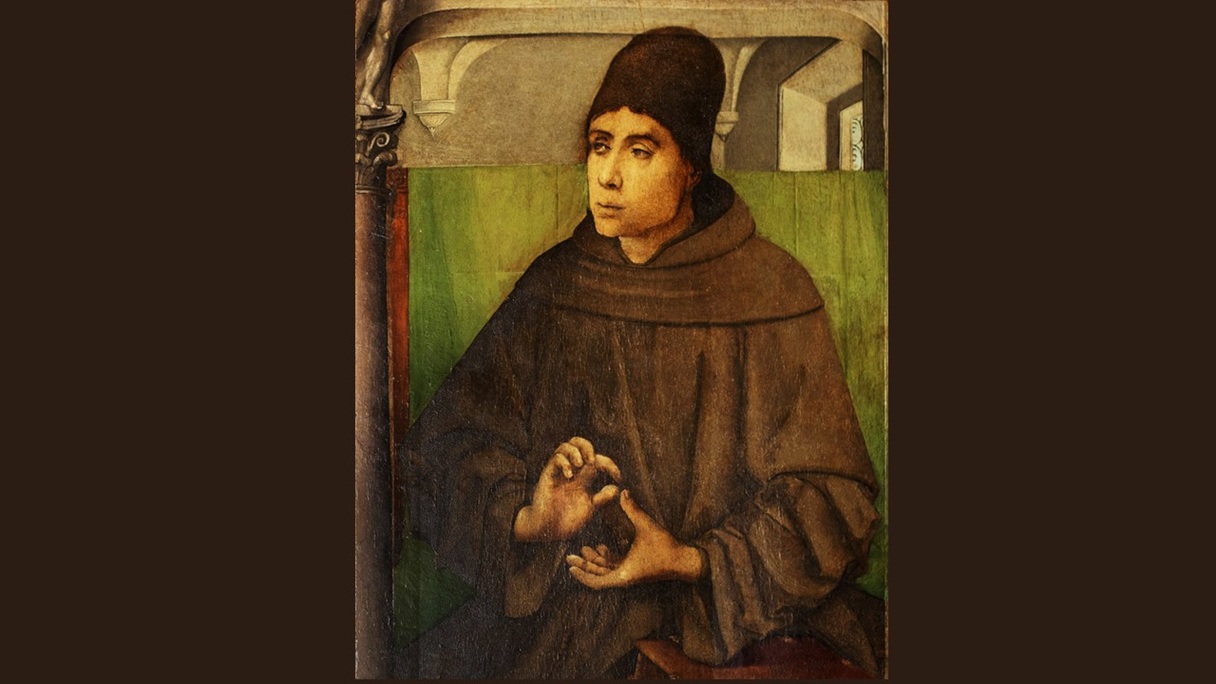
Doctor Subtilis

—Blessed John Duns Scotus (1265–1308)

A proud and canny Scot from Duns am I,
an infant when Franciscans reached our coast.
These friars gave me tools to weigh the why
of doctrines puzzling theologians most.

Northhampton brothers shaped my childish mind.
My tutors sent me then to Oxford’s halls
where I embraced the academic grind,
mastered the skill of philosophic brawls.

At Paris—nonpareil prestige—I taught.
Adept in Lombard’s Sentences, my role,
aiding each lad to learn attested thought,
espouse our one true faith to save his soul.

French Philip sought to tax the papal land.
My loyalty stayed ever with the Church.
Against his royal law I took a stand:
I was soon severed from my lofty perch.

The King restored my rank within a year,
a brisk reversal of his regal stance.
I flourished in that intellectual sphere,
performed an erudite Scholastic dance.

Thereafter, my superiors humbled me.
consigned me to Cologne, a modest berth,
a post to chasten my celebrity,
a ploy to hurl my hubris down to earth.

At forty-one, Death claimed me for his own.
A Latin verse adorns my German tomb.
It tells of Scotland, England, France, Cologne—
priories where my priest’s vocation bloomed.

Always, I wrote: profound, the feel of quill
in hand, of fluid iron-gall ink, the play
of logic’s labyrinth, a thinker’s thrill
at bringing covert knotty points to bay.

I advocate the “this-ness” of each thing
(Aquinas contra, on this point we’re split).
God’s Being is the same as our own being
but we are finite, He is infinite.

By atheist pedants, I am misconstrued:
they think I ushered in modernity.
Not so! Re-read me! When correctly viewed,
my work fits us for blest eternity.

.

.

Mary Jane Myers resides in Springfield, Illinois. She is a retired JD/CPA tax specialist. Her debut short story collection Curious Affairs was published by Paul Dry Books in 2018.

ShareTweetPin
The Society of Classical Poets does not endorse any views expressed in individual poems or commentary.
Read Our Comments Policy Here
Next Post
‘Gruesome’: A Poem on the LA Riots of 2025, by Adam Wasem

'Gruesome': A Poem on the LA Riots of 2025, by Adam Wasem

‘On Seeing You Upon Waking’ by Martin Rizley

'A Sonnet for My One True Love' and Other Poetry by Aaron Nydegger

‘New York, New York’: A Poem on the NYC Mayor Race, by Brian Yapko

'New York, New York': A Poem on the NYC Mayor Race, by Brian Yapko

Comments 6

  1. Roy Eugene Peterson says:
    7 months ago

    This is an erudite etude on an eminence echoing down through the years who wrote essays on the ephemeral and eternal that continue to elicit praise as you have done in your excellent poem.

    Reply
    • Mary J Myers says:
      7 months ago

      Dear Roy

      Thank you for your positive comments. I’m fascinated by Duns Scotus.

      Of course, Gerard Manley Hopkins wrote a gorgeous poem in which he describes how the spirit of Duns Scotus still permeates Oxford. Here is his two line description of Scotus:

      Of realty the rarest-veinèd unraveller; a not
      Rivalled insight, be rival Italy or Greece;….

      An impossible dream, to match Hopkins’s virtuosity!

      Most sincerely
      Mary Jane

      Reply
  2. Joseph S. Salemi says:
    7 months ago

    This is an interesting combination of a dramatic monologue, narrative, and a philosophic exposition. And for something of this nature, the choice of ABAB quatrains was wise. It separated the various pieces of information, whether personal history or philosophic comment, into manageable segments for the reader.

    Scotus didn’t differ from Aquinas solely on the issue of haeccitas. There were other things like Divine will and the Immaculate Conception (the Church eventually went with Scotus on this point rather that with Aquinas). It’s also well to note that rivalry between the two orders of friars (Dominican and Franciscan) frequently played a role in the theological debates of that time, and even later on.

    As for a medieval Catholic theologian who may have helped usher in modernism, that award should probably go to William of Occam. Read the book “Ideas Have Consequences” (1948) by a American southern scholar whose name I believe was Richard Weaver.

    Reply
    • Mary J Myers says:
      7 months ago

      Dear Joseph

      Thank you for your positive comments. I wrote several quatrains about Duns Scotus’s philosophy, but I winnowed the discussion down to one quatrain. Two practical reasons: 1) I have a very tenuous grasp of medieval philosophy, and was afraid of making a “howler” mistake! and 2) I thought further discussion might “swamp” the rest of the poem, and cause reader disinterest.

      Modern scholars have been preoccupied in sorting through the documents attributed to Duns Scotus. Some of this material turns out to have been written most probably by others. For example, the Grammatica Speculativa, an important text that influenced Heidegger, was written by Thomas of Erfurt, and not by Duns Scotus. H’s mistake might make a delicious poem subject! How the “history of ideas” is riddled with misunderstandings.

      Thank you for your reference to Weaver’s book. I’ve been aware of this book for some time, and it’s in my “reading queue.” Perhaps I should definitely read it soon.

      Most sincerely
      Mary Jane

      Reply
  3. Margaret Coats says:
    7 months ago

    The swaying lines of this “Scholastic dance” reveal a character with a genuine, permanent exultation in the intellect. That’s no easy ballet, Mary Jane! Nonetheless, you portray Duns Scotus as a man thrilled by the subtle joys of the mind from early childhood to eternal blessedness. The portrait also indicates how he overcame the scholar’s vice of pride through the ups and downs of a stellar career, especially because his superiors were wise in their direction of him, and Scotus himself obedient enough to accept their assignments. The poem rather subtly goes on to display his saintliness in fierce fidelity to his Franciscan and priestly vocations. Both of these are above all concerned (as is his scholarship, and his longing even in heaven for his work to be rightly understood) with the central purpose of a churchman, the salvation of souls.

    Clear and wonderful work of history and characterization, particularly as a man of this temperament is not where our world today naturally looks for inspiration.

    Reply
  4. Mary J Myers says:
    7 months ago

    Margaret

    I am so blessed to have you as a reader. A poet often wonders: who in the world is interested in my particular preoccupations? So, we poets do our best to clarify our throughts—write a poem—then with trepidation send the poem out—and voila! sensitive and appreciate readers appear as through some wondrous spiritual synchronicity!

    As you note, Duns Scotus (and many great and saintly Scholastics) did phenomenal intellectual work. They were trained rigorously in dialectic, and yet they were also obedient to their superiors. The overarching goal was holiness. In contrast, look at the Marxist carnage in our contemporary educational institutions. The atheist/agnostic “tenured radicals” have had no training in careful logic, and weak administrators have allowed them to “run wild.”

    Most sincerely
    Mary Jane

    Reply

Leave a Reply Cancel reply

Your email address will not be published. Required fields are marked *

  1. C.B. Anderson on ‘Art and Nature’ and Other Poetry by C.B. AndersonJanuary 8, 2026

    To be perfectly honest, Michael, I never know how what I write will strike a reader. Sometimes things just work…

  2. C.B. Anderson on ‘Art and Nature’ and Other Poetry by C.B. AndersonJanuary 8, 2026

    My wife, Julian, has often asks me why I write poetry when I could be writing songs and making some…

  3. Margaret Coats on ‘Refrigerator Bird’ and Other Poetry by Armaan Fatteh-PatilJanuary 8, 2026

    You write some exceptionally fine lines, Armaan. For one example from each poem: Wrong means reaching. Wrong means getting at…

  4. Margaret Coats on ‘King of Poets’: A Poem by Margaret CoatsJanuary 8, 2026

    Thanks, Margaret B! His inspired words have echoed through the ages, in many languages, and I've memorized Psalm 1 in…

  5. Margaret Coats on ‘King of Poets’: A Poem by Margaret CoatsJanuary 8, 2026

    Thank you for describing my lines with such appreciation, Bhikku Nyanasobhano. The qualities you mention are what I could hope…

Receive Poems in Your Email

Enter your email address to subscribe to this blog and receive notifications of new posts by email.

Join 1,621 other subscribers
Facebook Twitter Youtube

Recent Poems

  • Two Sonnets by Nino Martoglio, Translated by Joseph S. Salemi
  • ‘Wall of Ice’ and Other Poetry by James Bontrager
  • ‘King of Poets’: A Poem by Margaret Coats
  • ‘Watercolors’: A Poem by Susan Steele Rives
  • ‘Art and Nature’ and Other Poetry by C.B. Anderson
  • ‘Star of Wonder’: A Poem by James A. Tweedie
  • ‘Yeonmi Park’s Advice to Americans’: A Poem by Warren Bonham
  • ‘Caravaggio’: A Poem by Lisa J. Roberts
  • ‘Refrigerator Bird’ and Other Poetry by Armaan Fatteh-Patil
  • ‘The Oak Trees’: A Poem by Bhikkhu Nyanasobhano
  • ‘A Cardinal on a Snowy Day’: A Poem by Rob Fried
  • Poets Susan Jarvis Bryant and James Sale Respond to Mamdani’s Swearing In as NYC Mayor
  • ‘Single Room Cigarette, 17th Floor Yale Club of Manhattan’: A Poem by Alec Ream
  • ‘Legacy of Light’: A Poem by Martin Briggs
  • ‘The Swarm’ and Other Poetry by Cheryl Corey
  • ‘Lament of a Poet Falsely Accused of Using AI’ and Other Poetry by Paul Buchheit
  • ‘A Gift from the South’: A Poem by Julian Woodruff
  • ‘New Year’s Peeve’: A Poem by Susan Jarvis Bryant
  • ‘Homage to Brigitte Bardot’: A Poem by Joseph S. Salemi
  • ‘Dearth of Emotional Intelligence’ and Other Poems by Russel Winick
  • ‘Fireflies’: A Poem by Mark Stellinga
  • ‘Real Poetry’: A Poem by Eric v.d. Luft
  • ‘Flaws’: A Poem by Joshua Thomas
  • Two Final Poems by Sally Cook
  • ‘Twelve Labors More, Part I’: A Poem by Evan Mantyk
  • ‘A Perfect Match is Found’: A Poem by Roy E. Peterson
  • ‘The Seven Crossings’: A Poem by Ulysses Arlen
  • ‘An Open Book’ and Other Poetry by David McMahon
  • A Video Poetry Reading by Paul Erlandson
  • ‘Otto and Octavius at Christmas’: A Children’s Poem by Mary Gardner

Categories

  • Acrostic
  • Alexandroid
  • Alliterative
  • Art
  • Best Poems
  • Blank Verse
  • Chant Royal
  • Classical Poets Live
  • Clerihew
  • Covid-19
  • Deconstructing Communism
  • Educational
  • Epic
  • Epigrams and Proverbs
  • Essays
    • Interviews with Poets
    • Poetry Reviews
  • Featured
  • From the Society
  • Great Poets
    • Dante Alighieri
    • Edgar Allan Poe
    • Emily Dickinson
    • Geoffrey Chaucer
    • Henry Wadsworth Longfellow
    • Homer
    • John Keats
    • John Milton
    • Robert Frost
    • William Blake
    • William Shakespeare
    • William Wordsworth
  • Human Rights in China
  • Limerick
  • Love Poems
  • Music
  • Pantoum
  • Performing Arts
  • Poetry
    • Beauty
    • Children's Poems
    • Culture
    • Ekphrastic
    • Found Poems
    • High School Poets
    • Humor
    • Riddles
  • Poetry Challenge
  • Poetry Contests
  • Poetry Forms
    • Haiku
  • Poetry Readings
  • Rhupunt
  • Rondeau
  • Rondeau Redoublé
  • Rondel
  • Rubaiyat
  • Sapphic Verse
  • Satire
  • Science
  • Sestina
  • Shape Poems
  • Short Stories
  • Song Lyrics
  • Sonnet
  • Symposium
  • Terrorism
  • Terza Rima
  • The Environment
  • Translation
  • Triolet
  • Video
  • Villanelle

Quick Links

  • About Us
  • Submit Poetry
  • Become a Member
  • Members List
  • Support the Society
  • Advertisement Placement
  • Comments Policy
  • Terms of Use

Welcome Back!

Login to your account below

Forgotten Password?

Retrieve your password

Please enter your username or email address to reset your password.

Log In
No Result
View All Result
  • Poems
    • Beauty
    • Culture
    • Satire
    • Humor
    • Children’s
    • Art
    • Ekphrastic
    • Epic
    • Epigrams and Proverbs
    • Human Rights in China
    • Music
    • Performing Arts
    • Riddles
    • Science
    • Song Lyrics
    • The Environment
    • The Raven
    • Found Poems
    • High School Poets
    • Terrorism
    • Covid-19
  • Poetry Forms
    • Sonnet
    • Haiku
    • Limerick
    • Villanelle
    • Rondeau
    • Pantoum
    • Sestina
    • Triolet
    • Acrostic
    • Alexandroid
    • Alliterative
    • Blank Verse
    • Chant Royal
    • Clerihew
    • Rhupunt
    • Rondeau Redoublé
    • Rondel
    • Rubaiyat
    • Sapphic Verse
    • Shape Poems
    • Terza Rima
  • Great Poets
    • Geoffrey Chaucer
    • Emily Dickinson
    • Homer
    • Henry Wadsworth Longfellow
    • Dante Alighieri
    • John Keats
    • John Milton
    • Edgar Allan Poe
    • William Shakespeare
    • William Wordsworth
    • William Blake
    • Robert Frost
  • Love Poems
  • Contests
  • SCP Academy
    • Educational
    • Teaching Classical Poetry—A Guide for Educators
    • Poetry Forms
    • The SCP Journal
    • Books

© 2025 SCP. WebDesign by CODEC Prime.

This website uses cookies. By continuing to use this website you are giving consent to cookies being used. Visit our Privacy and Cookie Policy.