• Submit Poetry
  • Support SCP
  • About Us
  • Members
  • Join
Thursday, January 8, 2026
Society of Classical Poets
  • Poems
    • Beauty
    • Culture
    • Satire
    • Humor
    • Children’s
    • Art
    • Ekphrastic
    • Epic
    • Epigrams and Proverbs
    • Human Rights in China
    • Music
    • Performing Arts
    • Riddles
    • Science
    • Song Lyrics
    • The Environment
    • The Raven
    • Found Poems
    • High School Poets
    • Terrorism
    • Covid-19
  • Poetry Forms
    • Sonnet
    • Haiku
    • Limerick
    • Villanelle
    • Rondeau
    • Pantoum
    • Sestina
    • Triolet
    • Acrostic
    • Alexandroid
    • Alliterative
    • Blank Verse
    • Chant Royal
    • Clerihew
    • Rhupunt
    • Rondeau Redoublé
    • Rondel
    • Rubaiyat
    • Sapphic Verse
    • Shape Poems
    • Terza Rima
  • Great Poets
    • Geoffrey Chaucer
    • Emily Dickinson
    • Homer
    • Henry Wadsworth Longfellow
    • Dante Alighieri
    • John Keats
    • John Milton
    • Edgar Allan Poe
    • William Shakespeare
    • William Wordsworth
    • William Blake
    • Robert Frost
  • Love Poems
  • Contests
  • SCP Academy
    • Educational
    • Teaching Classical Poetry—A Guide for Educators
    • Poetry Forms
    • The SCP Journal
    • Books
No Result
View All Result
Society of Classical Poets
  • Poems
    • Beauty
    • Culture
    • Satire
    • Humor
    • Children’s
    • Art
    • Ekphrastic
    • Epic
    • Epigrams and Proverbs
    • Human Rights in China
    • Music
    • Performing Arts
    • Riddles
    • Science
    • Song Lyrics
    • The Environment
    • The Raven
    • Found Poems
    • High School Poets
    • Terrorism
    • Covid-19
  • Poetry Forms
    • Sonnet
    • Haiku
    • Limerick
    • Villanelle
    • Rondeau
    • Pantoum
    • Sestina
    • Triolet
    • Acrostic
    • Alexandroid
    • Alliterative
    • Blank Verse
    • Chant Royal
    • Clerihew
    • Rhupunt
    • Rondeau Redoublé
    • Rondel
    • Rubaiyat
    • Sapphic Verse
    • Shape Poems
    • Terza Rima
  • Great Poets
    • Geoffrey Chaucer
    • Emily Dickinson
    • Homer
    • Henry Wadsworth Longfellow
    • Dante Alighieri
    • John Keats
    • John Milton
    • Edgar Allan Poe
    • William Shakespeare
    • William Wordsworth
    • William Blake
    • Robert Frost
  • Love Poems
  • Contests
  • SCP Academy
    • Educational
    • Teaching Classical Poetry—A Guide for Educators
    • Poetry Forms
    • The SCP Journal
    • Books
No Result
View All Result
Society of Classical Poets
No Result
View All Result
Home Poetry Beauty

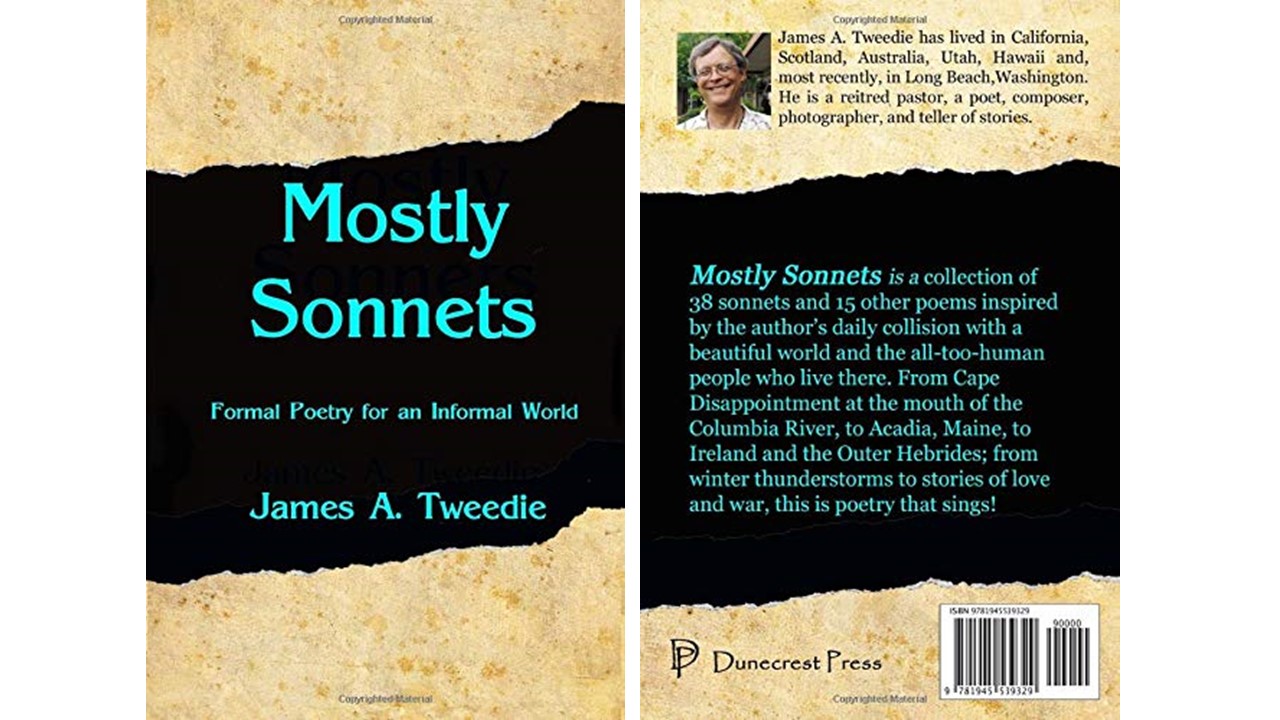
A Review of James A. Tweedie’s Mostly Sonnets: Formal Poetry in an Informal World

March 3, 2021
in Beauty, Essays, Poetry, Poetry Reviews
A A
13
poems A Review of James A. Tweedie’s <em>Mostly Sonnets: Formal Poetry in an Informal World</em>

Reviewed Book: Mostly Sonnets: Formal Poetry in an Informal World by James A. Tweedie, Dunecrest Press, July 2019

by Theresa Rodriguez

As a fellow sonneteer, I felt like I was reading the words of a kindred spirit when I read James A. Tweedie’s Mostly Sonnets: Formal Poetry for an Informal World. Tweedie is a very fluid writer with a clean, clear, expressive style, which grabs ahold of you with its immediacy and beauty of execution. What is most striking is the mixture of Christian belief intermingled with an honesty of thought, never coming across as sermonizing, but expressing a faith-filled wonder and appreciation for the natural world and the place of the intelligent believer within it.

In “For My Beloved,” the closing couplet summarizes a sonnet on communion, or the Eucharist:

.

A sacramental mystery divine
To taste that I am Yours, and You are mine.

.

In “Love that Lasts” we are treated to such phrases as “flame-impassioned kiln of lust;” “Incendiary fireworks of heart / And thigh;” and “faux-felt, fickle love” which is “temporal and ephemeral at best.” The closing couplet brilliantly summarizes the contrast of lust versus true love:

.

True love is not based solely on the thrill,
But reaffirmed each day by force of will.

.

In Poem IV of the “Poems of Hibernia and Caledonia” (“To the Unknown Scribe of the 8th Century Book of Kells”), we learn of the scribe:

.

He transcribed scripture and illumed each text
With intricate designs infused with prayer;
Forsaking this world’s kingdoms for the next.

.

One of my favorites is “When God dies,” which is a powerful antidote to atheism:

.

The silent echoes of a stillborn sun
Portend the doom of uncreated day,
As once-knit atoms come unspun
And time implodes in random disarray.

Now-soulless life unbreathes its final gasp,
Unsuffering in meaningless distress,
As darkness holds the cosmos in its grasp—
Imbued with mindless, vapid pointlessness.

Abandon hope, all ye who enter here,
For separated from eternity,
Love, truth, and beauty fade and disappear,
The hapless victims of Modernity.

A universe that’s empty, formless, void,
Is all that’s left when God has been destroyed.

.

In Mostly Sonnets we are also treated to a set of three love sonnets “In an Antiquated Style;” a pair of sonnets about the Seven Wonders of the Ancient World; a sonnet about treading “The Pilgrim Path,” where “We must cross our daily Rubicon;” a sonnet about humpback whales; and a powerful reflection in “On Regret,” where the author is reflecting on his life and the choices of the past:

.

Although I have regrets, it’s far too late
To undo what I did so long ago.
Perhaps it’s best to bless and consecrate
The past to God, and then just let it go.

And yet how nice it would have been, somehow,
To know back then the things that I know now.

.

What I appreciate most is Tweedie’s honesty when it comes to dealing with matters of his own faith. In the sonnet “What If” he asks a series of rhetorical questions about the possibility of “faith proven false,” opinions possibly “found to be in error on review,” and the chance that “…all that I’ve held certain [is] turned unclear.” The final couplet sums up his believing heart perfectly:

.

Take note: My faith in Jesus remains strong,
But as for all the rest I could be wrong.

.

I have found throughout the book that his closing couplets are very strong and have a truly musical flow to them—as do the poems themselves, full of lyrical beauty and many well-articulated truths.

Other topics such as a rural Christmas, the Black Death, a winter thunderstorm, a whale watch, and issues of faith provide a variety of reading pleasure. This was a truly enjoyable reading experience. I would recommend Mostly Sonnets to anyone who loves the sonnet form and would enjoy the combination of finely-written poetry with an honest, religious aesthetic sense.

.

.

 

ShareTweetPin
The Society of Classical Poets does not endorse any views expressed in individual poems or commentary.
Read Our Comments Policy Here
Next Post
‘And Our Paths Through Flowers’ by David Whippman

'Who Knew' and Other Poetry by Áine Mae

‘The White Man’s Burden’ by Rudyard Kipling: Poem, Background, and Analysis

'The White Man's Burden' by Rudyard Kipling: Poem, Background, and Analysis

Submit Poetry

'Tradition' by Troy Camplin

Comments 13

  1. James Sale says:
    5 years ago

    A sonneteer on a sonneteer: wonderful! I think James Tweedie’s sonnets are first-rate, and I agree with Theresa that his concluding couplets can be incredibly powerful – James really is somebody who understands the sonnet form. I strongly recommend his book and I am really pleased I have a copy!!!

    Reply
    • james A. Tweedie says:
      5 years ago

      Thank you, James. I appreciate your kind words even as I appreciate the help you offered when I was preparing this book for publication.

      Reply
      • James Sale says:
        5 years ago

        Well, it’s a beautiful collection James, so it was a pleasure!!!

        Reply
  2. Theresa Rodriguez says:
    5 years ago

    Thank you to Evan for publishing this review, and to James Tweedie for writing such an excellent book!

    Reply
  3. C.B. Anderson says:
    5 years ago

    Yes, James Tweedie is a national treasure, whose work fairly overflows with concinnity and profound thought. I think that everyone here knows that, though James himself might be too modest to love hearing such an accolade.

    Reply
    • James A. Tweedie says:
      5 years ago

      C.B. While I do not yet consider myself old enough to be designated a “national treasure” (although when I turn 70 in May–as Joe did this week–I may reconsider) I am, nonetheless, enjoying basking in the warmth of your accolade. Also, I believe this may be the first time the word “concinnity” has ever been employed on my behalf. It is not a word I would ever chose to describe myself but, modest though I am, I feel compelled by gratitude to accept, embrace, and savor it. Especially since I doubt I will ever have the opportunity to do it again!

      Reply
  4. Susan Jarvis Bryant says:
    5 years ago

    Theresa, this is a beautiful review for a worthy and engaging poet. Thank you for bringing James Tweedie’s accomplishment to our attention. Bravo James!

    Reply
  5. Sandra Ginn Keeney says:
    5 years ago

    Is Mr. Tweedie’s Mostly Sonnets available anywhere besides on Amazon?

    Reply
    • James A. Tweedie says:
      5 years ago

      Sandra, In addition to Amazon, my book is available in several bookstores in my corner of south-west Washington. It is also available directly from me at the same cost, including shipping, charged by Amazon.

      If this interests you feel free to contact me through Evan.

      Reply
      • Sandra Ginn Keeney says:
        5 years ago

        Contacting Mr. Mantyk for 2 copies of your book, Mostly Sonnets… @ $ 9.95 each. I will need postage since I was a Prime Amazon user.
        S. Keeney

        Reply
  6. Corey Elizabeth Jackson says:
    5 years ago

    The imagery in the sonnet “When God dies”, quoted in this review, is uniquely rich and powerful in pointing to a universe devoid of consciousness. “Stillborn sun”, “uncreated day”, “once-knit atoms”, “time implodes”, “now-soulless life”, “vapid pointlessness” . . . all these stark, entropic concepts place in razor-sharp relief the effervescent faith of the conscious human heart. This sonnet, by its sheer and evocative contrasts, is a spellbinding testament to the truth of a God that can never be, as the final couplet says . . . “destroyed. “

    Reply
    • James A. Tweedie says:
      5 years ago

      Corey,

      You have captured my intent with precision. It pleases me greatly that this poem spoke to you so clearly and convincingly.

      The words and phrases you cite were wrested from my soul by a power greater than my own. I may “own” the poem but in truth it belongs to God who, I firmly believe, brought it into existence through me.

      It is, regardless, a poem offered in praise for the glory of God.

      Reply
  7. Andrew Benson Brown says:
    5 years ago

    Just ordered a copy. Excited to read it!

    Reply

Leave a Reply Cancel reply

Your email address will not be published. Required fields are marked *

  1. C.B. Anderson on ‘Art and Nature’ and Other Poetry by C.B. AndersonJanuary 8, 2026

    To be perfectly honest, Michael, I never know how what I write will strike a reader. Sometimes things just work…

  2. C.B. Anderson on ‘Art and Nature’ and Other Poetry by C.B. AndersonJanuary 8, 2026

    My wife, Julian, has often asks me why I write poetry when I could be writing songs and making some…

  3. Margaret Coats on ‘Refrigerator Bird’ and Other Poetry by Armaan Fatteh-PatilJanuary 8, 2026

    You write some exceptionally fine lines, Armaan. For one example from each poem: Wrong means reaching. Wrong means getting at…

  4. Margaret Coats on ‘King of Poets’: A Poem by Margaret CoatsJanuary 8, 2026

    Thanks, Margaret B! His inspired words have echoed through the ages, in many languages, and I've memorized Psalm 1 in…

  5. Margaret Coats on ‘King of Poets’: A Poem by Margaret CoatsJanuary 8, 2026

    Thank you for describing my lines with such appreciation, Bhikku Nyanasobhano. The qualities you mention are what I could hope…

Receive Poems in Your Email

Enter your email address to subscribe to this blog and receive notifications of new posts by email.

Join 1,621 other subscribers
Facebook Twitter Youtube

Recent Poems

  • Two Sonnets by Nino Martoglio, Translated by Joseph S. Salemi
  • ‘Wall of Ice’ and Other Poetry by James Bontrager
  • ‘King of Poets’: A Poem by Margaret Coats
  • ‘Watercolors’: A Poem by Susan Steele Rives
  • ‘Art and Nature’ and Other Poetry by C.B. Anderson
  • ‘Star of Wonder’: A Poem by James A. Tweedie
  • ‘Yeonmi Park’s Advice to Americans’: A Poem by Warren Bonham
  • ‘Caravaggio’: A Poem by Lisa J. Roberts
  • ‘Refrigerator Bird’ and Other Poetry by Armaan Fatteh-Patil
  • ‘The Oak Trees’: A Poem by Bhikkhu Nyanasobhano
  • ‘A Cardinal on a Snowy Day’: A Poem by Rob Fried
  • Poets Susan Jarvis Bryant and James Sale Respond to Mamdani’s Swearing In as NYC Mayor
  • ‘Single Room Cigarette, 17th Floor Yale Club of Manhattan’: A Poem by Alec Ream
  • ‘Legacy of Light’: A Poem by Martin Briggs
  • ‘The Swarm’ and Other Poetry by Cheryl Corey
  • ‘Lament of a Poet Falsely Accused of Using AI’ and Other Poetry by Paul Buchheit
  • ‘A Gift from the South’: A Poem by Julian Woodruff
  • ‘New Year’s Peeve’: A Poem by Susan Jarvis Bryant
  • ‘Homage to Brigitte Bardot’: A Poem by Joseph S. Salemi
  • ‘Dearth of Emotional Intelligence’ and Other Poems by Russel Winick
  • ‘Fireflies’: A Poem by Mark Stellinga
  • ‘Real Poetry’: A Poem by Eric v.d. Luft
  • ‘Flaws’: A Poem by Joshua Thomas
  • Two Final Poems by Sally Cook
  • ‘Twelve Labors More, Part I’: A Poem by Evan Mantyk
  • ‘A Perfect Match is Found’: A Poem by Roy E. Peterson
  • ‘The Seven Crossings’: A Poem by Ulysses Arlen
  • ‘An Open Book’ and Other Poetry by David McMahon
  • A Video Poetry Reading by Paul Erlandson
  • ‘Otto and Octavius at Christmas’: A Children’s Poem by Mary Gardner

Categories

  • Acrostic
  • Alexandroid
  • Alliterative
  • Art
  • Best Poems
  • Blank Verse
  • Chant Royal
  • Classical Poets Live
  • Clerihew
  • Covid-19
  • Deconstructing Communism
  • Educational
  • Epic
  • Epigrams and Proverbs
  • Essays
    • Interviews with Poets
    • Poetry Reviews
  • Featured
  • From the Society
  • Great Poets
    • Dante Alighieri
    • Edgar Allan Poe
    • Emily Dickinson
    • Geoffrey Chaucer
    • Henry Wadsworth Longfellow
    • Homer
    • John Keats
    • John Milton
    • Robert Frost
    • William Blake
    • William Shakespeare
    • William Wordsworth
  • Human Rights in China
  • Limerick
  • Love Poems
  • Music
  • Pantoum
  • Performing Arts
  • Poetry
    • Beauty
    • Children's Poems
    • Culture
    • Ekphrastic
    • Found Poems
    • High School Poets
    • Humor
    • Riddles
  • Poetry Challenge
  • Poetry Contests
  • Poetry Forms
    • Haiku
  • Poetry Readings
  • Rhupunt
  • Rondeau
  • Rondeau Redoublé
  • Rondel
  • Rubaiyat
  • Sapphic Verse
  • Satire
  • Science
  • Sestina
  • Shape Poems
  • Short Stories
  • Song Lyrics
  • Sonnet
  • Symposium
  • Terrorism
  • Terza Rima
  • The Environment
  • Translation
  • Triolet
  • Video
  • Villanelle

Quick Links

  • About Us
  • Submit Poetry
  • Become a Member
  • Members List
  • Support the Society
  • Advertisement Placement
  • Comments Policy
  • Terms of Use

Welcome Back!

Login to your account below

Forgotten Password?

Retrieve your password

Please enter your username or email address to reset your password.

Log In
No Result
View All Result
  • Poems
    • Beauty
    • Culture
    • Satire
    • Humor
    • Children’s
    • Art
    • Ekphrastic
    • Epic
    • Epigrams and Proverbs
    • Human Rights in China
    • Music
    • Performing Arts
    • Riddles
    • Science
    • Song Lyrics
    • The Environment
    • The Raven
    • Found Poems
    • High School Poets
    • Terrorism
    • Covid-19
  • Poetry Forms
    • Sonnet
    • Haiku
    • Limerick
    • Villanelle
    • Rondeau
    • Pantoum
    • Sestina
    • Triolet
    • Acrostic
    • Alexandroid
    • Alliterative
    • Blank Verse
    • Chant Royal
    • Clerihew
    • Rhupunt
    • Rondeau Redoublé
    • Rondel
    • Rubaiyat
    • Sapphic Verse
    • Shape Poems
    • Terza Rima
  • Great Poets
    • Geoffrey Chaucer
    • Emily Dickinson
    • Homer
    • Henry Wadsworth Longfellow
    • Dante Alighieri
    • John Keats
    • John Milton
    • Edgar Allan Poe
    • William Shakespeare
    • William Wordsworth
    • William Blake
    • Robert Frost
  • Love Poems
  • Contests
  • SCP Academy
    • Educational
    • Teaching Classical Poetry—A Guide for Educators
    • Poetry Forms
    • The SCP Journal
    • Books

© 2025 SCP. WebDesign by CODEC Prime.

This website uses cookies. By continuing to use this website you are giving consent to cookies being used. Visit our Privacy and Cookie Policy.