• Submit Poetry
  • Support SCP
  • About Us
  • Members
  • Join
Tuesday, August 18, 2026
Society of Classical Poets
  • Poems
    • Beauty
    • Culture
    • Satire
    • Humor
    • Children’s
    • Art
    • Ekphrastic
    • Epic
    • Epigrams and Proverbs
    • Human Rights in China
    • Music
    • Performing Arts
    • Riddles
    • Science
    • Song Lyrics
    • The Environment
    • The Raven
    • Found Poems
    • High School Poets
    • Terrorism
    • Covid-19
  • Poetry Forms
    • Sonnet
    • Haiku
    • Limerick
    • Villanelle
    • Rondeau
    • Pantoum
    • Sestina
    • Triolet
    • Acrostic
    • Alexandroid
    • Alliterative
    • Blank Verse
    • Chant Royal
    • Clerihew
    • Rhupunt
    • Rondeau Redoublé
    • Rondel
    • Rubaiyat
    • Sapphic Verse
    • Shape Poems
    • Terza Rima
  • Great Poets
    • Geoffrey Chaucer
    • Emily Dickinson
    • Homer
    • Henry Wadsworth Longfellow
    • Dante Alighieri
    • John Keats
    • John Milton
    • Edgar Allan Poe
    • William Shakespeare
    • William Wordsworth
    • William Blake
    • Robert Frost
  • Love Poems
  • Contests
  • SCP Academy
    • Educational
    • Teaching Classical Poetry—A Guide for Educators
    • Poetry Forms
    • The SCP Journal
    • Books
No Result
View All Result
Society of Classical Poets
  • Poems
    • Beauty
    • Culture
    • Satire
    • Humor
    • Children’s
    • Art
    • Ekphrastic
    • Epic
    • Epigrams and Proverbs
    • Human Rights in China
    • Music
    • Performing Arts
    • Riddles
    • Science
    • Song Lyrics
    • The Environment
    • The Raven
    • Found Poems
    • High School Poets
    • Terrorism
    • Covid-19
  • Poetry Forms
    • Sonnet
    • Haiku
    • Limerick
    • Villanelle
    • Rondeau
    • Pantoum
    • Sestina
    • Triolet
    • Acrostic
    • Alexandroid
    • Alliterative
    • Blank Verse
    • Chant Royal
    • Clerihew
    • Rhupunt
    • Rondeau Redoublé
    • Rondel
    • Rubaiyat
    • Sapphic Verse
    • Shape Poems
    • Terza Rima
  • Great Poets
    • Geoffrey Chaucer
    • Emily Dickinson
    • Homer
    • Henry Wadsworth Longfellow
    • Dante Alighieri
    • John Keats
    • John Milton
    • Edgar Allan Poe
    • William Shakespeare
    • William Wordsworth
    • William Blake
    • Robert Frost
  • Love Poems
  • Contests
  • SCP Academy
    • Educational
    • Teaching Classical Poetry—A Guide for Educators
    • Poetry Forms
    • The SCP Journal
    • Books
No Result
View All Result
Society of Classical Poets
No Result
View All Result
Home Essays

A Review of Juvenalia by Reid McGrath

October 12, 2020
in Essays, Poetry, Poetry Reviews
A A
12
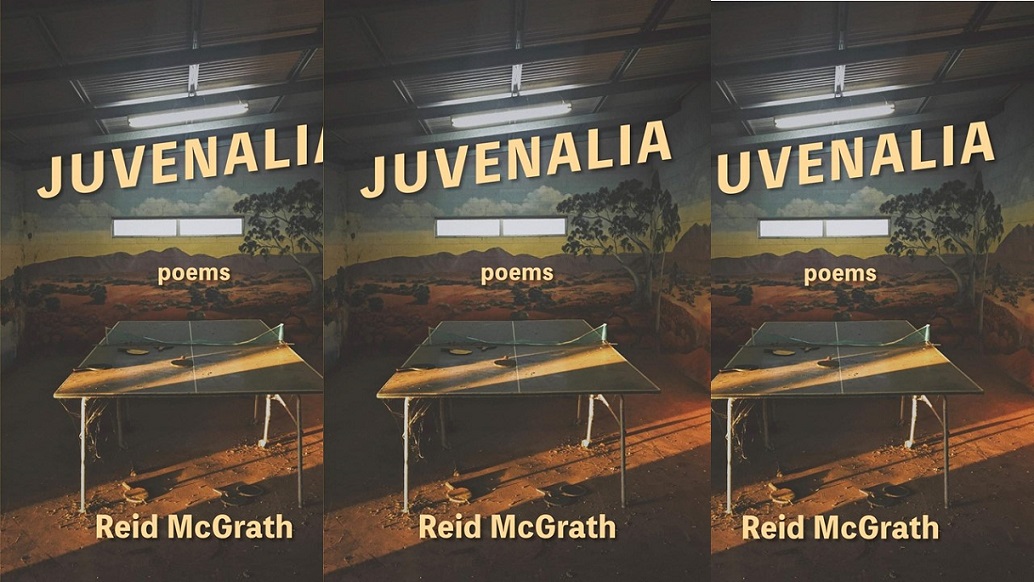
poems A Review of <em>Juvenalia</em> by Reid McGrath

Juvenalia by Reid McGrath, Kelsay Books, 2019

by James Sale

Regular readers of The Society of Classical Poets’ pages will be familiar with the name of Reid McGrath; he has been extensively published here, and in 2015 won First Prize in its annual poetry competition. This collection of his work, Juvenalia, charts his progress and his journey over the last few years. What, then, do we find?

The first thing to comment on is of course the title, which it is easy to miss or misinterpret: I looked at it and thought, “Why is the poet describing his own poetry as juvenilia, a word we are all familiar with?” I looked again and then spotted that juvenilia was in fact juvenalia—a subtle substitution of an “a” for an “i.” This subtlety is, I think, a distinguishing mark of McGrath’s poetry, of which more later. But the juvenalia refers to the exact opposite of juvenilia, since it refers to the games instituted in AD 59 by the Emperor Nero which marked—in the shaving of the beard for the first time—that one had passed from youth to manhood. I suspect, too, that there is a play on words here with a reference to Juvenal, the Latin satiric poet; there is certainly plenty of satiric bite in his work.

This bite begins early on in the collection: titles like “The Backwards Romantic” or “Ars Poetica” immediately let you know that the poet has something to say about the contemporary scene. One of the epigraphs to “Ars Poetica” is Ezra Pound’s “Make it new” and the penultimate stanza of the poem seems withering in its understated way:


And we will go and we will build something
that has some form, that took some tinkering.
It will be “new” just like a snowflake is,
how every orchid’s different from all orchises.


What is clever here are the slightly off metrical and rhyming schemes: McGrath is attempting to move poetry away from formlessness, but it seems to me that to jump from free verse to wholly regular metrics and rhyme is too big, so instead he explores form and moves in a subtler and more cunning way. The final couplet contains a line with anapestic substitutions before nailing the point in almost perfect iambic meter, though the final, fifth foot is weak but its rhyme carries it:


It’ll be as symmetrical as it can be
to frame the chaos of our history.


All this seems highly wrought and powerful. McGrath is a poet who understands form, and who understands meter and rhyme, not in a mechanical and di-dum, di-dum or sweet/tweet way that some advocate; but in a way that is highly expressive and draws on the potential inherent in the language.

Indeed, on the subject of rhyme, McGrath is somewhat of a master. You may have thought that is/orchises was recherché enough, but there is plenty more: from “Juxtaposition” we have man/elan, from “Sportsmanship” law/Hoorah and—to give one more, extreme example—from “The Holistic Physician” Go/sano where a Latin tag is invoked.

But given this capability for the more abstruse rhyming, I am pleased to report that McGrath can breathe new life into the old rhyming clichés, which actually, only master poets should attempt; for in lesser hands stale rhymes give formal poetry that bad name which modernists are always wanting to foist on us. Take, however, McGrath’s apparently clichéd sonnet, “Valentine.” First, the title itself and its subject matter might seem typically sentimental; it is a poem about his love for his wife, after all. Consider, though, the final sestet;


You have refreshed; you irrigate my heart.
You’re water and you’re sunshine and you’re air
that’s unpolluted: cool then warm. You part
the darkness of my isolated lair.
Now fertile is my chest; and a Love grows,
and now you are my Heart; you are my Rose.


I would argue there is a compelling power in these lines. Note the first two lines and the five repetitions of “you”; the build-up of antinomies; the use and dis-use of capitals (one of his subtleties), especially with the first “Now” where the capitalisation here seems less to do with the beginning of the line, since the preceding two lines have foregone it, but more to do with a spondaic substitution that prepares us for a hammer-blow second “now” in the final line where perfect iambic is absolutely restored. That “heart” in the first line has now become “Heart” indicates, perhaps, the world of Platonic ideals—forms—that the poet has now reached. In this context “grows” and “Rose” seems exactly right.

My favourite poem in the collection is probably, “Lines Composed Before Finding The Society of Classical Poets.”


Savants like to arrange their stars
and push their poets into piles:
marble-misers who assign the jars
according to the artists’ styles.
They line them in their fusty den
when they deem an era’s past,
and deign to burp them now and then,
but work to invent a ‘new’ cast.

Classicists have since ceased to be,
and Rhyme is out of fashion now,
but she still moves me like the sea
rocks a sun-soaked splintered scow.
All good men have come from men,
like oaks which out the leafmeal sprout;
what once was old appears again:
It is an everlasting fount.


It may seem somewhat self-serving in that our own dear SCP gets a poem to itself! But here McGrath addresses our perennial issue of why we write as we do; why we ignore the “fashion” in which “Rhyme is out” (notice the capital here too, as McGrath effectively hypostatises rhyme); and instead insist, like “All good men,” that “She” (the Muse?) is “an everlasting fount.” Wonderful.

If McGrath stays with poetry—and does not subside into domestic bliss, as gorgeous as that can be (Beware the Valentine, McGrath/May lead you from the Muse’s path!)—I believe that in the years to come he will produce even greater works of poetry. This is certainly a great start and I recommend it to all true poetry lovers.




ShareTweetPin
The Society of Classical Poets does not endorse any views expressed in individual poems or commentary.
Read Our Comments Policy Here

RandomPoems

‘Not Every Morning’ and Other Poetry by Anne Janai
Beauty

‘Not Every Morning’ and Other Poetry by Anne Janai

September 23, 2017

  Not Every Morning Not every morning is as this one, calm excitement for a future brought by change, so...

‘Beauty’ and Other Poems by Shindy Cai
Culture

‘Ghost Lightning’ and Other Florida Poetry by Brian Yapko

December 7, 2025

  Ghost Lightning So ominous, this strange, unsettling sight: Sharp lightning pulses pierce the moonless sky In silence as if...

Next Post
‘The Tweeter Strikes Back’: A Poem on Donald Trump by Christopher Lindsay

'The Tweeter Strikes Back': A Poem on Donald Trump by Christopher Lindsay

‘A Sonnet for the Sonnet-Maker’ and Other Poetry by Theresa Rodriguez

'Sonnet CXLIII' by Jake Murel

‘Retired K-9’ and Other Poetry by Allen Lee Ireland

'Retired K-9' and Other Poetry by Allen Lee Ireland

Comments 12

  1. Leo Zoutewelle says:
    6 years ago

    With the enlargement of James’ commentary this poem contains more words than can be digested in one day! Wow.

    Reply
  2. Theresa Rodriguez says:
    6 years ago

    Thank you, James, for providing us with such an engaging review! I will have to order a copy of Mr. McGrath’s book.

    Reply
  3. james sale says:
    6 years ago

    Reid is a very fine poet indeed, so I hope this review provides a more extensive readership for his powerful work. Thank you for commenting Leo and Theresa – it’s good to have a perceptive audience for real poetry.

    Reply
  4. Joseph S. Salemi says:
    6 years ago

    McGrath is an excellent poet who deserves more recognition. Let’s hope this perceptive review of the man’s work will generate some of that.

    Reply
    • James Sale says:
      6 years ago

      Amen to that Joe!

      Reply
  5. Andrew Benson Brown says:
    6 years ago

    Love the subtle play on the title. Interesting observation too, James, about masters reworking the old rhyming clichés. I found the ‘Valentine’ sestet quite moving and not at all formulaic, which is hard to pull off when you’re dealing with a topic that has been done literally millions of times.

    I have just ordered a copy of this.

    Reply
  6. james sale says:
    6 years ago

    Thanks Andrew – there is almost nothing an author likes to hear more – especially poets – than the sentence: “I am buying your book”. I am sure Reid will be delighted to learn this, particularly as you are a formidable poet yourself. The greatest compliments are always from our peers!

    Reply
  7. sally Cook says:
    6 years ago

    I agree on the excellence of this poet;s work. Cursed E-mail prevents me writing more.

    Reply
  8. james sale says:
    6 years ago

    Thanks Sally. Appreciate your comment.

    Reply
  9. Susan Jarvis Bryant says:
    6 years ago

    James, this is a wonderful book review. Recently, I have had the pleasure of reading some of this fine poet’s works, and Mr. McGrath’s writing is intriguing, inspirational, and exceptional. I will definitely be checking “Juvenalia” out. Thank you!

    Reply
  10. james sale says:
    6 years ago

    Thanks Sue – I know you will enjoy Reid’s fine work. Much to like about it!

    Reply
  11. BDW says:
    6 years ago

    Three qualities distinguish the poetry of Mr. McGrath from his contemporaries: his texture-rich diction, his novelistic vision, and his goodness imbued with common sense. His athletic approach to existence has suggested my single contemporary charichord: Wes Cuebal Reid.

    The Poetry of Reid McGrath
    by Cadwel E. Bruise
    “…what art could twist the sinews of thy heart?”
    —William Blake, “The Tyger”

    His poems are full of raw energy,
    linguistic power, and remarkable,
    strong phrases that spill over everywhere.
    His art, like rock, is hard and durable;
    its truths are blunt; and Winslow Homer is
    a kindrid spirit in that bleak landscape.
    His world, indeed, at times, is onerous,
    like karst escarpments, easy to be scraped.
    It is sincere as mountains, and as staid.
    His lines are sober, somber, serious,
    like rushing rivers, not easy to wade;
    they run the gamut, calm to furious.
    His verbal structures seem like mighty walls,
    or waterfalls of hardy howls and bawls.

    Reply

Leave a Reply Cancel reply

Your email address will not be published. Required fields are marked *


  1. Estée Crenshaw on The Society of Classical Poets 2026 Haiku CompetitionAugust 18, 2026

    A dragonfly lands The full moon ripples away Across the water Trees ringed with shadows After the light snowfall of…

  2. Monika Cooper on ‘Solitude’ and Other Poems by Mary Jane MyersAugust 18, 2026

    I love Egg Gathering! I'm always amazed by how some sonnets seem much longer than others, due to how much…

  3. Margaret Coats on ‘Totentanz’: A Poem by James A. TweedieAugust 18, 2026

    Glad to hear about the painting-plus-poetry cycle as a whole--and the fact that it was a cultural phenomenon, not just…

  4. Dylan McCormick on The Society of Classical Poets 2026 Haiku CompetitionAugust 18, 2026

    Love must be stockpiled If you have nowhere to store That is known as grief

  5. Jim Manahan on ‘The Gold Star Mother’: A Poem by Gerard MaritatoAugust 18, 2026

    This is a genuine, sincere and heartfelt poem Gerry. I know you put your heart and soul into writing it.…

Subscribe to Daily Poems

Enter your email address to subscribe to this blog and receive notifications of new posts by email.

Join 1,613 other subscribers

Recent Poems

  • ‘Song of the Frog Princess’: A Poem by Scharlie Meeuws
  • ‘The Odyssey: Nolan and Solot Compared’: An Essay by Michael Curtis
  • ‘Solitude’ and Other Poems by Mary Jane Myers
  • ‘The River Not Taken’ and Other Poetry by Brian Yapko
  • ‘Totentanz’: A Poem by James A. Tweedie
  • ‘In God Is Our Trust’: A Poem by Roy E. Peterson
  • ‘Confession’: A Poem by Jeffrey Essmann
  • ‘Religious Poetry, and Religionist Poetry’: An Essay by Joseph S. Salemi
  • The Zingers of Adam Sedia: A Review by Theresa Werba
  • ‘A Paradox’: A Poem by Shamik Banerjee
  • ‘A Prayer of Aristotle’: A Poem by Margaret Coats
  • ‘The Sparrow’: A Poem by Michael Pietrack
  • ‘Chemo Refusal’ and Other Poetry by Golan Shahar
  • ‘Deliverance’ and Other Poetry by Peter Venable
  • ‘Rain’ and Other Poems by Russel Winick
  • ‘The Story of a Plague’ and Other Poetry by Michael Robinson
  • ‘Javert Derailed’: A Poem by Zanna Barton
  • ‘People Forget’: A Poem by James Sale
  • ‘Good and Evil’: A Poem by Roy E. Peterson
  • ‘The Royal Arse Hortillery’: A Poem on the Spoonerism, by Jeff Eardley
  • ‘Who Hears a Robot’s Prayer?’ and Other Poetry by Brian Yapko
  • The Society of Classical Poets 2026 Haiku Competition
  • Four Love Sonnets by Adam Sedia
  • ‘Rasputina Confers with Her Cohorts’: A Poem by Joseph S. Salemi
  • ‘Warfare by Remote Control’: A Poem by Paul A. Freeman
  • ‘The Passing’: A Poem by Margaret Brinton
  • ‘Of Webs and Whispers’: A Poem by Susan Jarvis Bryant
  • Poetry Book Review: Petrarch’s Canzoniere, Translated by A.M. Juster
  • ‘What Folly Dares’ and Other Love Poems by James A. Tweedie
  • ‘Allegrezza’ and Other Poetry by Rob Griffith

Categories

  • Acrostic
  • Alexandroid
  • Alliterative
  • Art
  • Best Poems
  • Blank Verse
  • Chant Royal
  • Classical Poets Live
  • Clerihew
  • Covid-19
  • Deconstructing Communism
  • Educational
  • Epic
  • Epigrams and Proverbs
  • Essays
    • Interviews with Poets
    • Poetry Reviews
  • Featured
  • From the Society
  • Great Poets
    • Dante Alighieri
    • Edgar Allan Poe
    • Emily Dickinson
    • Geoffrey Chaucer
    • Henry Wadsworth Longfellow
    • Homer
    • John Keats
    • John Milton
    • Robert Frost
    • William Blake
    • William Shakespeare
    • William Wordsworth
  • Human Rights in China
  • Limerick
  • Love Poems
  • Music
  • Pantoum
  • Performing Arts
  • Poetry
    • Beauty
    • Children's Poems
    • Culture
    • Ekphrastic
    • Found Poems
    • High School Poets
    • Humor
    • Riddles
  • Poetry Challenge
  • Poetry Contests
  • Poetry Forms
    • Curtal Sonnet
    • Haiku
  • Poetry Readings
  • Rhupunt
  • Rondeau
  • Rondeau Redoublé
  • Rondel
  • Rubaiyat
  • Sapphic Verse
  • Satire
  • Science
  • Sestina
  • Shape Poems
  • Short Stories
  • Song Lyrics
  • Sonnet
  • Symposium
  • Terrorism
  • Terza Rima
  • The Environment
  • Translation
  • Triolet
  • Video
  • Villanelle

Quick Links

  • About Us
  • Submit Poetry
  • Become a Member
  • Members List
  • Support the Society
  • Advertisement Placement
  • Comments Policy
  • Terms of Use

Welcome Back!

Login to your account below

Forgotten Password?

Retrieve your password

Please enter your username or email address to reset your password.

Log In
No Result
View All Result
  • Poems
    • Beauty
    • Culture
    • Satire
    • Humor
    • Children’s
    • Art
    • Ekphrastic
    • Epic
    • Epigrams and Proverbs
    • Human Rights in China
    • Music
    • Performing Arts
    • Riddles
    • Science
    • Song Lyrics
    • The Environment
    • The Raven
    • Found Poems
    • High School Poets
    • Terrorism
    • Covid-19
  • Poetry Forms
    • Sonnet
    • Haiku
    • Limerick
    • Villanelle
    • Rondeau
    • Pantoum
    • Sestina
    • Triolet
    • Acrostic
    • Alexandroid
    • Alliterative
    • Blank Verse
    • Chant Royal
    • Clerihew
    • Rhupunt
    • Rondeau Redoublé
    • Rondel
    • Rubaiyat
    • Sapphic Verse
    • Shape Poems
    • Terza Rima
  • Great Poets
    • Geoffrey Chaucer
    • Emily Dickinson
    • Homer
    • Henry Wadsworth Longfellow
    • Dante Alighieri
    • John Keats
    • John Milton
    • Edgar Allan Poe
    • William Shakespeare
    • William Wordsworth
    • William Blake
    • Robert Frost
  • Love Poems
  • Contests
  • SCP Academy
    • Educational
    • Teaching Classical Poetry—A Guide for Educators
    • Poetry Forms
    • The SCP Journal
    • Books

© 2025 SCP. WebDesign by CODEC Prime.