• Submit Poetry
  • Support SCP
  • About Us
  • Members
  • Join
Thursday, January 8, 2026
Society of Classical Poets
  • Poems
    • Beauty
    • Culture
    • Satire
    • Humor
    • Children’s
    • Art
    • Ekphrastic
    • Epic
    • Epigrams and Proverbs
    • Human Rights in China
    • Music
    • Performing Arts
    • Riddles
    • Science
    • Song Lyrics
    • The Environment
    • The Raven
    • Found Poems
    • High School Poets
    • Terrorism
    • Covid-19
  • Poetry Forms
    • Sonnet
    • Haiku
    • Limerick
    • Villanelle
    • Rondeau
    • Pantoum
    • Sestina
    • Triolet
    • Acrostic
    • Alexandroid
    • Alliterative
    • Blank Verse
    • Chant Royal
    • Clerihew
    • Rhupunt
    • Rondeau Redoublé
    • Rondel
    • Rubaiyat
    • Sapphic Verse
    • Shape Poems
    • Terza Rima
  • Great Poets
    • Geoffrey Chaucer
    • Emily Dickinson
    • Homer
    • Henry Wadsworth Longfellow
    • Dante Alighieri
    • John Keats
    • John Milton
    • Edgar Allan Poe
    • William Shakespeare
    • William Wordsworth
    • William Blake
    • Robert Frost
  • Love Poems
  • Contests
  • SCP Academy
    • Educational
    • Teaching Classical Poetry—A Guide for Educators
    • Poetry Forms
    • The SCP Journal
    • Books
No Result
View All Result
Society of Classical Poets
  • Poems
    • Beauty
    • Culture
    • Satire
    • Humor
    • Children’s
    • Art
    • Ekphrastic
    • Epic
    • Epigrams and Proverbs
    • Human Rights in China
    • Music
    • Performing Arts
    • Riddles
    • Science
    • Song Lyrics
    • The Environment
    • The Raven
    • Found Poems
    • High School Poets
    • Terrorism
    • Covid-19
  • Poetry Forms
    • Sonnet
    • Haiku
    • Limerick
    • Villanelle
    • Rondeau
    • Pantoum
    • Sestina
    • Triolet
    • Acrostic
    • Alexandroid
    • Alliterative
    • Blank Verse
    • Chant Royal
    • Clerihew
    • Rhupunt
    • Rondeau Redoublé
    • Rondel
    • Rubaiyat
    • Sapphic Verse
    • Shape Poems
    • Terza Rima
  • Great Poets
    • Geoffrey Chaucer
    • Emily Dickinson
    • Homer
    • Henry Wadsworth Longfellow
    • Dante Alighieri
    • John Keats
    • John Milton
    • Edgar Allan Poe
    • William Shakespeare
    • William Wordsworth
    • William Blake
    • Robert Frost
  • Love Poems
  • Contests
  • SCP Academy
    • Educational
    • Teaching Classical Poetry—A Guide for Educators
    • Poetry Forms
    • The SCP Journal
    • Books
No Result
View All Result
Society of Classical Poets
No Result
View All Result
Home Poetry Beauty

‘Épuration’ by Joseph S. Salemi

June 2, 2021
in Beauty, Culture, Poetry
A A
14
poems 'Épuration' by Joseph S. Salemi

.

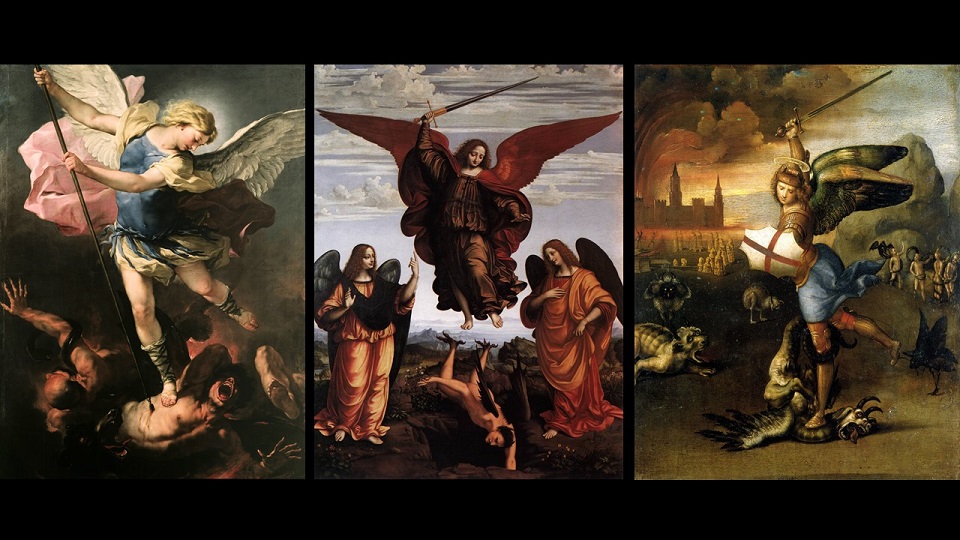
On the Greek isle of Tilos are the ruins of the sanctuary of Pythian Apollo. Over them has been built the Church of the Archangel Michael.

“Now rot here on the earth that nourishes men. No longer will you live to be an evil mischief to mortals.”

—Homeric Hymn to Apollo

Saint Michael, God’s own musketeer,
Commander of angelic hosts;
Saint Michael of the lucent spear
Too glorious to be dimmed by boasts;

Hold back the hordes of this sick age
That seek our blood on every side—
The Mongols of our lust and rage,
The Persians of our pampered pride.

May your lance pierce the inward parts
Of what drives our diseased decline—
Like Phoebus, fill the beast with darts
And leave it in putrescent slime.

Let your sword swing and dole out death
In one immense and lethal arc
To all whose leprous, tainted breath
Infects the light and plagues the dark.

Like Trojans, may their throats be cut
By Achilleus, lost to hope—
Or let them, like the suitors’ sluts,
Dance strangled on a laundry rope.

Let them lie in mounded pyres
Awaiting the all-cleansing flame—
Let them belch, in those last fires,
The stench of their forgotten name.

And then, Saint Michael, Like-to-God,
Stand watch against vindictive night,
Lest gore from your chastising rod
Bring back, unseen, the venomed blight.

Originally published in TRINACRIA

.

.

Joseph S. Salemi has published five books of poetry, and his poems, translations and scholarly articles have appeared in over one hundred publications world-wide.  He is the editor of the literary magazine Trinacria and writes for Expansive Poetry On-line. He teaches in the Department of Humanities at New York University and in the Department of Classical Languages at Hunter College.

ShareTweetPin
The Society of Classical Poets does not endorse any views expressed in individual poems or commentary.
Read Our Comments Policy Here
Next Post
‘Obituary’ and Other Poetry by C.B. Anderson

'The Birthday Rose' by Cheryl Corey

A Poem on the Australian Mice Plague, by Norma Pain

A Poem on the Australian Mice Plague, by Norma Pain

‘Tank Man—Remembering The Unknown Rebel’ by Susan Jarvis Bryant

'Tank Man---Remembering The Unknown Rebel' by Susan Jarvis Bryant

Comments 14

  1. Margaret Coats says:
    5 years ago

    A perfect cursing psalm, first asking restraint of evils for which we are responsible, then obliteration of incorrigible enemies, and finally protection from their return. The structure shows without saying that we must be vigilant over ourselves, lest we have any part in the return of the venomed blight. Saint Michael, defend us in this battle!

    Reply
  2. James A. Tweedie says:
    5 years ago

    To all whose leprous, tainted breath
    Infects the light and plagues the dark

    Words do have power, especially when the pen is wielded by one who knows how to use it.

    As for praying for Michael to vent God’s wrath and judgment in the manner of a vengeful Greek mortal/god, well, that is certainly thinking out of the box!

    And . . . I would love to know who is being addressed and cursed in your citation from the Homeric Hymn to Apollo.

    Reply
    • Joseph S. Salemi says:
      5 years ago

      In the Homeric Hymn, Apollo is addressing the carcass of the terrible she-dragon that had surrounded the omphalos (the center of the world). He had killed her with his arrows, and then said “Rot there, and trouble mankind no longer.” The Greek word for “rot” is “pytho,” so Apollo is sometimes called the Pythian god when he acts to destroy or eliminate anything disgusting, vile, or polluting. The “conceit” of this poem is to connect the earlier myth of the Pythian Apollo with the Christian idea of St. Michael the Archangel.

      Reply
      • James A. Tweedie says:
        5 years ago

        Thank you.

        I am especially grateful for your bringing me back to the concept of a poetic “conceit.”

        Also, it seems to me that Apollo is often the one who displays behavior which could be described as “evil mischief to mortals!” As with all of the classical deities, Apollo reflects a personality as complex (and conflicted) as any human. This is, I think, part of what continues to make the Olympian soap opera so interesting and compelling for us today.

        Reply
      • Margaret Coats says:
        5 years ago

        It’s not just Apollo’s personality as seen in myth. Part of myth’s wealth of meaning lies in symbolism. This is clearest in Apollo’s solar symbolism: the sun is needed for crops to grow, but too much sun scorches crops and causes famine. Also seen in Apollo as causer of plague and healer.

        As for Michael venting God’s wrath on mortals, this is well within the box of several Biblical psalms praying for God to avenge His people on their enemies. In the Vatican II Liturgy of the Hours, the passages have been excised. These divinely inspired texts remain in the prayer of the Church only in a few traditional religious orders that recite the entire Psalter each week.

        Reply
      • Joseph S. Salemi says:
        5 years ago

        Apollo, like his sister Artemis, is a cold divinity who can be cruel and destructive. He has no playful, humorous side. But in my view he is the most important of the Graeco-Roman gods because all human achievement, art, and civilization are under his patronage, and he is the absolutely essential destroyer of what is evil, sick, degraded, ugly, inferior, and corrupt. Without Apollo and his far-shooting arrows, all filth and infection grows without check.

        The problem today in the West is that we have no Apollo figure to fulfill this crucial role, except for St. Michael the Archangel. And as Margaret has pointed out, the vile corruption of Vatican 2 has done all in its power to eliminate St. Michael from Catholic liturgy, prayers and consciousness. This was no error. It was deliberate.

        Reply
  3. Julian D.Woodruff says:
    5 years ago

    Thank you, Joseph. The allusion to Apollo is surely (in part at least) meant to denote how the dark sentimentalism and subjectivism rampant today must be defeated by the the power of objectivism and reason: insistence on the prevalence of absolute truth (light, the “lucent spear”).
    There are so many powerful lines here, my favorites being
    “Like Phoebus, fill the beast with darts
    And leave it in putrescent slime.”
    Did you have something quite specific in mind when writing “laundry rope”?

    Reply
    • Joseph S. Salemi says:
      5 years ago

      The “laundry rope” refers to the killing, in Homer’s Odyssey, of the serving-girls who had dishonored Odysseus’ house by sleeping with the suitors who were tormenting his wife Penelope. The girls were strangled to death by Odysseus’ son Telemachos on a clothesline (at the direction of Odysseus). It was part of the major cleanup of his house that followed on his return to Ithaka.

      The previous Homeric reference in the same quatrain is to Achilleus’ sacrifice of Trojan captives at the funeral pyre of his friend Patroklos, towards the end of the Iliad.

      Reply
  4. paul buchheit says:
    5 years ago

    A lot of imagery and wrath here. Very lyrical. Great work, Joseph!

    Reply
  5. Sally Cook says:
    5 years ago

    Dark and strange, with iron-clad stanzas, this poem sits like a block of marble on our near horizon.
    Thought that I had seen this before; re-read your note, and realized I must have seen it in that excellent journal TRINACRIA.

    Reply
  6. Susan Jarvis Bryant says:
    5 years ago

    For me, this poem is a masterclass in spot-on technique. It makes a conceit look easy. The same applies to the excellent employment of alliteration – never gratuitous, never forced, just a pure joy to read aloud and revel in the musicality of the piece. Joe S., thank you for your inspiration.

    Reply
  7. Cynthia Erlandson says:
    5 years ago

    Amen!

    Reply
  8. David Watt says:
    5 years ago

    The cut and thrust of consistently powerful imagery flows logically, and
    beautifully within its technically faultless framework.

    Reply
  9. C.B. Anderson says:
    5 years ago

    Like Sally, I barely remember this, though I must have read it. Perhaps this is because Michaelmas coincides with Oktoberfest.

    Reply

Leave a Reply Cancel reply

Your email address will not be published. Required fields are marked *

  1. Mike Bryant on ‘Darkness and Dawn’: A Christmas Triptych by Susan Jarvis BryantJanuary 8, 2026

    Susan, I know this poem came from much contemplation and work. I love it. I believe that you have illuminated,…

  2. Jeffrey J Essmann on ‘King of Poets’: A Poem by Margaret CoatsJanuary 8, 2026

    P.S. The conceit that Saul is still nursing his grudge against David in Heaven somehow provides me a strange comfort,…

  3. Jeffrey J Essmann on ‘King of Poets’: A Poem by Margaret CoatsJanuary 8, 2026

    Thank you so much for this, Margaret. As someone whose spiritual life is centered on the Liturgy of the Hours,…

  4. Michael Pietrack on ‘Art and Nature’ and Other Poetry by C.B. AndersonJanuary 8, 2026

    Business as Usual: This poem hits hard in the best way, saying what most people only think. It’s bold, honest,…

  5. Michael Pietrack on ‘Wall of Ice’ and Other Poetry by James BontragerJanuary 8, 2026

    Wall of Ice: You turn personal struggle into a gripping, cinematic battle that keeps the reader engaged from the first…

Receive Poems in Your Email

Enter your email address to subscribe to this blog and receive notifications of new posts by email.

Join 1,621 other subscribers
Facebook Twitter Youtube

Recent Poems

  • Two Sonnets by Nino Martoglio, Translated by Joseph S. Salemi
  • ‘Wall of Ice’ and Other Poetry by James Bontrager
  • ‘King of Poets’: A Poem by Margaret Coats
  • ‘Watercolors’: A Poem by Susan Steele Rives
  • ‘Art and Nature’ and Other Poetry by C.B. Anderson
  • ‘Star of Wonder’: A Poem by James A. Tweedie
  • ‘Yeonmi Park’s Advice to Americans’: A Poem by Warren Bonham
  • ‘Caravaggio’: A Poem by Lisa J. Roberts
  • ‘Refrigerator Bird’ and Other Poetry by Armaan Fatteh-Patil
  • ‘The Oak Trees’: A Poem by Bhikkhu Nyanasobhano
  • ‘A Cardinal on a Snowy Day’: A Poem by Rob Fried
  • Poets Susan Jarvis Bryant and James Sale Respond to Mamdani’s Swearing In as NYC Mayor
  • ‘Single Room Cigarette, 17th Floor Yale Club of Manhattan’: A Poem by Alec Ream
  • ‘Legacy of Light’: A Poem by Martin Briggs
  • ‘The Swarm’ and Other Poetry by Cheryl Corey
  • ‘Lament of a Poet Falsely Accused of Using AI’ and Other Poetry by Paul Buchheit
  • ‘A Gift from the South’: A Poem by Julian Woodruff
  • ‘New Year’s Peeve’: A Poem by Susan Jarvis Bryant
  • ‘Homage to Brigitte Bardot’: A Poem by Joseph S. Salemi
  • ‘Dearth of Emotional Intelligence’ and Other Poems by Russel Winick
  • ‘Fireflies’: A Poem by Mark Stellinga
  • ‘Real Poetry’: A Poem by Eric v.d. Luft
  • ‘Flaws’: A Poem by Joshua Thomas
  • Two Final Poems by Sally Cook
  • ‘Twelve Labors More, Part I’: A Poem by Evan Mantyk
  • ‘A Perfect Match is Found’: A Poem by Roy E. Peterson
  • ‘The Seven Crossings’: A Poem by Ulysses Arlen
  • ‘An Open Book’ and Other Poetry by David McMahon
  • A Video Poetry Reading by Paul Erlandson
  • ‘Otto and Octavius at Christmas’: A Children’s Poem by Mary Gardner

Categories

  • Acrostic
  • Alexandroid
  • Alliterative
  • Art
  • Best Poems
  • Blank Verse
  • Chant Royal
  • Classical Poets Live
  • Clerihew
  • Covid-19
  • Deconstructing Communism
  • Educational
  • Epic
  • Epigrams and Proverbs
  • Essays
    • Interviews with Poets
    • Poetry Reviews
  • Featured
  • From the Society
  • Great Poets
    • Dante Alighieri
    • Edgar Allan Poe
    • Emily Dickinson
    • Geoffrey Chaucer
    • Henry Wadsworth Longfellow
    • Homer
    • John Keats
    • John Milton
    • Robert Frost
    • William Blake
    • William Shakespeare
    • William Wordsworth
  • Human Rights in China
  • Limerick
  • Love Poems
  • Music
  • Pantoum
  • Performing Arts
  • Poetry
    • Beauty
    • Children's Poems
    • Culture
    • Ekphrastic
    • Found Poems
    • High School Poets
    • Humor
    • Riddles
  • Poetry Challenge
  • Poetry Contests
  • Poetry Forms
    • Haiku
  • Poetry Readings
  • Rhupunt
  • Rondeau
  • Rondeau Redoublé
  • Rondel
  • Rubaiyat
  • Sapphic Verse
  • Satire
  • Science
  • Sestina
  • Shape Poems
  • Short Stories
  • Song Lyrics
  • Sonnet
  • Symposium
  • Terrorism
  • Terza Rima
  • The Environment
  • Translation
  • Triolet
  • Video
  • Villanelle

Quick Links

  • About Us
  • Submit Poetry
  • Become a Member
  • Members List
  • Support the Society
  • Advertisement Placement
  • Comments Policy
  • Terms of Use

Welcome Back!

Login to your account below

Forgotten Password?

Retrieve your password

Please enter your username or email address to reset your password.

Log In
No Result
View All Result
  • Poems
    • Beauty
    • Culture
    • Satire
    • Humor
    • Children’s
    • Art
    • Ekphrastic
    • Epic
    • Epigrams and Proverbs
    • Human Rights in China
    • Music
    • Performing Arts
    • Riddles
    • Science
    • Song Lyrics
    • The Environment
    • The Raven
    • Found Poems
    • High School Poets
    • Terrorism
    • Covid-19
  • Poetry Forms
    • Sonnet
    • Haiku
    • Limerick
    • Villanelle
    • Rondeau
    • Pantoum
    • Sestina
    • Triolet
    • Acrostic
    • Alexandroid
    • Alliterative
    • Blank Verse
    • Chant Royal
    • Clerihew
    • Rhupunt
    • Rondeau Redoublé
    • Rondel
    • Rubaiyat
    • Sapphic Verse
    • Shape Poems
    • Terza Rima
  • Great Poets
    • Geoffrey Chaucer
    • Emily Dickinson
    • Homer
    • Henry Wadsworth Longfellow
    • Dante Alighieri
    • John Keats
    • John Milton
    • Edgar Allan Poe
    • William Shakespeare
    • William Wordsworth
    • William Blake
    • Robert Frost
  • Love Poems
  • Contests
  • SCP Academy
    • Educational
    • Teaching Classical Poetry—A Guide for Educators
    • Poetry Forms
    • The SCP Journal
    • Books

© 2025 SCP. WebDesign by CODEC Prime.

This website uses cookies. By continuing to use this website you are giving consent to cookies being used. Visit our Privacy and Cookie Policy.