• Submit Poetry
  • Support SCP
  • About Us
  • Members
  • Join
Thursday, January 8, 2026
Society of Classical Poets
  • Poems
    • Beauty
    • Culture
    • Satire
    • Humor
    • Children’s
    • Art
    • Ekphrastic
    • Epic
    • Epigrams and Proverbs
    • Human Rights in China
    • Music
    • Performing Arts
    • Riddles
    • Science
    • Song Lyrics
    • The Environment
    • The Raven
    • Found Poems
    • High School Poets
    • Terrorism
    • Covid-19
  • Poetry Forms
    • Sonnet
    • Haiku
    • Limerick
    • Villanelle
    • Rondeau
    • Pantoum
    • Sestina
    • Triolet
    • Acrostic
    • Alexandroid
    • Alliterative
    • Blank Verse
    • Chant Royal
    • Clerihew
    • Rhupunt
    • Rondeau Redoublé
    • Rondel
    • Rubaiyat
    • Sapphic Verse
    • Shape Poems
    • Terza Rima
  • Great Poets
    • Geoffrey Chaucer
    • Emily Dickinson
    • Homer
    • Henry Wadsworth Longfellow
    • Dante Alighieri
    • John Keats
    • John Milton
    • Edgar Allan Poe
    • William Shakespeare
    • William Wordsworth
    • William Blake
    • Robert Frost
  • Love Poems
  • Contests
  • SCP Academy
    • Educational
    • Teaching Classical Poetry—A Guide for Educators
    • Poetry Forms
    • The SCP Journal
    • Books
No Result
View All Result
Society of Classical Poets
  • Poems
    • Beauty
    • Culture
    • Satire
    • Humor
    • Children’s
    • Art
    • Ekphrastic
    • Epic
    • Epigrams and Proverbs
    • Human Rights in China
    • Music
    • Performing Arts
    • Riddles
    • Science
    • Song Lyrics
    • The Environment
    • The Raven
    • Found Poems
    • High School Poets
    • Terrorism
    • Covid-19
  • Poetry Forms
    • Sonnet
    • Haiku
    • Limerick
    • Villanelle
    • Rondeau
    • Pantoum
    • Sestina
    • Triolet
    • Acrostic
    • Alexandroid
    • Alliterative
    • Blank Verse
    • Chant Royal
    • Clerihew
    • Rhupunt
    • Rondeau Redoublé
    • Rondel
    • Rubaiyat
    • Sapphic Verse
    • Shape Poems
    • Terza Rima
  • Great Poets
    • Geoffrey Chaucer
    • Emily Dickinson
    • Homer
    • Henry Wadsworth Longfellow
    • Dante Alighieri
    • John Keats
    • John Milton
    • Edgar Allan Poe
    • William Shakespeare
    • William Wordsworth
    • William Blake
    • Robert Frost
  • Love Poems
  • Contests
  • SCP Academy
    • Educational
    • Teaching Classical Poetry—A Guide for Educators
    • Poetry Forms
    • The SCP Journal
    • Books
No Result
View All Result
Society of Classical Poets
No Result
View All Result
Home Love Poems

‘Imitating Shakespeare’s Sonnet 107’ by James Sale

December 15, 2024
in Love Poems, Poetry, Sonnet, William Shakespeare
A A
20
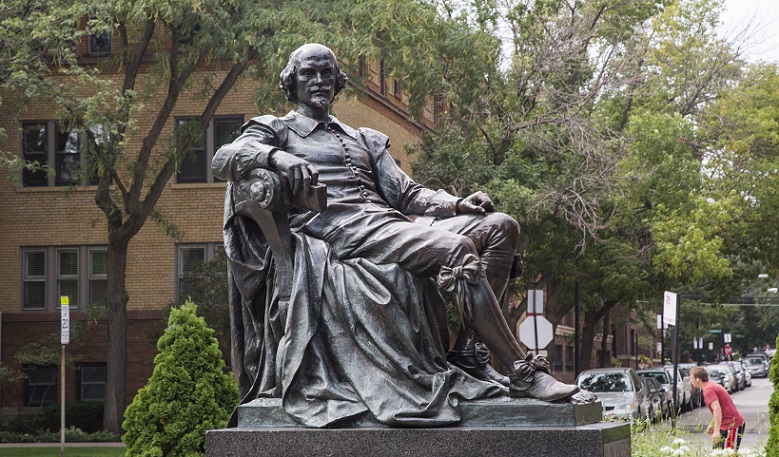
poetry/mantyk/shakespeare

.

Imitating Shakespeare’s Sonnet 107

.

Sonnet 107

__by William Shakespeare

Not mine own fears, nor the prophetic soul
Of the wide world dreaming on things to come,
Can yet the lease of my true love control,
Supposed as forfeit to a confined doom.
The mortal moon hath her eclipse endured,
And the sad augurs mock their own presage;
Incertainties now crown themselves assured,
And peace proclaims olives of endless age.
Now with the drops of this most balmy time,
My love looks fresh, and Death to me subscribes,
Since, spite of him, I’ll live in this poor rhyme,
While he insults o’er dull and speechless tribes:
And thou in this shalt find thy monument,
When tyrants’ crests and tombs of brass are spent.

.

Imitating Shakespeare: 107

__by James Sale

My love looks fresh, as every lover’s does,
For dateless ages, or at least until
The cozy comforts of settling down close
Atom-fired collisions of will to will;
Meantime, the whole world’s business stinks on:
Wars, rumors, famines, earthquakes, dope and plagues,
Some stupid voice erupts with… Negotiations.
Breakthroughs. Arms control. Hope. The latest Trade
And all the irrelevance of speechless tribes
Waving to oblivion with tactless art,
Mindless as modernism. They’ve all connived
At mediocrities and betrayed the heart.

Let them preach peace, their palates packed arsenals;
My job’s to love you, and to make it final.

.

.

James Sale has had over 50 books published, most recently, “Mapping Motivation for Top Performing Teams” (Routledge, 2021). He has been nominated by The Hong Kong Review for the 2022 Pushcart Prize for poetry, has won first prize in The Society of Classical Poets 2017 annual competition, and performed in New York in 2019. He is a regular contributor to The Epoch Times. His most recent poetry collection is “StairWell.” For more information about the author, and about his Dante project, visit https://englishcantos.home.blog. To subscribe to his brief, free and monthly poetry newsletter, contact him at [email protected]
ShareTweetPin
The Society of Classical Poets does not endorse any views expressed in individual poems or commentary.
Read Our Comments Policy Here
Next Post
‘Let’s Just Say’: A Poem by Mark Stellinga

'Let’s Just Say': A Poem by Mark Stellinga

‘Journalists Live in a Fantasy World’: A Poem by Roy E. Peterson

'Journalists Live in a Fantasy World': A Poem by Roy E. Peterson

‘Intersubjective Bootstrap’: A Poem by Josh Mitteldorf

'Intersubjective Bootstrap': A Poem by Josh Mitteldorf

Comments 20

  1. Richard Craven says:
    1 year ago

    (i) The jarred scansion in line 4 complements the line’s sense.
    (ii) I particularly like how the iambic convention invites the pronunciation of the “i” in “business” in line 5.
    (iii) The imperfect rhyme between “stinks on” and “negotiations” doesn’t quite work for me – something to do with the latter’s feminine ending, I think.
    (iv) “Waving” in line 10 is a nice trochaic substitution.
    (v) Allow me to suggest an alternative line 12 which better maintains the iambic pentameter: “as mediocrities betrayed the heart”.
    (vi) I have to say that the concluding heroic couplet doesn’t quite work. Again it’s something to do with line 13’s feminine ending.

    On another note, it’s only just struck me – although it’s probably been said before – that the concluding heroic couplet in Shakespeare’s sonnet is strongly reminiscent of Horaces Odes lib.3 30 line 1: “Exegi monumentum aere perennius”.

    Reply
    • James Sale says:
      1 year ago

      Thanks Richard, appreciate your detailed comments.

      Reply
  2. Roy Eugene Peterson says:
    1 year ago

    Fascinanating update in modern English of one of Shakespeare’s love poems that I have read, but into which I never delved deeply. The best lines of yours for me were:
    “Waving to oblivion with tactless art,
    Mindless as modernism. They’ve all connived
    At mediocrities and betrayed the heart.”
    I might have used “that” rather than “and” in the third line, but the meaning is the same.

    Reply
    • James Sale says:
      1 year ago

      Thanks Roy – glad you liked some of these lines, and the lines you pick out are so relevant to today!!!

      Reply
  3. James A. Tweedie says:
    1 year ago

    James,

    To Roy’s list of favorites I would add your opening line as one of mine,

    “My love looks fresh, as every lover’s does.”

    It’s not particularly romantic, but it is sort of cheeky–akin to your love for her being a “job!”

    If I miss anything at all in your poem, it would be a reprise of Shakespeare’s marvelously alliterative line, “The mortal moon, hath her eclipse endured.”

    Which is, in any case, a line beyond imitation.

    Reply
    • James Sale says:
      1 year ago

      Thanks James – to miss only that is praise indeed! Thanks.

      Reply
  4. C.B. Anderson says:
    1 year ago

    If density of meaning is the prime attribute of art (something I was told in my Philosopy of Art class at Harvard University), then this poem is certainly a work of it. I can grasp the gist, but the many details are hard to condense into a succinct summary. Yet, here we are, doing our best to make the best of a complicated situation.

    Reply
    • James Sale says:
      1 year ago

      Ha ha ha!!! Very dry, CB, and thanks for making the attempt; yes, some things are complicated. But is it worth the effort? Only you can say. But I always keep in mind that wonderful title that WB Yeats used: ‘The fascination of what’s difficult’.

      Reply
  5. Margaret Coats says:
    1 year ago

    Shakespeare may have done something similar, as writers in his day (and much of the past) found great worth and no shame in imitating predecessors. You, James, re-invent his work in your own style. I miss his smoother meter, more precise logic, and exalted yet intimate tone. In return, you provide an interesting contemporary structure. Your early lines and final couplet form a frame with the Shakespearean theme re-stated. You re-figure eternity in a practical way. The world’s business refuses to stay in the background, but demands center stage in a broadcast voice outspeaking you. This mindless modernism is amusing in its betrayal of the heart of the poem as well as the heart of the lover. You grab the heart back with one satirical line telling off the world, and a final one firmly grasping love as assigned employment.

    Reply
    • James Sale says:
      1 year ago

      Thanks Margaret. Yes, this mindless modernism does its best to betray our deepest aspirations, hopes and loves: hence the forever need of vigilance! Glad you found some merit in my re-framing of the master’s work.

      Reply
  6. Adam Sedia says:
    1 year ago

    I think your sonnet stands wonderfully on its own without any reference to Shakespeare, though I don’t think it loses anything by acknowledging the Bard’s inspiration. You give us some wonderful turns of phrase (“atom-fired collisions of will to will,” “stinks on,” “mindless as modernism”), and make good use of the Shakespearean form’s opportunity for a double-turn.

    Reply
    • James Sale says:
      1 year ago

      Thanks Adam – much appreciated; and of course, you are right: poems need to stand alone without reference to others, though by referencing it in this way I am, I hope, contributing to the wider aim of the SCP to promote classical poetry; so, I have overtly done this just by way of information. Of course, the downside is that critics may easily make hay with the shortfalls of one’s efforts compared with the magisterial masters. However, as you know, we should aim high; and for myself, I am not intimidated by the past, rather feel inspired by it – as my ‘run’ on Dante illustrates. Much appreciate your kind words.

      Reply
  7. ABB says:
    1 year ago

    The use of jarring near-rhymes and loose scansion here reflects the theme of the “stupid” and “mindless” modern world well. It’s not an especially pretty poem, but then it isn’t supposed to be. One might interpret the out of sync feminine ending rhymes, especially in the final couplet, with the commitment to personal love over and against chaos. Well done.

    Reply
    • James Sale says:
      1 year ago

      Thanks ABB – yes, to get to love is a struggle and it doesn’t always rhyme well! Appreciate your comments.

      Reply
  8. Patricia Allread says:
    1 year ago

    Greetings, James!
    Shakespeare is one of my favorites. so many others.. For me, the simpler, the poem, the better. Example, Robert Frost. I liked the last two lines… the best!
    Happy 2025!

    Reply
    • James Sale says:
      12 months ago

      Dear Patricia – simple is good! Frost is great. Happy 2025!!!

      Reply
  9. Michael Pietrack says:
    9 months ago

    That final line—“My job’s to love you, and to make it final”—landed hard. It feels like a man planting a flag in scorched earth. In a world addicted to distraction and betrayal, the idea that love could still be “final” is… honestly, kind of radical.

    Reply
    • James Sale says:
      6 days ago

      I hadn’t seen this before Michael – so thanks – and I am glad the last line hit you so hard – kinda radical!!!

      Reply
  10. Linda Alice FOwler says:
    9 months ago

    I think this updated imitation is favoloso James!

    Reply
    • James Sale says:
      6 days ago

      Just seen this – thanks Linda – love the word favoloso: if it’s not, it should be Italian!!!

      Reply

Leave a Reply Cancel reply

Your email address will not be published. Required fields are marked *

  1. C.B. Anderson on ‘Art and Nature’ and Other Poetry by C.B. AndersonJanuary 8, 2026

    To be perfectly honest, Michael, I never know how what I write will strike a reader. Sometimes things just work…

  2. C.B. Anderson on ‘Art and Nature’ and Other Poetry by C.B. AndersonJanuary 8, 2026

    My wife, Julian, has often asks me why I write poetry when I could be writing songs and making some…

  3. Margaret Coats on ‘Refrigerator Bird’ and Other Poetry by Armaan Fatteh-PatilJanuary 8, 2026

    You write some exceptionally fine lines, Armaan. For one example from each poem: Wrong means reaching. Wrong means getting at…

  4. Margaret Coats on ‘King of Poets’: A Poem by Margaret CoatsJanuary 8, 2026

    Thanks, Margaret B! His inspired words have echoed through the ages, in many languages, and I've memorized Psalm 1 in…

  5. Margaret Coats on ‘King of Poets’: A Poem by Margaret CoatsJanuary 8, 2026

    Thank you for describing my lines with such appreciation, Bhikku Nyanasobhano. The qualities you mention are what I could hope…

Receive Poems in Your Email

Enter your email address to subscribe to this blog and receive notifications of new posts by email.

Join 1,621 other subscribers
Facebook Twitter Youtube

Recent Poems

  • Two Sonnets by Nino Martoglio, Translated by Joseph S. Salemi
  • ‘Wall of Ice’ and Other Poetry by James Bontrager
  • ‘King of Poets’: A Poem by Margaret Coats
  • ‘Watercolors’: A Poem by Susan Steele Rives
  • ‘Art and Nature’ and Other Poetry by C.B. Anderson
  • ‘Star of Wonder’: A Poem by James A. Tweedie
  • ‘Yeonmi Park’s Advice to Americans’: A Poem by Warren Bonham
  • ‘Caravaggio’: A Poem by Lisa J. Roberts
  • ‘Refrigerator Bird’ and Other Poetry by Armaan Fatteh-Patil
  • ‘The Oak Trees’: A Poem by Bhikkhu Nyanasobhano
  • ‘A Cardinal on a Snowy Day’: A Poem by Rob Fried
  • Poets Susan Jarvis Bryant and James Sale Respond to Mamdani’s Swearing In as NYC Mayor
  • ‘Single Room Cigarette, 17th Floor Yale Club of Manhattan’: A Poem by Alec Ream
  • ‘Legacy of Light’: A Poem by Martin Briggs
  • ‘The Swarm’ and Other Poetry by Cheryl Corey
  • ‘Lament of a Poet Falsely Accused of Using AI’ and Other Poetry by Paul Buchheit
  • ‘A Gift from the South’: A Poem by Julian Woodruff
  • ‘New Year’s Peeve’: A Poem by Susan Jarvis Bryant
  • ‘Homage to Brigitte Bardot’: A Poem by Joseph S. Salemi
  • ‘Dearth of Emotional Intelligence’ and Other Poems by Russel Winick
  • ‘Fireflies’: A Poem by Mark Stellinga
  • ‘Real Poetry’: A Poem by Eric v.d. Luft
  • ‘Flaws’: A Poem by Joshua Thomas
  • Two Final Poems by Sally Cook
  • ‘Twelve Labors More, Part I’: A Poem by Evan Mantyk
  • ‘A Perfect Match is Found’: A Poem by Roy E. Peterson
  • ‘The Seven Crossings’: A Poem by Ulysses Arlen
  • ‘An Open Book’ and Other Poetry by David McMahon
  • A Video Poetry Reading by Paul Erlandson
  • ‘Otto and Octavius at Christmas’: A Children’s Poem by Mary Gardner

Categories

  • Acrostic
  • Alexandroid
  • Alliterative
  • Art
  • Best Poems
  • Blank Verse
  • Chant Royal
  • Classical Poets Live
  • Clerihew
  • Covid-19
  • Deconstructing Communism
  • Educational
  • Epic
  • Epigrams and Proverbs
  • Essays
    • Interviews with Poets
    • Poetry Reviews
  • Featured
  • From the Society
  • Great Poets
    • Dante Alighieri
    • Edgar Allan Poe
    • Emily Dickinson
    • Geoffrey Chaucer
    • Henry Wadsworth Longfellow
    • Homer
    • John Keats
    • John Milton
    • Robert Frost
    • William Blake
    • William Shakespeare
    • William Wordsworth
  • Human Rights in China
  • Limerick
  • Love Poems
  • Music
  • Pantoum
  • Performing Arts
  • Poetry
    • Beauty
    • Children's Poems
    • Culture
    • Ekphrastic
    • Found Poems
    • High School Poets
    • Humor
    • Riddles
  • Poetry Challenge
  • Poetry Contests
  • Poetry Forms
    • Haiku
  • Poetry Readings
  • Rhupunt
  • Rondeau
  • Rondeau Redoublé
  • Rondel
  • Rubaiyat
  • Sapphic Verse
  • Satire
  • Science
  • Sestina
  • Shape Poems
  • Short Stories
  • Song Lyrics
  • Sonnet
  • Symposium
  • Terrorism
  • Terza Rima
  • The Environment
  • Translation
  • Triolet
  • Video
  • Villanelle

Quick Links

  • About Us
  • Submit Poetry
  • Become a Member
  • Members List
  • Support the Society
  • Advertisement Placement
  • Comments Policy
  • Terms of Use

Welcome Back!

Login to your account below

Forgotten Password?

Retrieve your password

Please enter your username or email address to reset your password.

Log In
No Result
View All Result
  • Poems
    • Beauty
    • Culture
    • Satire
    • Humor
    • Children’s
    • Art
    • Ekphrastic
    • Epic
    • Epigrams and Proverbs
    • Human Rights in China
    • Music
    • Performing Arts
    • Riddles
    • Science
    • Song Lyrics
    • The Environment
    • The Raven
    • Found Poems
    • High School Poets
    • Terrorism
    • Covid-19
  • Poetry Forms
    • Sonnet
    • Haiku
    • Limerick
    • Villanelle
    • Rondeau
    • Pantoum
    • Sestina
    • Triolet
    • Acrostic
    • Alexandroid
    • Alliterative
    • Blank Verse
    • Chant Royal
    • Clerihew
    • Rhupunt
    • Rondeau Redoublé
    • Rondel
    • Rubaiyat
    • Sapphic Verse
    • Shape Poems
    • Terza Rima
  • Great Poets
    • Geoffrey Chaucer
    • Emily Dickinson
    • Homer
    • Henry Wadsworth Longfellow
    • Dante Alighieri
    • John Keats
    • John Milton
    • Edgar Allan Poe
    • William Shakespeare
    • William Wordsworth
    • William Blake
    • Robert Frost
  • Love Poems
  • Contests
  • SCP Academy
    • Educational
    • Teaching Classical Poetry—A Guide for Educators
    • Poetry Forms
    • The SCP Journal
    • Books

© 2025 SCP. WebDesign by CODEC Prime.

This website uses cookies. By continuing to use this website you are giving consent to cookies being used. Visit our Privacy and Cookie Policy.