


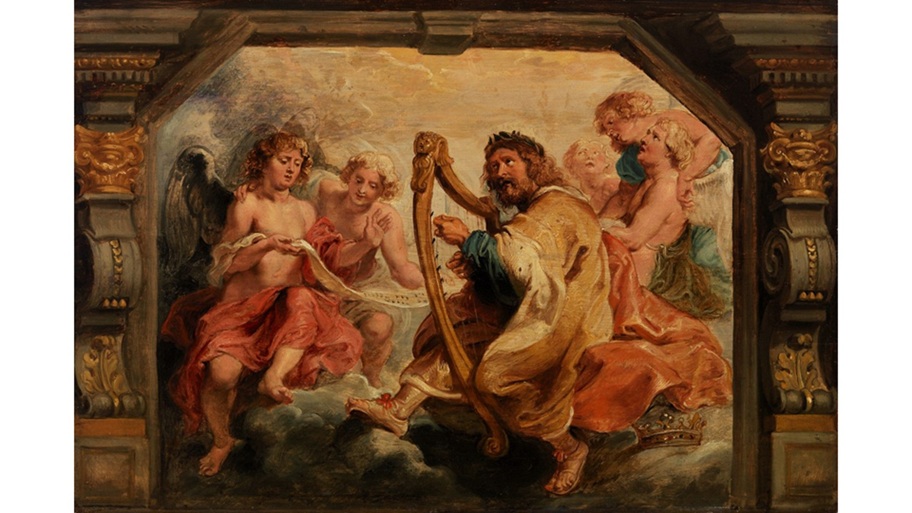
King of Poets
Salaciously Saul slouches on the throne
(Backbiting envy never sits upright)
Since David’s victories surpass his own.
The king’s hard heart and weakened faith excite
Malevolence for which he won’t atone.
Young David could have cured the spirit’s flaw
With moving melodies from seven strings
To usher in a reverential awe
Affectionate, and stop mad wanderings
Outside the mind’s accustomed manly law.
Not David, but Saul’s disobedience,
Had introduced the soul’s cacophony,
Reverberating strident preference
For self-directed Saulish tyranny,
Instead of psalmody’s magnificence.
In pastures, David’s boyish fingers learned
To kill a bear or lion with bare hands
And arms God gave. His shepherding soon turned
To pluck concurrent notes on catgut strands
Well-tuned, whence pleasing concord he discerned.
To add his baritone felt natural,
Pronouncing Eden’s Hebrew as inspired;
The music broached a higher interval:
To speak of Law and Deity required
Ascent to overtones angelical.
The messianic reign will sing eight modes
Of chant, it’s said; eight strings befit new lyres.
The ten-stringed psaltery plays heaven’s odes
While David orchestrates celestial choirs
For blissful listeners in ideal abodes.
O Israel’s sweet singer, lend me ruth
Like yours to magnify the Holy Name,
To praise, give thanks, adore, lament, and soothe,
Beatitudes and parables proclaim,
Dancing with youthful confidence in truth.
Poet’s Note
Many of the 150 psalms in the Bible are attributed to David, king of Israel after Saul. As a shepherd boy he played a portable harp or lyre (kinor) of seven strings. Jewish tradition predicts a harp of eight strings for the kingdom of the Messiah, a descendant of David. Christians (for whom the Messiah is Jesus Christ) point to the liturgical music of Gregorian chant in eight modes. Both traditions regard the ten-stringed psaltery (a musical instrument mentioned in the divinely inspired psalms) to be a figure of the Ten Commandments, whose perfect observance makes heavenly music.
“Eden’s Hebrew” alludes to the opinion of some Jewish and Christian thinkers that Biblical Hebrew, in which David composed his globally significant lyric poetry, is the original language of humankind. Historical linguistics describes it otherwise, but scholarly controversy continues.
Margaret Coats lives in California. She holds a Ph.D. in English and American Literature and Language from Harvard University. She has retired from a career of teaching literature, languages, and writing that included considerable work in homeschooling for her own family and others.














Yet another expertly crafted poetic form I’ve never seen before. I also hope I’m not the only one who knew nothing about the concepts in the poem including Eden’s Hebrew and the Harp of eight strings. I generally hate to have my ignorance exposed, but your poems make that process something I look forward to.
Thank you, Warren! I often create the form for the poem, or rather choose a traditional one less often used, in contrast to our more common couplets and quatrains. I do have an inclination toward odd numbers, shown here with seven five-line stanzas. The intent in bringing forward little known information is a classical one: poets don’t so much instruct as remind readers of thing likely to have been forgotten. That way we keep ancient culture current!
I, too, learned some fascinating things by reading this poem and the poet’s note. Though the psalmist’s “instrument of ten strings” is familiar, I didn’t know it had been assumed to be a figure of the Ten Commandments. Nor had I heard the theory that Hebrew was the original human language.
Your characterization of Saul in the first verse is a concisely expressed, intense, and believable one. “Soul’s cacophony” and “Saulish tyranny” are not only great phrases, but they echo each other sonically.
As one unlearned in Biblical history and musical theory, I welcome the Poet’s Note, which increases my appreciation of the erudition behind your poem. You are certainly equipped to deal with lofty themes and do it with impressive skill. What I like especially is the dignity of your lines. They are eloquent and beautiful but not overdone, not extravagantly ornamented. They do not hasten but proceed with grace–musically, I might say. The structure of your stanzas is particularly interesting; it must have required some careful planning to get those triple rhymes, but you have done it without noticeable strain. Thus, when we reach the end of the poem, the poet steps out in the last stanza with both modesty and confidence, entirely in tune with what has gone before. This is a remarkable demonstration of poetic art.
Margaret C.
Can’t you just hear David’s music echoing through the ages? You also have a capacity to inspire!
from Margaret B.
Margaret, you undoubtedly are a musical historian, a singer in choirs praising God, and masterful poet that I could read all day. David was a man of many talents who ascended from a shepherd to king but more than that left us with a great legacy of Hebrew poetry befitting the tradition and times. I really loved the double and triple rhymes in each verse that flowed mellifluously as I read them. You have given us a rare gift for our education and edification.
I love your beautiful biblically themed poem Margaret. It flows very naturally like a mellow and melodious brook which picks its way through rocks and meadows on its way down the mountain. You touch on the contrasting Spirits which animate Saul and David and the relationship between heavenly music and obedience to God, which grants entry into the peace of His kingdom. If there is a balm in Gilead I would imagine it to flow just like your poem. Great job!
Poor Saul, who had no call to change his name to Paul.
Very musical, well-crafted poem, Margaret. Thanks for a delightful return to the Old Testament!
Thanks for sharing your biblical poem. And I learned from your contributor’s note. I am a lapsed catholic getting re-acquainted with the faith, so I appreciate poetry that incorporates it.
Thank you, Margaret, for this masterly fusion of prayerfulness with music terminology and biblical narrative. For anyone who doesn’t know it, now might be a good time to get acquainted with “O Lord, whose mercies numberless”, from Handel’s oratorio Saul: it’s tuneful and deeply moving.
Margaret,
This is a lovely song to sacred music and those producing it. (It seems I’ve been drafted into my parish choir, trying to sing for the 1st time in 15+ years, struggling to reach e’ at one end and c at the other, but looking forward to widening the compass on music of Josquin, Morales et al.)
Your lines, with their occasional enjambments, flow so smoothly, after the opening, that is, with its metrical comment on the unruly Saul. And the proximity of “Saulish” and “psalmnody” is a nice ironic punning touch.
The connection between the modes and the 8-stringed lyre is new to me, so thank you for your note, too. An, speaking of numbers, I’m guessing your choice of meter and stanza length for this poem had something to do with David’s five fingers.
Thank you so much for this, Margaret. As someone whose spiritual life is centered on the Liturgy of the Hours, I’ve found that, after meditating on and savoring the poetic–and, as others have remarked, the educative–beauties of this work, my experience of the Psalms has already been deepened, for which, again, I can’t thank you enough. God bless, and all best in the new year.
P.S. The conceit that Saul is still nursing his grudge against David in Heaven somehow provides me a strange comfort, one I should probably remember when I go to Confession this weekend.