• Submit Poetry
  • Support SCP
  • About Us
  • Members
  • Join
Friday, January 9, 2026
Society of Classical Poets
  • Poems
    • Beauty
    • Culture
    • Satire
    • Humor
    • Children’s
    • Art
    • Ekphrastic
    • Epic
    • Epigrams and Proverbs
    • Human Rights in China
    • Music
    • Performing Arts
    • Riddles
    • Science
    • Song Lyrics
    • The Environment
    • The Raven
    • Found Poems
    • High School Poets
    • Terrorism
    • Covid-19
  • Poetry Forms
    • Sonnet
    • Haiku
    • Limerick
    • Villanelle
    • Rondeau
    • Pantoum
    • Sestina
    • Triolet
    • Acrostic
    • Alexandroid
    • Alliterative
    • Blank Verse
    • Chant Royal
    • Clerihew
    • Rhupunt
    • Rondeau Redoublé
    • Rondel
    • Rubaiyat
    • Sapphic Verse
    • Shape Poems
    • Terza Rima
  • Great Poets
    • Geoffrey Chaucer
    • Emily Dickinson
    • Homer
    • Henry Wadsworth Longfellow
    • Dante Alighieri
    • John Keats
    • John Milton
    • Edgar Allan Poe
    • William Shakespeare
    • William Wordsworth
    • William Blake
    • Robert Frost
  • Love Poems
  • Contests
  • SCP Academy
    • Educational
    • Teaching Classical Poetry—A Guide for Educators
    • Poetry Forms
    • The SCP Journal
    • Books
No Result
View All Result
Society of Classical Poets
  • Poems
    • Beauty
    • Culture
    • Satire
    • Humor
    • Children’s
    • Art
    • Ekphrastic
    • Epic
    • Epigrams and Proverbs
    • Human Rights in China
    • Music
    • Performing Arts
    • Riddles
    • Science
    • Song Lyrics
    • The Environment
    • The Raven
    • Found Poems
    • High School Poets
    • Terrorism
    • Covid-19
  • Poetry Forms
    • Sonnet
    • Haiku
    • Limerick
    • Villanelle
    • Rondeau
    • Pantoum
    • Sestina
    • Triolet
    • Acrostic
    • Alexandroid
    • Alliterative
    • Blank Verse
    • Chant Royal
    • Clerihew
    • Rhupunt
    • Rondeau Redoublé
    • Rondel
    • Rubaiyat
    • Sapphic Verse
    • Shape Poems
    • Terza Rima
  • Great Poets
    • Geoffrey Chaucer
    • Emily Dickinson
    • Homer
    • Henry Wadsworth Longfellow
    • Dante Alighieri
    • John Keats
    • John Milton
    • Edgar Allan Poe
    • William Shakespeare
    • William Wordsworth
    • William Blake
    • Robert Frost
  • Love Poems
  • Contests
  • SCP Academy
    • Educational
    • Teaching Classical Poetry—A Guide for Educators
    • Poetry Forms
    • The SCP Journal
    • Books
No Result
View All Result
Society of Classical Poets
No Result
View All Result
Home Poetry Culture

‘On Water & Evil’: A Poem by D.R. Rainbolt

August 4, 2023
in Culture, Poetry
A A
14
poem/rainbolt/culture

.

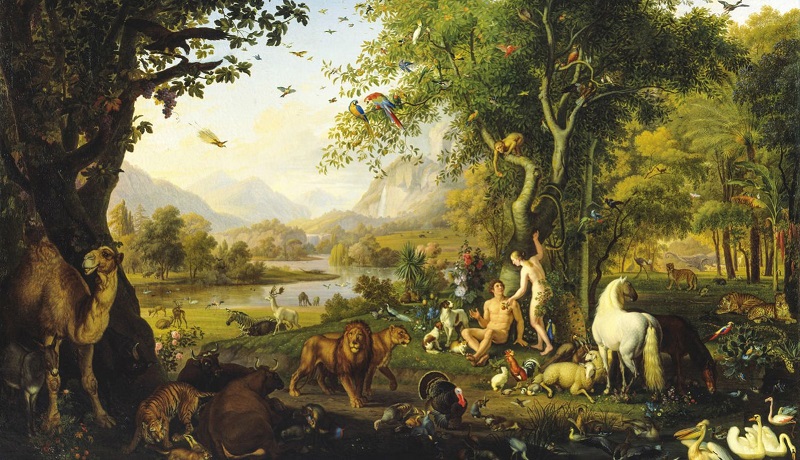
On Water & Evil

“Evil, like water, seeks the lowest point.”

—Earnest McDaniel

The thunder clapped again, applauding light
Displays, and weighted condensation fell
From Heaven’s darkened brow—a picture of
That story told about the Serpent’s flight
From bliss eternal to Earth, then Hell.
He flew! He fled! And made a mess of love.

So, condensation newly fallen flows;
Like evil, seeps to ever deeper lows.

Slopes only steepen once hands have the fruit,
When innocence to “in a sense” transforms,
And wisdom payment for new knowledge turns.
Then serpentine streams poison to the root,
And dewy drops cry from the clay. Dark storms
Contrast the paradise for which each yearns.

.

.

D. R. Rainbolt is a resident and native of the unique cowboy-cajun-country cultural cross-roads that is Northwest Louisiana. Some of his poems have appeared in Vita Latina magazine.


ShareTweetPin
The Society of Classical Poets does not endorse any views expressed in individual poems or commentary.
Read Our Comments Policy Here
Next Post
poem/medical assistance in dying/MAID

'The Blame Game' and Other Poetry by Susan Jarvis Bryant

poem/harrison/culture

A Poem on Censorship: 'Batten the Sovereign Soul' by Maura H. Harrison

poetry/curtis/essays

'Paradise Lost Satan Found in the Modern': An Essay by Michael Curtis

Comments 14

  1. Paddy Raghunathan says:
    2 years ago

    D. R.,

    The poem reads really well.

    But Interesting that you see condensation as evil. For me, condensation is welcome, so long as it doesn’t lead to any plumbing leaks, if you know what I mean. But on really hot days, I look forward to “some” condensation. 🙂

    Best regards,

    Paddy

    Reply
    • D. R. Rainbolt says:
      2 years ago

      Paddy,

      On these 100+ degree August days, I too look forward to some water! To be fair, the Bible sees water both ways. God drew land out of the chaotic waters and hemmed them in with it at creation, yet one must be born of water and of spirit to truly live. God shows common grace by “rain[ing] on the just and the unjust”, yet he judged the world with a flood. Etc., etc. This poem simply ponders liquid water’s gravity-induced journey and the similarity of that to human sin. As one once told me, “Sin will take you farther than you ever thought you’d go and cost you more than you ever wanted to pay.”

      Thank you for taking the time to read and comment!

      Reply
  2. Monika Cooper says:
    2 years ago

    This whole thing is very interesting from the opening quote to the conclusion. I have been fascinated lately with water’s tendency to “go lower.”

    The first stanza as an account of satan’s fall reminds me of the lines from Blake’s Song of Experience: “When the stars threw down their spears And watered heaven with their tears.” It always seemed too beautiful a couplet to describe the fall of demons. But perhaps the fall of the demons should be seen as beautiful: it was justice.

    “He flew! He fled! And made a mess of love.” Wonderful.

    The “innocence” “in a sense” pun is wonderful too: they lapse to the language of excuses and equivocation.

    The “dewy drops” must be not just water any more but the blood of Abel.

    And I think Paddy’s comment has great relevance. We fight the fiery darts of the enemy with the kindly candlelight of faith. We fight the enemy’s evil water with water that that goes lower still. (I think of Our Lord stooping to wash the apostles’ feet.) And not with water only but with water and Blood: that speaks more eloquently than that of Abel.

    Reply
    • D. R. Rainbolt says:
      2 years ago

      Monika,

      I am humbled by your kind words and encouraged that my meaning did get through. The “dewy drops” are indeed the blood of Abel. I love your image of Jesus stooping even lower than the water of evil to wash the evil away with his own water and blood. It’s such a powerful thought that Jesus’s blood “speaks a better word” than that of Abel. Abel’s blood spoke judgment against his murderer. Jesus’s speaks forgiveness for his murderers.

      Reply
  3. Cheryl Corey says:
    2 years ago

    “Weighted condensation” is an interesting description for water, since, as everyone knows, water is heavier than air. Try lifting a bucket of water sometime, and you’ll find out!

    Reply
  4. Jeremiah Johnson says:
    2 years ago

    Your poem reminds of the Medieval concept of the universe that everything is trickling down from the outermost sphere of the universe (the only space great enough for the presence of God) to the center and least significant point of the universe – the center of the earth, where Satan resides.

    Reply
  5. James A. Tweedie says:
    2 years ago

    Marvelous expansion of an interesting metaphor drawn from an equally trenchant epigraph. The rhyme scheme is new (to me) but effective abcabcddefgefg

    And thank you for not rhyming love with dove or above.

    Reply
    • D. R. Rainbolt says:
      2 years ago

      Mr. Tweedie,

      I am am honored to receive your feedback! Yes, the unorthodox rhyme scheme was an intentional effort on my part to marry the two themes by moving the volta to dead center. Thus, the poem’s “hinge” is the two center lines.

      Reply
  6. Joseph S. Salemi says:
    2 years ago

    Pindar says “Water is best” (ariston men hudor) in his First Olympian, as life and comfort are unthinkable without it. The fact that free-flowing water always seeks the lowest possible level is an interesting metaphor for the notion that free will, making an evil choice, will tend to lower and debase one’s character, but it has the kind of strangeness that critics like Johnson sometimes complained of in the Metaphysical poets, with their tendency to yoke together improbable imagery.

    Reply
  7. David Paul Behrens says:
    2 years ago

    To me, this is what classical poetry is all about. “In a sense,” it could have been written long ago.

    Reply
  8. Margaret Coats says:
    2 years ago

    Water is best, as Joseph quotes Pindar, not only because it is needed for life and comfort, but because it signifies potential. That’s how this poem can be understood to make appropriate use of water imagery. Here we have moved far beyond Rainbolt’s first poem on Creation to the point of the first and most disastrous fall, experienced (and chosen) by the highest pure spirit created. This was the creature with the greatest potential. When his free will chooses evil, some of the water above the heavens condenses into drops. Water has no form of its own, but here it takes form as the instrument of divine justice (“Heaven’s darkened brow”), expelling the Serpent to earth, then hell. The depths of hell are said to be ice, water permanently formed into a solid mass of eternal punishment.

    Liquid water is both destructive and creative, washing away existent forms and allowing new forms to emerge. In this function, water is associated with seeds. Seeds hold potential form, but water is needed for development. And here we get the soil-and-root destination of water, but more important is that neutral water can deform or reform. Words like “mess” and “seeps” suggest choices of bad will against good form.

    The form of the sonnet is a kind of funnel shape. Instead of standard sonnet proportions, we see 6-2-6. The last sestet speaks of steepening slopes, implying the difficulties of rising from the level where formless water settles. Wisdom, the highest gift of the spirit, has turned into payment for experiential knowledge of evil and cannot help. Nor can water alone help human clay rise out of this pit; baptismal water conveys reforming grace by power of the word (yearned for but not yet spoken at the end of the poem). Mr. Rainbolt, I hope my interpretation is acceptable.

    Reply
  9. Paul says:
    2 years ago

    This poem is interesting, especially when you consider the Holy Land is a hot place where water is reverred.

    Reply
  10. James Sale says:
    2 years ago

    A fascinating poem and I love some of the lines in this which have a strong syntactical thrust. Whether one agrees that water is evil depends on many factors. In the Tao Te Ching water is considered the ‘most powerful thing on Earth’: ‘… nothing can surpass it in fighting the hard and strong’. Equally, ‘nothing is softer or weaker than water’.

    Reply
  11. Mia says:
    2 years ago

    I agree that this is a fascinating poem and very dramatic. I can imagine it being recited. On another note , am I the only one fascinated with the fact that your name is Rainbolt? I hope you don’t think me rude for saying so. I am being very sincere. Thank you for this excellent and enjoyable poem.

    Reply

Leave a Reply Cancel reply

Your email address will not be published. Required fields are marked *

  1. Roy Eugene Peterson on ‘Encounter with My Dead Father’: A Poem by Scharlie MeeuwsJanuary 9, 2026

    Sharlie, this a wonderful personal poem and reflection of your precious relationship with your father. I can identify with that,…

  2. Maria Panayi , nee Solomonides. on ‘King of Poets’: A Poem by Margaret CoatsJanuary 9, 2026

    Dear Margaret, this is such a wonderful poem, perfectly composed and so inspiring as it uplifts and elevates the reader…

  3. Susan Steele Rives on ‘Watercolors’: A Poem by Susan Steele RivesJanuary 9, 2026

    Paul, Thank you! I'm glad you enjoyed the poem and that it inspired you to try something new! Susan

  4. Susan Steele Rives on ‘Watercolors’: A Poem by Susan Steele RivesJanuary 9, 2026

    Paul, Thanks so much. Like you, I find that my creative inclinations are better-executed with pens rather than paintbrushes. I…

  5. Lisa J. Roberts on ‘Caravaggio’: A Poem by Lisa J. RobertsJanuary 9, 2026

    Thank you, Paul! I’m glad you like it. Definitely give it a try.

Receive Poems in Your Email

Enter your email address to subscribe to this blog and receive notifications of new posts by email.

Join 1,620 other subscribers
Facebook Twitter Youtube

Recent Poems

  • ‘The Measure of a Woman (or a Man)’ and Other Poetry by Paul A. Freeman
  • ‘Encounter with My Dead Father’: A Poem by Scharlie Meeuws
  • Two Sonnets by Nino Martoglio, Translated by Joseph S. Salemi
  • ‘Wall of Ice’ and Other Poetry by James Bontrager
  • ‘King of Poets’: A Poem by Margaret Coats
  • ‘Watercolors’: A Poem by Susan Steele Rives
  • ‘Art and Nature’ and Other Poetry by C.B. Anderson
  • ‘Star of Wonder’: A Poem by James A. Tweedie
  • ‘Yeonmi Park’s Advice to Americans’: A Poem by Warren Bonham
  • ‘Caravaggio’: A Poem by Lisa J. Roberts
  • ‘Refrigerator Bird’ and Other Poetry by Armaan Fatteh-Patil
  • ‘The Oak Trees’: A Poem by Bhikkhu Nyanasobhano
  • ‘A Cardinal on a Snowy Day’: A Poem by Rob Fried
  • Poets Susan Jarvis Bryant and James Sale Respond to Mamdani’s Swearing In as NYC Mayor
  • ‘Single Room Cigarette, 17th Floor Yale Club of Manhattan’: A Poem by Alec Ream
  • ‘Legacy of Light’: A Poem by Martin Briggs
  • ‘The Swarm’ and Other Poetry by Cheryl Corey
  • ‘Lament of a Poet Falsely Accused of Using AI’ and Other Poetry by Paul Buchheit
  • ‘A Gift from the South’: A Poem by Julian Woodruff
  • ‘New Year’s Peeve’: A Poem by Susan Jarvis Bryant
  • ‘Homage to Brigitte Bardot’: A Poem by Joseph S. Salemi
  • ‘Dearth of Emotional Intelligence’ and Other Poems by Russel Winick
  • ‘Fireflies’: A Poem by Mark Stellinga
  • ‘Real Poetry’: A Poem by Eric v.d. Luft
  • ‘Flaws’: A Poem by Joshua Thomas
  • Two Final Poems by Sally Cook
  • ‘Twelve Labors More, Part I’: A Poem by Evan Mantyk
  • ‘A Perfect Match is Found’: A Poem by Roy E. Peterson
  • ‘The Seven Crossings’: A Poem by Ulysses Arlen
  • ‘An Open Book’ and Other Poetry by David McMahon

Categories

  • Acrostic
  • Alexandroid
  • Alliterative
  • Art
  • Best Poems
  • Blank Verse
  • Chant Royal
  • Classical Poets Live
  • Clerihew
  • Covid-19
  • Deconstructing Communism
  • Educational
  • Epic
  • Epigrams and Proverbs
  • Essays
    • Interviews with Poets
    • Poetry Reviews
  • Featured
  • From the Society
  • Great Poets
    • Dante Alighieri
    • Edgar Allan Poe
    • Emily Dickinson
    • Geoffrey Chaucer
    • Henry Wadsworth Longfellow
    • Homer
    • John Keats
    • John Milton
    • Robert Frost
    • William Blake
    • William Shakespeare
    • William Wordsworth
  • Human Rights in China
  • Limerick
  • Love Poems
  • Music
  • Pantoum
  • Performing Arts
  • Poetry
    • Beauty
    • Children's Poems
    • Culture
    • Ekphrastic
    • Found Poems
    • High School Poets
    • Humor
    • Riddles
  • Poetry Challenge
  • Poetry Contests
  • Poetry Forms
    • Haiku
  • Poetry Readings
  • Rhupunt
  • Rondeau
  • Rondeau Redoublé
  • Rondel
  • Rubaiyat
  • Sapphic Verse
  • Satire
  • Science
  • Sestina
  • Shape Poems
  • Short Stories
  • Song Lyrics
  • Sonnet
  • Symposium
  • Terrorism
  • Terza Rima
  • The Environment
  • Translation
  • Triolet
  • Video
  • Villanelle

Quick Links

  • About Us
  • Submit Poetry
  • Become a Member
  • Members List
  • Support the Society
  • Advertisement Placement
  • Comments Policy
  • Terms of Use

Welcome Back!

Login to your account below

Forgotten Password?

Retrieve your password

Please enter your username or email address to reset your password.

Log In
No Result
View All Result
  • Poems
    • Beauty
    • Culture
    • Satire
    • Humor
    • Children’s
    • Art
    • Ekphrastic
    • Epic
    • Epigrams and Proverbs
    • Human Rights in China
    • Music
    • Performing Arts
    • Riddles
    • Science
    • Song Lyrics
    • The Environment
    • The Raven
    • Found Poems
    • High School Poets
    • Terrorism
    • Covid-19
  • Poetry Forms
    • Sonnet
    • Haiku
    • Limerick
    • Villanelle
    • Rondeau
    • Pantoum
    • Sestina
    • Triolet
    • Acrostic
    • Alexandroid
    • Alliterative
    • Blank Verse
    • Chant Royal
    • Clerihew
    • Rhupunt
    • Rondeau Redoublé
    • Rondel
    • Rubaiyat
    • Sapphic Verse
    • Shape Poems
    • Terza Rima
  • Great Poets
    • Geoffrey Chaucer
    • Emily Dickinson
    • Homer
    • Henry Wadsworth Longfellow
    • Dante Alighieri
    • John Keats
    • John Milton
    • Edgar Allan Poe
    • William Shakespeare
    • William Wordsworth
    • William Blake
    • Robert Frost
  • Love Poems
  • Contests
  • SCP Academy
    • Educational
    • Teaching Classical Poetry—A Guide for Educators
    • Poetry Forms
    • The SCP Journal
    • Books

© 2025 SCP. WebDesign by CODEC Prime.

This website uses cookies. By continuing to use this website you are giving consent to cookies being used. Visit our Privacy and Cookie Policy.