


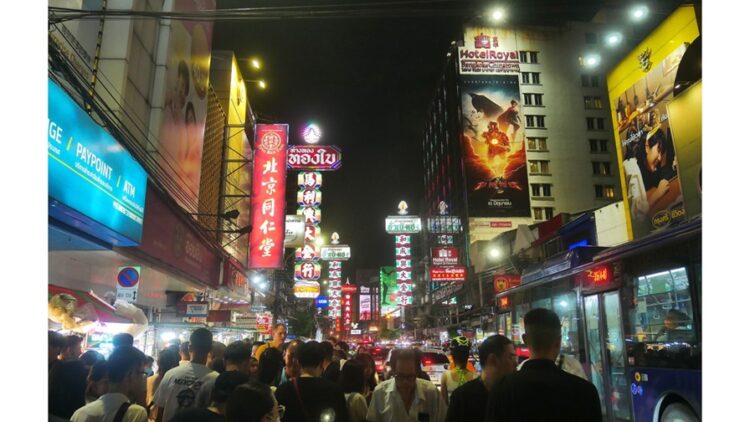
One Night in Bangkok
6:00 p.m.
One night in Bangkok—and this searching man
From Georgia must explore its fevered dreams
And garish hues. The sun sets neon red.
This close to the equator twilight falls
Just after six. And that’s when nightlife calls.
Ignore the jetlag… he has just one night.
He leaves his room to see each novel sight—
A tropic city rich with life and splendor,
Both brash and tranquil. Stepping out, he sees
A craftsman carve a saintly apparition—
A bodhisattva of Buddhist tradition.
7:00 p.m.
The man now hungers both in soul and flesh.
The sidewalks swarm with vendors selling food:
Grilled squid, fresh coconut, shrimp fried or stewed,
Plus rice and noodles steamed in iron pots.
Night-merchants set up stalls to loudly hawk
Tattoos, massages and bright yellow shirts—
The color worn to honor Thailand’s king.
The foreign man then sees a stunning thing:
Before each home there is a Spirit House—
A small shrine on a pole which augurs peace
With offerings so good luck might increase.
8:00 p.m.
The fever starts—he can’t miss how the streets
Are packed—exotic, fascinating, new.
The faces: petals stuck on wet bamboo.
The square throbs like a heartbeat with a crowd
Of laughing women, men who leer out loud.
They want you in their clubs; the barkers shout
The lure: “See pretty girls!” The music calls—
A techno-beat that drones and fills the ears
With pounding which is meant to stir the blood
Of tourists. Sudden thunder booms and roars
As tropic lightning strikes and fierce rain pours.
9:00 p.m.
The Bangkok night is full of steam and storm.
The thunder shouts then stops and once it turns,
The night perspires and the throng returns,
Joined by a sultry breeze from off the river.
The man now rests and eats a red-bean bun,
Exhausted though the evening’s but half done.
A Buddhist temple beckons with the drone
Of monks in orange robes whose chanted prayers
Intrigue him and yet soothe his heart as well.
He vows he shall return to see this sight
One day when he sees Bangkok in the light.
10:00 p.m.
He steps inside a Thai-themed cabaret
And soon percussive bells and symbols play
As folklore dancers now begin their art:
A stately stylized form of tableau dance
With mindfulness of every crafted pose.
The feet are bare, the faces glow with pride.
The costumes—antique Siamese—all shine.
He claps and then returns out to the street
Where silks are bartered in the nighttime heat.
He buys a yellow shirt—a royal fling—
100 baht in honor of the King.
11:00 p.m.
The frenzy’s in full-swing… there’s flesh for sale,
As Bangkok vaunts wild nights which leave no trail.
The foreigner is curious. Though shy
He must see for himself what sin is nigh.
The red light district titillates and shocks
With offers made—astonishing in scope—
For those pursuing sexual seditions.
The foreigner can overhear strange words—
From what he grasps, the terms are being set:
Endearment and engagement for a tryst.
But not for him. He moves on through the mist.
12:00 Midnight
How strange the world seen through a stranger’s eyes!
Exhausted by the neon and the sighs,
The foreign man walks back to his hotel.
He checks to see the time back in the States,
Then telephones Atlanta just to know
That the familiar still exists. And so
A short long distance call: “I love you too.”
And then a long time staring out the glass
Into this night of quiet breath and heat.
Amazed by all, his prejudices crumble.
One night in Bangkok makes a sure man humble.
A Rubaiyat of Chiang Rai
The tropic mountains beckon green—
A grandeur I have seldom seen
As vines encloak an ancient shrine
Which lushly crowns this sacred scene.
I’m here because I need a sign
That what I fear will yet be fine.
My soul is chained to anxious dread
Of forces savage and malign.
But Chiang Rai offers peace instead;
Deep awe attends each step I tread.
Here worries are not all they seem,
And in this Eden calmly shed.
How life abounds here! See it teem!
Great elephants traverse a stream
As waterfalls spray cooling steam.
What’s real is here. The rest’s a dream.
Brian Yapko is a retired lawyer whose poetry has appeared in over fifty journals. He is the winner of the 2023 SCP International Poetry Competition. Brian is also the author of several short stories, the science fiction novel El Nuevo Mundo and the gothic archaeological novel Bleeding Stone. He lives in Bradenton, Florida.










The quatrains of Chiang Rai are quite lovely, and since they are as clear as crystal little needs to be said about them. It is a good poetic instance of a troubled soul going to a calming and soothing “locus amoenus” to get peace of mind.
The seventy-seven lines of “One Night in Bangkok” make for an ambitious narrative in stanzas. Seven hours in the life of a foreign visitor turn out to be something of a psychological revelation — not just of what the visitor sees and hears, but also of his personal desires and reactions. He wants food, he wants souvenirs, he wants to see the sights, he toys with the idea of sex, he is entranced by the noise around him, and he seems genuinely curious about the symbols of Buddhism and Thai culture everywhere. But he also is a little scared, and his phone call home is a kind of protective talismanic act for him. It’s a long way from Bangkok to Atlanta.
A Western male traveler alone in Bangkok inevitably suggests sex tourism — the city is infamous for that business. The 8 PM and 11 PM stanzas deal directly with this possibility, but visitor does not take advantage of the easy availability of commercial sex. We are not told why. We are left to think about it, and wonder. The fact that he was once a “sure” man but is now a “humble” one suggests a learning experience that was not rooted in simple pleasure.
Sustaining interest in a narrative for seventy-seven lines is not easy, and the division of the poem into “hours” was an excellent device to make things go smoother. I can imagine this narrative continuing at greater length, with more exploration of the visitor’s reactions and thoughts.
Thank you very much indeed, Joe. I’m especially pleased that you enjoyed the rubaiyat. In my opinion, this lovely form — used by Robert Frost in his famous “Stopping By Woods on a Snowy Evening” — is much underrepresented in the field of classical poetry. It has actually become one of my favorite forms and has much potential for expansive subjects yet with controlled emotional expression.
I also appreciate your sensitive eye on the Bangkok poem. I must confess that there is an autobiographical element to this poem — it is an impressionistic piece which reflects my memories of a long-ago trip to Thailand. It was a fascinating adventure and Bangkok was both intimidating and yet strangely calm for such a big city. I tried to convey this in the nonce form of 11 line stanzas (11 is supposed to said to numerologically convey spiritual awakening) of which six lines rhyme and 5 do not. This was intended to convey an echo of a city which is which the orderly and the chaotic combine.
As a semi-autobiographical piece the evening in Bangkok does indeed reflect my own memories — the amazing smells of food which was sold everywhere and anywhere, the stalls set up to hawk all kinds of souvenirs, the yellow-shirts which are associated with the monarchy by a huge segment of the population on Monday’s to honor the king. And then there was the red light district where we had to see what it was all about but without participating in it. Thailand is famous as a hub for sexual tourism and its visibility and frankness are startling. It was very interesting to see, but — like the foreignor from Atlanta — this poet is much too shy for such folderol.
I’m very glad this poem sustained your interest. It was a bit risky, I thought, making a travelogue poem this long but the subject is complex (Bangkok has something like 15 million people) and the impressions are many and run deep. Thank you, Joe.
I was allowed to spend one week in Thailand on R&R (Rest and Relaxation) as a break from the war in South Vietnam. I remember visiting Chiang Mai (not Chiang Rai), the place that inspired the “Bridge Over the River Kwai,” Pattaya, Phuket, and various temples such as Ayutthaya. I had a suit made in Bangkok and watched an elephant show. Your vivid poetry struck long held memories in my mind as I focused on your wonderful imagery. Eating hot Thai food was an outstanding treat and reminded me of Mexican food though with more delights from the ocean. I remember in Vietnam like in Thailand there were hot pepper sauces. The word in Vietnamese was hilariously, “Ah.” I decided that was because when one tasted it that is all they could say! Brilliant title for your second poem! Your reflections on Chiang Rai were beautifully wrapped and written with an interesting conclusion.
Roy, thank you so much for reading and commenting here! I love hearing your own story about Thailand (we stayed in Chiang Mai as well as Chiang Rai — rather different experiences, yet not too far apart geographically.) I very much would have liked to see the River Kwai and have Phuket earmarked as a place to visit if we ever return to Thailand. You can probably tell from the poem that I just love Thailand. The elephants, the food, the gentleness of the people, the many Buddhist temples and monks in orange robes everywhere. I love the way that faith and tradition are so integrated into daily life and even the streets and sidewalks.
Thank you for your amusing “Ah” story about Vietnamese food. I like a good Pho soup. But it’s Thai food which has my heart — it’s one of my very favorite cuisines. I’m a nut for a good curry (not too hot, please!) And I love the noodle dishes, the basil, lemongrass, the hot peppers… Now I think Thai food for lunch would be a good idea.
The very name of the city suggests its preeminence in sex trade. But, Jesus! — the atmosphere you created was as thick as a reduced sauce composed of authentic Thai ingredients. Let me join you for lunch.
I like Khayyam’s chosen form as much as you do, and I think you do a creditable job of closing thoughts in the manner of his own self-contained stanzas. “A Rubaiyat” is a strange construction because, unless I’ve got it backwards, “Rubaiyat” is already a plural noun, meaning quatrains, so “A Rubaiyat” is kinda strange in normal English.
Kip, thank you very much for the great comment! I consider this Bangkok piece something of a travelogue/atmosphere piece so I’m very glad indeed that this is how you read it. Bangkok is indeed famous for its unapologetic sexual tourism, but — strangely — it is also a destination for plastic surgery. And neither of these things come close to describing what Bangkok is actually like, because it’s a serious, cosmopolitan city which happens to be scented by curry and lemongrass, where massages can be procured anywhere and everywhere, where the number of Buddhist temples seems to exceed the number of grocery stores, and where — even in the worst of traffic — the people smile and demonstrate astounding patience. If there’s a place on Earth where judgment and anger disappear, it has to be Thailand.
I didn’t know that Rubaiyat was already a plural. Thank you for the info. You’re right, of course. But I suspect in practical usage it has taken on its own English meaning. I note on this very site the title “How to Write a Rubaiyat.” https://www.classicalpoets.org/how-to-write-a-rubaiyat-with-examples/ So my guess is that as the word becomes Anglicized, its plural form is being accepted as the actual form name. Rather analogous to “data” “molasses” “dice” and “opera.” It may not be right — and I certainly may be on the wrong track here — but that’s the way linguistics works sometimes. I’ll keep it as-is because I like the sound of it.
Thank you Brian for this poetic Thai travelogue. You brought back the contradictory memories of Thailand. Pulsating, colorful, complex and monumental Bangkok. Peaceful, flavorful Chiang Rai with tea plantations and massage. You make me want to go back!
Thank you very much indeed, Jerry. I love what you have to say about the “contradictory memories” of Thailand. It’s so true. A place of placid dignity, ubiquitous faith, great beauty — natural and architectural — contrasted with the garish neon lights, the hawking vendors (food, merchandise, sexual adventures) and a general “let it be” attitude which must not be confused with indifference or uncaring. It is a monarchy most notable for the freedom it offers within its realm. It’s a fascinating place. And I’d go back in a heartbeat.
I saw the title “One Night in Bangkok” and my mind immediately went into the gutter, and the poem seemed to be hearing there with its depiction of nightlife, but no: instead we get a pastiche loaded with the sights, sounds, smells, flavors, and feelings of an exotic place glimpsed for the first time for only a single night. You transport us to Bangkok in a way that a travel guide or even a vlog could never do — the description and your impressions are blended perfectly.
Thank you very much, Adam! Yes, this poem was not intended to be overly tawdry but merely a reflection of what a late evening in Bangkok is really like. It’s autobiographical to some degree since I was there on a trip and all of the things that I describe were seen first-hand. As for that title… I don’t know if you’re familiar with the musical “Chess” with lyrics by Tim Rice and music by Abba’s Benny Andersson and Bjorn Ulvaeus, but my title was directly lifted from their hit song “One Night in Bangkok.” It made the rounds in 1984-1985 — you aree far too young to have heard it when it came out.