• Submit Poetry
  • Support SCP
  • About Us
  • Members
  • Join
Thursday, January 8, 2026
Society of Classical Poets
  • Poems
    • Beauty
    • Culture
    • Satire
    • Humor
    • Children’s
    • Art
    • Ekphrastic
    • Epic
    • Epigrams and Proverbs
    • Human Rights in China
    • Music
    • Performing Arts
    • Riddles
    • Science
    • Song Lyrics
    • The Environment
    • The Raven
    • Found Poems
    • High School Poets
    • Terrorism
    • Covid-19
  • Poetry Forms
    • Sonnet
    • Haiku
    • Limerick
    • Villanelle
    • Rondeau
    • Pantoum
    • Sestina
    • Triolet
    • Acrostic
    • Alexandroid
    • Alliterative
    • Blank Verse
    • Chant Royal
    • Clerihew
    • Rhupunt
    • Rondeau Redoublé
    • Rondel
    • Rubaiyat
    • Sapphic Verse
    • Shape Poems
    • Terza Rima
  • Great Poets
    • Geoffrey Chaucer
    • Emily Dickinson
    • Homer
    • Henry Wadsworth Longfellow
    • Dante Alighieri
    • John Keats
    • John Milton
    • Edgar Allan Poe
    • William Shakespeare
    • William Wordsworth
    • William Blake
    • Robert Frost
  • Love Poems
  • Contests
  • SCP Academy
    • Educational
    • Teaching Classical Poetry—A Guide for Educators
    • Poetry Forms
    • The SCP Journal
    • Books
No Result
View All Result
Society of Classical Poets
  • Poems
    • Beauty
    • Culture
    • Satire
    • Humor
    • Children’s
    • Art
    • Ekphrastic
    • Epic
    • Epigrams and Proverbs
    • Human Rights in China
    • Music
    • Performing Arts
    • Riddles
    • Science
    • Song Lyrics
    • The Environment
    • The Raven
    • Found Poems
    • High School Poets
    • Terrorism
    • Covid-19
  • Poetry Forms
    • Sonnet
    • Haiku
    • Limerick
    • Villanelle
    • Rondeau
    • Pantoum
    • Sestina
    • Triolet
    • Acrostic
    • Alexandroid
    • Alliterative
    • Blank Verse
    • Chant Royal
    • Clerihew
    • Rhupunt
    • Rondeau Redoublé
    • Rondel
    • Rubaiyat
    • Sapphic Verse
    • Shape Poems
    • Terza Rima
  • Great Poets
    • Geoffrey Chaucer
    • Emily Dickinson
    • Homer
    • Henry Wadsworth Longfellow
    • Dante Alighieri
    • John Keats
    • John Milton
    • Edgar Allan Poe
    • William Shakespeare
    • William Wordsworth
    • William Blake
    • Robert Frost
  • Love Poems
  • Contests
  • SCP Academy
    • Educational
    • Teaching Classical Poetry—A Guide for Educators
    • Poetry Forms
    • The SCP Journal
    • Books
No Result
View All Result
Society of Classical Poets
No Result
View All Result
Home Poetry Beauty

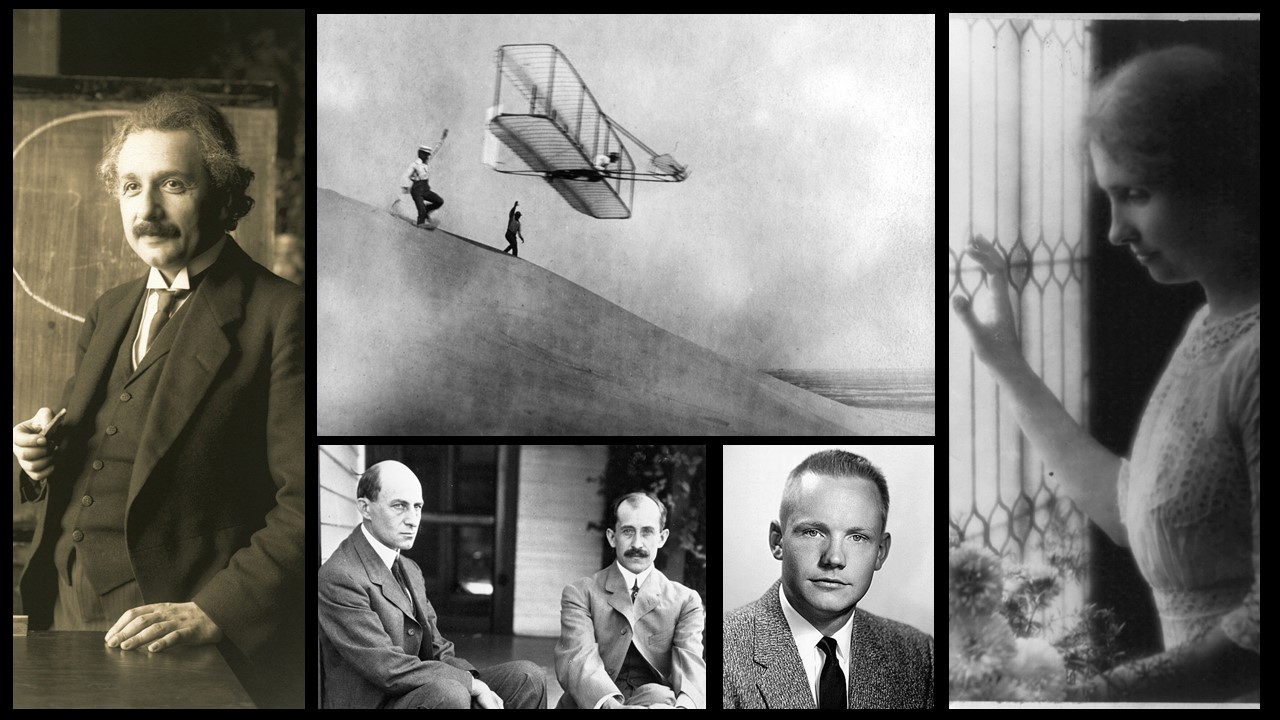
Poems on Helen Keller, the Wright Brothers, and Others, by Martin Elster

September 30, 2019
in Beauty, Culture, Humor, Poetry
A A
13
poems Poems on Helen Keller, the Wright Brothers, and Others, by Martin Elster

Helen Keller (1880-1968)

Your eyesight and hearing were gone,
yet you felt just as blithe as a fawn
___when you learned that a word
___could stand for a bird
or the flowers that bloomed in your lawn.

The very first word that you learned
was “water.” Thereafter you yearned
___for more, and then more
___till the letters would pour
from your soul into books, finely turned.

Face the sunshine and you will not see
the shadow, you said, for the key
___to happiness lies
___in kindness. Not eyes
nor ears, but your dreams made you free.

Received an honorable mention in Competition No. 3104 “Take Three” in The Spectator.


Neil Armstrong (1930-2012)

You could fly while still growing and green,
could repair any flying machine
___by your twenties, and tested
___new rocket planes, crested
the clouds in your bright X-15.

In due course, you were picked for Apollo
(undreamed of by falcon or swallow)
___to land on the moon,
___and to do it quite soon
so the Commies could no more than follow.

You touched the moon’s hide, took a stride,
spoke of steps and of leaps, then all pride
___disappeared as you turned
___toward your planet and learned
that your thumb is precisely as wide!


Albert Einstein (1879-1955)

A young-looking fellow employed
as a patent assessor enjoyed
___experiments done
___in his head—lots of fun
for a purposeful, smart anthropoid.

He rode a light beam, thought of clocks
and a man in a plummeting box,
___but had very cold toes—
___which is just how it goes
when forgetting to bring your wool socks.

Views of gravity, light, time and space
were suddenly new, and his face
___became famed as a lion
___and the stars of Orion
which, unlike his hair, know their place.


The Wright Brothers

Orville and Wilbur were right
that a flying machine could take flight.
___They spent money and years
___and, while they had fears,
they thought it might work. It just might!

To reach any meaningful height,
their engine, they knew, must be light.
___Then in 1903
___the seabirds would see
an odd and remarkable sight.

Though the ospreys and gulls saw them fly it,
most specialists didn’t quite buy it:
___“How could wings, so unbendable,
___be somehow ascendable?”
Yet they were, and now none can deny it!


Martin Elster serves as a percussionist with the Hartford Symphony Orchestra. His poems have appeared in numerous journals and anthologies. Honors include co-winner of RhymeZone’s 2016 poetry contest, winner of the Thomas Gray Anniversary Poetry Competition 2014, third place in the SFPA’s 2015 poetry contest, and three Pushcart nominations.

ShareTweetPin
The Society of Classical Poets does not endorse any views expressed in individual poems or commentary.
Read Our Comments Policy Here
Next Post
‘Irrelevant’ and Other Poetry by Joe Tessitore

'Irrelevant' and Other Poetry by Joe Tessitore

A Cento from the Political Poetry of Presidents Lincoln, Taylor, and Taft by Beverly Stock

A Cento from the Political Poetry of Presidents Lincoln, Taylor, and Taft by Beverly Stock

A Translation from Goethe’s Roman Elegies V

A Translation from Goethe’s Roman Elegies V

Comments 13

  1. Amy Foreman says:
    6 years ago

    Excellent epigraphic poems, Martin.

    Reply
  2. C.B. Anderson says:
    6 years ago

    Very clever rhymes with which to remind us of key events in history. Keep beating your drums and totting your sums, because you have a very receptive audience (readership) here. “[A]scendable,” in the fourth poem, is a wonderful neologism, and that’s what limericks are for. With all due deference to Helen Keller (and I’ve seen the film), you are a true Miracle Worker. For this submission I give you an A+.

    Reply
    • Monty says:
      6 years ago

      I can’t claim to’ve had a long-standing familiarity with the word ‘neologism’; I only became aware of it last year through these pages. But from how I now perceive that word, I must ask you, CB: What is neologistic about the word ‘ascendable’?
      It’s a long-established word (at least in British-English); and it simply means what it says . . ‘able to be ascended’ (eg: an ascendable mountain).

      Reply
      • C.B. Anderson says:
        6 years ago

        Monty, the problem is that “ascend” is an intransitive verb. One can ascend, but no one can ascend something, not even in UK English, I think. So “ascendable” makes no sense, except as a neologism. I would like some other competent grammarian to weigh in on this.

        Reply
      • Amy Foreman says:
        6 years ago

        I’m not a grammarian, but “ascend” can be transitive or intransitive (https://www.lexico.com/en/definition/ascend), making “ascendable,” acceptable, and, in my opinion, a terrific companion rhyme for “unbendable.”

        “If I ascend up into heaven, thou art there:” (Ps. 139:8).

        Reply
      • Monty says:
        6 years ago

        I’ve got a bit out of my depth, now (trans, intrans?); and also a tad perplexed, after reading that “one can ascend, but one can’t ascend ‘something’”; when we know that one can ascend a mountain, and a mountain is a ‘something’.

        I don’t even know where I am, now. Initially, I was looking no further than . . If a mountain can be climbed, it’s climbable. If it can be scaled, it’s scaleable. If it can be ascended, it’s ascendable. If I’m to now learn that ‘ascendable’ is wrong in that context . . then I really am in trouble.

        Reply
  3. Mark F. Stone says:
    6 years ago

    Martin, All four poems are very nicely done. I love the Apollo/or swallow rhyme. If I were to intrude on the poems and make suggestionss, I might, in The Wright Brothers poem, change “while” to “although” and “somehow” to “so.” It’s great to see you publishing on SCP!

    Reply
  4. C.B. Anderson says:
    6 years ago

    To Amy & Monty: Yes, one can ascend a mountain, but that does not mean that one has sent a mountain upward. In the poem, “wings” be somehow ascendable, but that never meant that anyone could climb up on wings or push wings to even higher heights. The problem with this construction is deeper than I initially suspected. This knot is in need of serious unraveling, or else we should just forget about it. I now understand that I can ascend a mountain or a ladder, but I would be hard pressed to push either one of them up. In the poem at issue, “ascendable” is used in such a way that defies logic and understanding: No one in his or her right mind would suggest that we ascend wings or that wings themselves possess the power of ascendability.

    Reply
    • Monty says:
      6 years ago

      Well, it took me a while to get there, CB, but I can now see what you’re saying: “How can wings be ascendable?” You’re right: it don’t make sense. In which case, I feel that it was rather generous of you to refer to ‘ascendable’ (in that context) as a neologism. I can’t be as generous; now it’s been pointed-out to me, I can only see the use of ‘ascendable’ as simply wrong.. a case of forcing the diction in order to find a fancy rhyme.

      It’d make a bit – but not much – more sense (diction-wise) if it was slightly tweaked thus:
      How can wings which do not bend
      Be somehow able to ascend?

      Reply
    • Amy Foreman says:
      6 years ago

      You are right, as usual, C.B. I didn’t think about it that way, but you are right. And now I can’t look at it any other way!

      Maybe Martin could substitute another word: one which specifically means “capable of flight” instead of “scaleable.” Possibly a rework of the last three lines, something like:

      “How could humans, incompetent
      Somehow be volitant?
      Yet we were, and now none can deny it!”

      Reply
      • C.B. Anderson says:
        6 years ago

        Amy, as I wrote initially, I think “ascendable” is a lovely neologism. Martin’s poems are perfectly good as they stand.

        Reply
  5. Monty says:
    6 years ago

    . . . and as I wrote initially, how can the word ‘ascendable’ be described as:

    a/ A new word, phrase or doctrine.
    b/ A newly-coined word or expression.
    c/ A relatively recent or isolated term, word, or phrase that may be in the process of entering common use; but that has not yet been fully accepted into mainstream language.

    (the a, b and c being definitions from three different dictionaries of the word ‘neologism’)

    Reply
    • C.B. Anderson says:
      6 years ago

      Monty,

      It can’t. But the problem I’m having is that I don’t know any word that covers this kind of error.

      Reply

Leave a Reply Cancel reply

Your email address will not be published. Required fields are marked *

  1. C.B. Anderson on ‘Art and Nature’ and Other Poetry by C.B. AndersonJanuary 8, 2026

    To be perfectly honest, Michael, I never know how what I write will strike a reader. Sometimes things just work…

  2. C.B. Anderson on ‘Art and Nature’ and Other Poetry by C.B. AndersonJanuary 8, 2026

    My wife, Julian, has often asks me why I write poetry when I could be writing songs and making some…

  3. Margaret Coats on ‘Refrigerator Bird’ and Other Poetry by Armaan Fatteh-PatilJanuary 8, 2026

    You write some exceptionally fine lines, Armaan. For one example from each poem: Wrong means reaching. Wrong means getting at…

  4. Margaret Coats on ‘King of Poets’: A Poem by Margaret CoatsJanuary 8, 2026

    Thanks, Margaret B! His inspired words have echoed through the ages, in many languages, and I've memorized Psalm 1 in…

  5. Margaret Coats on ‘King of Poets’: A Poem by Margaret CoatsJanuary 8, 2026

    Thank you for describing my lines with such appreciation, Bhikku Nyanasobhano. The qualities you mention are what I could hope…

Receive Poems in Your Email

Enter your email address to subscribe to this blog and receive notifications of new posts by email.

Join 1,621 other subscribers
Facebook Twitter Youtube

Recent Poems

  • Two Sonnets by Nino Martoglio, Translated by Joseph S. Salemi
  • ‘Wall of Ice’ and Other Poetry by James Bontrager
  • ‘King of Poets’: A Poem by Margaret Coats
  • ‘Watercolors’: A Poem by Susan Steele Rives
  • ‘Art and Nature’ and Other Poetry by C.B. Anderson
  • ‘Star of Wonder’: A Poem by James A. Tweedie
  • ‘Yeonmi Park’s Advice to Americans’: A Poem by Warren Bonham
  • ‘Caravaggio’: A Poem by Lisa J. Roberts
  • ‘Refrigerator Bird’ and Other Poetry by Armaan Fatteh-Patil
  • ‘The Oak Trees’: A Poem by Bhikkhu Nyanasobhano
  • ‘A Cardinal on a Snowy Day’: A Poem by Rob Fried
  • Poets Susan Jarvis Bryant and James Sale Respond to Mamdani’s Swearing In as NYC Mayor
  • ‘Single Room Cigarette, 17th Floor Yale Club of Manhattan’: A Poem by Alec Ream
  • ‘Legacy of Light’: A Poem by Martin Briggs
  • ‘The Swarm’ and Other Poetry by Cheryl Corey
  • ‘Lament of a Poet Falsely Accused of Using AI’ and Other Poetry by Paul Buchheit
  • ‘A Gift from the South’: A Poem by Julian Woodruff
  • ‘New Year’s Peeve’: A Poem by Susan Jarvis Bryant
  • ‘Homage to Brigitte Bardot’: A Poem by Joseph S. Salemi
  • ‘Dearth of Emotional Intelligence’ and Other Poems by Russel Winick
  • ‘Fireflies’: A Poem by Mark Stellinga
  • ‘Real Poetry’: A Poem by Eric v.d. Luft
  • ‘Flaws’: A Poem by Joshua Thomas
  • Two Final Poems by Sally Cook
  • ‘Twelve Labors More, Part I’: A Poem by Evan Mantyk
  • ‘A Perfect Match is Found’: A Poem by Roy E. Peterson
  • ‘The Seven Crossings’: A Poem by Ulysses Arlen
  • ‘An Open Book’ and Other Poetry by David McMahon
  • A Video Poetry Reading by Paul Erlandson
  • ‘Otto and Octavius at Christmas’: A Children’s Poem by Mary Gardner

Categories

  • Acrostic
  • Alexandroid
  • Alliterative
  • Art
  • Best Poems
  • Blank Verse
  • Chant Royal
  • Classical Poets Live
  • Clerihew
  • Covid-19
  • Deconstructing Communism
  • Educational
  • Epic
  • Epigrams and Proverbs
  • Essays
    • Interviews with Poets
    • Poetry Reviews
  • Featured
  • From the Society
  • Great Poets
    • Dante Alighieri
    • Edgar Allan Poe
    • Emily Dickinson
    • Geoffrey Chaucer
    • Henry Wadsworth Longfellow
    • Homer
    • John Keats
    • John Milton
    • Robert Frost
    • William Blake
    • William Shakespeare
    • William Wordsworth
  • Human Rights in China
  • Limerick
  • Love Poems
  • Music
  • Pantoum
  • Performing Arts
  • Poetry
    • Beauty
    • Children's Poems
    • Culture
    • Ekphrastic
    • Found Poems
    • High School Poets
    • Humor
    • Riddles
  • Poetry Challenge
  • Poetry Contests
  • Poetry Forms
    • Haiku
  • Poetry Readings
  • Rhupunt
  • Rondeau
  • Rondeau Redoublé
  • Rondel
  • Rubaiyat
  • Sapphic Verse
  • Satire
  • Science
  • Sestina
  • Shape Poems
  • Short Stories
  • Song Lyrics
  • Sonnet
  • Symposium
  • Terrorism
  • Terza Rima
  • The Environment
  • Translation
  • Triolet
  • Video
  • Villanelle

Quick Links

  • About Us
  • Submit Poetry
  • Become a Member
  • Members List
  • Support the Society
  • Advertisement Placement
  • Comments Policy
  • Terms of Use

Welcome Back!

Login to your account below

Forgotten Password?

Retrieve your password

Please enter your username or email address to reset your password.

Log In
No Result
View All Result
  • Poems
    • Beauty
    • Culture
    • Satire
    • Humor
    • Children’s
    • Art
    • Ekphrastic
    • Epic
    • Epigrams and Proverbs
    • Human Rights in China
    • Music
    • Performing Arts
    • Riddles
    • Science
    • Song Lyrics
    • The Environment
    • The Raven
    • Found Poems
    • High School Poets
    • Terrorism
    • Covid-19
  • Poetry Forms
    • Sonnet
    • Haiku
    • Limerick
    • Villanelle
    • Rondeau
    • Pantoum
    • Sestina
    • Triolet
    • Acrostic
    • Alexandroid
    • Alliterative
    • Blank Verse
    • Chant Royal
    • Clerihew
    • Rhupunt
    • Rondeau Redoublé
    • Rondel
    • Rubaiyat
    • Sapphic Verse
    • Shape Poems
    • Terza Rima
  • Great Poets
    • Geoffrey Chaucer
    • Emily Dickinson
    • Homer
    • Henry Wadsworth Longfellow
    • Dante Alighieri
    • John Keats
    • John Milton
    • Edgar Allan Poe
    • William Shakespeare
    • William Wordsworth
    • William Blake
    • Robert Frost
  • Love Poems
  • Contests
  • SCP Academy
    • Educational
    • Teaching Classical Poetry—A Guide for Educators
    • Poetry Forms
    • The SCP Journal
    • Books

© 2025 SCP. WebDesign by CODEC Prime.

This website uses cookies. By continuing to use this website you are giving consent to cookies being used. Visit our Privacy and Cookie Policy.