


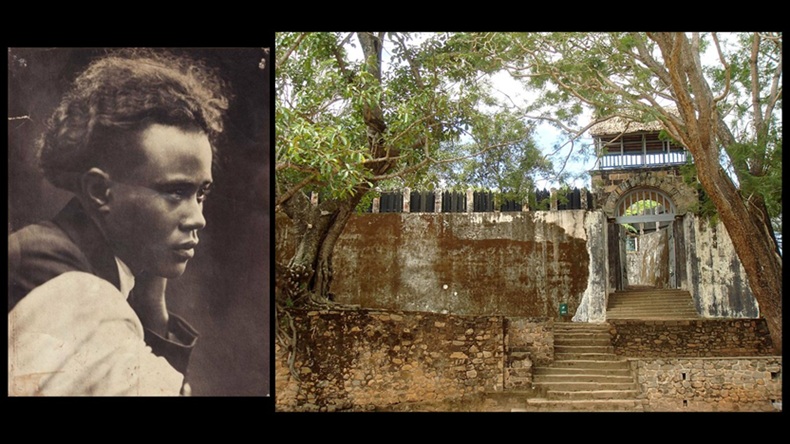
Seven Sonnets of Jean-Joseph Rabearivelo
Translated from French and Curated
by Adam Sedia
Introduction
Joseph-Casimir Rabearivelo (1903-1937) was born on March 4, 1903, in Antananarivo, Madagascar. At the time Madagascar had been a French colony since 1897, when it had annexed the island kingdom. His native language was Malagasy, spoken on the entire island. (Because Madagascar was originally settled from Borneo, Malagasy belongs to the Austronesian language family, and is thus more closely related to Hawaiian and Maori than any language on the African continent.)
Rabearivelo was born into an impoverished family that belonged to the Zanadralambo clan of the Merina nobility (Andriana). Though born into the Protestant faith of his class, a Catholic uncle provided for his education in local Catholic institutions, where he mastered French. After considering the priesthood, he lost his faith and at thirteen was expelled from school for lack of discipline and religious observance. He returned to Antananarivo, where he worked various low-skilled jobs, including at a library, where he immersed himself in reading.
His first works date from 1920-21, during which time he wrote under various pseudonyms and changed his first name to “Jean-Joseph” to have the same initials as Jean-Jacques Rousseau. In 1921 he befriended high-level French colonial bureaucrats and shared his passion for French literature with them. With their assistance his work appeared in French literary magazines, including 18° Latitude Sud in Antananarivo and La Vie in Paris. His first volume of poetry appeared in 1924, and the following year he published his first novel. In 1931 he co-founded the literary journal Ny Fandrosoam-baovao (“New Progress” in Malagasy) to promote Malagasy-language poetry. Throughout the 1930s he involved himself in the movement called “Hitady ny Very” (“The Search for Lost Values”), which promoted the traditional literary and oral arts of Madagascar.
In 1926 he married Mary Razafitrimo, a photographer’s daughter, who would remain devoted to her emotional and impetuous husband and bear him a son and four daughters. Years later the influence of the Jesuit priest and linguist Joseph Razafintsalama would lead him to return to the Catholic Church, which he described as his “grand humiliation.” However, the death of his daughter Voahangy in 1933 at the age of three plunged him into grief from which he never recovered. Afterwards, death became a frequent and recurring theme in his works.
Upon rejection for a civil service position and likely suffering from tuberculosis, he committed suicide on June 22, 1937. After taking ten grams of potassium cyanide, he wrote a final poem and burned the first five volumes of his personal journal, after which he documented in detail his experience dying from the poison. After his death, the remainder of his works were published posthumously.
Besides seven volumes of original poetry (one published posthumously), his work includes three historical novels, four plays, the libretto for Madagascar’s only opera, as well as translations of traditional Malagasy poetry into French and translations of Western authors including Baudelaire, Rimbaud, Rilke, Whitman, and Góngora into Malagasy.
Shortly after his death Rabearivalo was recognized as Africa’s first modern poet and upon Madagascar’s independence in 1960 he was named the country’s national poet.
Sources:
Sabatier, Arnaud; Boissière, Patrick “Jean-Joseph Rabearivelo, (1903–1937), poète malgache.” Les Rencontres de Bellepierre. 2011. (In French).
Valette, P. J.J. Rabearivelo. Lettérature malgache, Vol. 1. Fernand Nathan, ed. Paris, 1967. (In French.)
Translator’s Note
After 1931, Rabearivelo’s poetry took a decidedly modernist and surrealist turn, and his legacy is largely based on his role as one of Africa’s first modernist authors. Nonetheless, his first three volumes present poetry in the French classical tradition. I have drawn the sonnets presented here from those earlier works.
From La Coupe de Cendres (The Goblet of Ashes) (1924):
Royal Loves
(Ambohimanga)
Beneath these mossy rocks, the tree
_they shelter, I am sure
a secret lies, wholly obscure
_to written History.
A legend, She entices me
_by her royal allure,
to love her, to deliver her
_from here, this savagery . . .
I see myself among the Kings:
_In the blue evenings,
The serene nights. Once here, it seems,
_The sobs of waking crows,
were drowned out by echoing throes
_from lovers of our Queens.
Amours royales
(Ambohimanga)
Sous ces rochers moussus qu’abrite
un bel arbre, il paraît
qu’est enfoui tout un secret,
hors de l’Histoire écrite,
Une légende, Elle m’invite,
par son royal attrait,
à l’aimer, à la délivrer
de ce sauvage site . . .
Et je me vois au temps des Rois:
Jadis, ici, je crois,
par les soirs bleus, les nuits sereines,
S’éveillaient les corbeaux,
aux sanglots réduits en échos
des amants de nos Reines
Ambohimanga is the name of a rova (traditional fortified settlement) about 15 miles northeast of Antananarivo (Madagascar’s capital). It served as the royal residence and burial grounds of the kingdom of Imerina, which would unify the entire island under its rule in the nineteenth century. The rova remained closed to foreigners until French annexation in 1897, and remains an important symbol of Madagascar’s national identity.
“Queens” in the final line refers to the four queens who ruled the Kingdom of Madagascar: Ranavalona I (r. 1828-1861), Rasoherina (r. 1863-1868), Ranavalona II (r. 1868-1883), and Ranavalona III (r. 1883-1897). They maintained the unique practice of marrying their prime ministers, who wielded actual power for the last three queens.
Pomegranate
The newborn sun’s rays, searching, fill
_the branches and discern
the pomegranate’s ripe breast, turn
_it bloody as they drill.
Discreet kiss trembling with a thrill!
_Mighty embrace and burn!
And soon out of this spotless urn
_the purple juice will spill.
My lips will find its flavors sweeter
_for having come to be
fertile with sensuality
_and love hot with the fever
of the well-loved sun, the perfume
_of fields in fullest bloom.
Grenade
Les rayons du soleil naissant,
cherchant sous la ramure
le sein de la grenade mûre,
le mordent jusqu’au sang.
Baiser discret mais frémissant!
forte étreinte et brûlure!
Bientôt, de cette coupe pure,
du jus pourpré descend.
Son gout sera plus à mes lèvres
doux, pour avoir été
fécondé par la volupté
et l’amour plein de fièvres
du champ en fleurs et parfumé
et du soleil aimé.
Morning
You come to us, O Morn, from night’s closed walls,
and such fruit from a beauteous, toppled tree,
pulp of light from that lost grove that enthralls
with perfumes, offered up to my ennui!
So many souls, though, have no more a notion
of the bright enchantments held, enclosed within
your beauty. Your charms rise without emotion
among the golden thrills of living wine!
Your rosy birth within the woods’ green heart
whence fresh and life-bestowing winds depart,
laden with all the honey of slim sheaves;
the birth of your untempled god in hearts
that have perverted time and its slow arts,
is told in the vain cry the rooster heaves.
Matin
Tu nous viens, ô Matin, des murs clos de la nuit,
et telle un fruit d’un bel arbre abattu,
la pulpe de lumière offerte à mon ennui
m’enivre d’un parfum de quel verger perdu!
Que d’âmes, cependant, n’ont plus la notion
du clair enchantement enclos en ta beauté:
Tes charmes sont subis sans nulle émotion
parmi les frissons d’or de la vive claret!
Et ta naissance rose au cœur vert des forêts
d’où se lèvent des vents vivifiants et frais
chargés de tout le miel des gerbes élancées;
ta naissance de dieu sans temple dans les cœurs
qu’ont pervertis le temps et ses lentes rigueurs,
est par les vains appels des coqs seuls annoncée.
Grief of the Palms
Hecatombs made for those dark deities
that come among the sea-sprays’ bitter spew,
O slender guardians of the deep blue
upon the emerald margin of the seas,
palms—heralds that until but recently
announced the calm gulf and the firm earth, too—
what curses have been visited on you,
unfastened from the ocean’s perfidies?
What little now remaining to you lies
amidst a frigid sand bidden to rise
out of demented winds and raging waves;
now grief pervades a wasteland far and wide,
the ruins of what was your purest pride
swallowed up suddenly in wrecking raves.
Deuil des palmes
Hécatombes pour quels dieux obscurs
venant parmi les embruns amers,
ô sveltes gardiennes de l’azur
aux limites vertes de la mer,
palmes, naguère annonciatrices
de golfe calme et de terre ferme,
avez-vous subis les maléfices
que l’océan perfide renferme?
Le peu de ce qui vous reste gît
au milieu d’un sable chaud, surgi
des vents dements et des flots en rage,
et tout un desert porte le deuil
de ce qui fut votre pur orgueil
englouti dans un brusque naufrage.
From Sylves (Forests) (1927):
Postlude
Memory, memory, autumn of my heart,
what bird will sing in our woods of despair,
what blossoming will charm the languor where,
dethroned and exiled kings, we live apart?
The fairest of our birds, alas! depart,
and Time’s slow rigors drain and deign not spare
the sap that swells our mangled vines, snug lair
where supple, singing joy once teemed, our part.
In vain your fate brings sadness and dismay—
relentless flight, unstoppable decay
of my first youth when first its pathway wheels.
O memory: I know what force of blood,
which your sad wreckage stubbornly conceals,
makes you beauteous, forever in youth’s bud!
Postlude
Souvenir, souvenir, automne de mon cœur,
quel oiseau chantera dans nos bois désolés
et quelle floraison charmera la langueur
où, rois découronnés, nous sommes exilés?
Nos oiseaux les plus beaux, hélas! s’en sont allés,
et le Temps a tari, en sa lente rigueur,
la sève qui gonfla nos pampers mutilés,
nids où, souple et chantant, essaimait le bonheur.
Mais en vain me contriste et m’alarme ton sort,
inéluctable fuite, inéluctable mort
de ma prime jeunesse au tournant de l’allée,
ô souvenir: je sais quelle force de sang,
en tes sombres debris obstinément célée,
te fait un éternel et bel adolescent!
From Volumes (1928):
Aviavy
Tree that takes root within the stones of tombs,
whose living sap was once the blood perhaps
__of those whose flame illumes
my Imerina and its spirit’s lapse.
Into the blue your castle’s dark heights rise,
from which the morning’s face can resonate
__only the silent cries
our dead raise up against the wiles of Fate!
You tell us, lovely, lonesome tree, to stay
true to ourselves, to take our highest pride
__in how our lands engage us.
Ah, fig! To see you, your light leaves’ array,
inspires my song, though foreign rhythms hide
__its birth, learned from our sages.
Aviavy
Arbre qui prends racine aux pierres des tombeaux
et dont ta sève vive est peut-être le sang
de ceux qui furent les flambeaux
de mon Émyrne et de son esprit finissant,
tu dresses dans l’azur ton palais ténébreux
qui ne fait retentir dans le front du matin
que les appels silencieux
de nos morts contre les astuces du Destin!
Et tu nous dis, bel arbre isolé, de rester
nous-mêmes et d’avoir la suprême fierté
d’épouser nos seuls paysages.
Ah! qu’à te voir, ficus aux feuillages légers,
bien que naissant parmi des rythmes étrangers,
mon chant s’inspire de nos sages.
Aviavy is the Malagasy name for a fig-tree (in Madagascar Ficus trichopoda, Ficus polita, or Ficus carica), a traditional symbol of royalty. “Émyrne” (in the original French) is an archaic spelling of the Imerina Kingdom mentioned above.
Filao
Filao, filao, my brother in your sadness,
come to us from a distant, seaside land,
does Imerina’s sun have for your wanness
some part your inward nature can withstand?
You seem to rue the dances on your beach
of the sea’s daughters, of the breeze and sand;
in dreams you see a morn no storm can reach,
proud of your boundless energy, and grand.
Now that exile causes your bark to crack,
the force of your vain, failing turning-back
grants the birds only refuge without shade—
a work like my song, foolish and in vain
if, born of a strange rhythm and its shade,
it coursed not in my blood, through every vein!
Filao
Filao, filao, frère de ma tristesse,
qui nous viens d’un pays lointain et maritime,
le sol imérinien a-t-il pour ta sveltesse
l’élement favorable à ta nature intime?
Tu sembles regretter les danses sur ta plage
des filles de la mer, de la brise et du sable,
et tu revis en songe un matin sans orage
glorieux et fier de ta sève intarissable.
Maintenant que l’exil fait craquer ton écorce,
l’élan de tes rejets défaillants et sans force
ne dédie aux oiseaux qu’un reposoir sans ombre,
tel mon chant qui serait une œuvre folle et vaine
si, né selon un rythme étranger et son ombre,
il ne vivait du sang qui coule dans mes veines!
Filao is the Malagasy name for Casuarina equisetifolia, known in English as ironwood or Australian pine, a tree native to India with drooping, needle-like leaves and a seaside habitat.
Adam Sedia (b. 1984) lives in his native Northwest Indiana and practices law as a civil and appellate litigator. He has published four books of poetry and his poems, essays, and fiction have appeared in various literary journals. He is also a composer, and his musical works may be heard on his YouTube channel.











Adam, your translation resonates with me in raptured images of a tree (fig, pomegranate, pine, or some others). I can feel the love of nature in his poetry. Thank you for assisting us in understanding his life and work with which I was unfamiliar. You seem to have kept the rhyme scheme and certainly made a beautiful, skilled translation.
Adam, thank you for this fascinating piece on a poet I haven’t heard of. The older I get the more interested I am in the poet behind the words, and how much culture, politics, and life experiences shape their work. Your introduction has given me a far greater appreciation for the melancholic beauty of these stirring sonnets which you have brought skillfully to our attention. I am now wondering what especially drew you to Jean-Joseph Rabearivelo, and whether the life the poet led and its sad end influenced your translations. I am grateful for the work and thought that has gone into this. You have left me with much to ponder.
I like how you focus on Rabearivelo’s early work rather than the later modernist stuff for which he is better known. He seems somewhat comparable to Pessoa, whose status as Portugal’s greatest modern poet is largely based on his free verse, although he wrote a lot of formalist stuff too.
The lesson seems to be: write slop, get famous. I am curious, though, would connoisseurs today appreciate his obscurer work as much as they do if he hadn’t gotten famous writing modernist drivel?
Rabearivelo was certainly fortunate to have found sponsors for publication so early. And so are we, since otherwise it might be only the modernist material that survived. Well done, Adam, in research and in selection of these splendid quatorzains that reveal distinctive natural interests of a national poet. The translations are superb displays of how to translate form as well as content.
I particularly like “Pomegranate,” as I have a pomegranate tree in my back yard. My husband bought it as a decorative ornamental that would not produce more than a few small fruits. It has, however, grown up in accord with the sensuous description Rabearivelo and you provide, and now bears so many fruits I cannot keep up with the lengthy, patient processing needed to extract the seeds from each without excessive bloodying of the kitchen.
In answer to Andrew Benson Brown’s question above, I would say modernist repute does indeed help any traditional work done in the early modernist period to gain connoisseurs. I have collected work from several poets doing good formalist work, principally from the early 20th century but up to the early 21st, whom I’ve never seen mentioned or studied even by a Society like ourselves. They are too late to be classics. Rabearivelo surely was helped by nationalist affection as well as by modernist achievement, so he may be unique. Or it could be that poets hard to see within the globalist crowd sometimes earn attention by carving out a specialist niche.
I’m particularly grateful, Adam, for your discovery of these beautiful French poems. Hadn’t planned Saturday afternoon for this kind of attentive reading, but it’s been very much worthwhile.