


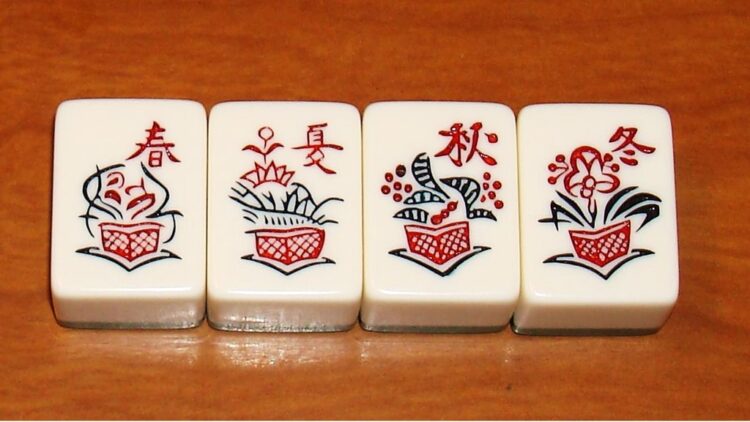
The Mahjong Flowers
Orchid
Lone in the cold of working solitude,
The scholar and the orchid strain to bear
Ripe blooms that otherwise remain as rare
As fertile virtue in the multitude.
But in their Suzhou courtyard’s quiet mood,
Assisted by the garden’s warming air,
New vigor hums as broad leaves sprout a pair
Of slender stems. Each forms a bud to brood
For weeks above the roots. They carry power
To cause emergence of an orchid flower,
Striped, spotted, solid, rich or pale of hue,
A wondrous complicated symmetry
Displaying tangible integrity
Where Song’s long-lasting beauty welcomes you.
Suzhou: Chinese city known for classical gardens
Song dynasty (960–1279): era of advanced culture
Bamboo
Upspringing to the sky, its tall stalks point
Incomparably straight, yet wavering still
Within the range set by each sturdy joint,
While twigs in breezes gaily volatile
Fluctuate nimbly, rustling sword-shaped leaves
To whisper soothingly as muted chime
Or unplucked samisen, whose faintness grieves
Brief leafspans torn to shreds before their prime.
A loud chorale by bamboo flutes begins—
A spirit hurricane devours their voice.
Mad clacking, scraping, roaring thunder thins
Percussive harmony into discordant choice,
Directing Susano-o’s melodrama
Storming green forces at Arashiyama.
Susano-o: Japanese Shinto god of wind and storm
Arashiyama: village known for impressive bamboo groves
samisen: lute-like Japanese instrument
Chrysanthemum
Hundreds of closed packed white chrysanthemums,
Milky blooms massed, a potted spectacular sphere,
At rest here near my writing desk, becomes
A pedestal of promise to persevere
In poetry prophetic of good cheer:
Its radiant burst explodes in rhapsodies
For those who know how stronger hearts cohere.
Imperial chrysanthemum, you ease
Desirable exertion that agrees
With sunny blessings Amatérasu grants
As colors glide through seasons’ galleries,
Making maturity a lively dance
Of ivory, topaz, copper, brick, and bronze,
Transmuting autumn into golden dawns.
Amaterasu: Japanese Shinto sun goddess, legendary ancestress of the imperial family
Plum
Youth on the verge of manifest renewal
Blooms readily when age strides independent
In mind and soul, with virtues more resplendent
Because of agony in their accrual.
The pink, white, red, or purple floral jewel
Betokens discipline in the ascendant,
Developing fidelity transcendent
As selflessness consumes the body’s fuel.
Lao Tzu, it’s said, was born beneath a plum:
His customary blossoms re-appear,
Good simple gems of wisdom in the Way
Instructing followers how they may come
To flower ultimately clean and clear
In spring when age-old plum sprays dazzle day.
Lao Tzu: Chinese sage (reputed 6th century BC), esteemed as founder of Taoism (the Way)
Margaret Coats lives in California. She holds a Ph.D. in English and American Literature and Language from Harvard University. She has retired from a career of teaching literature, languages, and writing that included considerable work in homeschooling for her own family and others.











Wow! These are the most beautiful nature poems I have ever read. What a privilege to read these gems reflecting your direct knowledge and passionate appreciation for natural wonders of the Far East including both China and Japan. I am entranced by the excelling imagery replete with color and comparisons such as the allusion to bamboo having sword-shaped leaves. I was not familiar with the genesis of the orchid having come from China, but how wonderful the story about the scholar and the orchid “strain” that has come to us down through the centuries from such an historic beginning. I love the musical reference to bamboo flutes and percussive harmony. The Chrysanthemum representing Imperial Japan has been known to me since childhood when I collected stamps from Japan with that symbol being on many sets. Then your brilliant poem on the plum enchanted me, especially with these lines:
“The pink, white, red, or purple floral jewel
Betokens discipline in the ascendant,
Developing fidelity transcendent
As selflessness consumes the body’s fuel.”
The title of “Mahjong Flowers” was intriguing, since there are four flower bonus tiles for extra points found in traditional Chinese sets of Mahjong. Each set of your flower verses matched the four tiles. How extraordinary is your set of Mahjong flower-related poems!
Thank you, Roy, for appreciating all of these. Each has a personal application; I’ve been through the gorgeous Suzhou gardens that are mostly outdoor areas, where in winter to spring the plant and the scholar struggle for achievement. A grower in the United States explains that our houseplant conditions are way too easy to produce the magnificent curving displays of flowers we can so easily purchase. According to him, the happy houseplant will say, “Why should I work?” And the green leaves will just remain barren and budless. It takes cold weather, benign neglect, and sparing water to bring about orchid beauty. Comparable effort of scholarly thought is required as well!
Much appreciate your liking for all of these blooms, that have taken me quite some labor. They are indeed nature and garden poems building on years of experience in the Orient.
These poems surprised me, though they shouldn’t have, as I ought to be well acquainted with your inventiveness by now, Margaret. You undertook to say something original and engaging about flowers, and you certainly succeeded; you go far beyond mere description. Of orchid stems and roots you say, “They carry power / To cause emergence of an orchid flower….” Now this is a skillful byway of language, a fresh means of expressing a thought and bringing the reader’s attention to the phenomenon. And as for presenting the look and color of these flowers, you employ not just the familiar five or six colors, but unusual terms like “brick”, “copper,” “rich or pale of hue,” “Milky blooms massed,” “purple floral jewel…”
Then you have the flowers has symbols or counterparts to other phenomena, like the orchid and the scholar, “Displaying tangible integrity…” Then in “Bamboo,” you turn to the sense of sound and the drama of music and thence to history.
Meanwhile your rhyme scheme assists the general feeling of elation. I’m still trying to figure out what rhymes with what, but what really matters is the effect of the poetic structure, which is lively and inspiring. When we get to the plum you somehow manage to bring in Lao Tzu, youth and age, and “gems of wisdom in the Way.” You find these remarkable connections and make them clear. These harmonizing pieces make a wonderful bouquet of poems.
Thanks for your careful attention to several aspects of the whole bouquet, Bhikku Nyanasobhano. The rhyme schemes are four classic ones from Western tradition, which may have been all the more confusing because only three are regularly recognized by writers in English. And I started with the less usual fourth or French-style sonnet for “Orchid.” The rhyme scheme is abba abba cc deed. The others are Shakespearean for “Bamboo,” Spenserian for “Chrysanthemum,” and Petrarchan for “Plum.” Sorry to have delayed so long in my response to you, but I have been otherwise overwhelmed. Your appreciation is always welcome, and always happily noticed.
Margaret, I am in awe of the beauty in this set of four sonnets. I took some time to look at the Japanese Mahjong tiles before reading…. my daughter Gloria and her husband just got back from a three-week trip to Japan, so Japan has been on my mind a lot lately…. and then behold! these beautiful sonnets!!! There is something in your diction that brings the spirit of Japan right in front of my eyes as I read… you are so careful, and thoughtful, and precise in your word choices, and this only serves to manifest and enhance the lovely imagery which lingers now in my mind. Stellar work!
Thanks, Theresa. As you know yourself, sonnets take time and thought to convey spirit. The “Chrysanthemum” here has been with me for more than a year, first as that thick ball of bloom, and now in re-growth newly manifesting itself. Putting together four of these, each with depth and precision, has been a labor of joy. I’m most grateful for your appreciation.
Margaret, I’m a watercolorist and currently studying “Sumi-e” and its subset of “Suibokuga” – Japanese monochromatic black ink painting. The book I’m reading refers to the above collection of plants as “Shikunshi”, or “Four Gentlemen”, wherein each plant represents a season and human virtues: Orchid for Spring – purity fragility and grace; Bamboo for Summer – integrity, flexibility and modesty; Chrysanthemum for Autumn – nobility, strength and vitality; and Plum Blossom for Winter – perseverance, humility and inner beauty. Taken as a quartet, they’re meant to symbolize both seasonal changes and stages of human life.
Thank you, Cheryl, for supplying this additional cultural context originally from China. It really needed to be here! Though I treat the flowers principally as flowers, there are seasonal touches in my poems, and maybe even slight hints of the virtues. Hope you’re enjoying sumi-e. I’ve been more concerned with calligraphy than painting, but I did learn to picture bamboo with a stalk stroke, a joint stroke, a twig stroke, and a leaf stroke. My husband argues that the joint stroke is unnecessary; instead you simply leave a clear space between lengths of stalk. And think of the varied myriads of bamboo paintings these techniques generate!
Flowery thanks to you four attentive and appreciative commentors on this quartet. I value each of your different perspectives, and will hope to reply individually. In preparation now for singing a grand centennial concert tomorrow, and will return better rested to focus on what you’ve said, Roy, Bhikku, Theresa, and Cheryl.
This poem is so creative and while the flowers are common, your writing made them so exotic. I am amazed at how you can create a story out of a simple flower(s).
Each has its own meaning and value–and I’ve given each a story in accord with experience. Thanks for paying attention, Laura. These things have power to beautify us in good will–and more!
Such a beautiful set of poems. As a music lover, I am particularly enamoured with “Bamboo” and its overall arc from growth and promise to destruction by an overwhelming force.
Thanks, Zumwalt. That’s a real story of walking in the very tall and narrow bamboo passageway at Arashiyama in Kyoto. The bamboo grows extremely high, and when a storm passes through, the wood is no longer flutes but percussion. It’s too well established to be totally destroyed, but it was a very scary afternoon for many of us trapped in the valley and unable to retreat as the wind was tearing down much that was capable of breaking. Many of us were holding onto useless umbrellas turned inside out. It may all be green and leafy again, but vulnerable once more!
Thank you for your time and effort to edify your readers with knowledge and depth of meaning, Margaret C. These sonnets are filled with beautiful and descriptive details as well as pertinent background information.
Fully-flowered detail! I make a point of it, and many thanks for your appreciation, Margaret B.
What a wonderful idea for a set of sonnets! The mahjong flowers are not only beautiful in themselves, but in that context are important aesthetic and cultural elements of the Sinosphere. You’ve done a wonderful job not only capturing the beauty and essence of each flower, but incorporating each into its Far Eastern cultural context, transporting us into the long-lost world of the traditional Far East.
Thanks, Adam. Much appreciate your identifying this set of flowers as “important aesthetic and cultural elements of the Sinosphere.” I’ve actually been in the places I mention, so in one way it’s not “the long-lost world of the traditional Far East.” But in another, you are correct. Especially, touring the well-preserved classical gardens of Suzhou, I could only be aware that they are most likely never seen by people living and working in that city today–the very people whom I did see on the streets as I was going to and from my foreigners’ hotel. All the more do I reflect on these four flowers as an honorable choice for shaping sonnets in my Euroamerican perspective of the moment!
Dear friends, thanks for the additional comments. I’m not yet well enough to respond individually, but will hope to acknowledge each of your views in time.
Margaret, so terribly sorry to hear you are not well! I hope for speedy healing, rest, and recovery!!!
Thanks, Theresa. I’m recovering gradually, with much needed rest.
And the aid of rarer, more valuable, more desirable, lastingly iconic art. Confirmed antidote to toxins too common.