


Two Sonnets
by Nino Martoglio (1870-1921)
translated from Sicilian by Joseph S. Salemi
I.
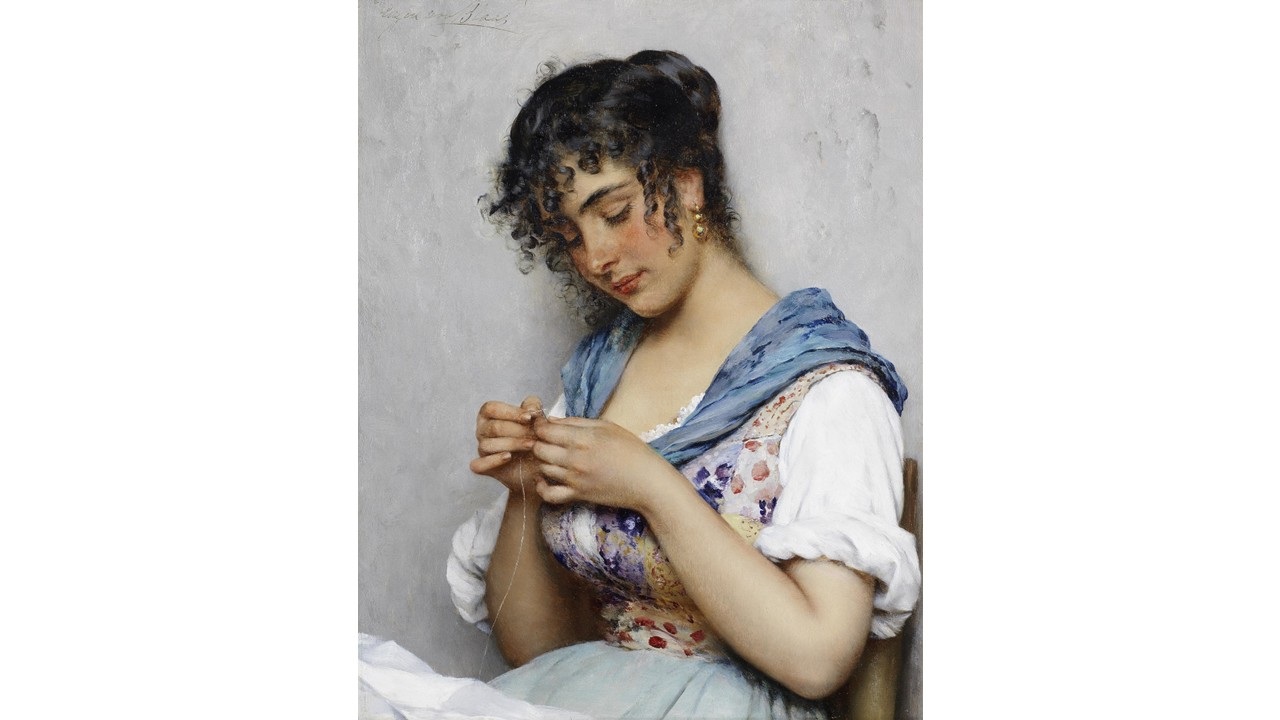
Young lady, you who work embroidery
At your small loom, behind the window’s glass—
Tell me, why is it that you gaze at me
When there in the morning I go by and pass?
Your needles are most exquisite, precise,
And made of steel well honed, and fixed in place—
But even sharper are those piercing eyes
Set in your cute and fetching baby-face.
You with your lovely, mischief-laden eyes
Have embroidered on this heart of mine,
Weaving a cipher of love in disguise.
My heart, although delighted, gives a cry—
For all the little holes you’ve pierced, I pine,
And you not knowing why my heart should die.
II.
For charity, I beg you girl, be good—
Don’t let my proffered prayer be asked in vain.
When I turn up here in your neighborhood
Don’t gaze at me, behind your window pane!
If you should want a cloth as pure as milk
To weave a cipher truly superfine,
Prepare the tray of needles and the silk;
Embroider on this wretched soul of mine.
Besides, your needles can embroider two
Ciphers of flame, with both placed side by side—
One cipher is for me, and one for you.
And if of reddish colors none remains
Among your spools, don’t look for where they hide—
Make them with the blood from my own veins.
Translator’s Note
Nino Martoglio was one of the major lights of modern Sicilian literature. His reputation rests not merely on his poetry, but also on his extensive work in drama, journalism, and film production and direction. He was a friend and associate of many of the literary figures of his day, including Pirandello, Carducci, and Trilussa.
Martoglio’s poetry is wide-ranging in its subject matter—it can be romantic, philosophical, comic, political, historical, and satiric. His satire was sometimes so sharp that it is said he had to fight over twenty duels with enraged men whom he had lampooned or ridiculed. But one of his most dominant themes is love, and the women he wooed, worshipped, fought, and argued with.
The two poems that I translate here are from his collection of sonnets to individual ladies—in this case a seamstress and embroideress named Tidda. I chose them because they show Martoglio’s skill in taking one particular aspect of his subject and expanding it as a kind of governing metaphor. Here it is Tidda’s skill as an embroideress, which he uses as a means of discussing her ability to embroider “ciphers of love” on his heart, taking his blood as color for her threads, and using his heart as a fine fabric on which to weave.
Martoglio’s dialect was that of Catania—an idiom somewhat different from the Sicilian that I learned from my mother and father (who spoke Messinese and Palermitan, respectively). But most Sicilian dialects are understandable to all native speakers, and Martoglio’s work remains popular throughout the island by all classes of people, very much as G.G. Belli’s Roman dialect poetry is enjoyed all over Italy. As a non-native speaker, I had some difficulty with his language, but I was helped by the excellent selection of Martoglio’s poetic work (with translations and notes) edited by Prof. Gaetano Cipolla in 1993.
Original Texts
I.
Signurinedda, vui c’arraccamati,
‘ntra lu tilaru, arreri la vitrina
dicitimi: pirchí è ca mi guardati
quannu di ’ddocu passu, a la matina?
Li vostri augghi sunnu prilibati,
ca su’ d’azzaru e ccu la punta fina,
ma chiú puntuti sunnu e chiú ammulati,
’ss’ occhi,’ntra ’ssa faciuzza di bammina.
Vui ccu ’ss’ ucchiuzzi beddi e tradituri
arraccamati supra lu me’ cori,
e arraccamati ’na cifra d’amuri:
ma tuttu spurtusatu lu me’ cori,
mori pri la priizza e lu duluri,
senza chi vui sapiti pricchi mori.
II.
Pri carità, ’scutati ’sta prijera
ca ju vi dugnu, amata signurina,
quann’ è ca svòtu di ’ssa cantunera
non mi guardati, arreri la vitrina!
Si poi circati la battista vera
pri farici ’na cifra suprafina
priparati la sita e la ugghiera
e arraccamati ’st’ arma mia mischina.
Anzi putiti arraccamarni dui,
cifri di focu, tutti dui vicini,
la cifra mia e la cifra di vui.
E allura si non vònnu purpurini,
’ntra li rucchedda nun circati chui.
fatili ccu lu sangu di ’sti vini.
Some Notes on the Sicilian:
Signurinedda: This could be translated as “Little Miss,” but I prefer simply to say “Young lady.” Sicilian uses diminutive suffixes much more frequently than English does.
’ddocu: An adverb of direction meaning “there; in that place.” From Latin ad locum (“to the place”). Assimilated in Vulgar Latin to allocu, with the eventual loss of initial /a/ and the typical Sicilian change of ll to dd.
ca: This word usually means “that” in Sicilian as a relative pronoun or a subordinating conjunction, but in line 6 of the first poem it most likely means “because.” From the Latin quare (“why,” or “for what reason”), which has also given rise to the French conjunction car.
spurtusatu: pierced; having many holes. From an unattested late Latin expertusum (“thoroughly penetrated”).
priizza: contentment, happiness. From Latin pretia, the plural of pretium (“price, value, worth”). The semantic shift seems to have been from “things of great value” to the happiness that comes from having such things.
battista: a soft, smooth fabric called batiste in French.
mischina: poor, wretched, unfortunate. From the Arabic miskin, which has the same meaning.
Joseph S. Salemi has published five books of poetry, and his poems, translations and scholarly articles have appeared in over one hundred publications world-wide. He is the editor of the literary magazine TRINACRIA and writes for Expansive Poetry On-line. He teaches in the Department of Humanities at New York University and in the Department of Classical Languages at Hunter College.













I love these poems, your expert translation, and the brilliant imagery they depict of love and longing. I read your notes avidly that explained so much and deepened my appreciation for the subject and for your translation skills. You are fortunate to have such linguistic ability inculcated and preserved via your family roots.
Thank you, Roy. I only wish I had the same skill in Sicilian as my father and mother had.
Beautiful sonnets. Thank you for the careful translations!
You’re welcome, Paul.
Joe, I very much enjoyed both of these masterful translations of two enchanting sonnets by a poet unfamiliar to me. The use of weaving as an extended metaphor is charming as is the entire narrative of the smitten young beau who sees the young seamstress and falls in love when we don’t even know her name! Romantic with a nice flair for the dramatic (“Make them with the blood from my own veins”) that is the hallmark of naive youth.
You do us a great service, Joe, to introduce our classical poetry community to Martoglio. His poetry is not only charming but great fun. They seem particularly suited to be performed for an audience. These could almost be arias in an Italian opera.
Thanks, Brian — I’m very pleased that you like the work. The first non-English poetry I ever came in contact with was the Sicilian poetry of my grandfather, when I was a small child.
Martoglio was a playwright as well as a poet, so there is a strong dramatic element in his compositions. Martoglio was a close friend of the writer Luigi Pirandello, and in fact Martoglio was the one who urged and finally convinced Pirandello to try his hand at drama. Together they wrote a number of plays in Sicilian, and Martoglio also went on to become a producer and director of films.
In his collection of sonnets Martoglio lists the name of this particular woman as “Tidda,” which indicates that her first name was most likely Agata (the English Agatha), with the diminutive form Agatella. In Sicilian the name Agatella would be “Agatidda,” which normally became the nickname “Tidda.” Both Sicilian and standard Italian have a tendency to create nicknames from the final syllables of someone’s full name (“Lorenzo” would be called “Enzo,” and “Nicola” would be “Cola”). The Sicilian form of Salvatore (in the diminutive form “Salvatorello”) would be “Sarvaturiddu,” with the shortened form “Turiddu.” Salvatore was my father’s name, and his parents generally called him “Turiddu,” or sometimes “Turi.”
I am excited to see these. They are beautiful works by a lesser-known poet (certainly not one encountered in Italian literature courses), but they stand out as fine examples of the love-sonnet, with a skillful use of metaphor rendered even more incisive by its relation to the poems’ known subject (the embroideress),.
I am also excited to see you feature poems in Sicilian. Unfortunately, most people call the regional Italian languages “dialects,” but they evolved separately from Latin and are languages in their own right. Modern standard Italian is essentially a constructed language (though based heavily on the Tuscan of Dante and Petrarch) and imposed on the regional languages, which until recently were treated with extreme prejudice. I remember my grandfather’s Neapolitan, which sounded closer to standard Italian than the Sicilian here, but still sounded different from both.
Adam, thank you for this enthusiastic comment. Yes, the prejudice against any “dialects” in Italy was great after the nation’s unification, even though (as you point out) standard Tuscan is an artificial literary construct. The Fascists did their best to suppress non-standard forms of Italian for two main reasons. First was the upper bourgeois and academic prejudice against what was considered “peasant” speech, and second was the totalitarian political need to make everyone speak exactly the same way.
This led the Italian government to insist on classifying non-standard forms of Italian as mere “dialects,” even if they were clearly separate Romance languages like Sardinian and Sicilian, or absolutely not part of the Italic branch at all, like Friulian and other forms of Rhaeto-Romansch in the north. Incidentally, this reclassification by Fascist Italy impelled Switzerland to rebrand its own Rhaeto-Romansch dialects as a fourth official tongue of the Swiss Federation (along with French, German, and Italian) as a way to discourage possible irredentist claims for Swiss territory by Mussolini.
But the “dialects” still survive in Italy, though many snobbish social-climbing types will refuse to speak them in public. Some, like Milanese and Neapolitan and Romanesco and Sicilian, have serious canons of literature. And here in America we have the wonderful example of the U.S. Army naming one of its standard MREs for field rations as
“Pasta Fazool” — pure Neapolitan idiom for pasta with beans. It’s right up there with Beef Stew, Franks and Beans, and Chicken a la King.
Enjoyed the sonnets — and profited from the notes. I like to see the decisions made by a translator, especially one working from a language I don’t know.