


The Dryads
The day we found the hoof-prints in the soil
And felt the breath of dark, indolic heat,
We dropped our implements of rustic toil
And took the path marked by the cloven feet.
The fields were newly garlanded in green,
Swathed in the uncorrupted redolence
Of Springtime, delicately perched between
Fecundity and frigid impotence.
The forest rose up, threatening and high.
We stepped across the threshold of the wild,
To find our senses overpowered by
A melody that beckoned and beguiled.
Into the forest’s heart, lost in a trance,
We hurried, thinking not how far or long.
Unknowingly, our steps became a dance,
Bound tightly to the rhythm of that song.
We wandered in the ancient woods alone,
Possessed by haunting music, barely heard
But beautiful and flawless in its tone,
Beyond the voice of man or beast or bird.
The forest shimmered as the day awoke,
With dew-drops shivering on bough and stem,
As emeralds shimmer down a lady’s cloak,
From gilded brooch to swaying velvet hem.
The silver notes flung at us on the breeze,
Shed from that far-off, scintillating strain,
Became a torrent flowing through the trees,
Sweet-voiced, as sings the sunlit summer rain.
A veil of leaves abruptly drew apart,
To guide us down into a sun-drenched glade,
Into the forest’s ancient, glowing, heart,
From whence that shining melody was played.
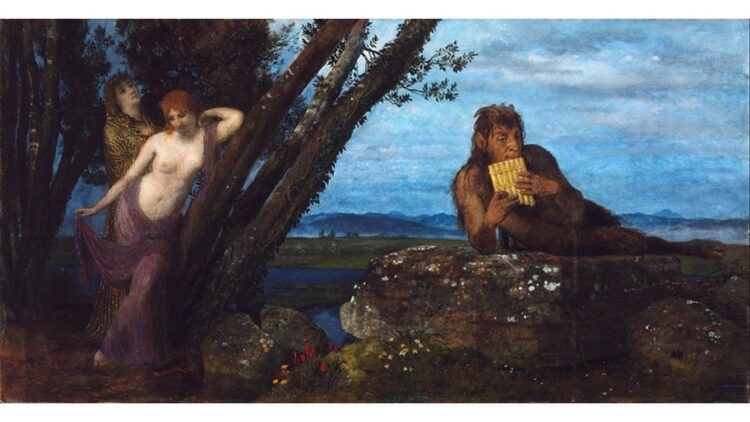
And there we found the ancient Hornéd One,
Enthroned amidst the bells and lady’s slips,
Bedappled by wind-shadows in the sun,
The haunting song piped sweetly on his lips.
How quickly he sprang up as we drew nigh!
We froze there, gazing on his countenance.
So strange, and yet familiar as the sky,
The fields, the woods—all Nature’s great expanse.
He met us where we stood in mute surprise,
Beneath the sweet, unfurling wreaths of oak.
He searched our faces with his glowing eyes,
And touched our burning brows but never spoke.
Still, with his other hand, he carried on
The piping that had called so urgently,
Until we found our inhibitions gone,
The stupor lifted and our spirits free.
He saw his horns reflected in our eyes,
The thrill awakening, the ravishment.
He shook his tufted tail and wooly thighs,
He took our hands and up, away we went,
The three of us, to dance, cavort, and play,
‘Twixt sunbeams and deep, cooling pools of shade,
To scoff at winter’s distant, cold decay.
We reveled, free of guilt and unafraid,
In Springtime, in our lust and heartiness—
The things that fade as seasons pass away,
Whose fading should be laughed at nonetheless,
Before all mirth is lost in yesterday.
Then nightfall came, so suddenly, so soon.
The woods filled with the soft, pulsating light
Of glow-worms, and the stars, and crescent moon,
The airy flutterings of moths in flight.
The shadows of our heated bodies swayed
Across the drapings of our verdant bed.
And in the shadow-world we saw displayed,
A twisted pair of horns upon each head.
Patricia Rogers Crozier has been published in The Washington Post. She holds a B.S. in Physics from Mississippi College. She resides in Gulf Breeze, Florida and works at Publix. She is the winner of the 2024 SCP International Poetry Competition.

















Exquisite. Mesmerising. Perfect! Your poem drew me on like the music of the pan pipes. And then that last line, half expected, half feared, hit me with a jolt!
Thank you, I am so glad you enjoyed it!
Patricia, what a magnificent poem. Thanks to a succession of vividly graphic images, your narrative is utterly absorbing; your choice of vocabulary is unfailingly perfect; and the piece as a whole exudes the timeless, dreamlike quality its subject demands. As one who has attempted an uncannily similar theme (but with very unsatisfactory results), I wish I could write like this.
What a compliment! I am thrilled to have made an enjoyable poem, I hadn’t planned for it to be so long and was concerned it may have turned out too long to be enjoyable.
Thank you, Patricia, for this beautifully written and inspired poem. I echo the previous comments and was particularly struck by the profundity of “The things that fade as seasons pass away, Whose fading should be laughed at nonetheless,
Before all mirth is lost in yesterday”. Best wishes, Bruce
Thank you for saying so, and for taking the time to read it! It ended up being much longer than I intended. All the best to you as well!
What a treat it is to wake up to this luscious and lilting poem – a mellifluous and hypnotic cornucopia of linguistic images so vivid they rose from the page and enveloped me in their wonder. Thank you, Patricia. “The Dryads” is a triumph!
Thank you! I am very happy that reading “The Dryads” was enjoyable. It was a joy to write, which was good because it took a long time!
You have touched ethereal elegance and elicited Elysian entropy in a poem enmeshed in a dream-like state that at once enchants and enmeshes the mind. Rarely have I read such absorbing poetry that drove my senses with such explicit and imaginative imagery.
Thank you! It is very kind and encouraging of you to say so.
This is an amazing piece of work, both in execution and in subject. The language is “sylvan-rich”, if I might coin a compound, and summons up all the ancient mysteries of Pan, Faunus, the Dryads, the Satyrs, and the entire realm of nature haunted by divinities that are both beautiful and dangerous.
When the speakers say “We dropped our instruments of rustic toil,” my first thought was that they are male — either farmers or herdsmen or shepherds. And yet the ending comes with suggestions of amatory play — wild and uninhibited — among the speakers and the god or gods whom they encounter. But perhaps the speakers are not human. Maybe they are “The Dryads” of the title: female spirits of the trees. It might be deliberately uncertain.
In any case, the real focus of poetic energy here is the language. The poet has created a magnificent artifact of diction, expression, and description. “Dark, indolic heat” is striking, but so is “Bedappled by wind-shadows in the sun,” and “”He shook his tufted tail and woolly thighs.”
There’s clearly some wild sex going on in this piece — divine-human and even human-animal. But it’s been etherealized in the lush sylvan language of forests and groves and sun, stars, moon, and cool shade. I could imagine this as an ancient poem, but frankly it is much more reminiscent of Renaissance erotic poetry in Latin, such as done by Pietro Bembo.
The poem has the chief characteristic of excellent work — it’s interesting and intriguing.
Thank you! I had a lot of fun writing a raunchy woodland romp!
A beautiful poem. I could not stop reading, even though most longish verse tends to lose me.
Thank you! But I wouldn’t blame you whatsoever if you had found it too long, I kept trying to end it sooner but it kept going and going, pulling me deeper into the forest! EEK!
Some poems seem to have a life of their own and lead us to a natural end. The Dryads is the perfect length and with your permission I shall pass it on to one of my grandsons who enjoys reading and writing poetry.
This sizzlingly exotic piece was well worth the minor research I needed to do to fully ingest its scintillating message, Patricia. This a “WOW” from any accomplished poets’ perspective. Now – I’m off for a cold shower… 🙂
I’m happy to hear that “The Dryads” was an immersive reading experience! I think all the characters could also use a cold shower, haha!
This is an enchanting poem, Patricia — impressive in language, superbly paced (particularly the gradual unveiling) and, by turns, sensual, joyful and disturbing.
Thank you very much!
As others have said above, this is mesmerizing, magnificent, enchanting! The way you use language is truly magical. I love the way the “barely heard” music weaves its way throughout, and the way you describe it and its effects. “Silver notes flung at us on the breeze” become visible as well as audible. And the imagery is dazzling: “With dewdrops shivering on boughs and stem, / As emeralds shimmer down a lady’s cloak…” “Bedappled by wind-shadows in the sun” immediately brought the image of the way the shadows of leaves keep changing quickly in the wind — but I couldn’t have thought of that brilliant way to describe the phenomenon. “Before all mirth is lost in yesterday” is an incredibly original line, dense with possible meanings, which could lead to so many possible thoughts; I would love to see another poem by you, beginning with this line. This is an exceedingly rich poem!
Thank you for such thoughtful words, I am thrilled that my poem was enjoyable! It got so long that I worried it might be a cumbersome read.
An intimidating poem in its unbroken length, but what a pleasure to read, Patricia.
As mentioned above, mesmerising.
Thank you so much!
In a word, this poem is exquisite. The language is rich in both imagery and in its sheer luxuriance. You evoke a scene of beauty, unbounded glee, and eroticism, providing exactly the escape to another world that the best poetry does. Thank you.
Thank you, I’m thrilled that “The Dryads” summons to mind what was intended and is an escape from the mundane, as I had hoped!
This is absolutely gorgeous. Precision of language prevents the sophisticated vocabulary from being inaccessible. Lovely!
Patricia, this poem is so interesting and unusual– the imagery is so clear and well-rendered that I truly see the whole dreamlike experience in my mind’s eye! I could easily see a video made as an accompaniment to a reading of “Dryads”– or even a good, perhaps psychedelic sort of cartoon!!! I truly enjoy the poetic exploration of mythical figures– I thank you for doing so, and doing it so well!
Long it is, but an intriguing dryadic drama. Unlike mystery stories that depend on clues for a solution, this mystery never reveals all of its mystique. I follow it symbolically and linguistically, as a journey of bucolic persons becoming the dryads of the title. At the beginning, they are human workers who choose to drop their “implements of rustic toil.” They are READY to enter what’s sinister. And what is sinister? They eagerly follow not footprints but hoofprints, quickly shown to be “cloven.” Right from the start, then, we read of a pair attracted by evil. Nothing new about that, but this drama describes and characterizes their path. Literary and artistic telltale characteristics of devils are cloven hooves, horns, and a tail. They have these even when appearing in human form. Here one hardly appears at all. Interesting, Patricia, that you reserve the tail until nearly the end of the tale. Still at the beginning, though, comes a nasty smell. “Indolic” is a fecal fragrance in nature. You contrast it with the ordinarily pleasant “redolence” of Spring. Good word choice. There is no contrast with “indolence” from a different root. You probably learned of indoles in chemical physics.
Smell and sight and sound captivate the pair of persons. They are “overpowered” by melody, bound tightly by a haunting supernatural voice (neither man nor beast nor bird). There is an overnight time lapse in which nothing is said about what happens. Only after daybreak in the forest does the pair see the ancient horned one. They freeze. Surprisingly, perhaps, there is no speech. He mutely continues to make music. His horns are reflected in their eyes. This is where the tail comes in. And the additional horn symbolism of the crescent moon is visible. As night falls again, the pair of persons see shadows of “a twisted pair of horns upon each head.” A verily eerie ending!
Readers are not told what this means. Have they become devils? No telling. They may only seem to have horns. Nothing is said of tail or hoof or smell. I interpret the title (the only place where the word “dryad” occurs) as meaning the pair of persons become dryads through the process described. Is that good or bad? Again, no telling. Dryads do not normally have horns, and they can be sympathetic figures in myth. In Narnia, there are good and bad (green and red) dryads. A dryad is a tree spirit. What are the consequences if, as I interpret, human farm workers become dryads, at least partly through choice? Two things are affected: speech and motion. They may have lost the power of speech; the mute ancient horned one in the story suggests as much. Dryads in myth may be able to communicate by sound, but it’s usually by sounds made in or by the tree (such as leaves rustling or a voice faintly heard within the bark). They can leave the tree, but not go very far. Dryads are bound by some unknown power to the tree.
Some things may be fading for persons becoming dryads, but as the poem comments,
“Fading should be laughed at nonetheless
Before all mirth is lost in yesterday.”
A fascinatingly fading picture, Patricia, in a praiseworthy poem perennially ready to be read again!