


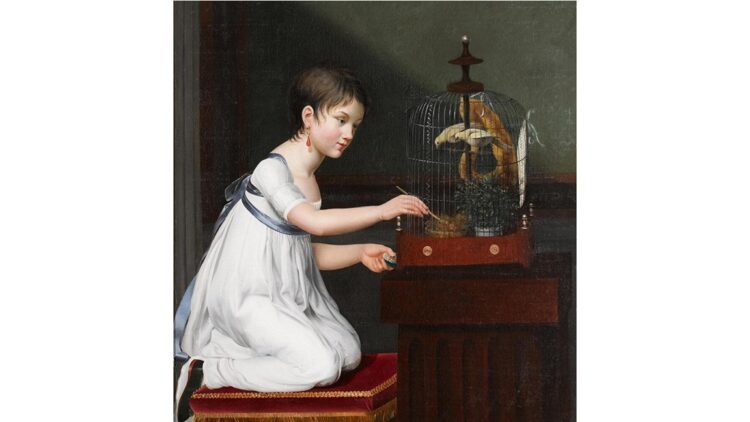
The Bird with the Ugly Voice
I kept a bird whose song was harsh and coarse,
A jarring cry, a rasping, croaking force.
I shut him in his cage beside the door,
And hoped in time his voice might charm me more.
I longed for melodies of sweet delight,
So trained him daily, patient in my rite.
I sang him airs, the lilting songs I knew,
And bid him learn what gentler birds pursue.
At first he croaked, a frog amid the reeds,
He spat his notes like scattered husks of seeds.
I soothed his throat with honey, mint, and tea,
Yet silence lingered, stubborn as could be.
I schooled him further, playing Mozart’s art,
And Chopin’s sighs to teach a listening heart.
He flapped his wings, bewildered on the perch,
While tones half-formed still wandered in their search.
Yet through the rain and sighing winds that blew,
He found odd strains, though bent and out of true.
One moonlit night, when all the world was still,
I leaned outwards, my breath restrained, my will.
A secret murmur trembled from his throat,
A hidden song that swelled to soaring note.
It rose and rose, a silver, starry choir—
And morn proclaimed: A Nightingale for Hire!
Scharlie Meeuws, a poet born in Germany, began writing at a young age. She studied in Spain and France, writing poems in Spanish and French before settling in England, where she co-owns Thorntons Bookshop, the oldest in Oxford. Scharlie’s poetry has been featured in magazines and anthologies, including the Guardian. Her work was recognized by Nobel Prize winner Vicente Aleixandre. Her most recent book is The Emotional Robot and Other Poems. Her poetry book Outbranching was published by Cerasus, London in 2021 and is available on Amazon.











Sharlie, this is sweet imagination that has lessons for us beyond that of the bird. Love, faith, and persistence can achieve wonders in life.
What a lovely poem with some great imagery, Scharlie. And what an unusual topic. The image of the frog is particularly fine, and what a wonderful ending.
Hans Christian Andersen would have loved this.
The poem begins in the definite style and tone of an allegory: an ugly-voiced bird kept in a cage by a speaker who wants to improve his bad qualities. I assumed that this would be an exemplum of the old saying “You can’t put lipstick on a pig,” or some other version of a reformist crusade that failed.
But the ending suggests otherwise. The bird improves a bit, and the last quatrain has him singing gloriously. Nevertheless the conclusion seems skewed by something: is the bird a nightingale, or is he just imitating one? And why would he be so commercially oriented as to be “for hire”? I take the ending to be a somewhat cynical comment on the unintended consequences of trying to “reform” someone. It usually doesn’t work, and may backfire instead.
Enjoyed your poem very much, Scharlie. I too was a bit flummoxed by the final line. Dr. Salemi’s opinion seems a good possibility but it would be interesting to know what you had in mind.
This intriguing poem that has drawn me in and got me thinking – could it be that the bird’s inspiration comes from beyond the cage and the wonder of famous composers? Is the bird’s song inspired by the language of the wind, the rain and the moonlight? It seems the speaker is keen to exploit the emergent nightingale… I feel the pierce of a thorn in a feathered breast. I especially like: “At first he croaked, a frog amid the reeds,/He spat his notes like scattered husks of seeds.” which contrasts beautifully with the closing lines. Scharlie, thank you!
Thank you Susan, for your kind words. I was amazed about the reactions i got from many readers and am grateful for this “applause” it is just a fun poem i wrote one day, it should bring a smile to whoever is reading this. I understand that is the case now.
This is a wonderful narrative poem, telling a story and leaving the reader wondering how things will resolve until the very end, which for me was a surprise. I love the detail and the clarity of the language.
I think I dated this bird once. Might’ve even married him. Alas, these nightingales of ours…
Love this! From the humor in that third stanza, the instruction via Mozart and Chopin, and the upbeat ending. I also love that sense of extension in that penultimate stanza, setting up that last stanza so nicely!
Upbeat amusement indeed, Scharlie! Transformation of the bird sings with funny and fowl behaviour.
I, for one, could feel the tension between bird and teacher. It was as though the bird—symbolic of her voice—finally broke free despite all the painstaking lessons. Only when everything else was lost did it emerge.
Isn’t that often how life works? When we finally reach bottom, when we come to the end of ourselves, when we collapse in exhaustion—there, of all places, we find our voice.
You made me smile with your comment, Brandon! And what you said feels absolutely true. Mind you, it might not always be the song of a nightingale…..
Scharlie:
This poem delights with its strangeness! The form is 24 lines: 12 heroic couplets (iambic pentameter). All the rhymes are masculine. There are 6 stanzas, each with two rhymed couplets.
The speaker is trying to train a caged bird whose song is naturally harsh. The spear wants the bird’s song to be a ‘melody of sweet delight’, like ‘ Chopin’s sighs’ and ‘Mozart’s art. ‘ The bird was ‘bewildered on the perch,’ though it is trying to imitate the sweeter sounds. The bird kept trying, and eventually ‘found odd strains, though bent and out of true. ‘ Finally, one night, the bird sang a ‘hidden song that swelled to soaring note. ‘ The bird is now ‘A Nightingale for Hire!’
The whole poem is a lovely conceit with a subtle “slant” meaning—what meaning? Open to endless discussion! a whimsical allegory, perhaps, of how we humans engage in creative endeavors: we take rather unpromising material and try and try to transform it into something artful and rare. Rather the way poetry is written, or artworks are painted!
I have one small query: in line 20, the end two words: ‘my will. ‘ I couldn’t quite follow what the speaker’s will is doing. Is it restrained, like the breath?
Wonderful work!
Most sincerely,
Mary Jane
I think your last guess is correct. The will is restrained, just like the breath. This is what is called in grammar a postpositioned subject noun that follows its verb. It’s an excellent device in formal poetry.
Thank you Mary Jane, you ask for the meaning of this poem. I would just say, dont judge a book by its cover, you might be surprised by the unexspected. 🙂
you made me happy by your appreciation.
This poem brought a smile to my face. I especially loved the lines, “At first he croaked, a frog amid the reeds,
He spat his notes like scattered husks of seeds.” It painted in my mind the image of a stubborn parrot. I found the lines referencing Mozart and Chopin relatable as I am about to take a piano examination. Oh how elusive those true tones can be!