• Submit Poetry
  • Support SCP
  • About Us
  • Members
  • Join
Tuesday, August 11, 2026
Society of Classical Poets
  • Poems
    • Beauty
    • Culture
    • Satire
    • Humor
    • Children’s
    • Art
    • Ekphrastic
    • Epic
    • Epigrams and Proverbs
    • Human Rights in China
    • Music
    • Performing Arts
    • Riddles
    • Science
    • Song Lyrics
    • The Environment
    • The Raven
    • Found Poems
    • High School Poets
    • Terrorism
    • Covid-19
  • Poetry Forms
    • Sonnet
    • Haiku
    • Limerick
    • Villanelle
    • Rondeau
    • Pantoum
    • Sestina
    • Triolet
    • Acrostic
    • Alexandroid
    • Alliterative
    • Blank Verse
    • Chant Royal
    • Clerihew
    • Rhupunt
    • Rondeau Redoublé
    • Rondel
    • Rubaiyat
    • Sapphic Verse
    • Shape Poems
    • Terza Rima
  • Great Poets
    • Geoffrey Chaucer
    • Emily Dickinson
    • Homer
    • Henry Wadsworth Longfellow
    • Dante Alighieri
    • John Keats
    • John Milton
    • Edgar Allan Poe
    • William Shakespeare
    • William Wordsworth
    • William Blake
    • Robert Frost
  • Love Poems
  • Contests
  • SCP Academy
    • Educational
    • Teaching Classical Poetry—A Guide for Educators
    • Poetry Forms
    • The SCP Journal
    • Books
No Result
View All Result
Society of Classical Poets
  • Poems
    • Beauty
    • Culture
    • Satire
    • Humor
    • Children’s
    • Art
    • Ekphrastic
    • Epic
    • Epigrams and Proverbs
    • Human Rights in China
    • Music
    • Performing Arts
    • Riddles
    • Science
    • Song Lyrics
    • The Environment
    • The Raven
    • Found Poems
    • High School Poets
    • Terrorism
    • Covid-19
  • Poetry Forms
    • Sonnet
    • Haiku
    • Limerick
    • Villanelle
    • Rondeau
    • Pantoum
    • Sestina
    • Triolet
    • Acrostic
    • Alexandroid
    • Alliterative
    • Blank Verse
    • Chant Royal
    • Clerihew
    • Rhupunt
    • Rondeau Redoublé
    • Rondel
    • Rubaiyat
    • Sapphic Verse
    • Shape Poems
    • Terza Rima
  • Great Poets
    • Geoffrey Chaucer
    • Emily Dickinson
    • Homer
    • Henry Wadsworth Longfellow
    • Dante Alighieri
    • John Keats
    • John Milton
    • Edgar Allan Poe
    • William Shakespeare
    • William Wordsworth
    • William Blake
    • Robert Frost
  • Love Poems
  • Contests
  • SCP Academy
    • Educational
    • Teaching Classical Poetry—A Guide for Educators
    • Poetry Forms
    • The SCP Journal
    • Books
No Result
View All Result
Society of Classical Poets
No Result
View All Result
Home Poetry

‘Then and Now’: A Sonnet by James Sale

June 24, 2026
in Poetry, Culture, Sonnet
A A
25
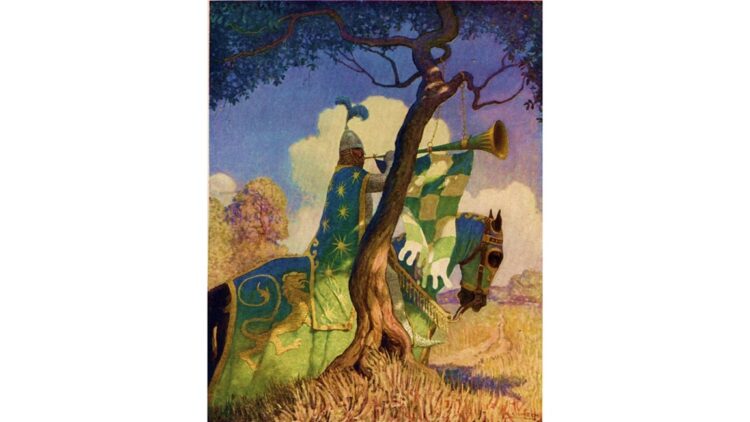
an illustration from The Boy's King Arthur by N.C. Wyeth

an illustration from The Boy's King Arthur by N.C. Wyeth


Then and Now

The gallery faces return: I name their names,
These powers invading dreams, who being dead
Are more alive, because of what they mean,
Than all the living, ignorant of need.

King Arthur, Lancelot and Guinevere
And a whole mythos for a Holy Grail;
Achilles’ wrath, thoughts of Troy—being there
As Helen causes human towers to fall.

These figures rise up now, condemn the now:
Our unheroic age of buttons pressed,
Humans depressed, and reasons which all show
Pride in packaging our powerlessness.

Deserving what we have: society’s
A eunuch posing with unbuttoned flies.


James Sale has had over 50 books published, most recently, “Mapping Motivation for Top Performing Teams” (Routledge, 2021). He has been nominated by The Hong Kong Review for the 2022 Pushcart Prize for poetry, has won first prize in The Society of Classical Poets 2017 annual competition, and performed in New York in 2019. He is a regular contributor to The Epoch Times. His most recent poetry collection is DoorWay. For more information about the author, and about his Dante project, visit https://englishcantos.home.blog. To subscribe to his brief, free and monthly poetry newsletter, contact him at [email protected].

Tags: Ancient GreeceJames SaleKing Arthur
ShareTweetPin
The Society of Classical Poets does not endorse any views expressed in individual poems or commentary.
Read Our Comments Policy Here

RandomPoems

‘Cat Contentment’: A Poem by Phillip Whidden
Beauty

‘Cat Contentment’: A Poem by Phillip Whidden

July 30, 2024

. Cat Contentment The cat begins his yawn by curling out His pinkest tongue tip as his lips begin To...

poem/bryant/valentine
Beauty

Three Sonnets by J. Simon Harris

September 18, 2018

I. I’ve awed at the Atlantic’s bluest depths, and peered at the Pacific’s deepest blues; the warm blue summer waters...

Next Post
Two Satirical Sonnets by Joseph S. Salemi

Two Satirical Sonnets by Joseph S. Salemi

‘Pouting Polly’: A Poem by Robert Nachtegall

'Pouting Polly': A Poem by Robert Nachtegall

‘The Roommate’: A Poem by Jeffrey Essmann

'The Roommate': A Poem by Jeffrey Essmann

Comments 25

  1. Roy Eugene Peterson says:
    2 months ago

    James this is a masterful piercing of the veil of the modern cultural scene in this unheroic age and referral back to those times truly to be valued and studied. Great work!

    Reply
    • James Sale says:
      2 months ago

      Thanks Roy – first out again! Appreciate your kind and encouraging remarks. Of course, it’s one thing writing about heroes in war, but another being one oneself – and serving in the forces as you have. But we all have to serve in our own way – or more exactly, the way we feel called: even writers can be heroes, perhaps! Let’s not forget Alexander the Great’s reaction to news when he considered the highest possible outcome would be that Homer would come back from the dead!

      Reply
  2. Jenna Tedesco says:
    2 months ago

    A delightful allegory! Just love it

    Reply
    • James Sale says:
      2 months ago

      Really pleased, Jenna – to love poetry is great indeed, and to love this particular example of it rejoices me greatly!

      Reply
  3. Joseph S. Salemi says:
    2 months ago

    What a devastating comment on the degradation of modern society, and how the cultural memory of what once was rises up in dreams to haunt the speaker. I am especially taken with the first quatrain, which creates a powerful interplay of dreams and reality, life and death. knowledge and ignorance, and our crying need for meaning.

    The second quatrain gives a mini-catalogue of figures and myths from our heroic past. The mention of Achilles’ wrath, Helen’s fatal and fateful beauty, and the Grail legend give the lie to any critique of this poem as merely nostalgic or sentimental — the myths of the West are packed with suffering, bloodshed, and conflict. But they are also about Western identity and self-respect and a willingness to fight even to the death.

    And this remembrance leads to the third quatrain, where the summoned-up figures allow us to judge and condemn the gutless cowardice and degeneracy that exist now, in a Western world flooded with lies, corruption and alien vermin. And that last closing couplet, about a society that is “A eunuch posing with unbuttoned flies” is a real slap in the face, if you as a reader haven’t yet gotten the point.

    Sometimes a sonnet can be as painful as a kick in the solar plexus.

    Reply
    • James Sale says:
      2 months ago

      Thanks Joe – love your response to the poem! Poetry certainly should ‘move’ us, and it’s great for me to know this has – very grateful for your insightful commentary.

      Reply
  4. Susan Jarvis Bryant says:
    2 months ago

    James, I love the way you draw upon the lessons from literary legends to create a powerful sonnet on the sorry and sick state of society today. I would be giggling at the image in the closing couplet if the words weren’t so damningly and horrifically true. Instead they have cut me to the quick with a painful jolt into a reality that seems as far from real as I can imagine. A wake up call indeed!

    Reply
    • James Sale says:
      2 months ago

      Thanks Susan – glad you got that giggle! But jolt too!

      Reply
  5. Brian Yapko says:
    2 months ago

    Oh, James, this excellent sonnet broke my heart. I feel like we are in a war trying to salvage all we can of the glories of Western civilization even as we are under being infiltrated, colonized and brainwashed by those who hate not only our culture but who have gone to war with History itself. The Arthurian and Trojan legends represent so much of a past which is not only glorious but essential. I feel as if I’m watching the burning of the Library at Alexandria in real time and powerless to stop it.

    Reply
    • James Sale says:
      2 months ago

      The burning of the Library of Alexandria is itself a powerful image, Brian, and add to it the Iconoclasts of the Byzantine empire, together with the Reformers and Puritans of the C16th and C17th, and we have near perfect depictions of the malevolent fundamentalists who are arising today under the guise of some utopian madness or other. So much learning lost – as ignorance masquerades as spirituality. Yes, weep we must – and still continue to fight for what is right! Thank you.

      Reply
      • Brian Yapko says:
        2 months ago

        And, of course, the Chinese communists in the course of the Cultural Revolution and the Bolsheviks in the Russian Revolution — especially anything associated with religion.

        Reply
  6. ABB says:
    2 months ago

    Love this. The last line is a great image, but what really struck me was, “Pride in packaging our powerlessness,” giving us three strong stresses with the alliterative syllables, while having the weak ‘-ing’ and ‘-less’ in the stressed positions, mimicking the theme of the line itself—or at least so it seemed to me. A devastating critique, indeed.

    Reply
    • James Sale says:
      2 months ago

      ABB — that is a very sharp reading. I would not call the whole line a Molossus strictly, since in classical metrics the Molossus is three long syllables, but in English we might say it produces a Molossic effect: a sequence of 3 heavy stresses, reinforced by the plosive alliteration — Pride / pack- / pow-.
      And yes, the beauty of your point is that the emphatic surface is undercut by the weak endings: -ing, -less, -ness. So the line becomes metrically and phonetically ironic: it sounds forceful whilst articulating helplessness. The pride is all in the packaging – and metrically it falls away. In other words, it’s fictive and it’s also mimetic!

      Reply
  7. jd says:
    2 months ago

    I too think this an excellent poetical commentary on our sad present and its
    total lack of character. Just the last two lines, which are wonderful, are aggravating my grammatical police. Wouldn’t it be more grammatical to say society’s/
    eunuchs posing with unbuttoned flies or, barring that, unbuttoned fly referring to the single eunuch? Or maybe I just don’t know enough about eunuchs.

    Reply
    • James Sale says:
      2 months ago

      Hi jd, thanks for your response and for raising this. It may be worth clarifying that “society’s” here is not the possessive but the contracted form of “society is”—exactly as in expressions such as “life’s too short” or “England’s won.” The enjambment delays that recognition by a fraction of a second, which I rather like because it momentarily unsettles the reader before the metaphor lands. While we’re on the subject of grammar, some readers might also wonder whether it should be “an eunuch.” Historically, that form was indeed common, but modern English follows pronunciation rather than spelling: because eunuch begins with the consonantal “yoo” sound, standard usage is “a eunuch,” just as we write a university, a European and a eulogy. Poetry certainly allows us to bend grammar when the poem requires it—but in this case, the grammar is actually doing exactly what I intended.

      Reply
  8. Theresa Werba says:
    2 months ago

    I share your sentiments, James, and have recently completed a poem about “then and now” as well. I read and hear about some of the horrors going on in Great Britain and I often think of you. Thank you for such an excellent sonnet which gives poetic voice to what we all know and feel!

    Reply
    • James Sale says:
      2 months ago

      Dear Theresa – thank you so much. Look forward to reading your own poem on this topic. Yes, horrors are going on in the UK – most horrible of all is the subtle (and not so subtle) erosions of our freedoms and our speech. There is something very totalitarian about our current government – we are almost lost. But, of course, as I believe in hope, and as I also subscribe to the old adage, The darkest hour is just before the dawn, then maybe some glittering salvation awaits us.

      Reply
  9. Adam Sedia says:
    2 months ago

    This is a powerful poem that packs its punch right from the very first quatrain, describing the legendary dead as more alive than the living. You maintain that energy and leave us with a stunning and fitting image in the final couplet. I could not think of a better description for our age, but I also see signs of it coming mercifully to an end.

    Reply
    • James Sale says:
      1 month ago

      Thanks Adam – and I pray you are right!

      Reply
  10. Michael Pietrack says:
    2 months ago

    condemn the now – great line, Sir James.
    I’d write more, but I must press other buttons to keep the lights on over here.

    Reply
    • James Sale says:
      1 month ago

      Keep the lights on Michael – it’s vital! And thanks.

      Reply
  11. Thomas Woodman says:
    2 months ago

    Yes, a very powerful commentary that says so much in so condensed a space/ The magic of the sonnet.

    Reply
    • James Sale says:
      1 month ago

      Thanks Tom – yes, the sonnet is a magical form, possibly my favourite of all English (though of course derived from the Italian) forms. It packs a punch – and for those who want something bigger, then there’s always the series of them!

      Reply
  12. Nathan McKee says:
    1 month ago

    Yes, we need to be reading and re-reading Homer and Mallory! And if Mallory via the Boy’s King Arthur with Wyeth’s wonderful illustrations, so be it.

    Reply
    • James Sale says:
      1 month ago

      Good advice Nathan – totally agree.

      Reply

Leave a Reply Cancel reply

Your email address will not be published. Required fields are marked *


  1. Margaret Brinton on ‘A Prayer of Aristotle’: A Poem by Margaret CoatsAugust 11, 2026

    You have put so much dignity into these verses, Margaret C. from Margaret B.

  2. Golan Shahar on ‘A Prayer of Aristotle’: A Poem by Margaret CoatsAugust 11, 2026

    Thanks, Margaret! This is wise, subversive, and almost seductive. And I say this as someone who is 55% Aristotelian…

  3. James Sale on ‘People Forget’: A Poem by James SaleAugust 11, 2026

    Ah! The Flood, James, the Flood! Did you know that Ashurbanipal, ruled approximately 668–631 BC, the last great king of…

  4. James Sale on ‘People Forget’: A Poem by James SaleAugust 11, 2026

    Let's hope it is more memorable Margaret and that people on this site 'remember' to take one small and specific…

  5. Golan Shahar on ‘The Sparrow’: A Poem by Michael PietrackAugust 11, 2026

    Thanks! This is super generous of you. Please email me at [email protected]

Subscribe to Daily Poems

Enter your email address to subscribe to this blog and receive notifications of new posts by email.

Join 1,610 other subscribers

Recent Poems

  • ‘A Prayer of Aristotle’: A Poem by Margaret Coats
  • ‘The Sparrow’: A Poem by Michael Pietrack
  • ‘Chemo Refusal’ and Other Poetry by Golan Shahar
  • ‘Deliverance’ and Other Poetry by Peter Venable
  • ‘Rain’ and Other Poems by Russel Winick
  • ‘The Story of a Plague’ and Other Poetry by Michael Robinson
  • ‘Javert Derailed’: A Poem by Zanna Barton
  • ‘People Forget’: A Poem by James Sale
  • ‘Good and Evil’: A Poem by Roy E. Peterson
  • ‘The Royal Arse Hortillery’: A Poem on the Spoonerism, by Jeff Eardley
  • ‘Who Hears a Robot’s Prayer?’ and Other Poetry by Brian Yapko
  • The Society of Classical Poets 2026 Haiku Competition
  • Four Love Sonnets by Adam Sedia
  • ‘Rasputina Confers with Her Cohorts’: A Poem by Joseph S. Salemi
  • ‘Warfare by Remote Control’: A Poem by Paul A. Freeman
  • ‘The Passing’: A Poem by Margaret Brinton
  • ‘Of Webs and Whispers’: A Poem by Susan Jarvis Bryant
  • Poetry Book Review: Petrarch’s Canzoniere, Translated by A.M. Juster
  • ‘What Folly Dares’ and Other Love Poems by James A. Tweedie
  • ‘Allegrezza’ and Other Poetry by Rob Griffith
  • ‘The Lessons of Lot’: A Poem by Adam Wasem
  • ‘Prophecy and Divine Intervention in Virgil’s Aeneid’: An Essay by Kaitlyn Brown
  • ‘The Last Voyage of Barnaby Bear’: A Poem by Tashvi Reddy
  • ‘Impressions’ and Other Poems by Russel Winick
  • ‘The Reveal of the Rocks’: A Poem by Kyle Fiske
  • ‘Art Work’: A Poem by T.M. Moore
  • ‘A Strange Sun’: A Poem by Patricia Rogers Crozier
  • ‘Shave Off Those Whiskers’: A Poem by Roy E. Peterson
  • ‘The Man from China’: A Poem by Evan Mantyk
  • ‘The Ballad of the Ghost Mountain Boys’: A Poem by Rachel Lott

Categories

  • Acrostic
  • Alexandroid
  • Alliterative
  • Art
  • Best Poems
  • Blank Verse
  • Chant Royal
  • Classical Poets Live
  • Clerihew
  • Covid-19
  • Deconstructing Communism
  • Educational
  • Epic
  • Epigrams and Proverbs
  • Essays
    • Interviews with Poets
    • Poetry Reviews
  • Featured
  • From the Society
  • Great Poets
    • Dante Alighieri
    • Edgar Allan Poe
    • Emily Dickinson
    • Geoffrey Chaucer
    • Henry Wadsworth Longfellow
    • Homer
    • John Keats
    • John Milton
    • Robert Frost
    • William Blake
    • William Shakespeare
    • William Wordsworth
  • Human Rights in China
  • Limerick
  • Love Poems
  • Music
  • Pantoum
  • Performing Arts
  • Poetry
    • Beauty
    • Children's Poems
    • Culture
    • Ekphrastic
    • Found Poems
    • High School Poets
    • Humor
    • Riddles
  • Poetry Challenge
  • Poetry Contests
  • Poetry Forms
    • Curtal Sonnet
    • Haiku
  • Poetry Readings
  • Rhupunt
  • Rondeau
  • Rondeau Redoublé
  • Rondel
  • Rubaiyat
  • Sapphic Verse
  • Satire
  • Science
  • Sestina
  • Shape Poems
  • Short Stories
  • Song Lyrics
  • Sonnet
  • Symposium
  • Terrorism
  • Terza Rima
  • The Environment
  • Translation
  • Triolet
  • Video
  • Villanelle

Quick Links

  • About Us
  • Submit Poetry
  • Become a Member
  • Members List
  • Support the Society
  • Advertisement Placement
  • Comments Policy
  • Terms of Use

Welcome Back!

Login to your account below

Forgotten Password?

Retrieve your password

Please enter your username or email address to reset your password.

Log In
No Result
View All Result
  • Poems
    • Beauty
    • Culture
    • Satire
    • Humor
    • Children’s
    • Art
    • Ekphrastic
    • Epic
    • Epigrams and Proverbs
    • Human Rights in China
    • Music
    • Performing Arts
    • Riddles
    • Science
    • Song Lyrics
    • The Environment
    • The Raven
    • Found Poems
    • High School Poets
    • Terrorism
    • Covid-19
  • Poetry Forms
    • Sonnet
    • Haiku
    • Limerick
    • Villanelle
    • Rondeau
    • Pantoum
    • Sestina
    • Triolet
    • Acrostic
    • Alexandroid
    • Alliterative
    • Blank Verse
    • Chant Royal
    • Clerihew
    • Rhupunt
    • Rondeau Redoublé
    • Rondel
    • Rubaiyat
    • Sapphic Verse
    • Shape Poems
    • Terza Rima
  • Great Poets
    • Geoffrey Chaucer
    • Emily Dickinson
    • Homer
    • Henry Wadsworth Longfellow
    • Dante Alighieri
    • John Keats
    • John Milton
    • Edgar Allan Poe
    • William Shakespeare
    • William Wordsworth
    • William Blake
    • Robert Frost
  • Love Poems
  • Contests
  • SCP Academy
    • Educational
    • Teaching Classical Poetry—A Guide for Educators
    • Poetry Forms
    • The SCP Journal
    • Books

© 2025 SCP. WebDesign by CODEC Prime.