


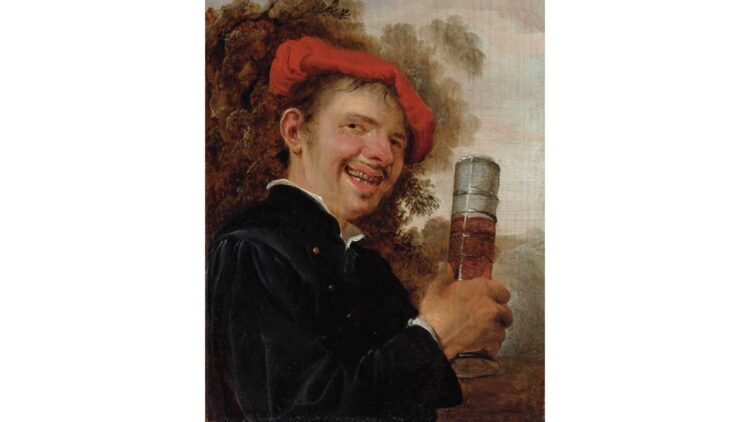
Elizabeth Barrett Browning
Has Second Thoughts
How do I hate you? Let me count the flaws:
I hate you for the sappy way you smile;
Your limping gait, as if you had the yaws;
Your vague uncertain dreaming, and the vile
Habit you have of staying far too long
After dessert is over. I detest
Your puerile, amateurish stabs at song,
And how your pants seem never to be pressed.
I can’t stand how you suck up to all folks
As if each loser were your lord and boss,
And how you turn our talks into daft jokes
By never comprehending that I’m cross;
But most of all, your vapid Pangloss air
Conjoined with that inane moronic stare.
Who Goes to Poetry Readings?
The flotsam and the jetsam of the literary scene:
The scribblers, the nonentities, the aging drama queen;
The crackpot from a mental ward whose eyes are bugging out;
The milquetoast Soul of Silence, and the disputatious lout;
The space cadets and loonies, and the stoners in a trance;
The matrons in their tweedy best—or polyester pants—
The academic retiree, the novelist manqué;
The nerdy undergraduate who’s got a lot to say;
The waif-like little poetess whose voice is barely heard;
The angry rebel writer with a conscience that’s been stirred;
The groupies and the culture freaks, the cougars and the whores;
The Jorie Graham wannabes, the haiku-spouting bores;
The open-mike performance clods who can’t compose a line;
And anyone who wants a glass of mediocre wine.
Joseph S. Salemi has published five books of poetry, and his poems, translations and scholarly articles have appeared in over one hundred publications world-wide. He is the editor of the literary magazine TRINACRIA and writes for Expansive Poetry On-line. He teaches in the Department of Humanities at New York University and in the Department of Classical Languages at Hunter College.














Mr. Salemi’s first sonnet reminds this reader of Catullus and Juvenal. The allusion from Voltaire is good; likewise, quotes, such as, “I can’t stand how you suck up to all folks, as if each loser were your lord and boss”.
While the second “sonnet’s” topic, I have delved into as well—through the sonnet—“the haiku-spouting bores”, etc. These two pieces make me think I was right to include Mr. Salemi in “Update on the Sonnet” at the beginning of the NewMillennium in 2000; his talent there continues.
Thank you, Bruce. I wanted to poke fun at that Elizabeth Barrett Browning poem, which even back in my college days the Jesuits called overblown, silly, and sentimental, besides being weighted down with abstractions. Catullus, Juvenal, and Martial seemed to be appropriate antidotes.
I just love to see form used in inspiring ways, and these two satirical sonnets have made my Thursday morning much sunnier. The images conjured in “Elizabeth Barrett Browning Has Second Thoughts” are so vivid, I can see and feel the presence of the recipient of these blazing barbs… perhaps that “moronic stare” indicates a resilience to rejection. Utterly hilarious.
“Who Goes to Poetry Readings?” is as scathingly vivid in its depiction – and the result is delightful. My favorite line is: “The groupies and the culture freaks, the cougars and the whores” – what a colorful picture it paints! By the time I got to the closing mediocre-wine line, my sides were aching.
In this pygmy-goat-stroking era of offending anyone and everyone, these sonnets should come with a warning for those who haven’t laughed in a while – I’ve heard that too much of a good thing can prove fatal. Joe, thank you!!
Susan, I’m always glad when a poem of mine can provoke surprise and laughter, especially in a talented fellow poet. The tendency today in poetry (both formal and modern) is to be so damned serious and pretentious and overblown with emotional quivering that the situation screams for deflation. We need more mischievous imps with hatpins going around puncturing the gaseous balloons that seem to be everywhere.
Your description of our “pygmy-goat-stroking era” is priceless!
Your parody of Elizabeth Barrett Browning certainly does not emulate the “sappy” sonnets you so often skewer. It is more like the wires for hair found in a Shakespeare sonnet. I was holding my breath expecting a twist at the end but instead was surprised by a twisted end.
“Who Goes to Poetry Readings” is reminiscent of the Bohemian poetry readings in smoke filled dens of the 1950s. Your extremely detailed descriptions of the denizens almost makes me conclude you may have visited on or two of them in your distant past.
I join Susan in praise of your marvelous talents that are both entertaining and absorbing comedic theater.
LTC Peterson, thanks for those kind comments. And yes — the sonnet of Shakespeare that you refer to is really funny, and I knew several rather uptight readers who disliked it for that reason (they thought it was “unworthy” of the Bard).
You’re quite correct — I’ve been to more poetry readings than I care to remember. I was too young to attend the Greenwich Village readings of the 1950s, but the 60s, 70s, 80s and 90s were packed with them, and forty years of experiences went into the composition of that particular sonnet. Around 1996 or 97 I said to myself “That’s it. Never again. I’ve had enough of these narcissistic people and the crappy Chablis.”
Joe, your ability to take the venerable sonnet form and weaponize it as a vehicle for satire is a source of deep sardonic pleasure. Your Barrett-Browning “sequel” is particularly hilarious when compared with the too-good-to-be-true language of the original – and you’ve sharpened the focus so that it zeroes in on the hapless object of the poem rather than a no-longer spellbound speaker. As between EBB’s original and your sequel, I suspect yours is the healthier analysis of the compatibility of the lovers. I am hopeful that your subject is not Robert Browning per se but has been generalized into a vapid lover who has neither skill, character nor backbone. I particularly love the phrasing of “vapid Pangloss air” which calls to mind Voltaire’s “Candide” which is itself a satire of the Leibniz “best of all possible worlds” philosophical paradigm. Satire in the service of satire. Excellent!
“Who Goes to Poetry Readings?” absolutely cracked me up. It is a “list” poem which is almost guaranteed to offer some hilarity — a form of comic poem which may have a different genesis, but which I associate with Gilbert and Sullivan. Gilbert was particularly adept at such “irksome type” lists in cynical lyrics like “I’ve Got a Little List” and “My Object All Sublime.” You do him proud. The various types you skewer are people we have all seen and who have offered nonstop irritation along with exceptional pretension. The pity of it is that back in the day, poetry readings – performances offered in a salon setting – were actually a staple of high culture. Relating back to your prior poem, for example. one can imagine the Brownings out for a lovely evening with Alfred, Lord Tennyson and other literary glitterati sharing poetry, reading Shakespeare, arguing over published Coleridge lectures. I can even imagine poetry readings with Dorothy Parker and other literary luminaries at the Algonquin Round Table.
But sometime in the mid-20th Century, the idea of poetry readings became a sort of Ginsberg-beatnik- hipster Ferlinghetti thing in which no one actually cared about the quality of what was being read and where it simply degenerated into another chance to “hang out” and receive ego-strokes rather than serious appreciation. Needless to say, these became vehicles for contemporary free verse rather than classical work. I’ve been invited to read poems at various poetry “slams” but have never accepted – largely because the type of poetry I prefer does not lend itself to that kind of improvisational atmosphere. As far as I can see, when it comes to the poetry readings that you’re satirizing, Joe, it’s all about the social interaction and self-congratulations. Literature seems to have very little to do with it.
Brian, thank you heartily for this analysis and appreciation. One of the things I love about the SCP is the high level of discourse in many of the discussion threads. If we are an educational site, a lot of the education goes on here where we bring up excellent points concerning how poems work, and the best ways to fashion them.
Yes, I definitely made the speaker of the EBB parody the exact opposite of what she was the case in the original. Yes, it is possible to read the poem as part of a breakup scene between two alienated lovers, but I basically put together a number of annoying characteristics or qualities of behavior and appearance that might turn off the speaker, or anybody. Several of them were merely rhyme-driven (flaws/yaws, folks/jokes), and I didn’t mean them to be actual complaints about Robert Browning.
Your perception about the “poetry readings” piece is right on the mark. I love cumulative “list’ poems that can carry the meter without any strong stops, and the work of Gilbert & Sullivan was clearly in my mind. But I was also thinking of John Clare’s work, since a sonnet composed of seven rhyming couplets is called “a Clare sonnet” after him. My variation was to use fourteeners instead of iambic pentameter.
I agree that poetry readings at private salons in the nineteenth century were a totally different ball game compared to what they have become today (especially with the nightmarish “open mike.”) Most poetry readings now are purely performative, and designed to allow venting, posturing, networking, virtue-signalling, and congratulation. As you say, the actual literary quality of the work presented doesn’t really matter to the performer or the audience. Everyone is just there to have a good time.
Calling our current situation the “Ginsberg-beatnik-hipster-Ferlinghetti thing” is one helluva solid and apt description! The weird “Poetry Slam” phenomenon is its natural outcome — and anyone who has been to a slam will tell you that the rules for performance and subject matter and style are very strict. In other words, the free-verse impulse to turn poetry readings into a populist free-for-all has — ironically — created a performance art as rigid as classical ballet. Literature is no longer a concern. Revolutionary acting out is now mandatory.
Just reacquainted myself with the original Elizabeth Barrett Browning poem, which yes, reads like a soppy Valentine’s Day poem. I enjoyed your satirical take, Joseph, as if we’re looking at St. Valentine’s Day thirty years on.
As for ‘Who Goes to Poetry Readings’, I went to one once in Abu Dhabi and wasn’t that impressed. There was a group of ‘piss-takers’ present who I think you would have approved of.
Thanks for the reads.
Well Paul, in all the forty years in which I went to poetry readings, I never made fun of anyone or insulted their work or caused a disturbance of any kind. Nor did I ever notice anything of that sort happening. Some persons in the audiences may have been bored, but no one was ever rude or “piss-taking.” Maybe manners are different in Abu Dhabi.
I wrote the poem on poetry readings some time around the year 2005, so I hadn’t been to an actual reading for several years.
I think alcohol had a lot to do with it, and as I recall the poem I particularly remember had an oft repeated refrain that was rather cringey. That said, the ‘Rooftop Rhythms’ poetry reading group is still going, I believe.
Fantastic satires, Joe. There’s something so satisfying to see invective laid out in perfect form. It’s a delight to read and even more fun to write. The Browning parody has a wonderful blend of savagery and pettiness, hinting at a bottomless and almost irrational loathing which puts me in mind of Martial at his best.
By contrast, “Who Goes to Poetry Readings?” is unremittingly scathing, as it should be. However, if this is based on your experiences up until the late 90s, I can only imagine how much worse these events must be today. Personally I’ve always avoided that scene for fear I might actually fit in.
Many thanks for the comments, Duncan. Martial is the Roman poet from whose work I learned Latin. I translated a great deal of his stuff into free verse, so his habits of thought and expression became second-nature to me. Savagery, pettiness, bottomless and almost irrational loathing? Absolutely on target! I can tell that you know the poet quite well.
Poetry readings tend to attract a certain psychological type: the ethereal dreamer on a mission, but with the concomitant need to self-dramatize. As for the audience — anything goes. Some come for the poetry, some for the wine, and some just to get laid.
These were simply wonderful, and a great illustration of the “speculative reality” of poetry: a reader (or indeed the poet) need not ever have experienced either subject to appreciate the descriptive content, but one who has experienced them will have an even richer experience, knowing the truth that underlies them. The first sonnet begins with a wonderful spoof of Mrs Browning’s Sonnets from the Portuguese, but quickly takes us on its own path. By the end, we fully agree with the narrator in detesting the subject, but then pause to consider whether the narrator’s perspective is clouded.
The second shows an interesting use of heptameter, which gives it a staid pace. The cast of characters it portrays is a real laugh – a dead-on description of everyone you could meet at a poetry reading. It provides an excellent snapshot of quasi-literary America in 2026.
Adam, your lucid comments touch on something that I am always harping on: fictive mimesis. Neither poem has to be taken as an account of actual experiences that I have had. The first one just presents a number of plausible reasons why one person might strongly dislike another, and the well-known poem of Mrs. Browning is simply a convenient peg on which I could hang those reasons. All of it is fictive invention working off a poem in the English canon.
The second poem is partially based on personal experiences, but it too is merely a weaving and stitching together of things remembered, things imagined, things likely and possible, and things which just happened to fit a rhyme-scheme. In other words, I want it to be read as a poem, not necessary as a deposition or testimony. As I see it, poetry is just a little fictive world that one creates for oneself, and which is nevertheless rendered familiar and plausible to readers who know the real world.
One of the peculiarities of our current culture is that poetry is such a low-status occupation but that so many people, paradoxically, want to be poets! So how do we decide who are the poets and who are the wannabe poets? One iron-test that has prevailed for some 500 hundred years in the English language is this: can they write a sonnet? Shakespeare could, Keats did, and we can name many others who passed the test. And here we have another: two brilliant sonnets from Joe Salemi. Both are great but I am particularly drawn to the second: it’s as relevant now as it was in the 1950s – so, so penetratingly accurate in its depictions of all the non-poets who like drones – but without the pollen – cluster to these events! But it’s not just the description, is it, for that could be done in prose? It’s the intense structure that compresses the meaning into its virulent disgust. Joe mentions Martial, but I feel a Swiftian indignation and savagery as well! Well done.
James, that is a very astute observation. In a world which in all other respect seems to have gone money-mad, why are so many persons driven to call themselves “poets” — a vocation that for 99% of its practitioners doesn’t bring in a tuppence of profit? I can only surmise that wannabe poets are driven by a deep psychological need for creative self-expression, and that they have been told by too many teachers that writing a poem is the easiest and cheapest way to achieve it. One faculty member in the English Department of a university here in the States seriously argued that anything can be called a poem, even the act of smashing a china plate on the floor. When that kind of mentality exists in the halls of higher learning, it’s no surprise that millions of unhappy people decide “I can be a poet!”
I deeply appreciate your comments, for which I thank you. Yes, a sonnet is a good touchstone for proving one’s worth as a poet. And as you say, in these two it’s not so much the description as the tightly bottled up indignation that makes them work.
Thank you, Dr. Salemi, for this pair of spot-on sonnets. I absolutely love the satire of Elizabeth Barret Browning—it’s refreshing to see a sonnet that does not take itself too seriously. The second, however, is more germane to my own experience, in that I have been to multitudinous poetry readings, events, and “slams” over the years— at arts venues, coffee houses, theaters, and online— and you very accurately depict what I have seen throughout my experience. Somehow they have “let me in” even when I am reading a piece of formal poetry, perhaps because of my own background as a Classical singer; I genuinely like performing my poetry publicly, and it livens things up, and because I am different, they in some way accept me. I also refuse to be marginalized, so I go anyway, and read anyway, despite my being usually the only person to read something formal for the entire event! Most of the time I either find very angry people with very angry poetry reciting their poetry very “loud”, or I find timid mice (who you can barely hear) who basically are reading their journal entries from the previous evening and think because they wrote something down, or a reading something out loud, that it is poetry. In between are the “intelligentsia” types who know what formal poetry is, but considers it “from another age” or “irrelevant” to today’s world—some of them have actual talent, but have never developed their talents through the discipline involved in creating formal poetry. I truly wish it were not this way!!! But I for one will continue to make my presence known at these events, if only to upset the apple cart!!!
Theresa, thank you for your comments. I know that there can be good things happening at a reading, and I do recall some memorably fine events hosted by Alfred Dorn and Daniel Fernandez at the Jefferson Library in lower Manhattan. In Brooklyn, Arthur Mortensen (the former editor of Pivot magazine) ran a very sensible and mature reading series on Court Street; and further down the street The Belanthi Gallery had presentations that were a combination of poetry with classical music selections. But such readings were the exception rather than the rule.
The very good formal poet Daniel Kemper published five essays here at the SCP some years back, in which he tried hard to convince us that we ought to attend poetry readings regularly and participate, so as to introduce free-verse types to rhyme, meter, tropes and figures, and all the other tools of what we might call classical or traditional English verse. I don’t know if his exhortations had any success with some of us, but in my opinion — and it’s just that, an opinion — the situation is now so far gone and out of our hands that our appearance at a typical poetry reading today would simply confirm to the bulk of the audience that we are just obsolescent survivals of a moribund tradition. We might be politely listened to as a historical curiosity. but not taken as models to follow.
This really has to do with what is going on (or more correctly, NOT going on) in the lower grades. In many schools the only type of poetry presented for consideration is the usual free-verse bilge. Persons who know traditional English verse know it from their parents, or from self-education, or from the long-dead habit of massive and voracious reading. Like cameo-carving or the making of Belgian lace, what we formal poets do has become a boutique art form, with a very limited niche market.
I have always defended the possibilities of free verse, and have nothing but respect for some of the masters in that field. But I think that there is one small but important difference between formal verse and free verse that ought to be recognized: It is very easy for any talentless person to pretend to write free verse, and to have his work pass muster with plenty of indiscriminating readers and editors in the po-biz community. But it’s not possible for someone without the requisite skills to write formal metrical verse, and get away with it by fooling people.
In any case, it’s good to upset apple carts. Brava ragazza!
Joseph
Thanks for these two well-crafted witty poems! A pleasure to read and recite.
Sonnet: ‘Second Thoughts.’ A playful clever Shakespearean sonnet. My favorite lines are: ‘And how you turn our talks into daft jokes By never comprehending that I’m cross.’ This description captures perfectly the flavor of lovers’ quarrels!
I was privileged to visit the Casa Guidi by myself, on an autumn afternoon. The place was attended by young British woman, and since I was the only visitor, I lingered a long time, savoring every detail of the silent rooms. My sense of Elizabeth’s temperament is that she was a sickly and fairly humorless young woman. She was madly in love with Robert, who literally rescued her from the imprisonment of her father’s house, and spirited her away to Italy. That said, Robert seems much less somber than she, and he wrote often in a witty, even bitingly sardonic vein. Therefore, I interpret your clever parody as perhaps Robert penning a sly send-up of himself, and sharing this little poem with Elizabeth privately, who for all we know is convulsed in giggles.
Iambic heptameter couplets (fourteeners) : ‘Poetry Readings’
I love fourteeners! As CS Lewis remarked: the line dances a jig! Your fourteeners are frolicsome and your rhymes are a lark! I’m afraid I might have been at one time ‘a waif-like little poetess whose voice is barely heard.’ However, I’m a lot more vocal now (alas, I can only hope that my poetic craft has improved!)
Sincerely
Mary Jane
Mary Jane, many thanks for the appreciative and perceptive comments. Yes, it’s possible to read my EBB poem as Robert’s impish and playful reply to his wife. But even so, it would be a rather harsh thing to send to a beloved spouse, even if it is a self-criticism.
I think Mrs. Browning was an excellent poet of great ability, but certain things about her style turned me off even when I was in school. She is overly “earnest,” she often depends too heavily on abstractions, she can be too emotional, and she has a habit of over-dramatization. These are not her faults alone, since they are shared by many nineteenth-century poets, and you can’t blame her for being part of her age. One of my motivations for writing this sonnet was to go against that style, and to compose something savage and earthy.
I’ve been to one poetry reading in my entire life (except for the times when Richard Wilber would read us a few in the freshman dining hall at Wesleyan). One was enough, but I can never seem to get enough of Salemi. Apparently I am addicted to sharply focused venom, the only remedy for which is taking in more of it.
Thanks, Kip. I’m glad I can provide what you need.
One more point about poetry readings: the very worst were the ones held in restaurants or bars. Imagine reciting a carefully crafted sonnet or a villanelle while dishware and utensils are clinking, waiters are walking past you, and somebody is loudly asking the bartender for another cocktail.