


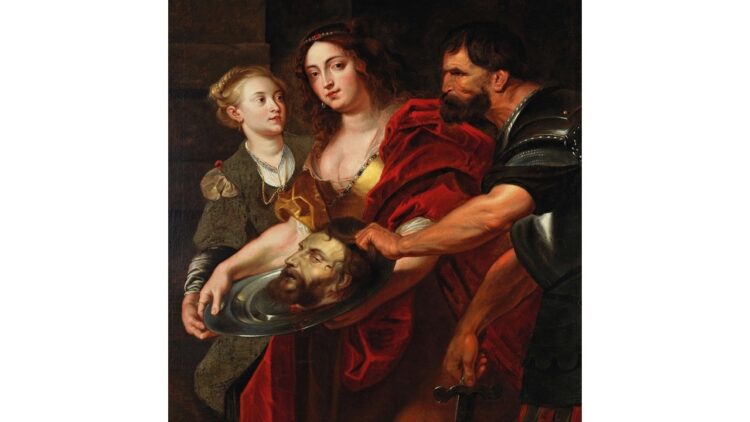
Herodias on John the Baptist
Yes, I remember him—the unwashed Jew,
The kind we hoped to leave behind with all
The ancient desert fantasies, the stench
Of goats and sheep, and long beards filled with lice.
Being a Greek is cleaner and more pleasant—
The wine more pungent, food made to our taste,
Without some pompous rabbi and “The Law”
To tell us what we can and cannot eat.
But nevertheless the rabble worshipped him,
With all his talk of Yahweh and the scriptures,
And his pretense to crackpot prophecy.
I didn’t mind all that. Who cared a fig?
Let the superstitious scum and dregs
Hold as a god some lunatic in rags,
Who lives on honey and raw locust bread
Amid the wilderness with snakes and fleas.
He didn’t come to court, or mar our feasts
With body odor and the need to preach.
None of us gave a thought to him, until…
Yes, it rankles still. He raised his voice
Against me and my husband, quoting some
Insipid strictures from forgotten texts
About a brother’s wife. As if we were
Still in tents with patriarchs and staffs!
Why should that busybody stick his nose
In business of the royal household, asking
About who slept with whom, and what they did?
It’s so un-Greek, so boorish, atavistic—
So redolent of sheep-dip and the desert:
Those wailing wastes where nomads crouch in fear
Upon some dungheap waiting for… who knows?
Some revelation, or some mystic call,
Or perhaps just the sick, prophetic urge
To tell the whole world how it ought to live.
I hated John. He wrecked what we had built,
Herod and I, here in this squalid land.
We did our best to civilize these beasts
With learning, art, fine architecture, songs
Culled from Hellenic brilliance, clothing rich,
Athletic sports, and Sybaritic dancing.
Dancing! Yes, that’s how we cut the knot
Of John’s annoyance and my husband’s fear.
My daughter knew how much I loathed that pig
Croaking about my “whoredom” and the sin
That lay upon our house. She rose and spun
Her lithe flesh in those veils of gossamer
To make my husband grant whatever wish
She chose to ask. And she restored my pride:
Give me, on a platter of pure silver,
The severed head of John, the captive prophet!
My heart near burst with love for such an act.
One hour later, soldiery arrived,
And they brought in the thing she had requested:
A foul, disgusting lump of hair and beard
From a fanatic’s corpse, still wet with blood,
Oozing saliva from its filthy lips,
The ones that besmirched my honor and my state.
So may they all end, those who speak out loud
Against what is no business of their own,
Who climb up from the gutter and presume
To speak for what they say is God’s own will.
I said this then to John’s mute, grisly head:
We cultured Greeks have lots of varied gods:
Which was the one you claimed to represent?
He didn’t answer. Not a syllable.
I poured a cup of wine to give my daughter
And we both laughed and drank each other’s health.
Poet’s Note
Herodias was the wife of Herod Antipas, one of the Jewish tetrarchs of Roman Judaea. She had previously been the wife of his half-brother, Herod Philip. It was a love match, and both of them divorced their existing spouses in order to marry. Such divorces were common among Greeks and Hellenized Jews at the time, but were considered violations of Mosaic law by rabbis and the common people.
No ordinary man in the street would have dared to say or do much about it, since the matter was between Herod and his new wife, and God. But an itinerant preacher-prophet named Iohanan (we call him John the Baptist) made several public speeches chastising Herod for his violation of Mosaic law, and in those speeches he made grossly insulting charges against Herodias and her chastity. Naturally this ignited her anger and resentment.
Herod Antipas did not want to kill Iohanan, since he believed that he might actually be a real prophet. But to please his wife he had the man arrested and imprisoned. According to the biblical story, which may be partly fictionalized, Herodias prompted her young daughter Salome to do a suggestive and provocative dance for Herod Antipas, in return for Herod’s publicly sworn promise to give her whatever she asked. She did the dance, and then insisted that she wanted the head of Iohanan brought to her on a platter as a reward. Trapped by his own oath, Herod gave orders for Iohanan to be decapitated, and his head was brought to Salome and her mother.
I have written this dramatic monologue in the voice of the mother, outlining her complaints against Iohanan for his insults to her, her contempt for his filth and unfashionability, and her general disdain for a Judaic heritage and religion that she, as a thoroughly Hellenized member of the royal family, considered backward and primitive. Iohanan’s death is seen by her as a deserved execution for disrespect and calumny against the ruling class.
The general thrust of this poem is to put forward this question: to what degree are we obliged to criticize publicly the private sexual sins of others? My own instinctive sympathies are with Herodias and Salome. The mutually voluntary acts that couples perform in the bedroom are not really the concern of anyone else.
Yahweh: One of the names of the god of the Jews in the Old Testament.
Locust bread: Although some argue that Iohanan ate actual insects, a more likely explanation is that the text refers to the sweet pods of the carob tree, which still today are referred to as “Saint John’s bread.”
Sheep-dip: Any liquid bath designed to cleanse herded animals from disease or insect infestation. Although the term was not invented until the 19th century, ancient shepherds used a variety of liquid concoctions to treat animals suffering from irritation or pests.
Sybaritic: Herodias uses this term in reference to the Greek city of Sybaris (in southern Italy) that was famous for its luxurious culture of wealth and self-indulgence. The adjective form became a watchword for extravagance, fine elegance, and sophistication.
Joseph S. Salemi has published five books of poetry, and his poems, translations and scholarly articles have appeared in over one hundred publications world-wide. He is the editor of the literary magazine TRINACRIA and writes for Expansive Poetry On-line. He teaches in the Department of Humanities at New York University and in the Department of Classical Languages at Hunter College.








Nicely done!!