


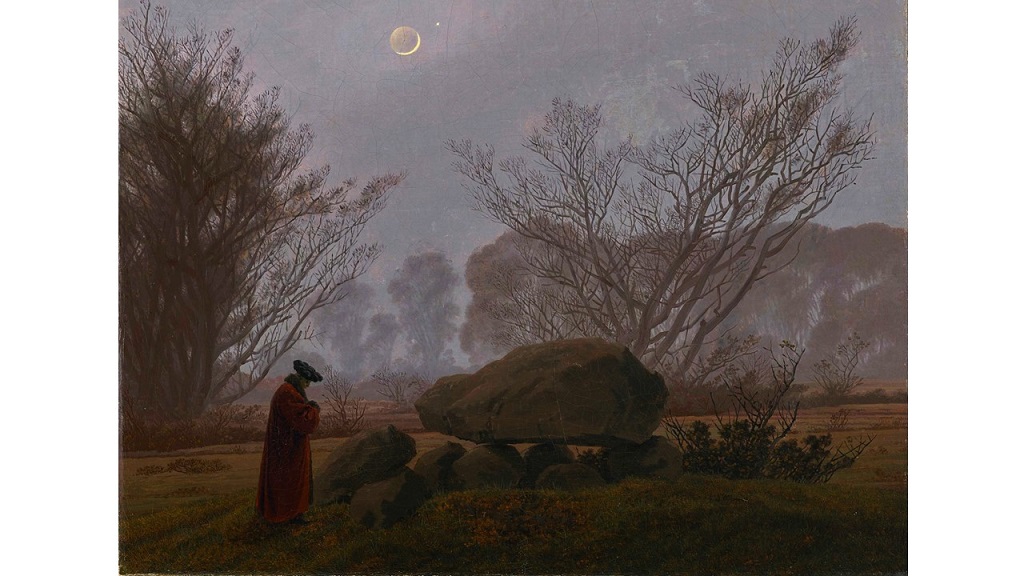
Solitude
Bright Venus, crescent moon, faint pearl-gray sky
obscurely light the scene. A giant dolmen
prostrate, astride huge boulders: megalith
collapsed, rock flotsam strewn across the fen.
Thin corkscrew trees extrude brown elfin leaves.
The time is evenfall, the hour when
quietude reigns: no sounds of creatures stirring,
of reprimanding squirrel or warbling wren.
A solitary figure stands in profile—
red robe, black hat—staid academician.
His head is bowed, his gloved hands clasped together.
Daily he visits this secluded glen,
a seeker with a Goethean intellect,
expanding his steady narrow scholar’s ken.
But runic stones, nor twilight’s silver gloom,
nor silence of this isolated place,
nor Friedrich’s skilled perspective—brooding don
aligned with tombal ruins—can ever trace
that consummate bleak terror we endure,
when our own destined deaths we squarely face.
Egg Gathering
A door half-open, gauzy gloom beyond.
Outside, a bare yard hemmed by wire-net fence.
Inside, contented clucks of laying hens,
a fetid warmth, as of a fungal pond,
the close air dense with gassy, birdy smells,
loose feathers stuck to mounds of dried-out dung.
A basket on a metal hook is hung,
in which are nestled brittle downy shells.
God’s potence: an immaculate ovoid.
Twice-daily, muslin-aproned, hair uncombed,
Clare skirts the field, recalls her great-aunt’s cow
hitched to a shaft, before brute tractors roamed.
A sacral virgin steadfast in her vow,
she gathers fecund eggs: pale, unalloyed.
The Suburbanite
As I was walking one June morning,
_around my neighborhood,
the houses in their tidy rows
_looked just as good homes should.
I skirted the stagnant man-made pond.
_A robin trilled its call
from somewhere on an oak tree branch:
_“For our nestlings we give all.
We spear small wriggling damp earthworms
_our babies can ingest,
and dive-bomb cats and jays and hawks
_that come too near our nest.”
But now the mowers started up
_their engines’ crashing blast.
“Oh, be not fooled by this lush green—
_your habitat can’t last.
We strangle all the wilding world
_with poison, scythe and blade.
Trimmed grass presents a flawless green,
_boxwoods cast subtle shade.
Wild creatures are not welcome here:
_no birds, nor bugs, nor bees.
So get thee gone! You make a mess.
_Our humans we must please.
They are our sober middling class
_whose taxes are sky-high—
doggedly working on their lawns,
_disorder they decry.”
Returning then, I shut my door.
_The A/C cooled the air.
Its hum blocked out the robin’s shrieks;
_I settled in a chair.
Mary Jane Myers resides in Springfield, Illinois. She is a retired JD/CPA tax specialist. Her debut short story collection Curious Affairs was published by Paul Dry Books in 2018.



















Mary Jane, this trio of atmospheric lyrics presents a hauntingly lovely and poetically lonely concerto.
The first poem, though entitled “Solitude,” gradually populates the scene. Venus beams in the first line. “Thin corkscrew trees” and “elfin leaves” animate the evening. You insist on its soundlessness–but do so by reminding readers of the missing noisemakers, squirrel and wren. Your rhyme scheme is subtle: xaxaxaxa xxxaxa xbxbxb. Rhyme indeed, but just so soft enough to be noticeable. In the second stanza, you introduce the human figure from the painting about which you write. He adds intellectual interest, being a scholar engaged in regular contemplation. This is more than the painter can tell with his art. And in the third stanza, you call for the painter Friedrich to play his part, defining what he and his meditative figure intend to approach as “consummate bleak terror.” This takes the poet as concerto conductor to say–and to question the possibility of consciously achieving it.
The sonnet “Egg Gathering” celebrates another lone figure, the virginal Clare achieving her twice-daily mission in a henhouse yard with all the sensual qualities thereof. She carries in her mind the memory of her great aunt’s time. I notice you don’t say “grandmother,” maybe in order to imply Clare’s faithful family succession without marriage and childbearing. She is nonetheless “steadfast in her vow” and, as the final word proclaims, “unalloyed” as the immaculate ovoids she gathers. This poem is a masterpiece of suggestion and wonder. Wonder, however, that may be known to us.
Does not the second stanza of “Solitude”
keep the pattern and rhyme xaxaxa,
just slightly slant?
Yes, you’re correct!
Margaret
Thank you as always for your close reading of, and erudite comments about my work. Your opinions are so very helpful to me.
I drafted the first draft of my poem ‘Solitude’ six years ago. Recently, I took it out of the drawer to wrestle with it yet again. This Friedrich painting is a personal favorite. Some 25 years ago, on my initial visit to the Getty Museum in Brentwood, CA, I first encountered this small painting. Captivated, I stood a long time studying it. On every subsequent visit to the Getty, I made a point of seeking it out.
The pattern of my poem is loosely based on the ekphrastic poem ‘Brueghel’s Winter’ by Walter de la Mare. There are 20 lines. Every second line is rhymed. As you note, to complement the reflective mood of Friedrich’s image, the rhymes are meant to be “soft.” The first 14 lines have seven rhymes based on the syllable “-en.” (The first rhyme-word “dolmen” is especially “soft” because its ending is feminine; “academician” is an approximate “slant” rhyme). The last six lines have three rhymes, and the ending syllable “-ace” features the “soft c” (“s”) sound.
In ‘Egg Gathering’ I set out to write a tribute to the “good country women” in my own family. I crafted the image first of the henhouse and then of the woman. As I pondered her, I realized: she resembles those remarkable women who take religious vows. So a metaphysical theme emerged as I continued to write.
‘The Suburbanite’ captures some of my impressions when I take my daily morning rambles (they are not power walks!) around my recently-built and oh-so-manicured “development.” I thought common-meter ballad meter might approximate the “andante” rhythm of my footsteps. A noisy reality of “quiet” neighborhoods: the ear-splitting sounds of lawn mowers and blowers!
Most sincerely
Mary Jane
I knew I loved these three poems for their rich, painterly words and I love
them even more after Margaret’s explication. Thank you, Mary Jane. They are
truly beautiful.
JD
Thank you for your kind comments.
Most sincerely
Mary Jane
I didn’t get to finish reviewing the concerto, Mary Jane, because I had to take care of the cat. Your last movement is great fun, though wryly contemporary. The scene is your neighborhood walk, and the instruments are a robin, power mowers, and the air conditioning. Maybe these could correspond to the music of solo piccolo (a small thing that can produce a real shriek), percussion, and a solo cello. But they are real–and the poet has the bardic facility of interpreting them. The robin aggressively asserts her message for five lines. The mowers hog the limelight for fourteen, drowning out the robin, and probably leading you as audience to depart. However, their communal noise (including human neighborhood complaints about messy green growth and taxes!) continues behind the hum of the A/C. Settling in a chair is relatable recognition for these hot summer days when outdoor exercise is not exactly comfortable.
Great variety displaying manifold artistry!
I greatly enjoyed these three poems—love the surprising word choices. “Pearl-gray sky” is a beautiful phrase. And as others have mentioned, I love the variety among the pieces—a rich buffet of different pleasures. Thank you for sharing!
Josh
Thank you so very much for your kind comments. It’s readers like you who keep me writing!
Most sincerely
Mary Jane
I love Egg Gathering! I’m always amazed by how some sonnets seem much longer than others, due to how much they hold. This one holds so much (I’m going back to count the lines now), so much sensory richness, so much food for thought: a impossibly full basket. I also love a proper name in lyric poetry, that doesn’t need to explain itself. Maybe it was Mandelstam was said that a poem with name in it is better than one without. Ah, here it is: “Thrice blessed is he who puts a name into his song.” (From The Horseshoe Ode.)
Monika
Thank you so very much for your kind comments. I love this quotation from Mandelstam. Such an interesting observation, and a new idea for me. Perhaps I will now become obsessed with weaving names into all my poems!
Sincerely
Mary Jane
Quite a turnaround in ‘Solitude’. I thought the first stanza was one of the best scene setters and descriptive pieces of poetry of a landscape I’ve ever read.
Another fantastic opening descriptive stanza in ‘Egg Gathering. The ‘brittle, downy shells’ is a great turn of phrase and metaphor, which I’m glad you extended in the second stanza, MJ.
A microcosm of the wider world in these climate-changing, bio-diversity diminishing times, The Suburbanite sums up the attitude of negligent disregard we human beings too often have to the creatures we share our planet with. I like the way the apparently jovial meter and content transform into a more serious theme.
Thanks for three riveting reads.
Paul
I am a bit overwhelmed by your praise! In ‘Solitude’ I was trying to do honor to one of my favorite paintings (see my comments above addressed to Margaret Coats). In fact, I have downloaded this image as wallpaper on my “desktop” for this computer.
‘Egg Gathering’ is a tribute to the country women in my family. Note: alas I’m a “city girl” who doesn’t like the reality of “country living” –though I admire (in theory) that type of life.
‘The Suburbanite’ alludes to the startling fact that my manicured neighborhood shelters very little wildlife. While I love
green lawns, and am obsessed with keeping mine picture-perfect, I do worry (sometimes): what are we doing, exactly? Where have all the creatures gone?
Sincerely
Mary Jane
Ms. Myers’ “Suburbanite” definitely got me thinking:
Urban Warfare
by Bud “Weasel” Rice
I love brick houses in their rows around the neighbourhoods,
for all the needs of living well and wants of gathered goods;
but so do all the animals one daily has to fight
from rose sunrises at dawn’s light to pale sun-sets at night.
I love the vultures gorging messy squirrels off the streets,
but not the harsh cicadas, chirping shrilly in large trees.
nor do I like red-tailed hawks leaving spoils on my lawn;
although dead rabbits aren’t as irksome as the living ones.
I love lawn mowers cutting grasses through most of the year,
but not the geckos, ants or frogs that constantly appear,
especi’lly not the hated wasps that constantly seek eaves,
nor flocking geese with excrement that pass in forceful vees.
I do not like wolf spiders in the kitchen or garage,
nor do I like the charging army worms in a barrage.
I do not like the snakes or crickets that dry up on walks,
nor even lone coyotes when they make their nightly stalks.
I hate mosquitoes when they buzz and stab the skin for blood.
Each one that’s killed makes one content to count each death as good.
Bird nests in gutters, chimneys, or wall-mounted outside lights,
though bad are note as fearsome as the hidden fierce ter-mites.
I love the concrete catchments and the reedy, man-made ponds
that are great engineering feats when storm-hit rain responds,
but dry up in the summertime and chase the ducks away.
There are so many animals one wants to keep at bay.
Thanks for the spur.
Dear BDW:
Thank you for reading and commenting on my poem. Thank you for sending Mr. Rice’s work (a nice touch–“weasel”!)–the speaker seems to “protest too much” and is subtly asking his reader to sympathize with the beleaguered animals. Last week a spider bit me on my toe as I slept, and it was painful to walk for several days! I know the spider was just doing what spiders do–and I must have threatened her somehow. Typically, if I see a spider I’ll catch her and put her outside. That said, I asked the pest control guy to treat my home again with his nasty chemicals, and finally he’s coming today. I’ll try not to breathe the air for the next 24 hours!
Most sincerely
Mary Jane