


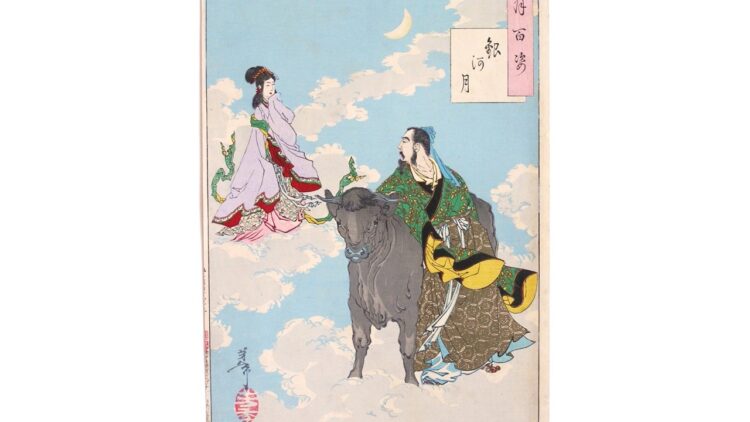
Star Festival
The legend of the love of a heavenly weaver girl and an earthly
cowherd was recorded in the Eastern Han dynasty 2000 years
ago. Stars of the Summer Triangle are Vega (weaver girl), Altair
(cowherd), and Deneb (bridge). The emperor of heaven allowed
the lovers to meet one day a year by crossing the Milky Way
on the seventh day of the seventh month in the Chinese lunar
calendar, which is August 19 this year. The celebration is
known as the Star Festival or Qixi. It is also observed
(sometimes by composing poems) in Korea, Japan, and
Vietnam—but not if the day is rainy.
The scorching afternoon will dim and cool
As earth below rolls on in torrid weather.
The Weaver Maid and Cowherd greet their day;
Clouds disappear for one enchanted evening.
Her woven silk, his wealth of milk and cream
Earn brilliance for their Summer Star Triangle:
Deneb, as Bridge, shines toward the other two.
Vega and Altair spend rare time together
Swimming in heaven’s river, the Milky Way.
Amazed stargazers see their love achieving
An incandescent happiness supreme,
And wish romantic starlight would bespangle
Them too; they hang their hopes on tall bamboo,
Writ in calligraphy of many a school.
The colored papers flutter, an array
Requesting skill in lyric or in weaving
Or in the Cowherd’s careful craft. His dream
Had won the Weaver Princess to entangle
Her beams with his, till starshine grew and grew;
The seventh night of the seventh month, by rule
Of heaven’s emperor, they glow together.
Their love, the ruler knew, had been receiving
Attention owed to work, for stars agleam
Should show befitting brightness, yet not mangle
Their beauties through an untoward rendezvous.
Star duties spark for each of them a tool
To brighten summer splendor when together
In gauzy garments, drinking healthy whey.
Iced noodles for the steamy evening seem
Comfort food; from festive bowls they dangle,
A luscious supper served on earth anew
When white-hot pinpoints glint in a sapphire pool
Above, with background shades of plum and heather
Rotating slow, the universe at play;
Star lovers smile, their radiant joys retrieving.
The Cowherd wonders whether he can wangle
Mementos the Maiden weaves, for a worldly few
Stray cows he’s lost, who might just ridicule
Affection shared one day a year together.
His Princess loves him more than she can say;
Though time is short, she wouldn’t think of leaving
Until she gives him scarves to prove esteem.
The night sky still appears clear cobalt blue;
The Milky Way, a mist of bridal tulle.
Next year, they yearn, will bring no drizzling weather
In lands that scan the heavens on this day,
For Vega and her Altair will be grieving
On either side of the night’s wide silver stream,
If love can’t overcome a rainy wrangle.
Margaret Coats lives in California. She holds a Ph.D. in English and American Literature and Language from Harvard University. She has retired from a career of teaching literature, languages, and writing that included considerable work in homeschooling for her own family and others.

















Thanks Margaret, very impressive! What a unique form? Does it have a name?
Thank you, Golan. The form corresponds to this holiday on the seventh day of the seventh lunar month, with seven stanzas of seven lines each and seven different rhyme sounds. The rhyme sounds are regularly cycled to end different lines in each stanza, but not in the manner of sestina endwords. Doesn’t have a name, and I’ve never seen another; it is simply something I made for the occasion!
Wow
Great story with unusual “out of this world” rhyme scheme. You are the star!
Thanks, Roy. Tonight’s the night for stargazing and wish-making, along with those cold somen noodles.
This legend has been delightfully interpreted by your poetic hand, Margaret C.
from Margaret B.
Thank you, Margaret B. It grows pleasantly with a bit of invention, which is the fun legends offer us.
A wonderfully-wrought poem, Margaret. At first I thought it was blank verse and then I realized you have done this amazing kind of rotating rhyme scheme. I looked it up and I think it’s a kind of septina?? It reminds me of the lanyards we used to make at summer camp, beautifully interwoven rhymes cascading on down the poem. I also find it interesting that so many cultures (all cultures??) have tales and myths and legends of divine beings mating or falling in love (or both) with humans!
Theresa, thanks so much for your interest in the form and rhyme. This poem resembles a septina because of the seven lines–and because it at first appears unrhymed. The sestina family of forms very rarely rhymes, but instead uses endwords that repeat in a set order. I have actual rhyme words here; the appearance of not rhyming arises because each rhyme sound only occurs once in each seven-line stanza. The rhyme scheme is thus abcdefg (recognize those as names of notes in the musical scale?), but the rhyme sounds appear in that order only in the first stanza. Second stanza has bcdefga, third stanza cdefgab, and so on. As it turned out, I think this rhyme order and recycling worked well to diminish emphasis on the falling rhythms of sounds b (ETHer), d (EEVing), and f (ANGle). I had to end with a “wrangle,” but that served to make a point about the story. And as you noted on camp crafts, I created a interwoven cascade, working in a way like my weaver girl Vega.
The best resource I ever found on the sestina and like forms is an essay by Sara Gwen Weaver, entitled “A Numbers Theory of the Sestina and Similar Repeating Forms.” It’s great on all x-tina features and the proper terms for them.
Very impressive. The ‘angle’ end-rhymes must have proved quite challenging.
Indeed they were! But I didn’t have to use the geometric words other than “triangle” which necessarily brought the sound into the poem, and simply would not fit anywhere except at the end of the line.
Theresa, on heavenly beings falling in love or mating with humans, I think this story may be the most complicated–because both are also stars we can see in the sky. And unlike some classic stories of mythical figures whose names are given to constellations, the Weaver Girl and the Cowherd continually cross boundary lines. As I remarked to Nicole Hofmans below, some versions of the stories have them married with children before the problem of not enough weaving work is noticed. And as we see in the Yoshitoshi illustration above, the Cowherd is riding what must be a heavenly cow on a cloud, while theoretically attending to a herd below!
Rich language I expected. That is your forte. But astronomy and ancient custom! I eyed your rhyme scheme, knowing I’d find evidence of ingenious construction. It’s over me, though, like the stars themselves. After choking at the daily news, what fresh and restful relief. Thanks, Margaret.
I’m so glad you find welcome relief here! I’ve celebrated the Star Festival several times in Japan, and that is desired effect of stargazing, thinking about the ancient story, and following the old custom of decorating summer scenery with gaily colored strips of paper containing written wishes. I like using rich language because it is a treasure to be honored and kept current in poetry. Thank you, Bhikku Nyanasobhano, for appreciating my work and for the honor you do to poetry with all your efforts!
We lesser mortals tend to think the constellations and stars rotating above our heads tell stories from Greek and Roman mythology, so how refreshing to read a celestial tale from another mythology.
And the rhyme scheme! Wow!
Thanks for the read.
Thank you, Paul. While the myth is Chinese, the star names I give here come from traditional Arab usage. And the rhyme scheme abcdefg was used by Petrarch (not changing the order of the sounds) for every one of eight stanzas in Poem 29 of his Canzoniere. He wrote in Italian, but this is really an odd canzone structure, with a pattern of internal rhyme, possibly derived from Provencal poetry. So we are all over the cultural map for this festival!
I am in love with the phrase, “The Milky Way, a mist of bridal tulle.” It’s gorgeous—the very thing separating the lovers is also associated with marriage and union. What a lovely contrast.
It also reminded me of the literary idea of estrangement—the way something familiar can be made strange enough for us to see it anew. This image estranges the Milky Way for me in such a beautiful way that I think it will stay with me permanently. I can imagine looking up at a field of stars years from now and still seeing that mist of bridal tulle.
It brought to mind the opening of Isaac Babel’s Red Cavalry: “The low, red sun rolls across the hills, as if beheaded.” A familiar sunset suddenly becomes startling and entirely new.
And then there is, “when white-hot pinpoints glint in a sapphire pool above”—another lovely image. It took me straight back to childhood, when I did an art project using a piece of black construction paper. I poked tiny holes through it and placed white paper behind it to create stars. I find myself reaching more and more for that kind of childlike wonder and creativity as I get older.
I also love the way the poem slides back and forth between mythic characters and actual stars, creating a dreamy space in between where our imaginations get to play.
There’s something especially moving about a love made precious by its limitation—one day together, followed again by separation. And I enjoyed the humor in the idea that even celestial lovers can become so absorbed in one another that responsibility eventually calls them back to their work.
Apparently, even among the stars, responsibility calls. ❤️
Thank you so much, Nicole. I’m glad you love these *starry* images! With this complicated ancient story referring to actual stars, there has to be sliding between the myth and the heavens, and you compliment me by describing what I’ve done as “creating a dreamy space in between where our imaginations get to play.” During the planning and the writing, it’s not easy to imagine the effect.
Especially since there’s a third level here, beyond the story and the stars. It’s the scene of the yearly celebrations on earth, where people like ourselves are stargazing, making wishes, decorating homes or gardens with colorful paper strips, and eating iced noodles. These noodles are the thinnest kind, said to represent threads the Weaver Girl makes into delicate scarves.
You’re right about the focus on how precious love can be when its expression is limited (in the myth, to one day each year–and even that may not happen in bad weather). People celebrating Tanabata in Japan certainly think along those lines, and do their very best to make the evening special. I’ve not been to China at Qixi, which is said to be similar to Saint Valentine’s Day with us (gifts, cards, declarations of affection, with hopes for a longer lasting romance).
The Milky Way being like bridal tulle does, as you say, leave something always above that represents happiness, even when responsibilities take the place of enjoyment. In one version of this story, the Weaver and the Cowherd were in fact married with two children before their neglect of work was noticed. But taking care of two small children, something is sure to be neglected!
Das war noch nie bei einer ander einmal so. Very cool.
Danke for adding a comment in German to the cultures referenced. Glad you found the poem as cool as the festival celebrations are supposed to be!
Dear Margaret,
This poem caught my eye because my brother recently told me about an ancient story. It boggles my mind that you can meticulously construct such a meaningful work with a form just for the occasion. I have read all the comments, and I must thank you for your thorough responses.
Thank you for your attention, Lauren! I’m grateful for your appreciation of the meaning and the form I’ve been able to give this transcendent story in my poem. And for your paying attention to the comments with my replies, because I do try to offer a grateful and thoughtful return for the kindness of commentors.