


On to Better Days
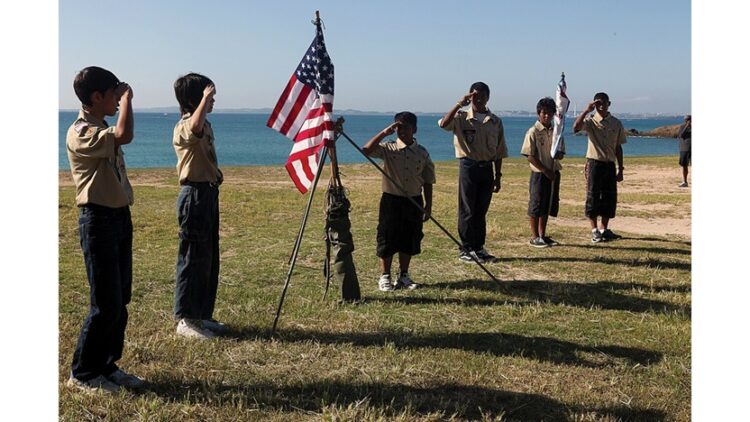
In this 250th year of the USA,
this nation of 340 million goes its way.
Which way that is, nobody knows. How could somebody know?
There are too many individuals to make that so.
Each person has life, liberty, pursuing happiness,
and goes about their lives the best they’re able, more or less.
Yet freedom in a land, like this is hard to comprehend;
where one feels bound, another bounds off to another end.
And happiness means many things to many people too;
where one is thankful for one’s life, one has another view.
And yet despite all of Time’s changes, the Republic stays,
its people hoping that it will go on to better days.
Bruce Dale Wise is a poet and former English teacher currently residing in Texas.











Hope for our future depends on curbing current chaos and that we don’t suffer consequences of social culture loss. We do not know what our future may hold, but we have the will and way to make it gold.
Mr. Peterson’s cautionary note is definitely warranted.
On the hopeful side you are, Bruce, considering your title and final words. There is careful nuance. First half of the poem explains that “better days” depends on individual judgment. This is perhaps more important in the United States than elsewhere. And you the poet state explicitly that given the number of opinions, it’s impossible to know even about the present. Second half of the poem goes over the triad of values mentioned in the Declaration of Independence: life, liberty, and the pursuit of happiness. Again you point out, whether any American or dweller in America is satisfied in regard to these, varies wildly. But in the last line you deliver a statement of hope felt by the people in general. This is where your poem is more thoughtful than it may seem. Underlying our dependence on individual views, and probably because we agree to value individual views, hope for the future can overcome despair, even in the face of things as daunting as the national debt.
Nice job in a dodeca, if I remember the name of your form correctly.
First off, why would one even write such a poem? “On to Better Days” is a bland, Romantic Emersonian response to PostModernist Robert Lowell’s weak, but creative poem on Ike. It is a mere docupoem of the nation’s endurance and population, yet not as exciting as Francis Scott Key’s National anthem.
Upon rereading it, I would pull out the comma in L7 and perhaps change L10 to “where one is thankful for one’s life, one has no gratitude”; but neither improves the poem that much.
And I actually thought of rewriting the poem in several ways, looking at American gains and losses over the centuries, including various wars and noted historical events; and there are so many patriotic lyrics one could draw from.
No longer do its bison roam as they were once wont to,
nor is the eagle’s flight the highest sight within one’s view;
and o’er the land now highways stream with cars, vans, trucks and bikes;
across the heavens, jets and airplanes climb up through the skies.
But, I didn’t want to go through the various wars, astronomical adventures, etc. because I didn’t want more than a dodeca.
Ms. Coats begins with a Yoda-like comment, while picking up some of the nuance or the complexity of writing such a poem, and ends with our national debt. Maybe I will come back to it, but the year is already 2/3 over.
Well, I’m glad I got the form name right. No slight intended by anything else I said! National debt is worrisome, but that was my incongruous interjection. Your poetic project starts to climb.
I remember the USA at 200. Who would have though the direction taken since, and who can predict the direction of the next 50?
That said, precepts like the pursuit of happiness, remain a constant.
Thanks for the thoughtful read, Bruce.
I, too, remember:
27 November 1976: Fort Eustis, Virginia
By Usa W. Celebride
It is an autumn Saturday. I sit amidst the scree,
of dry, brown, crackly leaves, against the rough bark of a tree.
The Sun casts out long shadows. It’s a time of purity,
of rest, of realism, grandeur and simplicity.
I am content, relaxed, austere, as is the air around
me here; the fine imagical lines of my mind abound.
It is the 27th of November. Sunlight warms;
America’s centennial here in Virginia’s arms.
I think of Washington, so far away in space and time,
glad I’m alive this momentary lapse of the sublime.
I like how the poem talks about “Life” as lived with a grateful heart. I wonder if the poem suggests that some see liberty as the freedom to serve where others see it as libertinism.
Mr. Maritato is correct. The poem does suggest, inter alia, that “some see liberty as the freedom to serve” where others see it elsewise.
It was in 1976, when I enlisted in the US Army; and the words of the above tennos were written
when I was studying my first MOS at the fixed-wing aircraft mechanic school at Fort Eustis, Virginia.
I am reminded of George Orwell:
“England will still be England, an everlasting animal stretching into the future and the past, and, like all living things, having the power to change out of recognition and yet remain the same”.
The author’s pessimism is entirely appropriate: There’s too much chaos and too much sand in the gears. Why would one even write such a poem? Because otherwise these perversions of reality might go unnoticed. Too much of what we think we know consists of caricatures of what’s really going on.
Mr. Anderson is correct—
there’s too much chaos…and…
there’s too much sand (in the gears).
We write such poems, because
otherWise these per-versions of reality
might go unnoticed.
There’s too much of what we know
that consists of caricatures of
what’s really going on?