


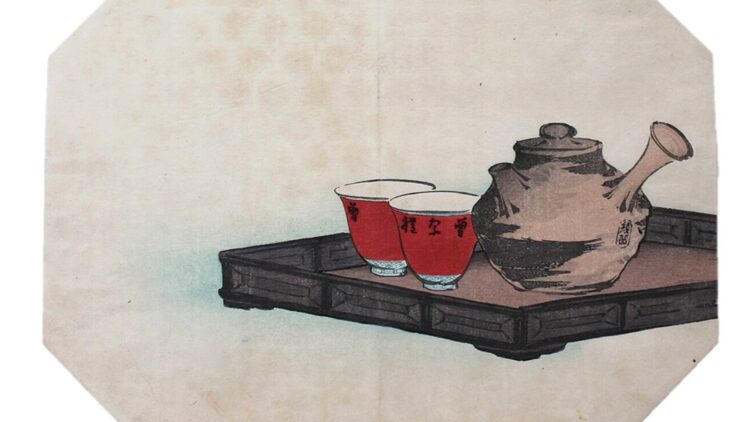
A Pot of Tea
__A pot of tea
Stirs the mind this winter morning.
__A pot of tea
Shared with you is felicity.
The mug, steam, and liquor warming
Our two souls—there’s love in brewing
__A pot of tea.
The Heliades
The mourning sisters call to Clymene,
Distressed at fell reward of their distress;
As mother’s desperate love inflicts injury,
Bleeding bark buries their self-bruised breasts
And stifles cries of grief with no redress
From love; so suffer the Heliades,
Whose amber tears course from swaying poplar trees.
Poet’s Note: In The Metamorphoses, Book II, Phaëthon is a boy who hubristically attempts to drive his divine father’s sun chariot. Unable to control the fiery cart and keep his course, Phaëthon nearly incinerates the earth, until Jove intervenes by striking him down. Phaëthon’s sisters, the Heliades, mourn their brother’s death for months, flagellating themselves in grief until they begin transforming into trees. Their mother, Clymene, tears at the bark forming around her daughters to try to save them, only to cause more serious injury. Suffering the wounds of their mother’s desperate love, the Heliades’s final cry is for mercy.
Samuel Gregg lives in Ephrata, Washington, where he teaches Theology, Choir, and Great Works at a classical Christian school.











A fine morning together safe from the cold winter. I picture the two lovers reconnecting on a Saturday morning after a busy week.
Yes! I was hoping that there was enough contrast to evoke a sort of Sabbath restfulness after a busy time– without distracting from the tranquility of the moment.
Wow! So clear and descriptive,. Well penned.
Thank you! Especially with these short forms, I aim for clarity and economy of language.
Thank you for the note, I was able to appreciate the second poem because of it, which was written well with its imagery and musicality. Also it’s rare to find Rondelet’s. Thank you for sharing.
You’re welcome! I originally wrote “The Heliades” to share with my students after they had studied Ovid’s work (they also had an ekphrastic project to do). We had read selections from C. S. Lewis’s The Four Loves prior to Ovid, so we were hyper-aware of depictions of love gone wrong. I love how in this passage the characters’ corrupted love coincides with the real loss and mourning of tragedy (it’s more complex than the episodes featuring Jove’s affairs).
As for the scarcity of rondelets, I don’t understand why more people don’t write them. They are fun to compose!
I was about to say the first poem was a like a truncated rondeau, then discover it’s a rondlet – I’m sure I’ll have a go at one today!
I’ve read ‘A Pot of Tea’ several times and it brings back all those memories of shared times with grandparents and parents (winter mornings getting back from my paper round), before the individuality of the teabag and the electric kettle took over. Sometimes we don’t recognise ‘felicity’ until it’s gone’.
I loved ‘The Heliades’. An episode of mythology I’ve never come across before (Thanks for the prose background). What a brilliant line, ‘Bleeding bark buries their self-bruised breasts’, and the image of the amber tears is striking.
Thanks for the reads, Samuel – now on to that rondlet!
Thank you so much for your kind words and reminiscences, Paul! I am glad to hear “A Pot of Tea” has inspired you to write a rondelet; I hope you find the experience rewarding. Also, your comments on “The Heliades” are encouraging.