


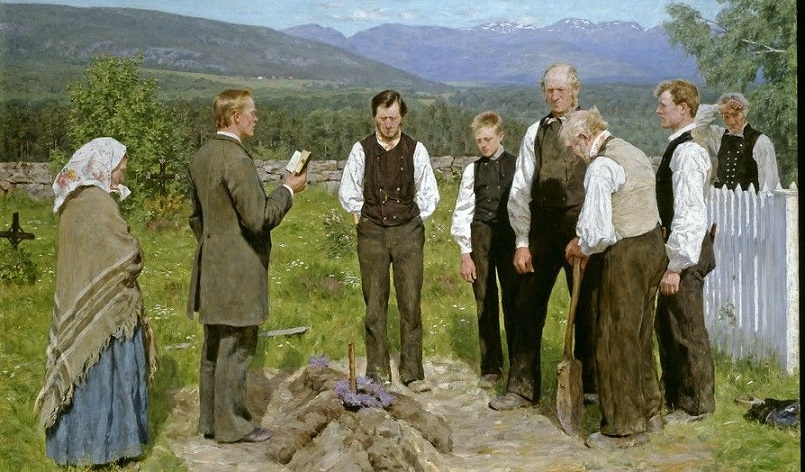
Reappraisals of Mortality
“After the first death, there is no other.” — Dylan Thomas
The hill is steep
That mourners keep
Descending, canted
To maximise
The keening cries
Of the enchanted
That scorn the promise
Of Dylan Thomas
When he declared
That the deceased—
Their souls, at least—
From death are spared.
At first perusal,
A flat refusal
To mourn seems cold,
But if you drink
Before you think,
You might be sold
On those who went
Before you, spent
Time, and spat phlegm.
One thing is sure:
They miss you more
Than you miss them.
C.B. Anderson was the longtime gardener for the PBS television series, The Victory Garden. Hundreds of his poems have appeared in scores of print and electronic journals out of North America, Great Britain, Ireland, Austria, Australia and India. His collection, Mortal Soup and the Blue Yonder was published in 2013 by White Violet Press.











C.B.,
I can’t say as I’m surprised to see another poem from you pondering mortality. Your reappraisal is thought-provoking, to say the least. I like the promise/Thomas pairing.
To wrap my head around the concluding three lines, which appear to be an inversion of what mourners generally seem to think (regardless of their take on Thomas’s promise), I suppose the drinking before thinking may be prerequisite…
Have you read Thomas’s “Notes on the Art of Poetry”? I read it recently in the preface to a collection of his poems, and quite liked what he had to say.
I have been mortal my whole life, Anna, but only recently has it seemed real — it must have something to do with being a grandfather.
Thomas, as you probably know, was a notorious drinker. Anna Evans once told me that on his deathbed he said something like: I just drank thirty whiskies in a row; I think that’s a record. So it is quite likely that he was into his cups when he penned his ideas. My own idea (in the last three lines) is that departed souls might still long for the world they have departed. The afterlife must be rather disorienting at first.
I haven’t read his “Notes …”, but I would like to. Some of his work is crazy good, and I would be glad to know what he had to say about it.
This is a fascinating take on the epigraph by Dylan Thomas, and on a possible emotional/spiritual state of both the living and the dead. I really like the rhyme- and metrical-scheme, too.
This, as you must know, is a nonce iambic dimeter form. I used the same scheme in “Art and Nature”, here:
https://www.classicalpoets.org/art-and-nature-and-other-poetry-by-c-b-anderson/
In case you are not already familiar with Thomas’ poem, here it is:
https://allpoetry.com/A-Refusal-To-Mourn-The-Death,-By-Fire,-Of-A-Child-In-London
… but without the feminine end rhymes, Cynthia, in “Art and Nature”.
I really admire this unusual style of metrical rhyme that says so much and then the unusual twist of “they miss you more” was both unexpected and a deep thought that inhabited my mind.
At first I was put off by “spat phlegm”, then I realized that dying is not pretty. I thought of my father. After he died his house was littered with spat-in tissues from asbestosis. Family and friends may be put off by the mess, and thus are not missing the deceased when they’re gone.
A fine poem keeping us grounded in our mortality.
Saying anything, Roy, is too much to ask nowadays of many of our elected speakers. Somebody has to do it!. And despite the bucolic images of bountiful orchards and green meadows given to us by some, nobody alive knows what the afterlife will be like. Will we become homesick?
Speaking kindly of the dead is the polite thing to do, Gerard, but mostly they were grit-and-mustard curmudgeons just like the rest of us. It’s said, as a manner of speaking, that they look down on us from above, and if they are able to, I’m sure they do. Being watched is better than being forgotten and ignored, a courtesy we should be willing to extend to them.
The Thomas/promise rhyme is superb. And the conclusion startling. But it reminds me of the Talmudic phrase that the departed have actually entered into “the true world.” I am amazed, Kip, that you can concentrate startling and profound ideas into such a tight form. Every single word counts. Which is at it should be.
Wonderful! I am very much a fan of dimeter and shorter lines; they really force creativity and have a laconic strength to them. Yours certainly do here. No mawkish sentimentality for this meditation on death. It is sober and sobering, and the dimeter is well-tailored to its tone. The ending also packs a punch, leaving the reader with much to ponder.
For sure, Adam, dimeter forces quick hard turns. Fortunately, I am a veteran dimwitter with a pronounced underbite. And it’s always fun to ponder the yonder.
Yeah, words matter, Brian, and they count insofar as we count them. For persons like us, measured words go a long way and are laden with meaning. It’s what we do and cannot do without.
What a piece — sad, despairing, and yet at the same time triumphant with the cockiness that Kip Anderson always infuses in his work.
The dimeter is excellent, and as I read it I thought “This might be said by someone close to panic, or by a tough, cool soldier who knows he’s fired his last round of ammo, but the enemy is still advancing, and he’s just gonna wait for the end.”
My panic these days, Joseph, is mostly due to being in the process of selling our house and moving to another town. I don’t recommend it. We are all waiting for the end, but some of us make poems about it, while there’s still time, with no hurry to get there.
Those two last lines are brilliant.
One to go back to.
Thanks for the read, CB
And thanks for reading, Paul. Whoever said “you can’t go back” was expressing a half-truth.