• Submit Poetry
  • Support SCP
  • About Us
  • Members
  • Join
Tuesday, May 12, 2026
Society of Classical Poets
  • Poems
    • Beauty
    • Culture
    • Satire
    • Humor
    • Children’s
    • Art
    • Ekphrastic
    • Epic
    • Epigrams and Proverbs
    • Human Rights in China
    • Music
    • Performing Arts
    • Riddles
    • Science
    • Song Lyrics
    • The Environment
    • The Raven
    • Found Poems
    • High School Poets
    • Terrorism
    • Covid-19
  • Poetry Forms
    • Sonnet
    • Haiku
    • Limerick
    • Villanelle
    • Rondeau
    • Pantoum
    • Sestina
    • Triolet
    • Acrostic
    • Alexandroid
    • Alliterative
    • Blank Verse
    • Chant Royal
    • Clerihew
    • Rhupunt
    • Rondeau Redoublé
    • Rondel
    • Rubaiyat
    • Sapphic Verse
    • Shape Poems
    • Terza Rima
  • Great Poets
    • Geoffrey Chaucer
    • Emily Dickinson
    • Homer
    • Henry Wadsworth Longfellow
    • Dante Alighieri
    • John Keats
    • John Milton
    • Edgar Allan Poe
    • William Shakespeare
    • William Wordsworth
    • William Blake
    • Robert Frost
  • Love Poems
  • Contests
  • SCP Academy
    • Educational
    • Teaching Classical Poetry—A Guide for Educators
    • Poetry Forms
    • The SCP Journal
    • Books
No Result
View All Result
Society of Classical Poets
  • Poems
    • Beauty
    • Culture
    • Satire
    • Humor
    • Children’s
    • Art
    • Ekphrastic
    • Epic
    • Epigrams and Proverbs
    • Human Rights in China
    • Music
    • Performing Arts
    • Riddles
    • Science
    • Song Lyrics
    • The Environment
    • The Raven
    • Found Poems
    • High School Poets
    • Terrorism
    • Covid-19
  • Poetry Forms
    • Sonnet
    • Haiku
    • Limerick
    • Villanelle
    • Rondeau
    • Pantoum
    • Sestina
    • Triolet
    • Acrostic
    • Alexandroid
    • Alliterative
    • Blank Verse
    • Chant Royal
    • Clerihew
    • Rhupunt
    • Rondeau Redoublé
    • Rondel
    • Rubaiyat
    • Sapphic Verse
    • Shape Poems
    • Terza Rima
  • Great Poets
    • Geoffrey Chaucer
    • Emily Dickinson
    • Homer
    • Henry Wadsworth Longfellow
    • Dante Alighieri
    • John Keats
    • John Milton
    • Edgar Allan Poe
    • William Shakespeare
    • William Wordsworth
    • William Blake
    • Robert Frost
  • Love Poems
  • Contests
  • SCP Academy
    • Educational
    • Teaching Classical Poetry—A Guide for Educators
    • Poetry Forms
    • The SCP Journal
    • Books
No Result
View All Result
Society of Classical Poets
No Result
View All Result
Home Covid-19

An Ancient Prophecy on Vaccinations Discovered by Margaret Coats

April 28, 2021
in Covid-19, Culture, Poetry
A A
19
poems An Ancient Prophecy on Vaccinations Discovered by Margaret Coats

.

Vaticination 

Sibylla says, Fear archers of immunity!
Beware the vanguard shock troops sharpening double tongues,
Whetted with grave authority
To weaken hearts and spew contagion into lungs.

They bend ingenious bows of bitter consequences;
The arrows superspread aberrant effluences
Throughout a population’s rungs,
First targeting hale elders, and those with frail defenses.

More missiles wound the unsuspecting innocent,
Who for protection bargain uninformed consent,
But safety is impermanent:
There will be endless piercings for new pestilences.

The combatants shoot swiftly, without a care to hide
The afterwrath descending on the indigent,
Subservient, parturient,
And others whom injections will have mortified

Some few years hence, when stealthy novelties produce
Diseases irresistible in all who tried
To get back lives they set aside,
Surrendering bare arms to unplanned suicide.

So many dullards due consideration lacked,
Or clutched vain hope, or fell as victims of abuse,
And only God can set them loose,
In mooted mercy for the multitude attacked.

How wonderful He makes my longing love for them,
The right of heart, or dupes I scarcely can contemn,
But with the screaming shaft, what truce?
It kills, and cackles at the unacknowledged fact.

.

vaticination: prophecy
Sibylla: name for various women who uttered oracles in classical antiquity

.

.

Margaret Coats lives in California.  She holds a Ph.D. in English and American Literature and Language from Harvard University.  She has retired from a career of teaching literature, languages, and writing that included considerable work in homeschooling for her own family and others.  

ShareTweetPin
The Society of Classical Poets does not endorse any views expressed in individual poems or commentary.
Read Our Comments Policy Here

RandomPoems

‘Winter Wore a Raiment White’ and Other Poetry by Alec Ream
Beauty

‘Winter Wore a Raiment White’ and Other Poetry by Alec Ream

January 5, 2018

. . Winter Wore a Raiment White Winter wore a raiment white, Checkered blue as snow in shade, As he...

‘Hoosier Autumn’: A Poem by Adam Sedia
Beauty

‘Hoosier Autumn’: A Poem by Adam Sedia

November 5, 2025

  Hoosier Autumn October! Morning nips and noontime burns; Crisped, sere, dun cornstalks fall beneath the scythe; Chrysanthemums blaze as...

Next Post
‘Like a Bell’ by Robert Boucheron

'Like a Bell' by Robert Boucheron

On Wearing Masks: ‘For Shame’ by Joe Tessitore

On Wearing Masks: 'For Shame' by Joe Tessitore

‘Like Abelard and Heloise’ and Other Poetry by Arthur L. Wood

'Like Abelard and Heloise' and Other Poetry by Arthur L. Wood

Comments 19

  1. Mike Bryant says:
    5 years ago

    Margaret, your translation is so apt for today. I read another translation from one of the Sibylline Books ten or fifteen years ago. Yours is much better since you’ve included rhyme, internal rhyme, and meter expertly. I’ve looked for the old translation and haven’t found it. Apparently, the book/books that survived the fire of the first century BC, have not survived the more recent conflagration.

    Reply
    • Margaret Coats says:
      5 years ago

      Over many centuries, the sibylline books have fallen prey to fire several times. Even the experts (of whom I am not one) merely have opinions about how much of what remains is authentic, and how far back it goes. One acknowledged custom is to re-work old prophecies to apply to new times.

      Reply
  2. Julian D. Woodruff says:
    5 years ago

    Quite brilliant, Margaret, and astonishing in its prescience.
    I have 3 comments / questions:
    1) Is this from the Prophetiae sybillarum, or otherwise, what source? Is the original not extant (in which case have you derived from earlier translations your metrical & rhyme schemes)?
    2) Your rhyme scheme is intriguing: only 4trains 4 & 6 use the same pattern. Is there an intricate logic to the variety, or is the rationale meant to illustrate a descent into irrationality?
    3) The hexameter is clear to me except in 2.4 & 4.1. Since you don’t seem to mind inverted word order (6.1), why not something like “First wounding elders hail and those with frail defenses” (2.4) and “The archers swiftly shoot …” (4.1)? Or are you adhering to rhythmic variants in the original?

    Reply
    • Margaret Coats says:
      5 years ago

      Thank you, Julian! While one might consult sibylline oracles, copying them was not allowed. I am working with an ancient source, but developing its features into English words with meter and rhyme as seems appropriate to me, and to my little knowledge of the genre of sibylline prophecy.

      The rhyme scheme is irregular to represent the whole poem as the sibyl’s “raving.” She is raving, though, in a reasonable manner–that is, in sympathy with the victims of the attack. The last stanza shows her compassion spoken in the first person (and sibyls did speak for themselves, not for the gods).

      Hexameter is usual for sibylline prophecy, but I put a shorter line in each stanza to figure what happens when a bowstring is released (it’s the same string, but looks and may be a bit longer when the archer stretches it in preparation to shoot).

      In the two lines for which you offer improvements, I’m relying on minor stresses (“ing” and “ants”), created by the established pattern, to add up to six stresses per line. I don’t want to adopt the suggested wording, though, because I’ve used “wound” and “archer” elsewhere in the poem. Perhaps, however, I could find suitable replacements. Many thanks for noting that the meter doesn’t seem right to you in these lines.

      Reply
  3. Susan Jarvis Bryant says:
    5 years ago

    Margaret, what an accomplishment! Very well done, indeed. I have one small niggle that I will confess I’m a tad embarrassed to mention – but shouldn’t the term in stanza 6, line 2 translate as “vein hope”?

    Reply
    • Margaret Coats says:
      5 years ago

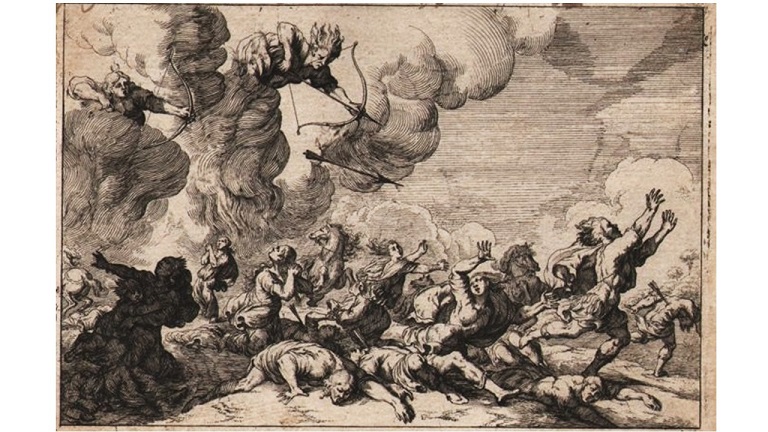
      Susan, you have something of a sibyl in you! I should have run the poem by you; I like the suggestion so much. However, I think I’ll keep “vain,” as these arrow injections are probably aimed in an intramuscular manner, rather than intravenously. Look at the man shot in the back on the right of the picture!

      Reply
      • Susan Jarvis Bryant says:
        5 years ago

        Margaret, I sincerely hope the poor souls receiving these savage shots will detail their side-effects to serve as a warning for future dullards. And as for the “endless piercings for new pestilences” (excellent alliteration) I’m sure after the first “piercing” many will take their chances with the new pestilences! We could all learn an awful lot from this ancient prophecy. I was wondering if the prophecy mentioned a slouchy, grouchy, fork-tongued Pox Fox or a man with rotating blades above his head?

        Reply
      • Margaret Coats says:
        5 years ago

        “Tongues like swords” are mentioned, and the text clearly describes a barrage of lies that spread fear, while the lying attackers themselves have no fear. I too hope side effects become widespread knowledge, but they will be underreported. Still, as I ‘m sure you know, the few confirmed miscarriages has led the UK government to tell pregnant women not to participate in this biologic experiment.

        Reply
      • Susan Jarvis Bryant says:
        5 years ago

        Margaret, would you believe that our local small town practitioner here on the coastal plains of Texas is running experimental trials of the COVID-19 shot on 6 month up to 12 year olds as of April 18th? Your poem says everything and my blood runs cold.

        Reply
      • Margaret Coats says:
        5 years ago

        Thanks, Susan, for showing your concern by coming back to this poem three times! Children are the quintessential “unsuspecting innocents,” incapable of informed consent for permanent alteration of their genetic makeup. It’s not something from which they can ever de-tox (as they could from contaminated food or drugs), and they have their entire lives ahead of them. Considering the nearly zero risk they face from the current epidemic, there is surely much greater risk in experimenting on them. No one knows what will happen “some few years hence.”

        Reply
  4. BRIAN YAPKO says:
    5 years ago

    Margaret, this is an amazing poem with so many details that walk the tightrope between reason and ravings, while also striking a delicate balancing between ancient/classical-sounding language and modern language and imagery so that it is both timeless and improbably relevant. “Dullards” is an underused word these days and I especially like your phrase “ingenous bows of bitter consequences.” I’ve read your work three times and only now feel like I’m getting the full impact. The rhyme-scheme and meter contribute to this sense of being prophetically inspired yet and spontaneous yet skillfully off-balance. A very memorable poem indeed!

    Reply
    • Margaret Coats says:
      5 years ago

      Brian, thank you for the time you’ve devoted to this poem and for your favorable judgment. For this to be a prophecy, it has to concern something important, and have some depth requiring interpretation. But to be a good poem, it needs beauty a reader can value, regardless of any message. I’m glad you brought up the image of the tightrope, because writing this has been something like trying to maintain balance and move ahead in uncertain times like those when ancient authorities would have consulted a sibyl. They expected inspiration from her, but not necessarily clear knowledge of what to do.

      Reply
  5. Damian Robin says:
    5 years ago

    Predictable, Margaret Coats.

    Reply
  6. Damian Robin says:
    5 years ago

    “Predictable …”
    Your erudition, attention to detail, and use of rhyme and meter in a meta-way (if that is understandable) to embellish the meaning.

    The imagery is all so polished.

    “safety is impermanent” I love and the many pithy statements that come out in everyday language.

    And the ever bright research that you helpfully give. Many thanks, ma’am.

    Reply
    • Margaret Coats says:
      5 years ago

      Thank you, Damian! You relieve me by saying that there are pithy statements in everyday language. I deliberately put some erudite words in the poem, and hoped there were not so many of them that readers would give up reading. This kind of prophecy seems to demand some dignified obscurity. When Roman authorities decided to consult the sibylline books in their possession, they sent specially chosen men, supposed to be capable of interpretation, to do the job.

      Reply
  7. C.B. Anderson says:
    5 years ago

    I didn’t know that this was a translation until Mike Bryant pointed it out. You are a classical poet in every sense of the phrase I can come up with. Each line you write is a crystalline construction and gives the reader something important to chew on. This is so with all of your poems I have read here. No throw-aways with you, Dr. Coats.

    Reply
    • Margaret Coats says:
      5 years ago

      I deeply appreciate the compliment, C. B. There is a classic text behind this poem, but the Society doesn’t list my poem as a translation, and you don’t see any original here, because the source is not reproduced. Rather, I take from the source a few main ideas: the attack with arrows as weapons, the lies preceding and accompanying the attack, and the speaker’s expression of concern for the victims, regardless of what made them fall prey to the attack. Her sympathy reflects my own compassion for all persons under severe pressure to participate in an unprecedented biologic experiment, whether or not they favor it. I know and love some who are willing and eager, and some who are reluctant with reason.

      The poem is an adaptation and imitation of sibylline prophecy. As I indicated above in my reply to Mike Bryant, adaptation happened in ancient times. Dire disasters have certain similarities, and scholars have noticed re-working of prophecies to suit later, similar events. That’s my classical procedure here, carefully applying a relevant text to the present situation.

      Reply
  8. C.B. Anderson says:
    5 years ago

    I misspoke in my comment above. You are not a classical poet in the sense that you wrote your poems a couple thousand years or so ago.

    Reply
    • Margaret Coats says:
      5 years ago

      Thank you! Although a tradition about sibyls has them living a thousand years (and remaining beautiful the entire time), this may not be the case for a scholar studying them or a poet assuming the voice of one. I’ll keep my age as it is, and hope to steer clear of the prophesied calamity.

      Reply

Leave a Reply Cancel reply

Your email address will not be published. Required fields are marked *

  1. Roy Eugene Peterson on National Poetry Month Limerick ChallengeMay 12, 2026

    Urszula, what an imaginative limerick! That is something Poe might have done! Sorry to be so late seeing this.

  2. Roy Eugene Peterson on National Poetry Month Limerick ChallengeMay 12, 2026

    Agreed, Urszula! Thank you for commenting.

  3. Joseph S. Salemi on ‘Spontaneous Conjugal Combustion’ and Other Poems by Susan Jarvis BryantMay 12, 2026

    When I was in the U.K. I heard that "poodle" could mean a henpecked or subservient husband, and by extension…

  4. Susan Jarvis Bryant on ‘Spontaneous Conjugal Combustion’ and Other Poems by Susan Jarvis BryantMay 12, 2026

    Yael, it's always lovely to hear from you. I'm thrilled you enjoyed the poems. I did have people in mind…

  5. Susan Jarvis Bryant on ‘Spontaneous Conjugal Combustion’ and Other Poems by Susan Jarvis BryantMay 12, 2026

    James, I'm hoping you enjoyed the villanelle and it hasn't worried you too much. Mike often suffers for my art…

Subscribe to Daily Poems

Enter your email address to subscribe to this blog and receive notifications of new posts by email.

Join 1,593 other subscribers

Recent Poems

  • A Poem on Coach “Black Mike” Castronis from Athens Y Camp, by Alec Ream
  • A Poem on the Zambian National Park Mosi-oa-Tunya, by Paul A. Freeman
  • ‘Creation of Mom’: A Mother’s Day Poem by Roy E. Peterson
  • ‘Spontaneous Conjugal Combustion’ and Other Poems by Susan Jarvis Bryant
  • ‘The Man in the Moon Was a Very Round Man’: A Poem by Lauren V. Leon
  • ‘Fibromytrauma’: A Poem by Golan Shahar
  • ‘A Lonely Sliver’: A Poem by Katie Tencza
  • ‘Higher Gas Prices Are a Small Price to Pay’: An Iran War Poem by Mark F. Stone
  • ‘Always Ahead’: A Poem by Scharlie Meeuws
  • ‘Hamlet’s Lawyer’ and Other Poetry by Brian Yapko
  • ‘On An Old Photograph’: A Poem by Joseph S. Salemi
  • ‘Faust Foresees His End’: A Poem by Martin Briggs
  • ‘À la Carte’ and Other Poetry by C.B. Anderson
  • ‘Where the Sweet Bluebonnets Bloom’: A Poem by Roy E. Peterson
  • ‘The Waters’: A Poem by Margaret Brinton
  • ‘The Pinnacle of Poetry’ and Other Poems by Russel Winick
  • The First American Sonnets: An Essay on David Humphreys, by Margaret Coats
  • ‘The Holy Rollers on Poetry’: A Poem by Joseph S. Salemi
  • Sappho’s ‘Poem 1’ Translated by Bruce Phenix
  • ‘The Cautionary Tale of Phone Addicted Mimi’: A Poem by Paul A. Freeman
  • ‘Look Away’: A Poem for America’s 250th Anniversary, by Roger Crane
  • ‘Sunday Morning in Canada’: A Poem by Jeffrey Essmann
  • ‘Bean’: A Poem by Jan Mennite
  • ‘The Swan’s Song ’: A Poem for Shakespeare’s Birthday, by Susan Jarvis Bryant
  • ‘The Gravedigger’: A Poem by Marie Burdett
  • ‘Waiting for the Perfect Man’: A Poem by Janice Canerdy
  • ‘The George-A-Saurus’ and Other Poetry by Brian Yapko
  • ‘When Asked: What’s Your Favorite Season?’: A Poem by Paul Millan  
  • ‘The Last At-Bat of Lyndon Braun’: A Poem by Michael Pietrack
  • ‘The Perpetual Battle’ and Other Poetry by Adam Sedia

Categories

  • Acrostic
  • Alexandroid
  • Alliterative
  • Art
  • Best Poems
  • Blank Verse
  • Chant Royal
  • Classical Poets Live
  • Clerihew
  • Covid-19
  • Deconstructing Communism
  • Educational
  • Epic
  • Epigrams and Proverbs
  • Essays
    • Interviews with Poets
    • Poetry Reviews
  • Featured
  • From the Society
  • Great Poets
    • Dante Alighieri
    • Edgar Allan Poe
    • Emily Dickinson
    • Geoffrey Chaucer
    • Henry Wadsworth Longfellow
    • Homer
    • John Keats
    • John Milton
    • Robert Frost
    • William Blake
    • William Shakespeare
    • William Wordsworth
  • Human Rights in China
  • Limerick
  • Love Poems
  • Music
  • Pantoum
  • Performing Arts
  • Poetry
    • Beauty
    • Children's Poems
    • Culture
    • Ekphrastic
    • Found Poems
    • High School Poets
    • Humor
    • Riddles
  • Poetry Challenge
  • Poetry Contests
  • Poetry Forms
    • Curtal Sonnet
    • Haiku
  • Poetry Readings
  • Rhupunt
  • Rondeau
  • Rondeau Redoublé
  • Rondel
  • Rubaiyat
  • Sapphic Verse
  • Satire
  • Science
  • Sestina
  • Shape Poems
  • Short Stories
  • Song Lyrics
  • Sonnet
  • Symposium
  • Terrorism
  • Terza Rima
  • The Environment
  • Translation
  • Triolet
  • Video
  • Villanelle

Quick Links

  • About Us
  • Submit Poetry
  • Become a Member
  • Members List
  • Support the Society
  • Advertisement Placement
  • Comments Policy
  • Terms of Use

Welcome Back!

Login to your account below

Forgotten Password?

Retrieve your password

Please enter your username or email address to reset your password.

Log In
No Result
View All Result
  • Poems
    • Beauty
    • Culture
    • Satire
    • Humor
    • Children’s
    • Art
    • Ekphrastic
    • Epic
    • Epigrams and Proverbs
    • Human Rights in China
    • Music
    • Performing Arts
    • Riddles
    • Science
    • Song Lyrics
    • The Environment
    • The Raven
    • Found Poems
    • High School Poets
    • Terrorism
    • Covid-19
  • Poetry Forms
    • Sonnet
    • Haiku
    • Limerick
    • Villanelle
    • Rondeau
    • Pantoum
    • Sestina
    • Triolet
    • Acrostic
    • Alexandroid
    • Alliterative
    • Blank Verse
    • Chant Royal
    • Clerihew
    • Rhupunt
    • Rondeau Redoublé
    • Rondel
    • Rubaiyat
    • Sapphic Verse
    • Shape Poems
    • Terza Rima
  • Great Poets
    • Geoffrey Chaucer
    • Emily Dickinson
    • Homer
    • Henry Wadsworth Longfellow
    • Dante Alighieri
    • John Keats
    • John Milton
    • Edgar Allan Poe
    • William Shakespeare
    • William Wordsworth
    • William Blake
    • Robert Frost
  • Love Poems
  • Contests
  • SCP Academy
    • Educational
    • Teaching Classical Poetry—A Guide for Educators
    • Poetry Forms
    • The SCP Journal
    • Books

© 2025 SCP. WebDesign by CODEC Prime.