


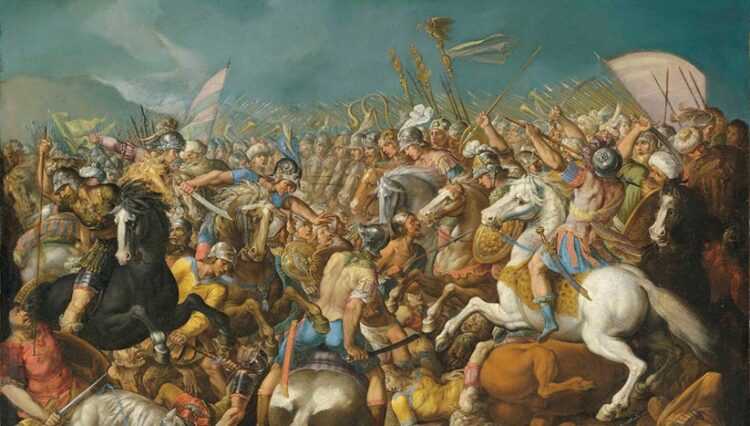
The Perpetual Battle
I
From Arad north to Hazor acrid smoke
Rose from each cyclopean citadel
Of Canaan—altar-fires gelt priests would stoke
To burn the blood of children slain to quell
The unrelenting, gluttonous demand
Of Baal and Moloch, snarling lords of hell—
Till others at another God’s command,
In righteous onslaught razed the cities, broke
The idols, seized and purified the land.
II
Far west across the sea, in Dido’s port,
The same smoke rose, the same blood amply stained
The same demonic altars built to court
The favor of the same cruel gods who reigned
Commanding haughty burghers to exalt
For their heirs’ blood the gold their sea-trade gained—
Till that same sea brought Scipio’s assault
From Rome, which no child-eating god could thwart,
To raze the town and sow its land with salt.
III
Under Rome’s rule God walked the land he purged;
Greece and Rome believed, and were sanctified.
Destroying blood-gorged gods, her children surged
Across the lands, beyond the ocean’s tide.
Yet masked in daylight, whispered in the night,
Still Baal’s and Moloch’s bloody rites abide,
Destroying life and innocence to spite
Creation, to have riches seized and splurged—
Till vengeance comes in fearsome, fiery might.
Hammer and Sickle
The north wind brings the smell of sulfur;
The south wind reeks with fresh manure.
One borne from factory stacks, the other
From fresh-plowed farm-fields—neither pure.
Stenches industrial and rural
Vie for the clear suburban air,
Where bourgeois noses snort demurral
At stimuli too strong to bear.
Adam Sedia (b. 1984) lives in his native Northwest Indiana and practices law as a civil and appellate litigator. He has published four books of poetry and his poems, essays, and fiction have appeared in various literary journals. He is also a composer, and his musical works may be heard on his YouTube channel.








Adam, there is a depth of meaning to me that I have (rightly or wrongly) ascribed to your poems. The single stark word, “Still,” was my influencer extending the meaning to the Shi’a Muslim mullah dominated Iran of today and their reversion to bloody pagan killings exemplified by killings of young people as recently reported. Similarly, I interpret “Hammer and Sickle” as a fascinating assessment of China, or Russia, or both.
The “still” has nothing to do with Iran. It is us – not only from our elites’ love of abortion, but trafficking and its related murders, which they are both perpetrating and covering up. I think that should make the word even more stark.
Perpetual battle, indeed. Such is history, and such, sad to say, is likely to be the future, as your unflinching poem suggests. Blood and cruelty again and again. Does mankind ever learn? It seems not. Yet your grave and dignified lines make clear the continuing human error for those who will understand and, it is to be hoped, will not participate in the round of folly and vice.
Yes, it is a narrative of blood and cruelty, but I also believe it is a narrative of divine justice. We always end up paying the moral debts we incur.
Adam, “gelt priests” really hits hard. You’re being historically straight — castrated temple hands keeping the fires hot for child sacrifice. Precise and ugly, just like it ought to be. But I’ll tell you where my mind wandered. How many outfits nowadays — churches included — belly up to the government trough and wake up one morning wondering where their backbone went? Those old Canaanite priests at least knew what they traded away. Ours just figure it comes with the job. Good thing poets never did take that deal. From Dante on down, the ones worth reading have always been the ones that Moloch couldn’t buy, couldn’t neuter, and couldn’t shut up. Yup, the battle is still raging — same god, different zip code. Great poem, Adam… lots to think about.
Your comment cuts straight to the issue. You are exactly right about the modern attitude. I am thankful that I could help to spur such insights. Thank you for your comment, too.
As an aside, I was proud of that word “gelt.” I think it perfectly illustrates the power of formal poetry. Its rhythmic and syllabic strictures force creativity and encourage reliance on a wide vocabulary. “Castrated” or “emasculated” just doesn’t have the same ring to it.
Two interesting and intriguing poems, because they deal with unexpected subjects, and the second poem reverses the reader’s expectations when the title is first encountered.
The first poem is a straightforward picture of child-murder — in Canaaan, then in Carthage, and now in the West and beyond. Each stanza ends with the retributive punishment due for such evil, whether actual or still to come.
The second poem naturally leads the reader, at first glance, to think it will deal with Communism. But in fact it is not about that subject. It is about the hammer of industrialization, and the sickle of agriculture. Communism took those symbols as a way to represent all the workers of the world, whether in cities or in rural areas. But Adam is using them here for something else, as a subversive comment on the current “developed” world. He mentions the smells of sulfur and manure, and the typical reaction of a pampered bourgeoisie to both of them. Affluent middle class types in their retreats and gated communities don’t want to be annoyed with the rough work of industrial factories, nor with the dirty work of farming and animal breeding. Like the old aristocracy, they simply want to live comfortably and lavishly in their estates, blissfully untroubled about how the goods and foods they consume are produced.
“Hammer and Sickle” is both satiric and subversive. The problems in the West are not due solely to our external enemies. Much of our decline is due to a consumerist bourgeoisie that thinks itself too important to worry about how things are made, and who want nothing to do with the bad smells of honest labor. Adam has kicked some ass in this little poem.
Thank you for drawing attention to “Hammer and Sickle.” This poem was inspired by an actual observation: the north wind blows the smoke from the steel mills in Gary and East Chicago (and the Whiting oil refinery); in spring the south wind brings the stench of fresh manure from the farms 20 minutes south of here. I figured there must be some meaning in this for me to find. I was particularly satisfied where thought led me, and I’m even more satisfied to read your comments. The title came last. I thought it was delightfully teasing without being misleading.
Both poems are excellent, Adam, but it is “The Perpetual Battle” which I find most striking — I love poems which convey the sweep of history and yours, in tercets, is compelling and deeply disturbing in its world-weary subject matter of the conflict between good and evil. “Perpetual” indeed. What I find particularly intriguing is the third stanza which addresses in highly economical terms world history from the time of Christ to the present. It’s quite a stunning compression of time, space and thought but one which effectively shows that, despite the flow of time, who we are is who we were. And judgment will not be kind.
Thank you! You have a skillful eye: that third section was the hardest to write.
Powerful poems, Adam. History truly is always a perpetual battle between good and evil. I think your numerous enjambments work well.
I’m amused, Adam, at the mild critique of certain bourgeois in “Hammer and Sickle.” These are directly accused of nothing more than a distaste for the sources of their necessities and pleasures, but in a poem paired with “The Perpetual Battle,” they would seem to lounge among those who splurge on riches and comforts, and may remain silent (or masked and whispering) to enable that Perpetual Battle against evil to gain ground.
In the “Battle” itself, I’m delighted to see explicit contrast between God and gods. This is necessary. Evil is more than moral failure that might perhaps be corrected or restrained by a superior society. Most of all, I’m glad to see you name “life and innocence” as the ideals being destroyed. The harm to children is greater than harm to physical life and integrity. Those who survive assault may be offered a full range of filth as life choices, with innocence derided as having no value, when in fact innocence is a healthy stage of human development, and one that some courageously preserve lifelong. Though you cite few examples, a better sketch of history would be rare.
Thank you, Margaret. The story of my conception of “The Perpetual Battle” is mildly amusing. I was listening to the comedian Tim Dillon discuss the Epstein case and he quipped about our billionaires offering sacrifices to Baal and Moloch. As with all good comedy, there was a kernel of truth in that, and I thought of interviews given by Frs. Ripperger, Reehil, and Martins (all exorcists) and I thought how the same old demons (literally) stay with us. I read elsewhere in commentary that the Holy Land was promised in the Old Testament not because there was anything special about it, but because God wanted to cleanse it of child sacrifice. I wondered if Rome’s destiny was not similarly intertwined with its destruction of the equally horrendous child sacrificing at Carthage.
Adam, thank you for this hard-hitting wake-up-call of a poem that is horrifying and beautifully wrought – a powerful combination. The title frames it perfectly. I hope it speaks to many. Thank you!
Oops, I missed “Hammer and Sickle” – an admirably crafted gem with an olfactory grab that places the reader in the middle of the honest stench of hard work that wrinkles the noses of the bourgeoisie… nothing has changed… the perpetual battle rages on. Good versus evil is never clear cut. It comes in many guises, as your two poems show us – skillfully.
Thank you, Susan. “Hammer and Sickle” was inspired by actual smells in my hometown, a bourgeois community nestled between heavy industry and farmland. You also exactly capture the sense I sought to convey with “The Perpetual Battle.” Secret sacrifices to the same demons still occur to feed the never ending human lust for power and control.
In the first poem a highly-regulated verbal economy is manifested. Notice that the words are never asked to carry more than their own weight and that not one of them could be profitably subtracted. What’s more, Sedia takes pains to place the third rhyme missing at the beginning of the tercet sequence into the final tercet, which, in my opinion, is the best way to round out terza rima.
The second is so rich with allusions and innuendo that the stench of them fills the noosphere. If it weren’t so god-awful chilling, it would make us split our sides with laughter.
I couldn’t agree more about how to end terza rima. And thank you for your comments. “Hammer and Sickle” was born of wry humor, based on actual observation — in Lake County, Indiana, you can drive from heavy industry and ghettoes to cornfields through everything in between in half an hour (not even on the expressway).
How easy it is to forget the savagery of peoples who have gone before (and let’s not forget the Aztecs et al, going even further West) and the appalling reality of child sacrifice. Indeed, nowadays we excuse it with euphemisms – abortion on demand? Choice? I love the alliterative line: ” cyclopean citadel / Of Canaan …” Very tight and commanding verse.
Thank you, James. The tightness of the verse made this a struggle to write, but I am happy to see the results so appreciated.