• Submit Poetry
  • Support SCP
  • About Us
  • Members
  • Join
Tuesday, October 20, 2026
Society of Classical Poets
  • Poems
    • Beauty
    • Culture
    • Satire
    • Humor
    • Children’s
    • Art
    • Ekphrastic
    • Epic
    • Epigrams and Proverbs
    • Human Rights in China
    • Music
    • Performing Arts
    • Riddles
    • Science
    • Song Lyrics
    • The Environment
    • The Raven
    • Found Poems
    • High School Poets
    • Terrorism
    • Covid-19
  • Poetry Forms
    • Sonnet
    • Haiku
    • Limerick
    • Villanelle
    • Rondeau
    • Pantoum
    • Sestina
    • Triolet
    • Acrostic
    • Alexandroid
    • Alliterative
    • Blank Verse
    • Chant Royal
    • Clerihew
    • Rhupunt
    • Rondeau Redoublé
    • Rondel
    • Rubaiyat
    • Sapphic Verse
    • Shape Poems
    • Terza Rima
  • Great Poets
    • Geoffrey Chaucer
    • Emily Dickinson
    • Homer
    • Henry Wadsworth Longfellow
    • Dante Alighieri
    • John Keats
    • John Milton
    • Edgar Allan Poe
    • William Shakespeare
    • William Wordsworth
    • William Blake
    • Robert Frost
  • Love Poems
  • Contests
  • SCP Academy
    • Educational
    • Teaching Classical Poetry—A Guide for Educators
    • Poetry Forms
    • The SCP Journal
    • Books
No Result
View All Result
Society of Classical Poets
No Result
View All Result
Home Love Poems

‘To My Beloved Husband’: A Sonnet by Isabel Scheltens

December 19, 2022
in Love Poems, Poetry
A A
13
poems 'To My Beloved Husband': A Sonnet by Isabel Scheltens

.

—To My Beloved Husband

Our married love is no ethereal sound
Which dies away when wedding bells cease tolling:
No idle lust for courting or cajoling
Which dissipates, its petty joys once crowned;
Nor yet a chain to keep the body bound,
Inured in stagnant care and yearly foaling:
No joke to sneer at, causally condoling
A freedom lost, a voyage run aground.
As yet, I know not all our love will be,
For time and we shall change and change forever.
We are but young. This is our only love.
Yet this I know: in humble constancy
We learn to love, to change and change together,
Until we, changeless, live with Him above.

.

.

Isabel Scheltens teaches at a Lutheran Classical school in Fort Wayne, Indiana, where she shares a love of history, literature and music with her students. 
ShareTweetPin
The Society of Classical Poets does not endorse any views expressed in individual poems or commentary.
Read Our Comments Policy Here

RandomPoems

poetry/homeschooling/teachers guide
Culture

‘Uninspired’ by Siri Espy

January 24, 2021

. I fear my motivation’s dead; there’s no one home inside my head. I’ve looked for it from dusk to...

poems The Society of Classical Poets 2020 Poetry Competition
High School Poets

The Society of Classical Poets 2020 Poetry Competition

September 1, 2019

Winners of the competition can be found here. "But with the true poet every thing is terse, touching, or brilliant....

Next Post
poem/yapko/elagabalus/transgender

On Cambridge Dictionary Expanding Woman Definition: 'There She Goes' by Susan Jarvis Bryant

‘Mother’s TV’ and Other Poetry by James Kirkpatrick

'Mother’s TV' and Other Poetry by James Kirkpatrick

‘Continuation’ and Other Poetry by C.B. Anderson

'Continuation' and Other Poetry by C.B. Anderson

Comments 13

  1. Peg says:
    4 years ago

    Beautiful…thank you!

    Reply
  2. Paul Freeman says:
    4 years ago

    A fine sonnet. The immediacy of the voice and the clearly relayed message (and imagery – ‘yearly foaling’!) of the poem made for an easy read of the intricacies of marriage.

    Thanks for the read, Isabel.

    Reply
    • Isabel Scheltens says:
      4 years ago

      Thank you for the encouragement. A direct, clear voice is what I value the most.

      Reply
  3. Norma Pain says:
    4 years ago

    A beautiful sonnet Isabel, thank you.

    Reply
  4. jd says:
    4 years ago

    I enjoyed reading it too, Isabel. To me it has a bell-like feel as if an echo of the wedding bells. Maybe it’s due to the ing endings which I like. The play on “change” in the final lines is nice too.

    Reply
  5. Joseph S. Salemi says:
    4 years ago

    I’ve always thought that the ABBA rhyme scheme for a quatrain is much harder to do than the more common ABAB. Yet in this sonnet the octet is not just beautiful in meter and diction, but also very smooth and fluent, without the slightest hitch or awkwardness. The alternation of masculine and feminine endings is also expertly done.

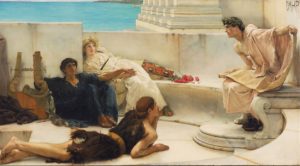
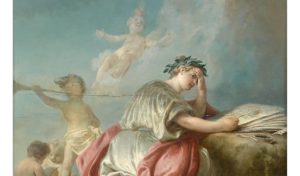
    And once again, Evan Mantyk finds the absolutely perfect illustration.

    Reply
    • Richard Craven says:
      4 years ago

      Firstly, your positive comment about the alternation of masculine and feminine endings is a good one. There’s exactly one feminine pair of rhymes in each unit of verse: the heroic couplet in each of the two ABBA-rhymed quatrains, and the imperfect but I think thoroughly permissible “forever/together” of lines 10 and 13.

      Secondly, it may help to clarify things if we refer to ABBA-rhymed quatrains as Petrarchan and ABAB-rhymed quatrains as Shakespearean – after all, what we have before us is a conventional Petrarchan sonnet, with
      (i) a Petrarchan octet (i.e. two Petrarchan quartets) as you noted, followed by
      (ii) a sestet with a rhyme scheme not concluding with a heroic couplet. albeit with the added flourish of a Spenserian preservation of rhyme between lines 4 and 5.

      I’ve described Isabel Scheltens’s poem as conventionally Petrarchan because it meets constraints (i)&(ii) above. However, she also subjects her poem interestingly to a third “Spenserian” constraint, namely lines 4 and 5, i.e. the final line of the first quatrain and the initial line of the second quatrain, form a heroic couplet. The effect of this in the Shakespearean sonnets which Spenser wrote are that they have the following rhyme scheme, viz. abab bcbc cdcd ee. It’s worth also noting that a truly Spenserian sonnet reapplies the constraint between lines 8 and 9, i.e. the concluding line of the second quatrain and the initial line of the third quatrain again form a heroic couplet.

      It might be felt that going the full Spenserian hog with a Petrarchan sonnet, i.e. abbaacca adeade, mitigates the effect of any change of mood aka volta introduced by the switch from octet to sestet. I would imagine that a consideration like this – volta emphasis – may underlie Ms. Scheltens’s decision to be a line 4/5 but not a line 8/9 Spenserian.

      Reply
      • Richard Craven says:
        4 years ago

        “I would imagine that a consideration like this – volta emphasis – may underlie Ms. Scheltens’s decision to be a line 4/5 but not a line 8/9 Spenserian.”

        … i.e. she wants to preserve the sestet’s formal and semantic integrity, which is fair enough.

        Reply
    • Isabel Scheltens says:
      4 years ago

      I appreciate that. Thank you.

      Interesting. I only recently started experimenting with abbaabba forms, and I am finding that it is easier to keep the same thought going. With ababcdcd the thoughts are more obviously distinct. That can be useful, depending on the subject.

      Reply
      • Richard Craven says:
        4 years ago

        You’re very welcome, and I quite agree. Please keep writing Spenserianised Petrarchan sonnets.

        Reply
  6. John Creekmore says:
    4 years ago

    The acknowledgment that the speaker is young and cannot be sure of what change may bring does not detract from the courage and devotion that rings forth from this work. Lasting marriages are made from such an outlook. Well done.

    Reply
  7. jd says:
    4 years ago

    Congratulations on your placement, Isabel. A great way to begin the year.

    Reply
    • Isabel Scheltens says:
      4 years ago

      Thank you! 🙂 I was very surprised!

      Reply

Leave a Reply Cancel reply

Your email address will not be published. Required fields are marked *


  1. Stephen DiLauro on ‘Biblical? Emblematic?’: A Poem by Stephen DiLauroOctober 19, 2026

    My grandfather had several apple groves on his fruit farm on upstate NY. I loved going there. I wrote a…

  2. Marguerite Crozier on ‘Biblical? Emblematic?’: A Poem by Stephen DiLauroOctober 19, 2026

    Stephen, this association is mentioned importantly in the Robert Harris book, "Second Sleep," a really good read, but not one…

  3. Joseph S. Salemi on ‘Every New Pantheon’: A Poem by C.B. AndersonOctober 19, 2026

    No, that totally escaped my notice. I just assumed that the first part dealt with the existence of divinities, while…

  4. Paul Freeman on The Blobfish—‘Mr Blobby’: A Poem by Paul A. FreemanOctober 19, 2026

    Thanks for reading and commenting, Gerard. These creatures in the deep ocean trenches are indeed denizens of the planet out…

  5. C.B. Anderson on ‘Biblical? Emblematic?’: A Poem by Stephen DiLauroOctober 19, 2026

    Not many things are worse than a phony sense of being, but many persons have no fear of falling. Good…

Subscribe to Daily Poems

Enter your email address to subscribe to this blog and receive notifications of new posts by email.

Join 1,660 other subscribers
No Result
View All Result

Resources

       1. A Guide to Writing Poetry

      2. The Best Poems of 2020      

      3. Poetry and Writing Contests

      4. Journals Accepting Formal Verse

Recent Poems

  • ‘Every New Pantheon’: A Poem by C.B. Anderson
  • ‘Biblical? Emblematic?’: A Poem by Stephen DiLauro
  • ‘The Valley’: A Poem by Briana Reavis
  • The Blobfish—‘Mr Blobby’: A Poem by Paul A. Freeman
  • ‘Nature’s Family’: A Poem by Margaret Coats
  • ‘The River & The Sea’: A Poem by Rohini Sunderam
  • Poems by Derzhavin, Akhmatova, and Tyutchev, Translated by Kevin Rainbow
  • ‘After-Action Report’: A Poem by Joseph S. Salemi
  • ‘The Walking Wounded’: A Poem by Jeffrey Essmann
  • ‘Their Words, My Fault’ and Other Poems by Russel Winick
  • ‘Lazarus I’: A Poem by Jason Hunt
  • Poetry Challenge: Dictionary Delights
  • ‘In Defense of Rhyme’: An Essay by Euphrates Moss
  • ‘Gun Control’: A Poem by Kevin Ahern
  • ‘Power of a Pen’: A Poem by Janice Stanley
  • The Best Haiku of 2026
  • ‘One Night in Bangkok’ and Other Poetry by Brian Yapko
  • ‘Invocation’: A Poem by D.R. Rainbolt
  • ‘Enjoy the Peace, Prepare for War’: A Poem by Roy E. Peterson
  • Faust Part Two, Act One: ‘A Pleasant Landscape’ by Goethe, Translated by Josh Olson
  • A Song Inspired by Robert Frost’s ‘The Road Not Taken’, by Gunny Markefka
  • ‘Reappraisals of Mortality’: A Poem by C.B. Anderson
  • ‘What Is the Measure of My Days?’: A Poem by Peter Venable
  • ‘Polar Coordinates’: A Poem by Adam Sedia
  • ‘It Never Lies!’: A Poem by Paul A. Freeman
  • ‘The Mahjong Flowers’: A Set of Sonnets by Margaret Coats
  • ‘The Martyrdom of Saint Cassian’: A Poem by Joseph S. Salemi
  • ‘Mind Versus Beauty’: A Poem by Johann Wolfgang von Goethe, Translated by Eric v.d. Luft
  • ‘Summer Sails’: A Poem by Paulette Calasibetta
  • ‘Aquarius’: A Poem by Patricia Rogers Crozier

Categories

  • Acrostic
  • Alexandroid
  • Alliterative
  • Art
  • Best Poems
  • Blank Verse
  • Chant Royal
  • Classical Poets Live
  • Clerihew
  • Covid-19
  • Deconstructing Communism
  • Educational
  • Epic
  • Epigrams and Proverbs
  • Essays
    • Interviews with Poets
    • Poetry Reviews
  • Featured
  • From the Society
  • Great Poets
    • Dante Alighieri
    • Edgar Allan Poe
    • Emily Dickinson
    • Geoffrey Chaucer
    • Henry Wadsworth Longfellow
    • Homer
    • John Keats
    • John Milton
    • Robert Frost
    • William Blake
    • William Shakespeare
    • William Wordsworth
  • Human Rights in China
  • Limerick
  • Love Poems
  • Music
  • Pantoum
  • Performing Arts
  • Poetry
    • Beauty
    • Children's Poems
    • Culture
    • Ekphrastic
    • Found Poems
    • High School Poets
    • Humor
    • Riddles
  • Poetry Challenge
  • Poetry Contests
  • Poetry Forms
    • Curtal Sonnet
    • Haiku
  • Poetry Readings
  • Rhupunt
  • Rondeau
  • Rondeau Redoublé
  • Rondel
  • Rubaiyat
  • Sapphic Verse
  • Satire
  • Science
  • Sestina
  • Shape Poems
  • Short Stories
  • Song Lyrics
  • Sonnet
  • Symposium
  • Terrorism
  • Terza Rima
  • The Environment
  • Translation
  • Triolet
  • Video
  • Villanelle

Quick Links

  • About Us
  • Submit Poetry
  • Become a Member
  • Members List
  • Support the Society
  • Advertisement Placement
  • Comments Policy
  • Terms of Use

Welcome Back!

Login to your account below

Forgotten Password?

Retrieve your password

Please enter your username or email address to reset your password.

Log In
No Result
View All Result
  • Poems
    • Beauty
    • Culture
    • Satire
    • Humor
    • Children’s
    • Art
    • Ekphrastic
    • Epic
    • Epigrams and Proverbs
    • Human Rights in China
    • Music
    • Performing Arts
    • Riddles
    • Science
    • Song Lyrics
    • The Environment
    • The Raven
    • Found Poems
    • High School Poets
    • Terrorism
    • Covid-19
  • Poetry Forms
    • Sonnet
    • Haiku
    • Limerick
    • Villanelle
    • Rondeau
    • Pantoum
    • Sestina
    • Triolet
    • Acrostic
    • Alexandroid
    • Alliterative
    • Blank Verse
    • Chant Royal
    • Clerihew
    • Rhupunt
    • Rondeau Redoublé
    • Rondel
    • Rubaiyat
    • Sapphic Verse
    • Shape Poems
    • Terza Rima
  • Great Poets
    • Geoffrey Chaucer
    • Emily Dickinson
    • Homer
    • Henry Wadsworth Longfellow
    • Dante Alighieri
    • John Keats
    • John Milton
    • Edgar Allan Poe
    • William Shakespeare
    • William Wordsworth
    • William Blake
    • Robert Frost
  • Love Poems
  • Contests
  • SCP Academy
    • Educational
    • Teaching Classical Poetry—A Guide for Educators
    • Poetry Forms
    • The SCP Journal
    • Books

© 2025 SCP. WebDesign by CODEC Prime.