


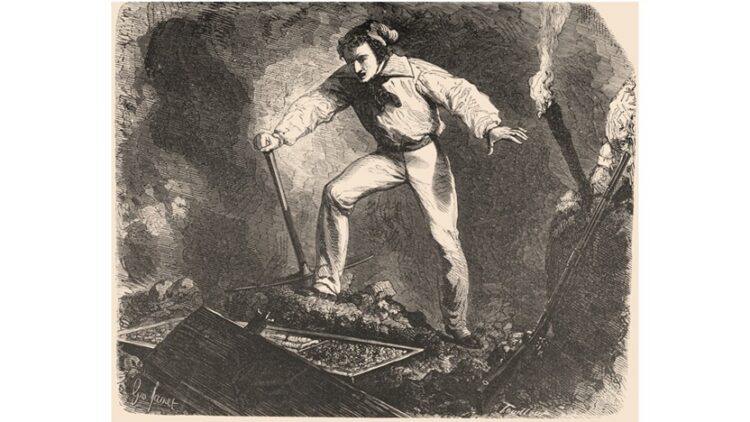
Self-Exploration
The furthest shores within my mind
are lands whose sands I must explore—
becoming a conquistador;
to do this quest I am inclined.
Deposits await to be mined
for gems whose worth are rare, therefore,
the furthest shores within my mind
are lands whose sands I must explore.
The journey inward is designed
for those who will engage in war
against their inner Minotaur.
To gain insight, I sail to find
the furthest shores within my mind.
The Alcoholic’s Epiphany
I ponder on life with a stout
and wonder why it went afoul,
then drink until I fume and shout
at anyone who gives a scowl.
I wake inside a cell and think
that maybe I should quit the drink.
But once released, I retrogress,
and that is why my life’s a mess.
The Devil’s Trick
Invite the devil if you dare,
but do not be surprised if he
decides to bring along despair,
as you are swept out to the sea.
A sea of sin where many drown—
you can see them around the town;
their glimmer gone, a buried song,
waiting for death to come along.
Paul Millan currently resides in Glendora, California. His work has appeared on Lighten-Up Online, and will appear in Westward Quarterly.












Very nice poetry, Paul, and all very relatable. I especially like the first, although instead of distant shores, I have often considered the mind as a sort of Milky Way – your own personal final frontier; and who doesn’t often battle that “inner Minotaur”.
Cheryl, the Milky Way is a great visual. Thank you so much for reading, and I’m glad you found them relatable.
Paul, these are very good examples of some of the less common “fair forms.” We are well-supplied at this site with 15-line rondeaux using a rentrement (the first portion of the first line) as a repetend. I happen to think the 13-line rondel, with two refrains, such as your “Self-Exploration,” is more difficult, and therefore a greater achievement. Yours not only makes fine use of the ABba abAB abbaA rondel rhyme scheme, but well imagines the archetypal psychology of the journey inward with a positive goal of self discovery and psychologically beneficial self conquest.
The other two poems both use the rispetto rhyme scheme of abab ccdd. I like “The Alcoholic’s Epiphany better, because the two stanzas reflect one another, in accord with the “look back” or “look again” Italian name of the form. Great vision simply presented!
Margaret, thank you for your informed knowledge, I will look into the terms “fair forms” since it’s my first time hearing of it. You could possible be correct that the Rondel might be more difficult than the Rondeau, it could stem from the limited amount of lines before the repeating lines from Stanza 1 to Stanza 2.
Thank you for the information regarding the Rispetto.
I greatly appreciate you for taking the time to read my poetry, and making insightful commentary.
Paul, “fair forms” is the name my own mentor, Helen Vendler, gave to what are usually called “fixed forms.” She thought “fixed” was rather a pejorative term for such potentially fine lyrics. I agree, and do my best to keep up her usage. Always appreciate your interest as well, neighbor!
Thanks for replying with the definition of “fair forms”, since a cursory google search did not yield any results mentioning fair. I have heard good things about Helen Vendler, maybe I will add some of her books to my future reading list to improve my knowledge about poetry. Again, thanks.
As mentioned, very relatable.
Thanks for the reads, Paul.
Paul, glad you found them relatable. And I have to say thank you for reading, I greatly appreciate it.
For me, three almosts, which could be tightened without too much effort.